The films of Italian filmmaker Lucio Fulci aren't as stylish or darkly beautiful as those of his contemporaries Mario Bava and Dario Argento, and those qualities never seemed to interest the director much. Fulci was primarily interested in gore, and his filmography is essentially an ongoing study of all the horrible things that can be done to the human body, depicted in graphic detail and without ever cutting away in order to be as revolting as possible. While pure gross-out doesn't usually do it for me, I can't help but admire Fulci's sense of showmanship, his technical skill and his, um, consistency of vision in films like Don't Torture a Duckling, The Beyond and City of the Living Dead.
Zombie is perhaps the quintessential Fulci movie. Released in 1979 and marketed in Europe as a sequel to Dawn of the Dead, the film has none of Dawn's satire or use of zombies as a way of examining bigger ideas. It's clear that Fulci is primarily interested in using zombies as a way of examining maggot-infested eyesockets, horrible flesh wounds and, in one mind-blowingly awesome scene, a zombie fighting a shark. Fulci's gift for realistic gore resulted in Zombie being banned in Great Britain; classified in the 1980s as a "video nasty," it wasn't released uncut in England until 2005. The film's most sickening moment occurs when a zombie attacks Paola (Olga Karlatos) and forces her head against a large splinter in a broken doorframe, puncturing her eyeball in a sickening close-up. To create the effect, makeup artist Gianetto De Rossi created a dummy head and slowly pushed it into the splinter, making sure to fill the eye with realistically squishy fluids. The impossible-to-forget scene doesn't really signify much about horror as a genre in a larger sense. But man, it sure is disgusting.
Tuesday, October 23, 2012
Monday, October 22, 2012
Making Monsters #21: Videodrome
Videodrome is the first film directed by David Cronenberg that fully realizes the director's ideas, preoccupations and fetishes. Cronenberg takes the premise of a bootleg cable broadcaster (James Woods) who discovers a sadistic, ultraviolent underground program that carries a signal which mutates the viewer's mind and body and runs with it - the movie is like a Marshall McLuhan essay brought to life with more fleshy orifices and sadomasochistic sex than McLuhan might have envisioned. The film anticipates the digital era not with a single thesis statement but by illustrating the notion of video as a constantly mutating, malleable, living organism that can be manipulated to serve any ideology. That it realizes this idea through James Woods discovering a vaginal video player in his torso, hallucinating himself whipping a bound Debbie Harry in the clay-walled Videodrome set and killing one character with a flesh grenade not only makes this the most entertaining media studies lecture ever; it's also a clear view into the mind of a filmmaker who is at once highly intelligent and fascinatingly kinky.
Cronenberg's video hallucinations were brought to life by Rick Baker, who does a great job of bringing the director's most extreme concepts to life with a tactile, often squishy believability. Baker does an incredible job, in particular, of realizing the idea of video technology as a living, breathing thing. A videotape's sprockets suddenly protrude like bulging eyes, and TVs breathe, pulsate, get aroused and ooze blood and guts when they're injured. In the movie's most memorable scene, a TV featuring Debbie Harry's character, conservative pundit/masochist Nikki Brand, purrs seductively at Woods' character, Max Renn. It's not clear, at this point, whether Brand is working for Videodrome's makers or if Videodrome is masquerading for Brand; either way, it's quite a sight when a close-up of Harry's lips protrudes from the screen, urging Max to "come to Nikki." As Max presses his face against the screen, the lip envelop his head in an image that is both freakily sensual and just plain freaky. Baker created the effect by replacing the TV's screen with a large dental dam that he could stretch and manipulate while a rear projection of Harry's lips played on the screen. I can't recall another movie where the monster is media itself - Cronenberg's villains are often concepts that he doesn't always feel a need to personify - and certainly not another filmmaker who could make such a cerebral notion of horror so viscerally unnerving
.
Cronenberg's video hallucinations were brought to life by Rick Baker, who does a great job of bringing the director's most extreme concepts to life with a tactile, often squishy believability. Baker does an incredible job, in particular, of realizing the idea of video technology as a living, breathing thing. A videotape's sprockets suddenly protrude like bulging eyes, and TVs breathe, pulsate, get aroused and ooze blood and guts when they're injured. In the movie's most memorable scene, a TV featuring Debbie Harry's character, conservative pundit/masochist Nikki Brand, purrs seductively at Woods' character, Max Renn. It's not clear, at this point, whether Brand is working for Videodrome's makers or if Videodrome is masquerading for Brand; either way, it's quite a sight when a close-up of Harry's lips protrudes from the screen, urging Max to "come to Nikki." As Max presses his face against the screen, the lip envelop his head in an image that is both freakily sensual and just plain freaky. Baker created the effect by replacing the TV's screen with a large dental dam that he could stretch and manipulate while a rear projection of Harry's lips played on the screen. I can't recall another movie where the monster is media itself - Cronenberg's villains are often concepts that he doesn't always feel a need to personify - and certainly not another filmmaker who could make such a cerebral notion of horror so viscerally unnerving
.
Making Monsters #20: A Nightmare on Elm Street
The most iconic horror character of the past thirty years has to be Freddy Krueger, the horribly burned, dream-stalking villain of the Nightmare on Elm Street series. What gives Freddy an edge over other famous slashers like Jason Voorhees and Michael Myers is that Freddy was played by one actor, Robert Englund, over the course of eight movies. In the best and worst movies in the series, Englund is clearly always giving his performance 110%; he's obviously having a great time playing such a horrible character, and his skill for creating a fully formed character under heavy makeup is as impressive as Boris Karloff or Lon Chaney. Anyone who has seen Englund at a Q&A knows his knowledge and appreciation of classic and contemporary movies is vast - when I met him, he completely geeked out when he saw my Let the Right One In t-shirt, and he grilled me on what I thought of the Swedish and American movies and the novel, citing specific scenes. So even when he's skateboarding or playing Nintendo, Englund always makes sure the integrity of the character and what made him frightening in Wes Craven's original film shines through.
Englund's performance is also the constant through all the subtle changes in makeup design Freddy undergoes with each film. While the work of makeup artists like Kevin Yagher and and Greg Cannom in the sequels is impressive, the character design by David B. Miller for the original movie remains the most frightening. Craven had actually written Freddy as even more grotesque-looking, with a partially exposed skull and open sores dripping pus, but Miller explained to the director that this would be impossible to make convincing on the film's low budget. Instead, Miller studied photos of burn victims to create a look for the character that is believable but not completely realistic, and purposefully so; Yagher would later call Freddy a "male witch," and his look is as fantastic as it is grotesque. When Englund was asked about the remake at the Q&A I attended last year, he was tactful and complimentary to Jackie Earl Haley's performance, but pointed out that changing the makeup to a more realistic "burn victim" look sacrificed Freddy's striking profile and his larger-than-life screen presence. He's right - one of the many things wrong with the remake is that Freddy was less frightening than pitiful-looking. As designed by Miller, played by Englund and smartly kept in low light by director of photography Jacques Haitkin, Freddy retains a supernatural menace even after multiple viewings.
Craven's original movie remains the best largely thanks to his talent for imagining striking nightmare imagery that touches a collective nerve. These moments were brought to life by an effects team led by Jim Doyle, who was responsible for creating Freddy's iconic glove as well as designing the film's classic dream sequences. For the scene where heroine Nancy (Heather Langenkamp) falls asleep in the tub and is pulled into the water by Freddy, a bathtub set was built over a swimming pool, and Doyle spent much of the day underwater, playing Freddy's gloved hand himself. And for the film's goriest scene, when Nancy's boyfriend Glen (Johnny Depp in his screen debut) is sucked into his bed and moments later, a geyser of blood pours out of the hole, was pulled off using a gimbal set. The set is placed on a giant rotating axis, the camera is fixed to and moves with the set and the subject remains at the bottom of the set, so that it appears that the subject, not the set, is in motion. This was used famously for the scene of Gary Lockwood jogging around the Discovery One's centrifuge in 2001: A Space Odyssey, and is also used in A Nightmare on Elm Street for the scene where Tina (Amanda Wyss) is thrown around the walls and ceiling by an invisible Freddy (the same gimbal set was used later the same year for a scene in Breakin' 2: Electric Boogaloo!). For Glen's death scene, the set was rotated 180 degrees and 500 gallons of fake blood were dumped through the floor of the set. The effect almost proved to be deadly, as the gimbal set began spinning out of control, dumping fake blood all over the soundstage, shorting out the electricity and threatening to electrocute the entire crew (Wes Craven later called it a "Ferris wheel from hell"). Thankfully, nobody was hurt, and the glitch in the effect - the blood at one point appears to pour out sideways - only adds to its uncanny quality. It remains a memorable start to Depp's career, and a more interesting effect than every overblown setpiece in the three Pirates of the Caribbean sequels combined.
Englund's performance is also the constant through all the subtle changes in makeup design Freddy undergoes with each film. While the work of makeup artists like Kevin Yagher and and Greg Cannom in the sequels is impressive, the character design by David B. Miller for the original movie remains the most frightening. Craven had actually written Freddy as even more grotesque-looking, with a partially exposed skull and open sores dripping pus, but Miller explained to the director that this would be impossible to make convincing on the film's low budget. Instead, Miller studied photos of burn victims to create a look for the character that is believable but not completely realistic, and purposefully so; Yagher would later call Freddy a "male witch," and his look is as fantastic as it is grotesque. When Englund was asked about the remake at the Q&A I attended last year, he was tactful and complimentary to Jackie Earl Haley's performance, but pointed out that changing the makeup to a more realistic "burn victim" look sacrificed Freddy's striking profile and his larger-than-life screen presence. He's right - one of the many things wrong with the remake is that Freddy was less frightening than pitiful-looking. As designed by Miller, played by Englund and smartly kept in low light by director of photography Jacques Haitkin, Freddy retains a supernatural menace even after multiple viewings.
Craven's original movie remains the best largely thanks to his talent for imagining striking nightmare imagery that touches a collective nerve. These moments were brought to life by an effects team led by Jim Doyle, who was responsible for creating Freddy's iconic glove as well as designing the film's classic dream sequences. For the scene where heroine Nancy (Heather Langenkamp) falls asleep in the tub and is pulled into the water by Freddy, a bathtub set was built over a swimming pool, and Doyle spent much of the day underwater, playing Freddy's gloved hand himself. And for the film's goriest scene, when Nancy's boyfriend Glen (Johnny Depp in his screen debut) is sucked into his bed and moments later, a geyser of blood pours out of the hole, was pulled off using a gimbal set. The set is placed on a giant rotating axis, the camera is fixed to and moves with the set and the subject remains at the bottom of the set, so that it appears that the subject, not the set, is in motion. This was used famously for the scene of Gary Lockwood jogging around the Discovery One's centrifuge in 2001: A Space Odyssey, and is also used in A Nightmare on Elm Street for the scene where Tina (Amanda Wyss) is thrown around the walls and ceiling by an invisible Freddy (the same gimbal set was used later the same year for a scene in Breakin' 2: Electric Boogaloo!). For Glen's death scene, the set was rotated 180 degrees and 500 gallons of fake blood were dumped through the floor of the set. The effect almost proved to be deadly, as the gimbal set began spinning out of control, dumping fake blood all over the soundstage, shorting out the electricity and threatening to electrocute the entire crew (Wes Craven later called it a "Ferris wheel from hell"). Thankfully, nobody was hurt, and the glitch in the effect - the blood at one point appears to pour out sideways - only adds to its uncanny quality. It remains a memorable start to Depp's career, and a more interesting effect than every overblown setpiece in the three Pirates of the Caribbean sequels combined.
Saturday, October 20, 2012
Making Monsters #19: The Mummy
While mummies are a ubiquitous Halloween costume and decoration, they're actually very underused as cinematic monsters. Besides the classic 1932 Universal production starring Boris Karloff, there's the Hammer version with Christopher Lee, the 1999 movie and its sequels (which play more like Raiders of the Lost Ark than horror movies), the mummy stalking Elvis' nursing home in Bubba Ho-Tep, a memorable mummy hiding out in a young boy's closet in The Monster Squad, and about two dozen other mostly forgettable movies. Perhaps the popularity of zombies has rendered the mummy obsolete; whereas a mob of the flesh-eating living dead is a visceral threat, mummies usually work solo and move very slowly. The idea of a mummy stealing your soul probably can't compete with a zombie that wants to eat your brains. It's a shame, because the 80-year-old original remains a spooky little gem. Starring Boris Karloff as Imhotep, an ancient Egyptian priest who is revived when his tomb is unearthed by an archeological expedition, The Mummy was released the year after Frankenstein and is actually better than the earlier film in a few ways. Imhotep's pursuit of the woman he believes is his reincarnated lover adds an often-imitated element of Gothic romance to the story, and director Karl Freund (the cinematographer of Frankenstein) finds the right eerie tone for the film. And Karloff is terrific as Imhotep, giving the character a distant, otherworldly quality even when the character is passing himself off as a modern, non-mummified Egyptian.
As with Frankenstein, Karloff's makeup was created by Jack Pierce, who used Seti I's mummy as a reference for Imhotep. Pierce used collodion and cotton to create the weathered, preserved look of Imhotep's skin, and the mummy's bandages were created by soaking strips of linen with acid and burning them in an oven. Karloff's makeup took eight hours to apply and another two hours to remove, meaning the actor actually shot those scenes from the evening well into the night. It was, needless to say, a very unpleasant experience for Karloff, but the final result is equally impressive. While Karloff only actually wears the full mummy makeup in a few scenes, the look of Imphotep, coupled with Karloff's performance, made for a character that defined the look of the mummy in films in a way that hasn't been surpassed in 80 years.
Making Monsters #18: Predator
Roger Ebert opened his review of Predator by observing that "Predator begins like Rambo and ends like Alien, and in today's Hollywood, that's creativity. Most movies are inspired by only one previous blockbuster." It's true that Predator is essentially a mashup of gung-ho '80s action and the sci-fi/horror spin on And Then There Were None popularized by Alien (itself a brilliant reworking of '50s B-movies like It! The Terror From Beyond Space) and followed by countless imitators. But it transcends its derivative premise and works brilliantly on its own terms, thanks to director John McTiernan at the top of his game (his next film was Die Hard) and Stan Winston's unforgettable creature design. With his dreadlock-like quills, massive cranium and enormous mandibles (one of the most visceral cinematic representations of vagina dentata) the intergalatic big game hunter is a one-of-a-kind movie monster.
Winston's take on the Predator, as many fans of the movie know, wasn't the original character design. Steve Johnson (Big Trouble in Little China, A Nightmare on Elm Street 4) originally designed a Predator suit that looked more like a giant insect - the suit was actually used during production for several days, and Jean-Claude Van Damme was originally cast to play the Predator. But the character proved to be unconvincing on-camera and would not function in the film's tropical on-location shoot, so production was halted for six months while Winston came up with an alternate creature design. Working from concept art by Alan Munro, Winston created an intimidating alien that could plausibly hold his own in hand-to-hand combat with Arnold Schwarzenegger (it helped that the Predator was played by the late Kevin Peter Hall, who also played Harry in Harry and the Hendersons). And the idea of the mandible came from frequent Winston collaborator James Cameron, who mentioned while the two men were promoting Aliens that mandibles were something he's always wanted to see. The result is one of Winston's most enduring designs, a character strong enough that, even after two abysmal Aliens vs. Predator movies, people still want more.
Thursday, October 18, 2012
Making Monsters #17: The Return of the Living Dead
The Return of the Living Dead, a comic take on the premise of Night of the Living Dead that is a favorite among horror fans, was a troubled production when it was filmed in 1984. The schedule was rushed, the original makeup effects artist was fired midway through production, and first-time director Dan O'Bannon developed a nervous twitch from the stress. And as a result, many of the effects are actually pretty shoddy - if you look in the background of any shot involving a crowd of zombies, you'll see extras wearing what look like Halloween masks or barely any makeup at all. Despite this, the movie works, thanks to O'Bannon's irreverent take on the material - a writer on many beloved genre movies, including Alien, Dark Star and Total Recall, O'Bannon's only directed one other film. Luckily, The Return of the Living Dead is a fully realized expression of O'Bannon's humorously jaundiced worldview.
The film does contain one zombie design, known to fans of the movie as Tar Man, that is technically impressive and influential to zombie cinema ever since. Designed by original makeup artist Bill Munns and tweaked by replacement artist Kenny Myers, Tar Man solved the problem of how to build makeup appliances on an actor while creating a character who is convincingly wasting away. They began by casting Allan Trautman, a very slender actor and puppeteer who went on to do puppetry for the Muppets and movies like Men in Black and Babe. Trautman war a black leotard which was then fitted with polyurethane bones and black latex made to look like ragged, decaying flesh. The makeup design, and Trautman's convincing physical acting, made Tar Man a believable and fun addition to the movie. And it's Tar Man's famous line - "BRAAAAINS!" - that popularized the idea of zombies as being primarily interested in snacking on grey matter. I knew one horror geek who resented the idea that The Return of the Living Dead made people think that all zombies are only interested in brains. These are the sort of things that horror geeks worry about.
Wednesday, October 17, 2012
Making Monsters #16: Poltergeist
Poltergeist is largely remembered for two things today: the supposed curse surrounding the film and its sequels, and the question of whether director Tobe Hooper or co-writer/producer Steven Spielberg really directed the original film (my take is that there's clearly a lot of Spielberg in the movie, but also more of Tobe Hooper's style than most people realize). Both topics obscure what an excellent movie Poltergeist is and how well it holds up - I watched again a few months ago on Blu-ray, and it honestly stands up against any of this summer's blockbusters, both technically and for pure entertainment value. As a PG Spielberg production that recalls how Spielberg's gift for capturing childlike wonder is matched by his adolescent glee at capturing perfect gross-out moments, Poltergeist was one of the earliest horror movie experiences for many movie geeks growing up in the '80s, and it's a heck of a gateway drug.
As with The Shining, the movie transplants the haunted house story from Gothic mansions and cursed estates to a uniquely American and contemporary setting - in this case, an unassumingly boring planned community where one family is terrorized by ghosts who are very pissed off for reasons that become clear by the movie's end. Hooper and Spielberg pull out all the stops, determined to scare us every way they can. The early scenes are an atmospheric slow burn, an accumulation of the kind of details - chairs moved out of place, bent spoons, the family's youngest daughter Carol Anne (Heather O'Rourke) chatting with the unseen "TV people" - that are the bread and butter of the Paranormal Activity series. When all hell breaks loose, there are moments of shock, most memorably the payoff to son Robbie's (Oliver Robbins) fear of the very evil-looking clown doll in the corner of his room. And there are even moments of gross-out, like paranormal investigator Marty's (Martin Casella) face-ripping hallucination, that remind of how much Spielberg got away with, MPAA-wise, in the '80s. Poltergeist is great but certainly not subtle, turning horror into a state-of-the-art effects spectacular as effectively as Star Wars and Close Encounters of the Third Kind did with science fiction.
And Hooper and Spielberg are greatly aided in creating the ultimate haunted house by a murderer's row of special effects technicians, let by visual effects supervisor Richard Edlund (the original Star Wars trilogy, Raiders of the Lost Ark, Ghostbusters), makeup effects artist Craig Reardon (Altered States, The Funhouse, Twilight Zone: The Movie) and Industrial Light and Magic in one of their first productions as a full-blown effects house. The film uses just about every effects technique of the pre-digital era - forced perspective, models, animation, optical effects, prosthetic makeup, animatronics, even a gimbal set. Oh, and real skeletons in the film's explosive climax for added effect. In the movie's showstopping finale, the possessed house rises from its foundations and implodes, disappearing into another dimension in a flash of light. The effect was achieved by building a scale model of the house, and pulling it with cables towards a vacuum; the model was constructed to break apart in segments, and the effect, which took five seconds to film, was shot at 300 frames per second so that each second of real time would take up fifteen seconds of screen time. The scene completely blew my mind as a kid; even now, knowing how it was done, I find it astonishing and completely believable. The old adage that horror is about not showing everything is often true; however, if your intention is to make a film as credible and beautifully crafted as Poltergeist, by all means, astonish us.
As with The Shining, the movie transplants the haunted house story from Gothic mansions and cursed estates to a uniquely American and contemporary setting - in this case, an unassumingly boring planned community where one family is terrorized by ghosts who are very pissed off for reasons that become clear by the movie's end. Hooper and Spielberg pull out all the stops, determined to scare us every way they can. The early scenes are an atmospheric slow burn, an accumulation of the kind of details - chairs moved out of place, bent spoons, the family's youngest daughter Carol Anne (Heather O'Rourke) chatting with the unseen "TV people" - that are the bread and butter of the Paranormal Activity series. When all hell breaks loose, there are moments of shock, most memorably the payoff to son Robbie's (Oliver Robbins) fear of the very evil-looking clown doll in the corner of his room. And there are even moments of gross-out, like paranormal investigator Marty's (Martin Casella) face-ripping hallucination, that remind of how much Spielberg got away with, MPAA-wise, in the '80s. Poltergeist is great but certainly not subtle, turning horror into a state-of-the-art effects spectacular as effectively as Star Wars and Close Encounters of the Third Kind did with science fiction.
And Hooper and Spielberg are greatly aided in creating the ultimate haunted house by a murderer's row of special effects technicians, let by visual effects supervisor Richard Edlund (the original Star Wars trilogy, Raiders of the Lost Ark, Ghostbusters), makeup effects artist Craig Reardon (Altered States, The Funhouse, Twilight Zone: The Movie) and Industrial Light and Magic in one of their first productions as a full-blown effects house. The film uses just about every effects technique of the pre-digital era - forced perspective, models, animation, optical effects, prosthetic makeup, animatronics, even a gimbal set. Oh, and real skeletons in the film's explosive climax for added effect. In the movie's showstopping finale, the possessed house rises from its foundations and implodes, disappearing into another dimension in a flash of light. The effect was achieved by building a scale model of the house, and pulling it with cables towards a vacuum; the model was constructed to break apart in segments, and the effect, which took five seconds to film, was shot at 300 frames per second so that each second of real time would take up fifteen seconds of screen time. The scene completely blew my mind as a kid; even now, knowing how it was done, I find it astonishing and completely believable. The old adage that horror is about not showing everything is often true; however, if your intention is to make a film as credible and beautifully crafted as Poltergeist, by all means, astonish us.
Tuesday, October 16, 2012
Making Monsters #15: Basket Case
I've realized, writing this series, that the key to a successful special effect has less to do with the specific technique used than the conviction the filmmakers put into making it believable. Basket Case is a perfect example. It's the story of Duane (Kevin Van Hentenryck) and Belial, a pair of Siamese twins who take murderous revenge on the doctors who surgically separated them. Belial is horribly deformed, non-verbal (he communicates with Duane telepathically) and lives in a basket. It's a low-budget film, and Belial brought to life by the filmmakers with a puppet and stop-motion effects. Objectively speaking, Belial is a Boglin that occasionally turns into an angry Plasticine Wallace figure left in the sun. And yet I completely believe and care about Belial as a character when I'm watching Basket Case, thanks to Van Hentenryck's performance and director Frank Henenlotter's obvious investment in his characters and story. While Basket Case is tongue-in-cheek, it's obviously fueled by Henenlotter's love of exploitation movies - he has a lot of love for that ugly puppet, and so do I.
Consider the following scene. Belial is angry that Duane has gone on a date with a young receptionist, and he takes it out on their hotel room. From a technical standpoint, this scene is completely ridiculous. But watch it and tell me it doesn't make your day immediately and exponentially better. I know mine is. I love you, Belial.
Monday, October 15, 2012
Making Monsters #14: The Phantom of the Opera
This month wouldn't be complete without mentioning Lon Chaney. The man of a thousand faces, the patriarch of every monster makeup artist and horror movie star I idolized as a kid, Chaney developed his gifts as a versatile character actor and makeup artist on the stage before breaking into the movies in 1912 as a contract player for Universal. So in addition to his enormous influence on the entire history of what was then a brand new medium, Chaney also represents the connection between film and theatre; this link is especially clear with monster movies, which have much the same attraction as the theatrical genres - magicians, Vaudeville, Grand Guignol - that were in vogue when Chaney was a stage actor. Chaney created characters like his Quasimodo in The Hunchback of Notre Dame (his breakthrough performance) using theatrical techniques and materials - grease paint, a wig, basic facial appliances - brought to life by his gift for pantomime, which he developed as the child of two deaf parents. Disappearing into nearly every role, including his multiple collaborations with director Tod Browning, Chaney was both a master craftsman and a versatile character actor. With Chaney, the special effect and the performance were one and the same.
Chaney's most famous role, of course, is Erik in 1925's The Phantom of the Opera. To bring to life the disfigured character that Gaston Leroux's book describes as having the face of a corpse, Chaney covered his eye sockets with black paint, wore crooked false teeth and, most famously, used wire to turn the tip of his nose permanently up, giving it a pig-like appearance. The famous moment when Christine (Mary Philbin) removes the Phantom's mask, revealing his horrible visage frozen in shock, supposedly caused audiences in 1925 to scream and pass out; it was The Exorcist of its time. The scene is still startling; although it's easy now to scoff at Chaney's performance with the ironic distance that time affords, the fact is that Chaney's performance remains - after Robert Englund's Freddy-like Phantom and Gerard Butler's crooning, barely scarred Phantom - the most memorable and enduring incarnation of the character to date.
Sunday, October 14, 2012
Making Monsters #13: The Evil Dead
The Evil Dead became a horror classic that spawned two sequels, a remake, comic and video game spin-offs and an extremely loyal fanbase on the strength of a shoestring budget, lots of homemade monster makeup and an insanely hardworking and creative group of then-amateur filmmakers. The "Hey! Let's put on a show!" spirit that infuses director Sam Raimi's first film is infectious - a makeshift Steadicam rig (basically the camera mounted between a pair of 2x4s) allows for some very visceral POV shots, Raimi calls upon his love of The Three Stooges to pile one gory and inventive gag on top of another, and star Bruce Campbell's incredibly committed performance was the beginning of one of the most beloved characters in the genre. And while the effects used to bring the demons who possess the unlucky vacationers to life are far from state-of-the-art even in 1981, thanks to the ingenuity of effects artist Tom Sullivan and pure chutzpah of Raimi and his crew (who stayed on many weeks after principal photography, using doubles and dressing up as the demons themselves, to cram in as many gags as possible), they remain creepily effective. I saw a 35mm print of The Evil Dead a few years ago at a horror marathon, and while all of the movie's rough edges were magnified on the big screen, they only added to the film's grungy appeal.
This is especially true in the movie's showstopping finale, when Ash (Campbell) manages to destroy the demon-summoning Necronomicon and the ghouls inhabiting his friends' bodies quickly turn into a sticky pile of decaying flesh, guts, snakes and fluids of every color. The sequence is clearly accomplished with stop-motion animation and is about as photo-real as a California Raisins commercial, but that's completely beside the point. Raimi and Sullivan are so totally committed to going for the gross-out and bringing this disgusting tableaux to life that the sequence works brilliantly on the level of B-movie showmanship (keep in mind that a movie that leans heavily on Claymation was effective enough to be labelled a Video Nasty in the UK and banned for many years). As with all of Raimi's best subsequent work, it goes sublimely over the top. And the best thing about Raimi, as a filmmaker, is that even as he's become more respectable and works with budgets about five hundred times the size of The Evil Dead's, he's never lost his mischievous love of putting on a good show.
Saturday, October 13, 2012
Making Monsters #12: Dracula
Bram Stoker's Dracula is one of the most divisive horror movies of the past twenty years, largely because it arrived with massive amounts of hype - between the movie's arresting marketing campaign and the notion of Francis Ford Coppola trying his hand at the horror genre, expectations couldn't have been higher for the movie Fangoria declared "THE HORROR EVENT OF THE DECADE" on its cover. So it's understandable that, when horror fans got to see the film and discovered it was an idiosyncratic, overheated art film, they didn't really know what to make of it. I won't make the case that it's a misunderstood masterpiece; Coppola uses the fever dream atmosphere of the movie to gloss over a problematic screenplay, and the grandiose, romantic approach to the story borders on kitsch, and Keanu Reeves is famously out of his element. That said, I was so obsessed with seeing this movie when it was released that I actually reserved it at the local video store before it was released, and I absolutely loved it. To be fair, I was nine years old, but even as an adult I admire Coppola's experimental take on the book - the production and costume design are excellent, the rest of performances are over the top in the best way, and the film continues the fine Hammer tradition of copious bloodshed and heaving bosoms.
The most impressive aspect of the film is the contrast between Coppola's use of in-camera effects that could have been accomplished in the silent era and the state-of-the-art makeup effects by Greg Cannom, who deservedly won the Oscar for his work on the film. Cannom designed the makeup effects for The Lost Boys, and the look of the young vampires has influenced countless vampire movies since. For Dracula, Cannom goes wild with the notion of Dracula as a shapeshifter - we see him as a bearded warrior, a witch-like old man, an attractive Goth prince, a wolf and a giant bat. The latter two, especially the bat creature, are the most impressive - full-body, articulated latex makeups that are convincing without sacrificing Gary Oldman's performance (it helps that Oldman can disappear into seemingly any role). When Oldman, as the bat, transforms into hundreds of rats via a moment of sleight-of-hand, it's a wonderful marriage of state-of-the-art moviemaking and movie magic as old as the medium itself.
Friday, October 12, 2012
Monster Makers #11: Let Me In
It's probably obvious at this point that I have a bias towards practical effects. It's not that I'm a Luddite, and I'm not unequivocally opposed to CGI. What happens too often is that the unlimited possibilities that digital effects present actually restrict creativity; filmmakers shoot knowing that animators can create or fix anything later, and without the limitations of practical effects, they aren't motivated to be inventive in the way that Spielberg was when the shark didn't work. However, when a filmmaker uses CGI to realize a truly ingenious shot that couldn't be accomplished any other way, the result is exhilarating.
Take the car crash sequence in Let Me In, the American remake of Let the Right One In. Director Matt Reeves is largely faithful to the Swedish original, but the scene where Richard Jenkins, as the unnamed aging partner and caretaker of vampire Abby, botches a killing and flips his victim's car over an embankment, is a terrific addition to the story. The scene would be impossible without digital effects, which seamlessly blend shots from three different locations as well as invisibly swapping out Jenkins with a stuntman to create a seemingly unbroken shot entirely inside the car. But the shot works because Reeves doesn't sacrifice spatial continuity or the imperfect details - the drink splattered on the windshield, the air freshener violently swinging from the rearview mirror - that give the moment the verisimilitude that CGI usually irons out. It's a tense, brilliantly executed sequence that suggests what it might look like if Hitchcock were alive and working today.
Wednesday, October 10, 2012
Making Monsters #10: The Haunting
The Haunting is, by far, the scariest G-rated movie of all time. Robert Wise's adaptation of Shirley Jackson's classic novel The Haunting of Hill House, the story of a paranormal expert who brings two women with psychic abilities and a young skeptic to investigate an estate believed to have been haunted for generations, relies almost completely on the power of suggestion to generate suspense. Wise creates a malevolent character out of Hill House almost entirely from askew camera angles, the interplay of light and shadow and, especially, mysterious ambient noises on the soundtrack such as children's laughter and mysterious groans. It's maybe the best cinematic equivalent to the feeling of being a kid in bed with an overactive imagination ascribing sinister motives to the shadows on the wall.
The movie's overt "Boo!" moments are so few that they have a lot of oomph when they arrive. One of the most memorable is the scene where the characters are in a locked room and, accompanied by booming noise on the soundtrack, the door appears to warp inward from the force of something very powerful trying to break in. It's a very simple effect - a rubber door being pushed by crew members - that is frighteningly believable thanks to Wise and his crew's care to keep the story grounded, not to mention his cast's convincingly terrified reactions. I like a horror movie that skillfully piles on the gore and monster makeup as much as anyone, and at least one movie I've yet to write about this month takes a much more pyrotechnic approach to the haunted house story to brilliant effect. But it's healthy for the horror fan to be reminded sometimes about moments like this that rely on the power of the imagination. It's telling that 1999's remake of The Haunting, a CGI spectacular, is mostly forgotten, while that same summer saw two smash hit horror movies, The Blair Witch Project and The Sixth Sense, that owed a great deal more to Wise's atmospheric masterpiece.
Tuesday, October 09, 2012
Making Monsters #9: Hellraiser
The most impressive effect in Hellraiser is the return of Frank (Oliver Smith) from the grave after his brother Larry (Andrew Robinson) spills a few drops of his blood on the floor of the attic where Frank was torn to pieces by the Cenobites. The sequence was largely brought to life by shooting in reverse, so that blood flows up through the floorboards before two skeletal (animatronic) arms burst through. To pull off the amazing images of Frank's brain, skeleton and organs re-form, Keen created wax models of Frank's insides and gradually melted them, pulling the skeleton apart one bone at a time, then reversing the image. It's a marvelously uncanny effect, backed by Christopher Young's excellent score; in fact, when Sam Raimi basically remade the scene with the Sandman's rebirth in Spider-Man 3, he had Young quote his earlier work. It's a great scene, imaginative and fueled by the simultaneous horror of and attraction to the monstrous that makes Barker's work so memorable.
Monday, October 08, 2012
Making Monsters #8: Day of the Dead
Day of the Dead was lost in the shuffle back when it was released in 1985; in a year filled with great, fun horror movies like Re-Animator, The Return of the Living Dead and Fright Night, it was a downer by comparison and a movie that audiences mostly stayed away from. Its reputation has grown tremendously over the years - it's arguably the most influential of Romero's original trilogy in terms of the current aesthetic zombie movies, video games and the hit series The Walking Dead - and it's grown on me a great deal as well. Its grimy, cynical tone was originally a bit of a letdown after the brightly colored, comic book-influenced aesthetic of Dawn of the Dead. Now, I appreciate it as a series of Socratic dialogues demonstrating how our inability to pull together in the face of our extinction is as much the problem as the zombies themselves; in fact, the scientist characters' guinea pig zombie Bub (Howard Sherman) is one of the movie's most sympathetic characters. Of course, it's not the zombie My Dinner With Andre - the last half-hour is a huge, blood-splattered payback that feels like director George A. Romero and makeup artist Tom Savini taking their collaboration on these movies as far as it can go.
Of all the makeup artists I looked up to as a kid, Savini was at the top of the list. His inventiveness in making zombie epics on a low-budget and his work on Romero's other films (including another I'll write about later in the month) and indie productions like Friday the 13th and The Burning made me feel that it was possible to make a great, gory horror movie in my own back yard. Day of the Dead is Savini's masterpiece; the zombies are in a more decomposed state than in Dawn, and Savini goes wild with their rotting flesh, missing limbs and exposed organs. Once you get past the initial gross-out factor, the artistry on display is amazing; Savini, who drew on his experiences as a combat photographer in Vietnam as a reference for his work, never shies away from the grotesque details of what happens after we die.
The last reel of Day of the Dead, when the zombies break into the underground mine that has served as the characters' fortress and overpower the cast of soldiers, is an orgy of characters being torn limb from limb, most memorably the revolting comeuppance of the film's antagonist, Col. Rhodes (Joe Pilato). Pilato is perfectly hateful as Rhodes, and it's sickly satisfying to see him torn to bloody pieces by the undead - Savini sells the effect of Pilato's head protruding from a prosthetic body with real animal organs and viscera, made extra-gnarly after the refrigerator they were stored in before filming the scene was accidentally left unplugged for the weekend (the extras who willingly gnawed on rotten pig parts for the sake of art deserved some kind of award). It's a terrific ending for people with a certain (sick) point of view, an ultragory grand finale capped off by Pilato's classic delivery of Rhodes' final line: "Choke on 'em!"
Of all the makeup artists I looked up to as a kid, Savini was at the top of the list. His inventiveness in making zombie epics on a low-budget and his work on Romero's other films (including another I'll write about later in the month) and indie productions like Friday the 13th and The Burning made me feel that it was possible to make a great, gory horror movie in my own back yard. Day of the Dead is Savini's masterpiece; the zombies are in a more decomposed state than in Dawn, and Savini goes wild with their rotting flesh, missing limbs and exposed organs. Once you get past the initial gross-out factor, the artistry on display is amazing; Savini, who drew on his experiences as a combat photographer in Vietnam as a reference for his work, never shies away from the grotesque details of what happens after we die.
The last reel of Day of the Dead, when the zombies break into the underground mine that has served as the characters' fortress and overpower the cast of soldiers, is an orgy of characters being torn limb from limb, most memorably the revolting comeuppance of the film's antagonist, Col. Rhodes (Joe Pilato). Pilato is perfectly hateful as Rhodes, and it's sickly satisfying to see him torn to bloody pieces by the undead - Savini sells the effect of Pilato's head protruding from a prosthetic body with real animal organs and viscera, made extra-gnarly after the refrigerator they were stored in before filming the scene was accidentally left unplugged for the weekend (the extras who willingly gnawed on rotten pig parts for the sake of art deserved some kind of award). It's a terrific ending for people with a certain (sick) point of view, an ultragory grand finale capped off by Pilato's classic delivery of Rhodes' final line: "Choke on 'em!"
Making Monsters #7: The Fury
The Fury plays like a Super Size version of Carrie, director Brian De Palma's previous movie. The story of an ex-CIA agent (Kirk Douglas) whose son (Andrew Stevens) is kidnapped by a shadowy government agency because of his telekinetic powers takes the supernatural hook of Carrie - which was the basis in that film for a more intimate story about Carrie White being tormented to her breaking point - and adds a larger cast of characters, a globe-trotting conspiracy plot, larger-scale action sequences and a full orchestral score by John Williams. The movie was a modest success in 1978, but it remains very underrated and a favorite among De Palma fans for the way he brings his subversive, cynical sense of humor to a popcorn movie. De Palma also uses the bigger budget of The Fury to stage effects sequences, like the complicated rear-projection shot that places Amy Irving (as a young telekinetic woman) in the foreground while her vision of what happened to Douglas' son fills the rest of the frame, that magnify the director's lifelong obsession with the consequences of seeing.
The work of special effects artist A.D. Flowers and makeup artists William Tuttle and Rick Baker (on one of his first studio productions) comes to a literally explosive climax at the end of the film, when Irving's character uses her powers to blow John Cassavetes' villainous secret agent to smithereens. Whereas the exploding head scene in Scanners is a classic example of gross-out, the effect in The Fury is weirdly exhilarating, both because Cassavetes' character is a son of a bitch and because of the hilariously macabre feeling that De Palma made the entire film to arrive at the moment of blowing the godfather of independent cinema into a million pieces. Pauline Kael referred to the ending as "an orgasm," and it's clear that De Palma, who perfected the shock ending two years earlier with Carrie, wants to get his audience off. The effect is simple enough - a dummy rigged with explosives - but the most impressive trick in the scene is one of the most effective moments of misdirection in cinema. Just before Cassavetes blows up, he knocks over a lamp, so that we're distracted at the moment of the switch. It's a brilliant sleight of hand in the service of a fantastically gory magic trick. There doesn't appear to be a clip of the ending of The Fury on YouTube; if you haven't seen it, I can't recommend it highly enough.
Sunday, October 07, 2012
Making Monsters #6: The Exorcist
The Exorcist was perhaps the biggest step forward in horror being treated as a serious genre by critics and audiences, largely thanks to the verisimilitude director William Friedkin and his cast and crew brought to every aspect of the film. While it was and remains a very explicit film, its director clearly as eager to goose his audience as any disreputable B-movie director, even its most shocking moments are presented with a clear emphasis on credibility. This is evident in the approach that informed Dick Smith's design of the makeup appliances for the possessed Regan McNeil. Multiple makeup tests that skewed more towards the fantastic, giving actress Linda Blair a more witchlike appearance, were rejected because they looked ridiculous and unbelievable when juxtaposed against the realistic approach of her co-stars' performances. Smith's approach was ultimately informed by the early scenes in Blatty's script of Regan being compelled by the demon to mutilate her body; the majority of Blair's (and double Eileen Dietz's) character design is made up of scratches and wounds that Regan gave herself. Smith's iconic design fit in perfectly with the underlying source of the film's horror, which is not a horns-and-pitchfork devil as much as it is the idea of a sweet, innocent young girl suddenly and inexplicably turning into a vulgar, perverted monster.
After four decades, The Exorcist has barely dated in its ability to freak out audiences. The reasons why are evident in the famous head-turning effect that happens twice in the movie, most memorably during the infamous crucifix scene. It's over an hour into the movie, and the audience has already been assaulted by Regan's sudden profanity and the effects, particularly the thrashing bed that caused Blair real pain, that depict the girl's violent transformation. All hell has broken loose before Regan's head turns 180 degrees and asks her terrified mother, with Burke Dennings' voice, "Do you know what she did? Your cunting daughter?" And the sight itself is so frighteningly uncanny, aided immensely by sound effects artist Gonzalo Gavira (who Friedkin located and hired based on his sound design for El Topo), who added the sound of a cracked leather wallet being twisted over the image of Regan's head turning; the sound design is famously as important to the entire film's success as the makeup and special effects. So we barely register the cutaway, necessary in the pre-CGI days, to match Blair's performance with the dummy necessary to sell the effect. Friedkin and everyone else involved have persuaded us to believe in the reality of the film; we don't see the strings, because we're completely along for the ride.
Saturday, October 06, 2012
Making Monsters #5: Eraserhead
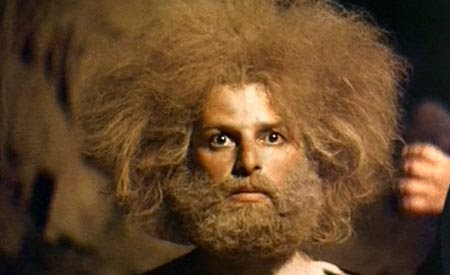
Eraserhead, along with a few of David Lynch's other films, often pops up on lists of the best horror movies even though it's not a horror movie as we generally understand the term (and it's actually quite funny from a certain point of view). But while Eraserhead doesn't feature supernatural beasts or a masked killer picking off one horny teenager at a time, it's frightening in a more abstract, existential way, a feature-length nightmare as dreamt by a mysterious technician in space who never wakes up. Eraserhead was Lynch's first feature, the first in a line of movies that explore the darkest aspects of human nature in a way that is as beautiful as it is horrifying. Much of the impact of his films can be attributed to Lynch's very personal approach to filmmaking, both in his gift for seemingly transferring the contents of his imagination to the screen intact and in his direct, hands-on involvment in nearly every aspect of the filmmaking process. Many of his collaborators have shared anecdotes about how Lynch is always eager to solve a problem on set by creating a prop or set decoration out of available materials, or writing the lyrics for "Mysteries of Love" during a lunch break on Blue Velvet when the production was unable to license This Mortal Coil's "Song to the Siren." This was never more true than on Eraserhead, which Lynch shot a little at a time, with very limited money and resources, over the course of four years. It was the typical no-budget situation with a director wearing many different hats, and Lynch's fingerprints are both figuratively and literally all over the movie.
Thursday, October 04, 2012
Making Monsters #4: Dead Alive
Long before the Oscar-winning, blockbusting Lord of the Rings trilogy astonished the world with the meticulous, cutting-edge effects that brought Middle Earth and many of its denizens to life, Peter Jackson was already a skilled and versatile director of effects-driven movies. The only differences were, instead of his own top-of-the-line visual effects house and large-scale fantasy epics, Jackson was baking makeup appliances in his parents' oven for the low-budget, gross-out horror comedies Bad Taste and Meet the Feebles. For 1992's Braindead (titled Dead Alive in the U.S.), Jackson worked with professional medic and makeup artist Bob McCarron (who would later work on The Matrix and other big-budget studio productions) to bring his ultragory zombie comedy to life. In Dead Alive, milquetoast Lionel (Timothy Balme) struggles to continue to care for his mother Vera (Elizabeth Moody) after a bite from a Sumatran rat monkey turns her into one of the living dead. As Vera infects other characters and the situation rapidly escalates, Jackson orchestrates a nonstop series of bloody sight gags that are so over-the-top disgusting that they become hilarious - he matches the Looney Tunes-inspired slapstick approach to splatter of Sam Raimi and takes it up to eleven. Oh, and there's also a priest who does kung fu.
When the zombies break loose at a house party in the last half hour, the film becomes like the most inventive and lovingly crafted realization of an extremely gifted ten-year-old's most horrifying notebook sketches, culminating in the most hilariously literal, disgusting Freudian metaphor ever committed to celluloid. But before that, we're treated with the movie's showstopper, as Lionel, equipped with an upturned lawnmower, hacks a few dozen zombies to smithereens. It's a pretty straightforward effect - a lot of writhing extras, plenty of prop limbs and organs and fake blood pumped through the lawnmower at a rate of five gallons per second. It's the sheer showmanship that makes the scene so satisfying - it's Jackson taking the zombie movie as far as it can go, a bloodbath that, like a splatter version of Sideshow Bob stepping on rake after rake, takes a gross-out joke past the point of its novelty, until it's completely repetitive and numbing, and then past that until the sheer scale of the bloodbath achieves a sublime, demented kind of genius. That Jackson just stretched one 300-page children's book into three movies suggests, sadly, that he doesn't have another Dead Alive in him; hopefully, as with some of the best moments in the Lord of the Rings trilogy, his new trio will contain flashes of the gifted young filmmaker who knew how to craft the perfect sick joke.
Wednesday, October 03, 2012
Making Monsters #3: King Kong
One of the most iconic movie monsters of all time - a beast known and loved by audiences around the world - was an 18-inch model made of aluminum, foam rubber, latex and rabbit fur (two models, actually). Along with an assist from two large-scale ape hands and a large-scale bust for specific effects shots, those two models were responsible for playing Kong, the eighth wonder of the world. That we believe what was basically a crude action figure was a fearsome creature, yet also a character capable of conveying emotions, is thanks to the meticulous attention and time its creators - directors Merian C. Cooper and Ernest B. Schoedsack and effects artist Willis O'Brien - put into bringing Kong to life.
Inspired by Cooper's lifelong fascination with gorillas and love for pulpy adventure stories (their previous collaboration was The Most Dangerous Game), Cooper, Schoedsack hired screenwriter Edgar Wallace to realize Cooper's basic premise - a giant ape is found on a mysterious island, is transported to America and terrorizes New York City. Principal photography lasted for eight months due to the painstaking care taken to get the live-action footage just right for composite shots involving optical effects (basically, to blend the 18-inch "giant ape" believably into each frame, not to mention the dinosaur Kong fights to the death). Cooper shot hundreds of setups for sequences like Kong's rampage through the island natives' village to convincingly pull of each effects gag - he was like the Michael Bay, only way better. Many scenes were reshot later into production in order to make them more convincing. At one point, Fay Wray sat in a tree for almost 24 hours to match her reactions with the stop-motion footage of the Kong/dinosaur footage just right. And O'Brien's work on the film went beyond animating Kong; he brought to life an entire mysterious island by combining live-action backgrounds with matte paintings and animation plates that created movement and depth through the entire background. These guys didn't just create a big ape, they brought an entire world to life.
The actual effects techniques they used were old-school even then - they'd been around since the silent era. But even though King Kong has been remade twice, that 18-inch model remains easily as compelling as state-of-the-art animatronics or motion-capture. We can see the seams and imperfections when we watch King Kong now, but all visual effects look dated eventually. What shines through is the care Kong's makers put into his creation - they believed in the big lug, and so do we. As the 1976 remake's producer Dino De Laurentiis famously put it, "No one cry when Jaws die. But when the monkey die, people gonna cry."
Inspired by Cooper's lifelong fascination with gorillas and love for pulpy adventure stories (their previous collaboration was The Most Dangerous Game), Cooper, Schoedsack hired screenwriter Edgar Wallace to realize Cooper's basic premise - a giant ape is found on a mysterious island, is transported to America and terrorizes New York City. Principal photography lasted for eight months due to the painstaking care taken to get the live-action footage just right for composite shots involving optical effects (basically, to blend the 18-inch "giant ape" believably into each frame, not to mention the dinosaur Kong fights to the death). Cooper shot hundreds of setups for sequences like Kong's rampage through the island natives' village to convincingly pull of each effects gag - he was like the Michael Bay, only way better. Many scenes were reshot later into production in order to make them more convincing. At one point, Fay Wray sat in a tree for almost 24 hours to match her reactions with the stop-motion footage of the Kong/dinosaur footage just right. And O'Brien's work on the film went beyond animating Kong; he brought to life an entire mysterious island by combining live-action backgrounds with matte paintings and animation plates that created movement and depth through the entire background. These guys didn't just create a big ape, they brought an entire world to life.
The actual effects techniques they used were old-school even then - they'd been around since the silent era. But even though King Kong has been remade twice, that 18-inch model remains easily as compelling as state-of-the-art animatronics or motion-capture. We can see the seams and imperfections when we watch King Kong now, but all visual effects look dated eventually. What shines through is the care Kong's makers put into his creation - they believed in the big lug, and so do we. As the 1976 remake's producer Dino De Laurentiis famously put it, "No one cry when Jaws die. But when the monkey die, people gonna cry."
Tuesday, October 02, 2012
Making Monsters #2: Bride of Frankenstein
In Mary Shelley's Frankenstein, the monster is said to be eight feet tall, with flowing black hair and pale, translucent skin; beyond that, the monster's appearance is mostly left to our imaginations. If, when reading the book, one cannot help imagining the creature with bolts in his neck and a severe flat top, this is a tribute to the enduring power of the work of Boris Karloff and makeup artist Jack Pierce, who brought the monster to life in James Whale's classic 1931 film. Pierce was one of the first big names in makeup effects - after working on silents like The Man Who Laughs, Pierce was the makeup artist on Tod Browning's Dracula, which led to him working on all of the iconic Universal horror characters of the '30s and '40s (including one we'll take a look at later in this series). For Frankenstein, Pierce studied anatomy and surgery before deciding that Dr. Frankenstein would cleanly saw off the top of the monster's head and clamp it shut, after inserting the brain, like a box lid. The effect is obviously exaggerated, but that doesn't make it any less memorable; using grease paint, cotton, gum and other out-of-the-kit techniques, Pierce created one of the most enduring monsters in movie history.
Bride of Frankenstein is a sequel that surpasses the original - it's sharply funny and more thematically complex. And the design of Elsa Lanchester as the Bride is a lesson in how sometimes, with monster makeup, less is more. The look of the Bride consists of pale makeup, raised brows, jagged scars across her throat and her unforgettable hairdo, a Marcel wave over a wire frame, but she's nearly as iconic as Karloff's monster. While many of the effects I'll be covering this month are elaborate show-stoppers, the Bride is a great reminder of the power of suggestion, not to mention an actress who knows how to hiss.
Monday, October 01, 2012
Making Monsters #1: Scanners
Mention the movie Scanners to
most people, even those who haven’t seen it, and this will almost
certainly be the first scene that comes to mind. David Cronenberg’s 1981
thriller about war between people with telekinetic abilities isn’t one
of his best films, but the early scene in which leader of the Scanner
rebellion Darryl Revok (Michael Ironside) turns the tables in grisly
fashion on a fellow Scanner (Louis Del Grande) during a demonstration is
an iconic classic in its own right. The scene is almost unbearably
tense as Revok’s target realizes something has gone very wrong and
starts to panic, building to an unforgettably gooey payoff as the poor
guy’s head detonates in a flash of blood and tissue.
Cronenberg’s
films will feature in this series more than those of any other
director, and for good reason – he’s universally acknowledged as the
master of bodily horror thanks to a body of work that finds fear not in
the supernatural but in sickness, mutation and destruction, and this
scene is one of the most blunt expressions of bodily horror in his
filmography. It was brought to life by legendary makeup artist Dick
Smith, whose credits include The Exorcist, Taxi Driver, Altered States and his Oscar-winning work on Amadeus;
Smith was also a teacher and mentor to many of the makeup effects
artists whose work will be included in the next few weeks. For this
scene, Smith created a prosthetic head, filled it with dog food and
rabbit livers and blew it apart from behind with a shotgun. The result
is an unforgettable image that helped usher in the splatter era of the
1980s. It’s worth noting that this was originally the opening scene of
the movie, but Cronenberg decided it was too strong after a test
screening and moved it to about ten minutes into the movie (where,
clearly, it’s much easier to take). Also Scanners was a
surprise hit that was number one at the box office the weekend it
opened; I love that America experienced this moment together.
Making Monsters: Horror Movies and the Art of the Uncanny
This October, I've decided to focus on the makeup and special effects that are a huge part of what makes horror movies so gruesomely entertaining. Horror is my favorite genre because it affords filmmakers nearly unlimited reign to exercise their imaginations; this is even more true for the effects artists who bring the many monsters, mutants and specters that populate our favorite scary movies to life. I'll feature a different movie, focusing on a character or scene, every day; this isn't a best-ever countdown, though, just a collection of some of the first movies that came to mind. Some are from state-of-the-art A-list horror movies, others represent the handmade aesthetic of classic exploitation and indie horror. If the list is largely populated by movies from the '70s and '80s, it's because, thanks to the new permissiveness of the era and the pioneering work of my childhood heroes - guys like Dick Smith, Tom Savini, Rick Baker and Stan Winston - those decades marked a high point for the possibilities of creating fantastic horror stories for the big screen.
In fact, today's entry starts the season off with a bang...
Monday, September 24, 2012
Now turn my eyes black.
My mother became a born-again Christian when I was eight years old; while I was an unusually skeptical third-grader, I decided to give it a try with her after a few months and, eventually, went with her every week to a startup Calvary Chapel. Calvary grew out of the "Jesus freak" movement in the 1960s, merging Pentacostal and fundamentalist characteristics with an informal, populist style intended to appeal to those who were put off by traditional church doctrines. Churches such as Calvary, with their relatively independent polity, pride themselves on their non-denominational status and the independent-mindedness this implies, even if they maintain most of the same dogmas and prejudices as any mainstream denomination. This was the strongest impression of the church I got as a child, feeling surrounded by adults who passionately believed they were unique, set apart for a common purpose that would be integral to the future of not only the church but the whole world. As I got older, I realized how many of these churchgoers were recovering from substance abuse, abusive relationships, severe depression and other painful experiences; it seemed like, for them, this sense of being a part of a tight-knit community united in a unique and special purpose was as much of a support as their faith in salvation through Christ. As if their past failures and traumas were preparation for their roles in the great work ahead.
I thought a lot about Calvary Chapel while watching The Master, the audacious and challenging new film by Paul Thomas Anderson. While Anderson's film is largely inspired by the life of L. Ron Hubbard and the early days of Scientology, it isn't really an exposé of Hubbard's controversial religion. While many of the central teachings and methods of The Cause, as it's called in the film, are very similar to those in Scientology - many of the questions posed to its disciples during "processing" were ones I answered when I took a personality test at the Church of Scientology in Boston - it could just as easily stand in for modern religious or secular movements like non-denominational Christianity, self-help doctrines, the New Age movement, est, Landmark, and the Human Potential Movement. It's a film about the new faces of spritual leadership in post-WWII America, our new attempts to find meaning and whether it's possible to thrive without a master. Alternately exciting, perverse, confounding and mesmerizing, it's a distinctly American story that is also the most original American film so far this year.
The face of The Cause is Lancaster Dodd (Philip Seymour Hoffman), referred to by most of the film's characters as Master, a writer and self-described doctor, nuclear physicist and theoretical philosopher who is above all, as he puts it, "I am a man. A hopelessly inquisitive man, just like you." He's talking to Freddie Quell (Joaquin Phoenix), a Navy vet who has boarded Dodd's yacht looking for work and to escape trouble. Quell is an impulsive, violent, sex-obsessed guy - his idea of flirtation is to write a note reading "Do you want to fuck?" signed with a smiley face. Physically and psychically scarred by his experiences in the war and pining for the lost love of his life, Freddie drifts through jobs as a department store photographer and cabbage picker, fighting and screwing and mixing toxic alcoholic concoctions out of paint thinner and Lysol. When one of Freddie's drinks nearly gets a migrant worker killed, he flees and hops aboard Dodd's ship; the next morning, with no memory of the night before, he meets Dodd, who is charmed by Freddie's animalistic nature (and homemade booze) and offers him a job with The Cause.
It's the relationship between Freddie and the Master that is at the heart of the film. Phoenix is terrific as Freddie; as interminable as I'm Still Here was, it was worth it if the experience results in more uninhibited, full-bodied performances like this one. Freddie isn't a contemplative man, but he's not dumb either; he's a creature of pure instinct who soon becomes one of Dodd's most passionate followers; while it's not clear he's even interested in the cause's philosophical tenets, he seems attracted to the promise of being freed from his past by his persuasive new teacher. Many of the film's most fascinating scenes involve Freddie's "processing" and other exercises meant to trigger memories of his current and past lives; these scenes are exciting both for the physical trials they put Phoenix through and through the intense, ambiguous chemistry between Freddie and Dodd. As Dodd, Hoffman is affected, jocular and even a bit mincing; we see early on that the Master's outward geniality barely masks a temper that is as strong as Freddie's. It's clear, as much as Dodd wants to cure Freddie, he also envies his wildness and, it's strongly suggested, may even be in love with Freddie. The language Dodd uses to scold Freddie, calling him a "naughty boy," has been interpreted as paternal, or that of a person speaking to his pet; I also read it as the language of domination and submission, of a master struggling to control the disciple that, he secretly hopes, will overpower and dominate him. It's a magnetically charged battle of wills, and both actors provoke each other into some of their best work.
Dodd tells Freddie at several points that they've met before, that theirs is an eternal struggle, and Anderson and DP Mihai Malimaire use the 65mm format to elevate their relationship to epic proportions. James Cameron is fond of saying that 3D can be as effective with a character drama as with an effects picture; after seeing The Master, I feel the same way about 70mm. While the film contains some gorgeous exterior shots, particularly the recurring image of the vibrant blue wake of a ship, this is a story largely told in close-ups, the clarity and detail of the format bringing every nuance of the performances into striking relief. The bold colors and stunning contrast, coupled with Jonny Greenwood's otherworldly score, give the scenes between Dodd and his disciples a hyperreal quality. The members and practices of The Cause aren't depicted with the kind of savage intensity as the scenes of Eli Sunday and his flock in There Will Be Blood; here, Anderson's approach is more analytical, distant, but heavy with intimations (as with Freddy's sleepy hallucination of a Cause gathering turning into a Bacchanalic orgy) of something darker. This is especially true with Dodd's wife Peggy (Amy Adams), who is suspicious of Freddie from the start and perhaps more fanatical about the cause than her husband; we see her able to use her sexuality to manipulate both Freddie and, especially, Dodd. Adams doesn't have as much screentime as the two male leads, but she's fantastic, dialing down her usual likeable screen presence to marvellously chilly effect. There's a very creepy scene where Peggy gets Dodd off while telling him in no uncertain terms what he can and cannot do, and we realize that Dodd's needs and failures are not far from Freddie's, that it's Peggy who is Dodd's master and, perhaps, the true leader of the cause.
As Freddie rebels against and returns to his master, lurching towards clarity only to regress into sudden violence, The Master becomes increasingly elliptical, blurring the lines between reality and Freddie's dreams and fantasies in ways that hold very interesting implications for the rest of the film. I spent much of the last third hoping that, as with There Will Be Blood, the final confrontation between the two leads would bring the film's intentions into focus. Honestly, that didn't quite happen, although Freddie and Dodd's final scenes together are quite moving. There's the suggestion that Freddie has, in fact, grown in some small meaningful ways over the course of the film, but he's still a puerile skirt-chasing scoundrel. The final scene and closing shot feel right, but I'm not sure why. Has Freddie mastered Dodd? Is he his own master? Is pussy, finally, the only thing worth believing in? These are the kind of questions The Master leaves us with, and it's frankly a bit maddening; while I don't agree with Ebert's assertion that "When I reach for [The Master], my hand closes on air," I do understand how he could feel that way. It's easily the most cerebral movie Anderson has made, and I look forward to revisiting it many times, I'm sure, for answers to these and new questions. I don't agree with the idea that Anderson has only recently grown up as a filmmaker - Boogie Nights and Magnolia are the works of a confident adult storyteller - but it has been fascinating to see him evolve from the wunderkind who, like quiz kid Stanley Spector in Magnolia, seems to be desperate to employ his prodigious gifts to win our love. The Master is the work of a director confident enough to follow his cinematic muse wherever it takes him, even if the journey is idiosyncratic, puzzling and even alienating to much of his potential audience. It's a fascinating chapter in the ongoing narrative of one of the best filmmakers working today, and I can't wait to see where Anderson takes us next.
Monday, August 20, 2012
All-Time Top 100 (2012 Edition)
I was invited to contribute my list of 20 favorite movies to a Muriels/Skandies best films poll, the results of which will be unveiled tomorrow. I intended to share my top 20 here, but of course my thoughts turned to the many movies that didn't quite make the final cut, so naturally, here's my updated 100 list. I've bolded the movies that would make up my top 10 (and look for some thoughts on my favorite movie, The Shining, courtesy of the Skuriels), but I decided to alphabetize the list this time; these are the movies at the very top of the heap, and at that point, it doesn't really matter whether a film is 36th or 74th; I love them all the same. According to Flickchart, I've seen close to 4500 movies, and it wouldn't take me very much effort to make a list of 500 or 1000 that I love; I think most of my fellow movie geeks could easily do the same. But we'll stick with 100, as the whole point of making a list is to make hard choices, boil things down to the movies I really can't imagine life without and, hopefully, start a conversation (hey, did you hear Sight and Sound ranked Vertigo above Citizen Kane?). So here it is, and you can check out the Skuriels' results here tomorrow.
Aguirre, the Wrath of God (Werner Herzog, 1972)
Alien (Ridley Scott, 1979)
All That Jazz (Bob Fosse, 1979)
Annie Hall (Woody Allen, 1977)
Apocalypse Now (Francis Ford Coppola, 1979)
The Assassination of Jesse James by the Coward Robert Ford
(Andrew Dominik, 2007)
Badlands (Terrence Malick,
1973)
Barry Lyndon (Stanley Kubrick, 1975)
Belle de Jour (Luis Bunuel, 1967)
The Big Lebowski (Joel and Ethan Coen, 1998)
Blade Runner (Ridley Scott, 1982)
Blow Out (Brian De Palma, 1981)
Blue Velvet (David Lynch, 1986)
Boogie Nights (Paul Thomas Anderson, 1997)
Brazil
(Terry Gilliam, 1985)
Carrie (Brian De Palma, 1976)
Children of Men (Alfonso Cuaron, 2006)
Chinatown (Roman Polanski,
1974)
Citizen Kane (Orson Welles, 1941)
City Lights (Charles Chaplin, 1931)
A Clockwork Orange
(Stanley Kubrick, 1971)
Close Encounters of the Third Kind (Steven Spielberg, 1977)
The Conversation (Francis Ford Coppola, 1974)
Creepshow (George A. Romero, 1982)
Cries and Whispers (Ingmar Bergman, 1972)
The Dark Knight (Christopher Nolan, 2008)
Dawn of the Dead (George A. Romero, 1978)
Days of Heaven (Terrence Malick, 1978)
Dead Man (Jim Jarmusch, 1996)
Don’t Look Now (Nicolas Roeg, 1973)
E.T. the Extra-Terrestrial (Steven Spielberg, 1982)
Ed Wood (Tim Burton, 1994)
8 ½ (Federico Fellini, 1963)
El Topo (Alejandro Jodorowsky, 1970)
The Elephant Man (David Lynch, 1980)
The Empire Strikes Back (Irvin Kershner, 1980)
Eraserhead (David Lynch, 1977)
Eternal Sunshine of the Spotless Mind (Michel Gondry, 2004)
Eyes Wide Shut (Stanley Kubrick, 1999)
Fargo
(Joel and Ethan Coen, 1996)
The Fly (David Cronenberg, 1986)
The Fountain (Darren Aronofsky, 2006)
The Godfather Part II (Francis Ford Coppola, 1974)
Goodfellas (Martin Scorsese, 1990)
Halloween (John Carpenter, 1978)
Harold and Maude (Hal Ashby, 1971)
Inferno (Dario Argento, 1980)
Inglourious Basterds (Quentin Tarantino, 2009)
Jaws (Steven Spielberg, 1975)
Jules and Jim (Francois Truffaut, 1962)
Kill Bill vol. 1 (Quentin Tarantino, 2003)
Kill Bill vol. 2 (Quentin Tarantino, 2004)
Last Tango in Paris
(Bernardo Bertolucci, 1972)
The Last Temptation of Christ (Martin Scorsese, 1988)
Lawrence of Arabia
(David Lean, 1962)
Let the Right One In (Tomas Alfredson, 2008)
Lolita (Stanley Kubrick, 1962)
Macbeth (Roman Polanski, 1971)
Magnolia (Paul Thomas Anderson, 1999)
The Man Who Fell to Earth (Nicolas Roeg, 1976)
Manhattan
(Woody Allen, 1979)
McCabe and Mrs. Miller (Robert Altman, 1971)
Miller’s Crossing (Joel and Ethan Coen, 1990)
Mulholland
Drive (David Lynch, 2001)
My Own Private Idaho (Gus Van Sant, 1991)
Nashville
(Robert Altman, 1975)
No Country For Old Men (Joel and Ethan Coen, 2007)
Nosferatu, Phantom der Nacht (Werner Herzog, 1979)
Once Upon a Time in America (Sergio Leone, 1968)
One Flew Over the Cuckoo’s Nest (Milos Forman, 1975)
Orpheus (Jean Cocteau, 1950)
Pat Garrett and Billy the Kid (Sam Peckinpah, 1973)
Persona (Ingmar Bergman, 1966)
Phantom of the Paradise
(Brian De Palma, 1974)
Psycho (Alfred Hitchcock, 1960)
Raging Bull (Martin Scorsese, 1980)
Ran (Akira Kurosawa, 1985)
Rashomon (Akira Kurosawa, 1950)
Repulsion (Roman Polanski, 1965)
Rushmore (Wes Anderson, 1998)
Schindler’s List (Steven Spielberg, 1993)
The Searchers (John Ford, 1956)
Secretary (Steven Shainberg, 2002)
The Seventh Seal (Ingmar Bergman, 1957)
The Shining (Stanley Kubrick, 1980)
Sid and Nancy (Alex Cox, 1986)
Sideways (Alexander Payne, 2004)
Synecdoche, New
York (Charlie Kaufman, 2008)
Taxi Driver (Martin Scorsese, 1976)
There Will Be Blood (Paul Thomas Anderson, 2007)
The Thin Red Line (Terrence Malick, 1998)
The Thing (John Carpenter, 1982)
The Third Man (Carol Reed, 1949)
Touch of Evil (Orson Welles, 1958)
True Romance (Tony Scott, 1993)
2001: A Space Odyssey (Stanley Kubrick, 1968)
Vertigo (Alfred Hitchcock, 1958)
Wings of Desire (Wim Wenders, 1987)
Y tu mama tambien (Alfonso Cuaron, 2006)
Zodiac (David Fincher, 2007)
Subscribe to:
Posts (Atom)