Tuesday, April 28, 2009

The Lawnmower Man, The Beaver Kid, and The Clumsy Waiter


It's time for another of the seasonal movie quizzes at Sergio Leone and the Infield Fly Rule, this time courtesy of one Professor Peabody ("Quiet, you." - did the Professor actually say that, or was it a Simpsons-only line?). I'm shockingly late to turn in my answers this semester, but luckily, there is no due date, so I encourage you to head over to SLIFR and try it yourself if you haven't already.

1) Favorite Biopic

My favorite movie about a real person is Lawrence of Arabia. Biopics tend to be way too formulaic for me, so I generally prefer ones like I'm Not There and Mishima that purposefully break the mold.

2) Dyan Cannon or Tuesday Weld?

Tuesday Weld. Pretty Poison was actually filmed in the town and county where I live.

3) Best example of science fiction futurism rendered silly by the event of time catching up to the prediction

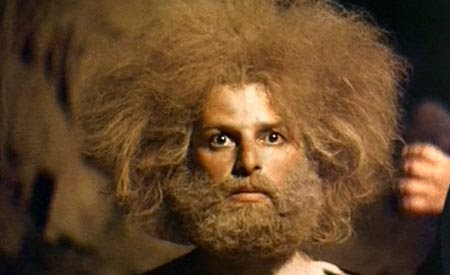
Any of the early-'90s virtual reality-themed thrillers that tried to paint cyberspace as a dangerous alternate reality capable of turning mentally challenged lawnmower men into all-powerful daemons or unleashing a wisecracking Russell Crowe into the world.

4) Annette Funicello & Frankie Avalon or Troy Donahue & Sandra Dee?

Annette and Frankie - my, was Back to the Beach in heavy rotation on HBO when I was a wee lad.

5) Favorite Raoul Walsh movie?

White Heat

6) Sophomore film which represents greatest improvement over the director’s debut

The Terminator has less flying piranhas than Piranha II, but is otherwise superior.

7) Ice Cube or Mos Def?

Mos Def

8) Favorite movie about the music industry

My first thought was Nashville as a default answer, but a quick glance shows that few have mentioned it so far, so perhaps it isn't considered a movie about the industry (it is, but it's about everything). So honorable mentions to Almost Famous and Phantom of the Paradise, respectively the sweetest and most acidic takes on the music industry.

9) Favorite Looney Tunes short

The ending of "What's Opera Doc?" shocked me when I was a kid.

10) Director most deserving of respect or upwardly mobile critical reassessment

I think Sam Mendes is one of the best new directors of the last 10 years, but he's also completely unhip, which hurts his cinephile street cred.

11) Ruth Gordon or Margaret Hamilton?

Oh, Maude!

12) Best filmed adaptation of a play

Amadeus

13) Buddy Ebsen or Edgar Buchanan?

I laughed the first time I read the story of how Ebsen was the original Tin Man but had to be hospitalized because of aluminum dust inhalation. Am I a bad person?

14) Favorite Jean Renoir movie?

I've only seen a few Renoir films so far, and while they were all inarguably brilliant, I have yet to truly fall in love with one. But The Rules of the Game is hilarious and, as I said, inarguably brilliant.

15) Favorite one-word movie title, and why

Alien. It sums up everything that fuels the movie's scares in the most elemental way possible.

16) Ernest Thesiger or Basil Rathbone?

I must admit that I didn't recognize the name "Ernest Thesiger." But after looking him up and realizing he played Dr. Pretorious in Bride of Frankenstein, that alone puts him ahead.

17) Summer movies—your highest and lowest expectations

Highest: That Inglorious Bastards will be as insanely entertaining as a decade of Tarantino's hyperbole promises.

Lowest: That Transformers 2, which will surely be the highest-grossing movie of the summer, will do anything other than further confirmation of my most pompous, elitist assumptions about the horrible taste of most moviegoers.

18) Whether or not you’re a parent, what would be your ideal pick as first movie to see with your own child (or niece/nephew)? Why?

I'm hoping that my daughter will be ready to go to the movies by the time Where the Wild Things Are is released. I think about this subject quite often. When my wife was pregnant with Luna, I read an article in the New York Times (I think) about how kids are becoming increasingly "platform agnostic" - a movie, a tv commercial and a video game on a cell phone all have the same value. So besides wanting to pass on my geekiness, I actually think it's important for parents to encourage an appreciation for movies, books and all stories that inspire curiosity and wonder.

19) L.Q. Jones or Strother Martin

Probably the closest call on this quiz. I'll go with Strother Martin - I was delighted by his performance in Butch Cassidy and the Sundance Kid when I revisited it a few weeks ago.

20) Movie most recently seen in theaters? On DVD/Blu-ray?

In theaters, Adventureland, which completely surprised me with its warmth and subtlety. On DVD, Brazil, which gets funnier and scarier every year.

21) Do you see more movies theatrically or at home? Why?

At home - we don't have much of a social life, but we have a pretty sweet home theater setup.

22) Name an award-worthy comic performance that was completely ignored by Oscar and his pals.

Though it's looking more and more like a one-off, Adam Sandler's performance in Punch-Drunk Love was the best of its year.

23) Zac Efron & Vanessa Hudgens or Robert Pattinson & Kristen Stewart

To be fair, I haven't seen High School Musical 3 or Twilight, so who knows, they could be really good. Kristen Stewart showed surprising depth in Adventureland, so I'll go with her and Babyface Nelson.

24) Name a great (or merely very good) movie that is too painful to watch a second time (Thanks to The Onion A.V. Club)

I've never been able to rewatch Boys Don't Cry. The film's second half is brutal not just for the violence and simulated rape, but because Kimberley Peirce and Hilary Swank do a frighteningly strong job of putting you in Brandon Teena's shoes - I left the movie feeling violated and emotionally drained. I tried watching it once on cable, but when Brandon and Lana kiss for the first time I decided to change the channel and leave the movie on high note.

25) Beyonce Knowles or Jennifer Hudson?

I truly don't have an opinion. Hudson, because who doesn't like to root for an underdog?

26) Favorite Robert Mitchum movie?

My favorite movie featuring Robert Mitchum is Dead Man. His best performance, of course, is Night of the Hunter.

27) Favorite movie featuring a ‘60s musical group that is not either the Beatles or the Monkees

Blow-Up (featuring the Yardbirds)

28) Maria Ouspenskaya or Una O’Connor?

Maria Ouspenskaya

29) Favorite Vincent Price movie?

His performance in Edward Scissorhands was one of the first to make me teary-eyed. As far as leading roles go, Theatre of Blood is one of the best black comedies.

30) Name a movie currently flying under the radar that is deserving of rabid cult status.

Due to rights issues, The Beaver Trilogy is one of the few cult films left that can basically only be seen on seventh-generation bootlegs. And it's well worth the effort - check out this and other YouTube clips and you'll see what I mean. Sidenote: I've just found out, through the comments on that page, that Groovin Gary died in February. That totally sucks - RIP, Olivia Newton Dawn.
31) Irene Ryan or Lucille Benson (or Bea Benaderet)?

Lucille Benson

32) Single line from a movie that never fails to make your laugh or otherwise cheer you up. (This may be obvious, but the line does not have to come from a comedy.)

"Well, Wildcat was written in a kind of obsolete vernacular...Wildcat...wild...cat...pow...wildcat...I'm going to go."

33) Elliot Gould or Donald Sutherland?

Elliot Gould's performance in The Long Goodbye is one for the ages, but Donald Sutherland is maybe the most underrated '70s-era actor. MASH, Don't Look Now, 1900, Animal House, Invasion of the Body Snatchers, Ordinary People, Kentucky Fried Movie...

34) Best performance by a director in an acting role

David Cronenberg is frighteningly convincing as a killer in To Die For and Nightbreed. It's also fun to see him get killed by Jason Voorhees in Jason X.

35) Favorite Barbara Stanwyck movie?

Double Indemnity

36) Outside of reading film criticism or other literature about the movies, what subject do you enjoy reading about or studying which you would say best enriches or illuminates your understanding and appreciation of life, a life that includes the movies?

Good question. I read a lot of philosophy, particularly the existentialists. It's all in the mind, you know.

Monday, April 20, 2009

Spring Cleaning


The combination of the late winter/early spring awards movie glut and my newfound tendency to take more time to write a review has led to a backlog of movies I'd intended to write about but are surely nearing the point where I can hardly remember what I meant to say and you could hardly care. So, in honor of the annual editions of Video Movie Guide I relied on in the pre-internet days, here are some brief thoughts on the a handful of recent movies before I move on to longer responses to two I saw last week - one great, the other an out-of-left-field masterpiece - and my answers to the latest quiz at Sergio Leone and the Infield Fly Rule.

The true test of a great actor is whether one can deliver a strong performance not just in a well-written tailor-made for him/her but in a weak movie that requires the actor to create something out of very little. In The Reader, Kate Winslet is the only compelling element of a movie that never knows what it is about. The frank eroticism of the first half clashes with the vaguely defined ethical quandaries of the second - the explicit sex scenes feel distateful in light of the Holocaust-related material, which end up feeling trivialized as they're framed within the story of one guy's traumatic, lifelong cock-block. If they weren't bound by the expectations of an Oscar-bait prestige picture, director Stephen Daltry and screenwriter David Hare would have been better off pushing the movie into The Night Porter territory, which at least would have been more interesting. That said, whenever Winslet is onscreen, The Reader briefly comes to life - she finds a complex inner life in Hanna Schmitz that the movie can't support. And yeah, as good as it was to see her finally win the Oscar, she should have won for Revolutionary Road.

Surprise of the year: I sort of liked Knowing. All signs pointed to Nicolas Cage's newest codebreaking thriller being a steaming turd, and I mostly went to figure out what Roger Ebert was thinking when he named it one of the best sci-fi movies he's ever seen. And while it's far from that, I was relieved to find out that the list of numbers predicting global disasters was merely a plot device and I wouldn't be in for two hours of Cage glumly working out code. The film actually shows an interest in the question of whether the universe is random or deterministic (in a popcorn-movie kind of way, but still), and Alex Proyas lends the film a haunting end-of-days atmosphere. It's goofy but likeable, with one of the best plane-crash sequences in memory, and I admired it for following its Biblical allusions through to their logical end (you may enjoy this more if, as a child, you were told that the literal apocalypse was not only real but just around the corner). More writing remains to be done about the ongoing performance art piece that is Nicolas Cage's filmography.

Let the Right One In definitely lives up to the hype and would have easily been on my Top 10 of 2009 list had I seen it in time. I didn't quite think it was a masterpiece, though I may like it a bit more when I see it with the corrected subtitles, which I'm told lend the movie the humor I felt it needed. Either way, it's head and shoulders above all the so-called "horror movies" that a horror fan has suffered through in recent years in search of the real thing. It's beautifully photographed, sincerely creepy (with a too-rare understanding of the importance of atmosphere) and ultimately moving for anyone who has felt like an outsider. I'll definitely revisit this one in greater depth, perhaps around Halloween.

Two Lovers reminds what a shame it is that Joaquin Phoenix was eaten by a pretentious, drug-addled Kodiak bear. His performance as Leonard, an emotionally fragile guy living at home with his parents and torn between two women, is remarkably complex and layered - I was particularly impressed with the way Leonard acts differently depending on who he's interacting with, the way everyone does in real life. I'm more mixed on the film itself - it's handsomely shot, and the performances are believable all-around, but the script ultimately felt a bit thin to me. Still, James Gray clearly knows how to tell a story with images, and I look forward to checking out his earlier films.

Something you probably already know: Sally Hawkins is terrific as Poppy, the incurable optimist whose life we observe for a little while in Mike Leigh's Happy-Go-Lucky. The spiritual opposite of David Thewlis in Leigh's Naked (another great performance), Poppy is filled with gratitude for her life and a desire to brighten the day of everyone she meets. The character could have easily been insipid and annoying, but in Hawkins' eyes we can see that Poppy is hardly naive; the movie is ultimately a winning argument for the virtues of relentless optimism. The scenes between Poppy and Scott (Eddie Marsan), her bitter, misanthropic driving instructor, are easily the highlight of the movie. En-ra-ha, Poppy, en-ra-ha...

Tuesday, April 07, 2009

Mola Ram, prepare to meet Kali - in Hell!

Indiana Jones and the Temple of Doom opens with one of the best non sequitors in cinema. After the Paramount logo dissolves to the image of a mountain emblazoned on a gong, the camera pushes in on a large dragon statue spewing smoke from its mouth. But the dragon isn't a priceless artifact or the entrance to a lost city - it's a kitschy stage prop, and we're thrown directly into a lavish, Busby Berkly-style production number ("Anything Goes" in Mandarin). While tentpole sequels usually have an inflated sense of self-importance, Indiana Jones and the Temple of Doom sets its self apart with its complete irreverance of its audiences' heightened expectations - even the film's title, blocked from our view by the introduction of nightclub singer Willie Scott (Kate Capshaw), is mocked for its arbitrariness. And though the willingness of creators Steven Spielberg and George Lucas to try anything resulted in many of the elements Temple of Doom is routinely criticized for - the gore, the frenetic pace, the perceived racism and sexism - it's the film's borderline-sociopathic nature that made it a favorite of mine as a kid. No director can adapt a child's perspective like Spielberg, and if I say that Temple of Doom feels like it was adapted from the bloody classroom scribbles of a gifted, manic 8-year-old with antisocial tendencies, I mean it in the best possible way.

Starting in 1930s Shanghai, Temple of Doom starts with Indiana Jones escaping crime boss Lao Che (Roy Chiao), ultimately landing (literally) in India. Jones, Scott and Jones' ten-year-old Chinese sidekick Short Round (Ke Huy Quan) are asked by the shaman of a small village to travel to nearby Pankot palace, which the villagers believe is location of a secret Thuggee cult that has stolen Shiva lingam (an ancient stone said to posess supernatural powers) and kidnapped the village's children. Thinking the stone may be his ticket to "fortune and glory," Indy agrees, and that's all the setup needed for a movie that moves breathlessly from bugs and booby traps to heart-ripping and zombification without ever apologizing for being the cinematic equivalent of a two-hour amusement park ride. More than its predecessor, Temple of Doom embraces the absurdity of its serialized ancestor. We're barely introduced to Wu Han (David Yip), one of Indy's many sidekicks, before he's shot and dies in Indy's arms alluding to past adventures we'll never see. He's just as quickly replaced by Short Round, the rare wisecracking movie kid who isn't completely insufferable - I love that we get the least possible justification for why Indy is travelling with a Chinese boy,I love the abrupt reveal (scored to Short Round's theme music) that reveals a ten-year-old drives Indy's getaway car, and I love that Short Round has his own theme music. Short Round's introduction is one of countless joyous movie moments in the first reel - Spielberg piles one sight gag on top of another in a way that recalls 1941 but without the bloat. Perhaps realizing that he was making a movie about nothing, Spielberg makes Temple of Doom a movie about the joy of moviemaking.


The film famously gets darker when Indy discovers the titular temple, where Thuggee high priest Mola Ram (Amrish Puri) presides over human sacrifices to Kali and forces the kidnapped children to dig for the missing Sankara stones. While Temple of Doom's tendency towards gross-out disturbed many parents and led (along with the same summer's Spielberg-produced Gremlins) to the creation of the PG-13 rating, the movie is actually gory in a way that certain kids are likely to embrace. Movies like Temple of Doom, Gremlins and Poltergeist were, in retrospect, healthy experiences for a literate young kid becoming aware of his own mortality and the resulting anxiety - the famous heart-ripping scene was more amazing than scary, an awesomely graphic externalization of the scary awareness that my body was filled with blood and guts. The whole movie can be seen as taking the perspective of a young boy both curious and afraid of the world beyond his doorstep, which goes a long way towards explaining many of the things it's been criticized for - the perceived xenophobia of the "chilled monkey brains" scene, the increased brutality of the action and particularly the movie's fear and derision of femininity in the form of shrieking, hysterical Willie Scott stem from the puerility that Spielberg understands as clearly as the earnest wonder that is its flipside. And when such willfull immaturity leads to a setpiece as perfectly born out of a child's sense of play as the awesome climactic mine cart chase, Temple of Doom makes a pretty strong case for willful immaturity as a virtue.

The film's casual imperialism is harder to defend, and I must admit that I cringe during the denouement when British troops arrive (accompanied by a triumphant John Williams fanfare) to blow away the Thugees and save the day. It's hard to imagine Spielberg, whose films have grown more morally complex over the years, ending one of his films with such an offhandedly irresponsible white hat/black hat moment today. Indeed, Spielberg has basically disowned Temple of Doom, and as his next feature, The Color Purple, continues a process of maturation begun in E.T., it's hard not to see Temple of Doom as something of an anomaly. And though I think it's a generally positive and perhaps necessary thing that Spielberg grew up, I sometimes miss the wunderkind with Peter Pan syndrome - nobody has ever made tastier cinematic junk food.

Wednesday, April 01, 2009

You spare me nothing!

The following is my contribution to the 3rd Annual White Elephant Blog-a-Thon.

Few filmmakers understand the importance of economy like Roger Corman. The exploitation auteur has directed over 50 films in his career and produced over 300, his low-budget epics famously giving directors like Martin Scorsese, Jonathan Demme and Francis Coppola their first break as well as financing the U.S. distribution of classics by Bergman, Herzog and many others. The stories behind the breakneck production of Corman's films are often more famous than the movies themselves; making very cheap films for a distribution system that nearly guranteed a project, Corman frequently saw an unused set or a few extra days in his shooting schedule as reason enough to conceive and shoot an entire film. Sometimes, as with Little Shop of Horrors (shot in two days), the hectic pace would result in an offbeat, irreverent classic that never stops to second-guess itself. 1963's The Terror is less successful; born out of Corman's realization, near the end of production on The Raven, that both a castle set and Boris Karloff would be available for two more days, it actually took an additional nine months for Corman and four other directors, including Coppola, Monte Hellman and star Jack Nicholson, to make it remotely comprehesible. The result is an uneven and somewhat nonsensical film, though it's a testament to Corman's talents that it's a very watchable mess.

Nicholson plays Andre Duvalier, a French lieutenant (ha!) separated from his regiment and wandering the coast (of?) when he meets a mysterious young woman (Sandra Knight) who disappears as he is attacked by a bird. Andre's quest to find the young woman leads him to a castle occupied only by the Baron Von Leppe (Boris Karloff) and his manservant Stefan (Dick Miller). Duvalier uncovers an old mystery involving reincarnation, mistaken identity and other tropes left over from Corman's superior Poe films. But it doesn't really matter what the movie is about - Corman spent much of the two days with Karloff shooting the actors walking down staircases and across corridors, figuring he'd be able to piece it together later. The lack of a functional plot might not matter if it were interesting to watch the actors play off each other - just last week I saw The Big Sleep, a great movie with a lame plot. Unfortunately, Karloff phones it in and Nicholson has yet to find his rebellious onscreen persona - he's surprisingly bland and uncomfortable on-camera. Even the usually dependable Dick Miller is given little to do. The result is a movie that is consistently almost interesting and frequently suggests better movies.

Still, The Terror reminds of what separates Roger Corman from B-movie peers like Ed Wood and Phil Tucker. Even at his worst, there's a basic understanding of classical narrative filmmaking and a decent attempt at creating atmosphere. Though I was never really engaged, I was also never bored, and at 80 minutes, the movie knows when to quit. The final scene also delivers one memorable image that made me wonder if Stanley Kubrick saw the film before The Shining. The Terror, for its many problems, is the work of a real filmmaker (five, actually), and it's probably as good as a movie constructed out of establishing shots could be.

Tuesday, March 31, 2009

Good joke. Everyone laugh.

Is it possible to write about Watchmen the movie without comparing it against Watchmen the book? Almost every review of the film eventually devolves into a checklist of how plot points, characters, production design - indeed, every shot - recreate or deviate from Alan Moore and Dave Gibbons' masterpiece. Every devoted fan of the book is going to have a detail or beat they sorely missed (I missed the Hooded Justice, after preventing Sally Jupiter's rape, teling her to cover herself up). To be fair, director Zack Snyder invites this kind of scrutiny; his film is as driven by an obsessive fidelity to its source material as his adaptation of Frank Miller's 300. I hated 300 for its monotonous visual style and seeming anti-intellectualism, and feared that Snyder was the worst possible choice for Watchmen, a comic driven more by ideological conflict than epic battles. During the stunning opening credits sequence, which presents an alternate history of the 20th century populated by superheroes scored to Dylan's "The Times They Are a-Changin'", I realized my fears were unfounded - Watchmen is every bit as ironic, complex and subversive as the book.

Starting with a balletic fight between retired superhero Edward Blake, AKA the Comedian (Jeffrey Dean Morgan) and a mysterious intruder that ends with Blake's murder, Watchmen takes place in an alternate 1985 where the existence of superheroes has resulted in, among other things, a U.S. victory in Vietnam, Nixon's fifth term in office and the impending threat of nuclear war. With superheroes having been outlawed a few years earlier, the costumed crimefighters have either retired or agreed (like the Comedian) to work for the government; only Rorschach (Jackie Earle Hailey) a masked vigilante (described as a "nutcase" by Moore) driven by vengeance and a black-and-white moral code. Rorschach's investigation of Blake's murder leads us into the stories of his fellow crimefighters and their forefathers (dubbed the Minutemen) and the world they live in. The film is a triumph of design; working with production designer Alex McDowell (whose credits include Fight Club and Minority Report), Snyder has created an alternate 1985 that serves as a funhouse mirror of the real 1985, pop cultural signifiers from the decade and artistic influences that informed the book. As I'm a sucker for movies that blur the line between actual and pop cultural history, it's the little details - the Ridley Scott-inspired tv commercials, the Man Who Fell to Earth-inspired wallpaper in the apartment of atom-age demigod Dr. Manhattan (Billy Crudup), the Muzak version of "Everybody Wants to Rule the World" playing in the tres sheik offices of billionaire mogul and "smartest man alive" Adrian Veidt, aka Ozymandias (Matthew Goode) - that bring the film's universe to life.

The structure of both the book and the film digresses from the murder mystery plot to flesh out the stories of each of the crimefighters, allowing for an understanding of the personal and philsophical reasons behind each characters' decision to become a masked vigilante even as each new story reveals the limitations of the previous crimefighter's ideology. My favorite character has always been Dr. Manhattan - the film thankfully retains the graphic novel's most powerful sequence (scored to Philip Glass' "Pruit Igoe/Prophecies"), as Manhattan, formerly Dr. Jon Osterman, recalls from his hideaway on Mars how, after an accidental atomization, he was transformed into a "quantum super-hero" whose understanding and control of the physical properties of the universe grow in proportion to his detachment from humanity (insert obligatory reference to glowing blue penis). I was surprised, watching the film, to find a deeper appreciation for Rorschach, a absolutist nutter who nevertheless is more aware of his own shortcomings than any of his fellow crimefighters. This is partly due to the performance by Haley, who succeeded with Little Children in making a pedophile sympathetic and, even though most of his performance is delivered through a mask, is the most compelling performer onscreen in any scene he appears in. The rest of the cast has varying degrees of success - Crudup is unexpectedly but effectively low-key as Dr. Manhattan, Morgan is darkly hilarious as the Comedian, and Patrick Wilson is great as Dan Drieberg, an insecure middle-aged guy, formerly known as Night Owl, who can only get it up after rescuing innocents. Malin Akerman, as Manhattan's girlfriend and second-generation crimefighter Silk Spectre, is alright in an underwritten role (Carla Gugino, as the first Silk Spectre, fares better). Matthew Goode is a visually striking choice for the brilliant and powerful Ozymandias, and the emotional detachment he brings to the role (along with the strange accents) are reminiscent of Thomas Jerome Newton.

It's Ozymandias' part of the film, however, that is slightly lost in translation. I don't mind the change that Snyder and screenwriters David Hayter and Alex Tse make to the film's ending - one deus-ex-machina is as good as another, and this one actually makes more thematic sense. But the surgery performed on the narrative to make the change results in a final twenty minutes that feel slightly truncated and off-balance compared to the rest of the film, and I winced when a famous line spoken by one character was omitted and then recalled, out of nowhere, by another. This misstep, however, only serves to illustrate what makes the rest of the film so unique - other than Ghost World, I've never seen another comic book adaptation so committed to the idiosyncrasies of its source material. While its relative commercial failure was probably inevitable - the audience I saw it with was palpably thown off during the rape scene and, by the ending, was completely lost - this only increases my affection for the film. Whether you love or hate Watchmen, it's one of the most admirable examples of a big-budget filmmaker putting one over on unsuspecting audiences; a friend and I continued to debate the actions of the characters for days after seeing it, and I hope some of those who were thrown off guard were inspired to do the same instead of completely dismissing the film. While it remains to be seen whether Snyder is just a master of absorbing his source material or if, as Watchmen suggests, he may be more than a slick visual director, remains to be seen; for now, however, the question is beside the point. The first time I saw Watchmen I was overthinking it, measuring it against the movie I've had in my head since I first read the book. The second time, experiencing the movie as its own thing, I realized how weird and dark and awesome it truly is. Alan Moore would do well to lift his curse.

Sunday, March 29, 2009

Taking Woodstock

The trailer for Taking Woodstock debuted on Dimitri Martin's show last week. Watching the trailer - which features a bunch of shots I worked on and raises my hopes that I made the final cut - I have to admit that, despite the self-depricating tone I took when writing about the film last year, it was pretty damn fun to be a part of. I feel like a living simulacrum.

Friday, March 20, 2009

The chai-wallah has done it again!

There's an absolutely exhilarating sequence towards the beginning of Slumdog Millionaire that finds Jamal (Ayush Mahesh Khedekar) and Salim (Azharuddin Mohammed Ismail), two young brothers living in the slums of Mumbai, as they flee a police officer. Referencing his film Trainspotting, director Danny Boyle follows Salim and Jamal as they navigate the crowded, elaborate alleys of the slum - set to A.R. Rahman's propulsive score, each shot is packed with chaos, color and life before cutting to a series of wide shots that emphasizes the overwhelming poverty of the city. It's a scene that gives you a feel for the experience of living in Mumbai, but Slumdog Millionaire never recaptures that feeling. Mistaking contrivance for destiny, Slumdog Millionaire is technically impressive but gimmicky and devoid of real feeling and, at its worst, frighteningly disconnected from the reality of slum life.

"But it's a fantasy," one might reasonably argue, and Slumdog Millionaire does present itself as a story of a boy and a girl swept up by the winds of destiny. The film begins with 20-year-old Jamal (Dev Patel), whose hard-knock life has left him with only one facial expression, as he is one question away from winning 20 million rupees on the Indian version of Who Wants to Be a Millionaire. As the show breaks for the night, Jamal is arrested on suspicion of cheating and interrogated by a police inspector (Irfan Khan) determined to know how Jamal could succeed where doctors and lawyers have failed; "it is written," as the film informs us, and as Jamal explains how he knew the answers to each question, we see how each one is tied to an important moment to his life. This results in an episodic structure that Paul Clark aptly compared to the Cheers episode where Cliff is a contestant on Jeopardy! - I must admit that I had to hold back unintentional laughter when, after we see a tragic memory linked with one of the answers, Jamal solemly says "Not a day goes by when I wish I didn't know the answer to that question." The whole "hand of fate" theme can be a very effective one, but there are probably hundreds of more interesting devices to illustrate this than a game show. And when fate is being used to pander to an audience's anti-intellectualism and desire for instant material rewards, the whole thing just feels shallow and patronizing. The film's outcome, which is never in question, would feel much more triumphant if Jamal exhibited some kind of intellectual curiosity - underdog stories are pointless if the underdog hasn't earned it in some way (without the training montage, who cares if Rocky Balboa beats Apollo Creed).

It's clear that Boyle and screenwriter Simon Beaufoy (adapting the novel Q&A by Vikas Swarup) are reaching for comparison to Charles Dickens, and Jamal's childhood even features an interlude where he, Salim and Jamal's lifelong love Latika (Frieda Pinto at 20, Rubiana Ali and Tanvi Ganesh Lonkar as a kid) must escape a Faginesque criminal. And though Slumdog Millionaire shares with Dickens an essentially passive protagonist whose life is driven by forces beyond his control, it lacks the passionate criticism of social injustice that gave Dickens' larger-than-life tales dramatic weight. Worse, its shallowness exposes Boyle's paternalism - sitting in a mostly white audience chuckling at the sight of a plucky, shit-covered brown kid, I couldn't shake the feeling that something (forgive me) stinks. I don't mean to accuse Boyle of racism, because that implies more intentionality than I think he's capable of; with each subsequent film, it becomes clearer that he's a hell of a craftsman and an increasingly facile storyteller. This extends to his characters - the film hinges on the question of whether fate will reuinite Jamal and Latika (what do you think?), but they're barely sketches of an adolescent notion of soulmates, and I just didn't care.

There is one element of Slumdog Millionaire I completely loved, however - Anil Kapoor as the game show host. Throughout the first two-thirds of the film I was hanging on every one of Kapoor's smarmy, elusive line readings, trying to figure out what the host's deal was - is he an agent of fate, or is he trying to trip the kid up, or is he just playing to the audience? When we get hints about the host's background and motivations, my attention drifted from Jamal and Latika as I started to picture the host's story in my head. Now that's a movie that would earn an end-credits dance number.

Thursday, March 19, 2009

Away We Go!

The trailer for Away We Go, the Sam Mendes movie I worked on last year, is now online. I wish I could point out a scene I'm in, but other than having watched a camera car film the scene at 1:28, I don't know yet whether any scenes I'm in made the final cut. As for the movie itself, it looks cute, perhaps a bit twee for my tastes, but definitely an interesting change-up for Mendes after the brutal (and, according to commenter Mattson Thomson, brutal to make) Revolutionary Road. Between this and Taking Woodstock (and possibly The Maiden Heist), it's looking like I'm the Where's Waldo? of summer 2009.

Thursday, March 12, 2009

A homosexual with power - that's scary!

If I were to evaluate films solely on the importance of their ideas, Milk would be the best movie of 2008. Gus Van Sant's biopic of slain politician and gay rights activist Harvey Milk has been in development for over a decade and gone through multiple directors and stars only to be released soon after the painful blow against gay rights it unknowingly foreshadows. Milk is not the best movie of 2008 - it transcends many of the conventions of biopics but is weighed down by others. But its rough patches are easily forgiven thanks to its big heart; Milk is a passionate, humane story not only of Harvey Milk but of the ongoing struggle for equal rights for all. Most importantly, Milk is a challenge to contemporary complacency and a much-needed reminder that the battles Milk waged are still being fought today.

A large part of Milk's success, however, is its lack of self-importance. Van Sant has never been an overtly political filmmaker, and while Milk is a departure from his more experimental recent films, it works as well as it does because it grounds its politics in very personal terms. We're introduced to Harvey Milk (Sean Penn) on the eve of his fortieth birthday, as he picks up young Scott Smith (James Franco) in a subway station. Penn is immediately believable in the role, embodying Milk's sensitivity and puckish sense of humor and conveying, with a quick glance after a stolen kiss, the fear of being outed that even this strong advocate for the importance of coming out once felt. His performance is revelatory, never slipping into caricature and emphasizing Milk's overwhelming, almost compulsive, generosity of spirit (forced to drop his assholish persona, he's also geniunely sexy for the first time since At Close Range). He and Franco have strong chemistry - though the film is never sexually explicit, moments like the shot of Harvey and Scott, having moved to San Francisco, making out against the storefront of Harvey's photo shop have a relaxed, matter-of-fact intimacy that goes a long way towards normalizing representations of homosexuality. Harvey's shop becomes a haven for young gay men like future activist Cleve Jones (Emile Hirsch, sporting an excellent 'fro), and as Harvey is finally motivated to stand on a literal soapbox and announce his candidacy for local office, the film makes a strong case for the importance of activism not for the sake of political gain as expression of basic and unacknowledged human needs. The meticulously recreated protest marches later in the film (intercut with real footage from the era) owe their impact to the earlier scenes - political and personal revolution, to Van Sant, are the same thing.

There's always a risk in telling the story of a slain hero of becoming pure hagiography, and the screenplay by Dustin Lance Black, while mostly successful, sometimes flirts with agitprop. Harvey's relationship with the troubled, jealous Jack Lira (Diego Luna) could have been a chance to explore the more complicated aspects of Harvey's role as Peter Pan to a generation of lost boys, but the script's narrative shortcuts and Luna's awkward performance diminish the emotional payoff. And two scenes involving a young, wheelchair-bound gay man, while based in fact, are clumsily manipulative and should have never made it past the first draft. The film is more nuanced in its depiction of Dan White (Josh Brolin), Harvey's fellow supervisor and, ultimately, the man who killed Milk and mayor George Moscone (Victor Garber). While it would have been easy to villify White as a caricature of a homophobe, Black and Van Sant try to understand him, portraying White as a man uncomfortable in his own skin and unable to shake an increasing feeling of disenfranchisement (I suspect a lot of white men feel the same way post-election). Brolin is excellent in the film's most challenging role, and Van Sant and DP Harris Savides frame Milk and White's scenes together in uncomfortably off-balance wide shots that emphasize the divide between one man trying to reach an understanding and another who is incapable or unwilling to understand. Milk's death scene is admirably restrained; as the frame rate subtly changes and the soundtrack drops out, Penn and Van Sant (referencing Milk's love of opera) give their hero a moment of grace as he dies alone and in the way he anticipated.

It's impossible, particularly in the scenes involving the battle against the Anita Bryant-endorced Proposition 6, not to think of the hateful, stupid Proposition 8 and the ongoing struggle for equal rights. The victory of Prop 8 can be largely attributed to the complacency of liberals who regard gay marriage as a hot-button issue; a forward-thinking friend cringes whenever Milk is mentioned, complaining he's tired of movies that "cram a message I already agree with down my throat." Fair enough, except that Milk doesn't preach to the choir and might actually move those who need it most. I realize it would be hard to get those who oppose gay rights to actually watch Milk, not just because they're afraid they might see a blowjob or something, but because they're so fond of criticizing movies they haven't seen (or, better yet, reduce them to a series of lame gay cowboy jokes). But I hope that, a year from now, some of them stumble upon it on cable while channel-surfing. If they're not moved by the closing documentary footage of a thousands-strong candlelight vigil populated by men and women united by a desire for acceptance and love, they should probably check to make sure their hearts are beating.

Saturday, March 07, 2009

And I'm going to Tangiers!

I know how uncool it is to love American Beauty, and I'm sort of embarrassed that I do. I still think it's the perfect movie for a 16-year-old - seeing it at that age, it affected me in a profound way, and for that I'll always remember it fondly as a specific kind of masterpiece. That said, every time I watch it, I find myself thinking more and more of my friend Garrison's admission that, during the plastic bag scene, he couldn't stop thinking about cigar-chomping teamsters manning leaf blowers just out of frame. There's no question that Sam Mendes' films are meticulously designed, and the effect is fascinating for some and oppressive for others. Revolutionary Road, Mendes' adaptation of the classic Richard Yates novel, is his most fastidious film yet, but here, the oppressive feeling is wholly intentional. The most scabrous relationship movie since Bad Timing, Revolutionary Road is like a dark B-side to American Beauty's search for poetry in the banality of suburbia - here, there are no signifiers of beauty to be found, death provides no epiphanies, and the sensitive young man in the neighborhood reveals not spiritual awareness but hypocrisy and self-delusion. Dour and unsparing, Revolutionary Road is Mendes' best and most surprising movie yet; I must finally admit to myself that, cool or not, I'm a fan.

Yates' book tells the story of Frank and April Wheeler, a young couple trying to break free of suburban conformity, in a terse, often blunt style, laying bare their self-delusions with the dispassionate clarity of an entomologist studying insects wriggling on a pin. The movie is as much a dissection as the book, starting as it does with a sharp cut from Frank (Leonardo DiCaprio) and April (Kate Winslet) flirting at a party, their lives filled with possibility, to the now-married Frank awkwardly applauding April, once an aspiring actress, looking defeated at the curtain call of a mediocre community play. We learn that Frank and April moved to suburban Connecticut when she became unexpectedly pregnant, with Frank taking a job at the same business firm his father slaved at for decades. In the first of several brutal arguments in the film, we learn that Frank and April have fallen victim to exactly what most young marrieds fear, the complacency and stagnation they vowed they were above. It's fair to ask whether the book, published in 1961, has any contemporary relevance, and whether we really need another indictment of suburbia. Which is fair, except that's not the point of the book or the movie - it's clear from the start that April and Frank, with their pretensions and arrogant belief that they're better than the people surrounding them, have chosen and doomed themselves to unhappiness. Mendes' snappy, Billy Wilder-influenced sense of mise-en-scene, coupled with the attractive, antiseptic production design (reminiscent of Interiors), invites not comical scorn but understanding - wouldn't it be easier, after all, to just give up?

While Frank reacts by doing the bare minimum at work and screwing a secretary (Zoe Kazan), April is determined to turn her life around, proposing to Frank that they move to Paris (Frank has often complained that Europe is the only place for intelligent people to live), where she'll get a job and support Frank as he figures out what to do with his life. As this plan first renews their passion for each other before going awry, Mendes' cannily exploits our memories of his famous leads (though if I read one more review that says "This time, the iceberg is their marriage," I'll gag). Winslet (whose performance I wrote about in greater detail here) is astonishing as April, juggling a complex range of emotions in the character's increasing anomie. DiCaprio is given perhaps an even more challenging role - while both characters receive plenty of criticism from Yates, the film's April is at least conscious of her own mistakes, while Frank is gradually exposed as a bullshit artist with middling daddy issues - and, to his credit, he commits to playing a severely unlikable character in a performance that recalls Jack Nicholson in Carnal Knowledge. When Frank and April square off, we're reminded of the undeniable chemistry that made Titanic work, and it's quite a thing to see that chemistry turn sour.

Revolutionary Road captures the novel's tragic, somber tone, but what surprises most about the film is its grasp of the book's underlying black comedy. Watching the film, I became increasingly aware of how it depicts the mundane as completely bizarre and grotesque - nosy neighbor Mrs. Givings (Kathy Bates) is photographed to look like a gorgon, and Frank's alcoholic workmate Jack Ordway (Dylan Baker), with his bizarrely aristocratic accent and strange timing, seems like he could kill everyone in the office at any moment. By the time Mrs. Givings' son John (Michael Shannon) visits from the local mental insitution to offer his two cents to the Wheelers, the film becomes a sort of baroque farce. While it's true that John is a writerly device, a way for Yates to say what the other characters won't, the character works for two reasons. First, Shannon is fearfully good in the role, as much a force of nature as Heath Ledger's Joker. Second, John's not insane - like many of the kids I grew up with, he's been hospitalized for his sensitivity and inability to "play the game." It may be cliche, but the truth is that the suburbs can be a destructive environment for anyone who refuses to settle. If the fights in the film's last half feel melodramatic, it's only because small-town life is punctuated by melodrama and just plain bad drama (as the opening scene suggests). Nobody is better than Mendes at portaying middlebrow banality; if you're sick of middlebrow banality, well, I totally get that, but for this suburb-raised kid, it's good therapy.

Saturday, February 28, 2009

What can I get ya, spring chicken?


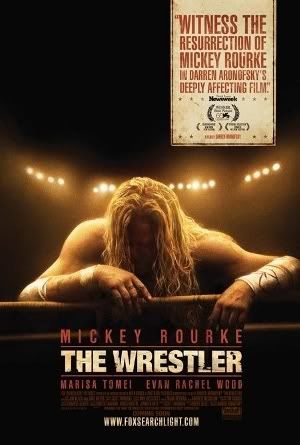
The Wrestler is a movie for children of the eighties. Though the film's archetypal underdog story is surely familiar to audiences of any age, I suspect the film has particular resonance for anyone who grew up in the late 1980s and early 1990s. Whether one liked wrestling or not, it was a constant part of our lives - oh, to think of all those wasted hours getting my ass kicked at WWF Royal Rumble on SNES - and, like most ephemeral crap culture, a projection of the values that, as kids, we were just learning were ours to inherit. While pro wrestling is as popular as ever, Randy "The Ram" Robinson, the titular character, is very much a product of an era when our heroes wore neon green pants and our villians had names like The Ayatollah. A walking anachronism living in the shadow of long-ago victories, Randy is of course played Mickey Rourke, that preternaturally gifted actor who, not too long ago, seemed like he was headed for the dustbin of history. That Rourke's story mirrors Randy's in many ways has been played up for months, but his performance is more than an act of pop-culture verisimilitude. Rourke's sensitivity, intelligence and complete lack of vanity, coupled the meticulously observed direction of Darren Aronofsky, create an unforgettable portrait of a man in tights (physically and emotionally!).

The excellent opening credits sequence, a collage of fliers and wrestling mags scored with Quiet Riot's "(Bang Your Head) Metal Health" (Randy's theme, which we'll hear throughout the film), gives us a glimpse of the height of Randy's celebrity before we're introduced to The Ram as an aging burlyman barely getting by on matches at small regional venues. Aronofsky's protagonists are frequently driven to obsessive lengths to recapture some perfect memory - a child's high school graduation, or a romantic walk in the snow - destroying themselves in the process. For Randy, the distant hope of "a ticket back to the top" drives him to put his body through incredible amounts of abuse for the sake of an ever-diminishing audience. Countless reviewers of The Wrestler have cited Barthes' essay on wrestling (and more felt the need to mention Marisa Tomei's breasts), and the film's scenes in the ring, particularly a punishing match with The Necrobutcher (playing himself), underline the sport's increasing nihilism. What makes Randy so poignant is that he's a one-trick pony (as Bruce Springsteen sings in the title track) who truly believes in the cliches behind wrestling - when he's driving around in his van listening to old metal ballads, his complete faith in the prefabricated values he embodies is unbelievably poignant. If the script by Robert Siegel, which finds Randy attempting to romance stripper Cassidy (Marisa Tomei) and repair his relationship with his estranged daughter Stephanie (Evan Rachel Wood), seems formulaic, it's only because Randy can only begin to understand his loneliness, regret and fear of anonymity through cliche. Armond White's complaint that the film is anti-spiritual completely misses the point - The Wrestler is about characters trying to find meaning in lives completely divorced from the real. It's perfect that, when Cassidy inevitably compares Randy to Christ, she's not referencing not the Bible but The Passion of the Christ.

What makes Rourke's performance so astonishing is his ability to take a character who is always, to some extent, performing, and allow us to glimpse the inarticulate despair underneath. When Randy attempts to reconcile with his daughter, we can tell that he's rehearsed this speech many times, but we also know that he means every word (Wood is excellent and underrated in a part mostly built on emotional traumas we never see). As the film follows Randy's every move, we come to see how his need to please the fans comes from a generosity of spirit - even when he's stuck working at a supermarket deli counter, he tries to give each customer a fun, memorable experience (like Paul Clark, I'd gladly watch another half-hour of deli scenes). At the same time, Randy's a self-pitying narcissist, and the film doesn't shy away from his worst moments. It's a credit to Aronofsky, though, that he never takes a condescending or judgemental approach to the character, asking only that we try to understand him. This approach extends to Cassidy, who doesn't get as much screentime but, thanks largely to Tomei's fantastic performance, we come to realize is hardly ever telling us (or Randy) what she's really feeling even as Tomei tells us everything we need to know about her - the conflict between her fear (like Randy) of losing the thing she's great at to age and her increasing acceptance of a life away from the security of a stage.

It'd be wrong to label the documentary-style filmmaking strategy - all handheld and available light - a return to Aronofsky's roots, because even when he his films were low-budget, they were never this stripped-down. It takes a great deal of confidence to abandon all directorial artifice and trust in the story and performances to carry the movie, and the approach pays off wonderfully here. As DP Maryse Alberti follows Randy into the harsh flourescent lights of his day job and the barely-lit club where Cassidy works, we're overwhelmed by the oppressive banality of Randy's life. When contrasted against the startling immediacy of the scenes in the ring, we start to understand why Randy is stuck in the past, even if that proves to be his undoing. The first time I saw The Wrestler, I found the conclusion frustrating, as there were several more appropriate resolutions for The Ram. Watching it again the other night, though the similarity to a certain series finale was still a bit distracting, I realized that, frustrating though it may be, it's the only ending that makes sense . Randy is never going to do the reasonable thing, and it's to Aronofsky and Rourke's great credit that we love him for it.

Sunday, February 22, 2009

"And now let's head down to the awards - the Hollywood Awards!"


Slumdog Millionaire, Boyle, Penn, Winslet, Ledger, Davis. Those are my predictions for who will take home Oscars tonight, and who cares why. Tonight promises to be one of the most predictable Oscar ceremonies in memory, and I don't know anyone who feels tonight's nominees reflect the best that 2008 had to offer (after the one-two punch of Scorsese and the Coens winning, the comedown was inevitable). Here's who I'll be rooting for tonight, in any case (longer write-ups of some of these are still ahead):

Best Picture - Slumdog Millionaire is as sure a bet as I can remember, and it's totally undeserving. The Mumbai-set Cinderella story is sometimes entertaining and features a terrific performance by Anil Kapoor as a game show host, but I was unmoved by the generic central romance, and there are literally hundreds more interesting devices to explore the machinations of fate than a game show. It's superficial and patronizing and, at its worst, borders on exploitation of its impoverished child actors. I haven't seen Frost/Nixon or The Reader. Milk was a bit more conventional than I'd hoped, but it's still a very good film and its heart is in the right place, so I wouldn't mind if it won. I guess I'm rooting for The Curious Case of Benjamin Button, David Fincher's strange and compelling epic; still, it's the first time in thirteen years that no film I truly love is in the race, so I won't cry at its inevitable loss to the chai wallah.

Best Director - Same. Not much else to say except, really, Danny Boyle is becoming an increasingly superficial director, and I'm sick of that self-satisfied grin plastered on his face at every awards ceremony like he's the cat who got the cream. Still like Trainspotting, though. Also, consider that Stephen Daldry now has as many Best Director nominations as Stanley Kubrick.

Best Actor - It's great seeing Richard Jenkins finally get some recognition, and his performance in The Visitor is subtle and impressive, but the movie is kind of boring. Brad Pitt is better in Benjamin Button than people are giving him credit for, but he's better as Chad Feldheimer. Sean Penn goes full-gay in Milk and gives the warmest and most moving performance of his career, and he certainly deserves the win. Still, it would sting to see even Penn take it away from Mickey Rourke, whose Randy the Ram is the most heartbreaking performance of the year. He knocks it out of the ballpark, everyone loves a comeback, and who doesn't want to hear the Mick's acceptance speech?

Best Actress - Kate Winslet is my favorite actress working today and I'd love to see her win, but I keep putting off seeing The Reader because it frankly sounds terrible and I fear this is indeed a "Career Achievement Award." I haven't seen Changeling, and though Meryl Streep and the rest of the cast of Doubt does strong work, I can't separate the performances from the hoariness of the script and direction. Melissa Leo is terrific in Frozen River, and if she won it'd be a great "triumph of the underdog" moment. But I'll be rooting for Anne Hathaway, who as the self-destructive Kym in Rachel Getting Married manages to invoke our sympathies for a complicated and potentially unlikable character.

Best Supporting Actor - This is maybe the strongest category this year, but I'd hate to be the actor who, in a surprise victory, steals it from Heath Ledger. His victory has been preordained since early last year, which would be irritating if the Joker wasn't also the performance of the year. I love Robert Downey Jr., but if the geezer faction of the Academy gives it to him as some statement that Iron Man was better, it'll be as groan-worthy as Rob Lowe and Snow White.

Best Supporting Actress - If anyone from Doubt is going to win it should be Viola Davis, who lent the film its few moments of emotional plausibility, and I suspect she may upset frontrunner Penelope Cruz (who was great as a passionate, impulsive artist in Vicky Cristina Barcelona). I like Taraji P. Henson more than most, I suspect. But I'll be rooting for Marisa Tomei, whose aging stripper Pam is as responsible for The Wrestler's emotional impact as Rourke, and who totally proves herself worthy of that first Oscar.

Best Original Screenplay - I said this in the Muriels comments as well: I just don't get In Bruges, and I say this as someone who acted in a McDonagh play and found it brilliant. I'm willing to have someone explain this to me. Milk is very good, but my few problems with it can be traced back to the script. I haven't seen Happy-Go-Lucky, and I was slightly less enthusiastic with Frozen River as a film than with Leo's performance. So I'll go with Wall-E, because nobody puts as much importance in story as Pixar, and because it should have been nominated for Best Picture.

Best Adapted Screenplay - Hmmm. I haven't seen two of these, didn't care for two more, and the flaws that kept Benjamin Button from masterpiece status are clearly attributable for Eric Roth's script. Whatever.

Best Cinematography - Some strong nominees here. I did like the look of Slumdog Millionaire, though Anthony Dod Mantle's gorgeous cinematography was rendered incomprehensible by the seizure-inducing editing. The Curious Case of Benjamin Button has perhaps the most gorgeous digital cinematography yet, but the need to shoot slo-mo scenes on 35mm (including the movie's most striking image) points to the format's ongoing limitations. I'll definitely be rooting for the IMAX-enhanced beauty of The Dark Knight.

Best Editing - Ditto The Dark Knight. Where others saw incoherence, I saw a brilliant economy of storytelling.

Best Art Direction - Gotta go with the attractive, antiseptic surfaces of Revolutionary Road that threatened to suffocate those poor Wheelers at any moment.

Best Costume Design - I hope the fashions on display in Milk come back very soon.

Best Makeup - All of these would be fine winners, but I'll go with the aging makeups of Benjamin Button...

Best Visual Effects -
...which were seamlessly blended with some of the subtlest, most believable CG character work in memory.

Best Sound - The squeal of the Batpod winding through an office building rocked my socks off.

Best Sound Editing - Consider that everything in Wall-E had to be created from scratch, and it's the obvious winner. Go Ben Burtt!

Best Score - Danny Elfman's score for Milk is surprising even as it recalls some of his best work, but Thomas Newman's score for Wall-E is weird, romantic and delightful.

Best Song - After three weeks of Slumdog Millionaire at Images Cinema, I've heard enough "Jai Ho" for this and the next lifetime. Go, Sledgehammer!

Best Animated Film - Wall-E.

Best Documentary Feature - Man on Wire will probably win, and it's very good. But how great would it be to see Herzog up there?

No opinion on shorts, etc., so I'll stop here. Here's hoping for a night of Rourke and Herzog acceptance speeches, and if not that, let's hope Jerry Lewis says "Polack" at least once. Good luck staying awake, everyone!

Thursday, February 19, 2009

Glad to be weirdly close.

I've never understood why "depressing" is routinely thrown around as a criticism for films that deal with loneliness and despair. To me, a depressing movie is something like Confessions of a Shopaholic, Fool's Gold or anything else that cynically sidesteps any real connection to human experience under the guise of escapism. When a filmmaker takes an honest look at our anxieties, weaknesses and particularly our mortality, it's like a spiritual palate cleanser - I leave the theater feeling refreshed and upbeat. Charlie Kaufman has never shied away from downbeat material; his protagonists are frequently caught in existential crises they haven't necessarily defeated by the end credits, and the humor in his films springs from heartache, insecurity and self-loathing. The darker aspects of Kaufman's screenplays have previously been offset by the more playful sensibilities of directors Spike Jonze and Michel Gondry, so Synecdoche, New York is perhaps the purest realization of his unsparing yet humane vision. There's no question that Kaufman's maddeningly dense directorial debut is an extremely daunting experience and, particuarly for artists and creative types, one that cuts to the bone. A film about the ways that art allows us to create meaning in a world that often seems meaningless, Synecdoche, New York levelled me, and yet few films have left me feeling so fearfully alive.

Since Kaufman's protagonist, Caden Cotard (Philip Seymour Hoffman), is a theater director, it's tempting to read Synecdoche, New York as autobiographical (to be fair, casting oneself as the lead in a previous screenplay sort of invites this reading). But Kaufman's protagonists are almost always artists, and as a story of the creative process, the film is more personal than self-referential; as with Being John Malkovich and Adaptation, the biggest conflict here is the divide between what we aspire to create and our own frailties. When we meet Caden, his marriage to painter Adele Lack (Catherine Keener) is failing and he's suffering through a series of mysterious ailments that, among other things, deprive him of the ability to salivate or cry. The early scenes of Caden directing a regional production of Death of a Salesman tell us how to read the rest of the film; "Everyone is disappointing the more you know someone," Adele tells Caden, and Caden's directions to his actors double as Kaufman's suggestion that drama is an attempt to understand these disappointments and, perhaps, to find something sublime in our imperfect lives. A scene where Caden reminds a room of actors that someday they'll all be dead should ring true for any director, whose job it is to sometimes make everyone around him feel completely terrible (and what does this say about anyone who would want this job?).

Adele's paintings are extremely small-scale, while Caden, who is awarded a MacArthur genius grant and uses the money to stage an experimental theatre piece inside an enormous warehouse, finds his own work becoming more and more elephantine. As the play expands over the years to encompass everyone in Caden's life and, eventually, a Caden double named Sammy Barnathan (Tom Noonan) who has been observing Caden for years, the film also grows beyond the dramas of Caden's life - his second marriage to narcissistic actress Claire (Michelle Williams), his search for his estranged daughter Olive (Sadie Goldstein as a kid, Robin Weigert as an adult) and his bittersweet friendship with his soulmate Hazel (Samantha Morton), who lives in a house that is always on fire - to encompass our collective drama, even hinting at the dystopian future we fear awaits us around the corner. Synecdoche, New York began with a studio exec's suggestion that Kaufman try writing a horror movie, and it often plays like a realization of our worst nightmares; this may be why many critics and audience members have rejected it as completely unpalatable (the multiple shots of characters examining their own shit probably didn't help either). But the film's dourness is offset by two things. First, it's extremely subjective, taking as its POV a struggling artist, a particularly difficult breed of human being (my wife is a saint). While I've encountered artists like Adele who choose to only experience the enjoyable aspects of life, I've never really understood how they pull that off (Olive's fate suggests that this is unadvisable, in any case). Second, if cinema is a collective art form, than the catharsis in the face of misery I described in my opening can be a powerful shared experience - though it's Hoffman's character in Doubt who preaches that doubt can be a powerful bond, it's Kaufman's film that realizes that concept more fully than the other, heavy-handed and stage-bound film can begin to. Besides, Synecdoche, New York is hardly two hours of suffering - it's too funny and compassionate, too self-deprecating in its unhappiness (note the multiple scenes where Caden cries during sex), too recognizably human to dismiss.

Kaufman is met in his outsized ambitions by Hoffman (never better) and the murderer's row of actresses playing the women who make up Caden's universe (why is it that movies about directing are always also about fucking?). I pretty much fell in love with Morton's Hazel, who is always at Caden's side but rarely says what she's really feeling, and the casting of Emily Watson as Morton's double is as delightful a metatextual high-wire act as the double team of Noonan and Diane Wiest as Caden's masculine and feminine selves. They and the rest of the cast admirably rise to the occassion of pulling off the emotional and conceptual obstacles Kaufman has constructed for them - as a FFC commenter pointed out, only Kaufman could construct a heartbreaking scene around the line "I'm sorry for abandoning you to have anal sex with my homosexual lover, Eric." Director of photography Frederick Elmes and production designer Mark Friedburg also deserve a great deal of credit for creating the flat, slightly dated world of the film, which grows more and more surreal as it progresses. And Jon Brion's score is a masterpiece of sustained anxiety - all of these elements together result in a film that is mostly about the anticipation of terrible or wonderful or important moments that, when they arrive, are over before we've realized it. Which would seem psychotic if it weren't generally true.

Tuesday, February 03, 2009

Top 10: 2008


You know what was a terrible year for movies? 1992. There were a few great ones, and a few others (Bram Stoker's Dracula, Alien 3) I like more than most, but otherwise it was stuff like Encino Man and Ladybugs all year long. Compared to 1992, 2008 looks pretty good, but there's no question that it was a so-so year, and a disappointment after the flood of greatness that was 2007. Still, the year ended pretty strongly, so what follows is a list of a handful of excellent movies and several more great or very good ones. It was one of those in-between years that found established auteurs experimenting with new genres and techniques with mixed but fascinating results. And while the prestige movies sometimes underwhelmed, it was a better-than-average year for popcorn movies, two of which made my top three. 2008 was too much of a grab bag for an overriding thesis; suffice to say that there was greatness out there, often in the most surprising of places.

Movies I haven't seen yet (curse you, limited release!): Let the Right One In, Happy-Go-Lucky, Wendy and Lucy, Frost/Nixon, The Reader, Gran Torino, Ballast, Waltz with Bashir, Hunger, The Duchess of Langeais, W

Underappreciated: Speed Racer, Indiana Jones and the Kingdom of the Crystal Skull. C'mon, lighten up.

Movie I Wanted to Like: Forgetting Sarah Marshall came highly recommended by several friends whose opinions I trust. I know I'm probably overthinking it, but it just seemed regressive, hypocritical and sad. However...

Performances I Liked in Movies I Didn't: Russell Brand in Forgetting Sarah Marshall, Anil Kapoor in Slumdog Millionaire, the cast of Doubt

Biggest Academy Awards Mystery: How Synedcoche, New York, the best and most original screenplay of the year, was overlooked in favor of In Bruges, which isn't original at all. I know it isn't Most Original Screenplay, but still...

Best Repertory Screening: Blade Runner with Q&A by Doug Trumbull was awesome, but the digital projection, while pristine, felt a little odd, like I was watching the movie in an enormous home theater. So I'll go with Halloween at the Brattle - a collector's 35mm print, pink, faded and beautiful.

Best First-Run Screening: The Dark Knight with a sold-out, captivated audience.

Worst Movie of the Year: The Happening. Greg, I'm actually fascinated to hear more about why it was the best of the year for you.

Worst Movie I Loved: Mamma Mia!

Best Blog Comment: "What's truly sad, Bemis, is the sarcastic, elitist, snobbish cynical universe YOU apparently occupy, in which even a cheery 'Hello' would have hideously naive meaning and give rise to the opportunity yet again to elevate yourself by putting down everyone else. Screw your elitist stupidity, Mama Mia was a blast, and that means it succeeded. PLEASE get some therapy! - An Author"

Most Anticipated in 2009: Inglorious Basterds, Shutter Island, The Tree of Life, Watchmen, Public Enemies, Where the Wild Things Are

And the list:


1. The Dark Knight Not much to say that hasn't been said already, but this is worth repeating: Heath Ledger is so scary in this it's unreal. I can imagine his Joker hooking up with Anton Chigurh and the Zodiac for the most disturbing buddy movie ever made. Ledger so thoroughly inhabits his character with every tic and gesture that it's easy to conclude that if you took him out of the picture, The Dark Knight wouldn't be nearly as effective or popular. But, of course, he is in the movie, and is the heart of Christopher Nolan's amazing portrait of a hero and a city at war not with its villian but what he personifies - entropy. It's the greatest balancing act of the year, honoring its source while reaching far beyond our expectations of what a "superhero movie" can be, never losing sight of its characters and complex storyline while still satisfying our appetite for visceral thrills. Is Batman a neocon? Did the geeks overreact? I don't care; once its moment in the zeitgeist has passed, The Dark Knight will still be an troubling, strange and exhilarating pop masterpiece.


2. Synecdoche, New York A movie that made me feel absolutely terrible for several days, and I can't stop telling anyone who will listen that they need to see it. Charlie Kaufman's directorial debut, about a theater director (Philip Seymour Hoffman) going to grandiose lengths to create the illusion of meaning in his life, has been accused of solipsism, but it's far too honest and self-deprecating for that. Funny because it's so horribly, horribly true, Kaufman strips down the artist's pretensions and ambitions to reveal the basic, unflattering truth: those of us who make art, who are compelled to collaborate, do so because we're afraid to die and we don't want to be alone. How wonderfully odd that a movie filled with medical horrors, shit, pain and heartbreak could ultimately reveal itself to filled with such compassion and empathy.


3. Wall-E My daughter doesn't really care for Wall-E, which is fair enough - at one-and-a-half, it makes sense that Monsters Inc. is more her speed. But I can't wait until the kids are old enough to share this one with me, because it's such a bold, imaginative entertainment and because it may be the best introduction for a sensitive young mind like Luna's into the state of the time and place she was born into. A message movie that avoids heavy-handedness in favor of the simple plea that we remember to love the world we live in, Wall-E loves its young audience too much to lie to it, but in offering hope without cheating or pandering, it ranks as Pixar's best (and that's saying a lot) and stands alongside the 60's and 70's sci-fi classics it pays loving homage to.


4. Revolutionary Road The most misunderstood movie on my list. It's fair to assume, in the shadow of American Beauty, that Sam Mendes' latest is yet another variation on the "weird things happen in the suburbs" subgenre that Mendes helped popularize. But his latest, like the Richard Yates book it's based on, goes far deeper than that. A domestic horror story which casts as its monsters complacency and self-delusion, Revlolutionary Road brings to its source a surprising undercurrent of dark humor, its impeccably designed surfaces merely the decoy Mendes uses to snare us. Superbly acted by its leads and featuring an unforgettable performance by Michael Shannon, Revolutionary Road strikes at the heart of fears any married person knows well, and does so with unflinching, sharp-witted, and ultimately devastating effect.


5. The Wrestler A perfect marriage of character and actor. There's no doubt that Mickey Rourke had the talent to pull off the role of Randy "The Ram" Robinson, a failure pile in a sadness bowl coasting on memories of glory in the ring, even if his own life hadn't gone to hell. But the pathos that Rourke's experience brings to the role is overwhelming. Robert Siegel's script hits all the formulaic beats, and deliberately so, as Randy is a self-mythologizing walking anachronism who really, truly believes in life as a three-act underdog story. Director Darren Aronofsky returns to his low-budget roots, with the constant use of handheld camera following Randy's every move, probing for his contradictions, hopes and regrets, questioning what it is that we expect our icons to be. The ending is both triumphant and devastating, and the Springsteen song that follows is, well, it's The Boss.


6. Che I'm waiting until DVD to write a proper review of this one, since I saw it under less-than-optimum circumstances - On Demand, at my parents' house, late at night and very tired. But my increasingly sleepy state was, perhaps, the perfect way to absorb Che, which turns Che Guevara's successful campain against Batista and his failed revolution in Bolivia into a deliberate, often deliberately mundane, story of process - history as "things that happened." Breathtakingly shot on the RED One camera and punctuated with surprisingly robust action sequences, Che is primarily focused on how theory becomes action - how intellectuals sitting around a living room talking about change becomes guys with guns in the jungle - and, in its disjointed structure (Full Metal Jacket is a fair comparison), how ambition gives way to failure. The result is the most cerebral epic in memory, anchored by Benecio Del Toro's pitch-perfect performance.


7. Rachel Getting Married The movie on this list that I'll most likely watch as cinematic comfort food after a long day. While Jenny Lumet's script contains elements of tragedy, Jonathan Demme's return to form is remarkable for its generous portrait of a broken but enduring family. The breathing room Demme's stripped-down, handheld approach affords his cast results in a breakthrough performance from Anne Hathaway and strong ensemble work all around. And though the movie's multicultural portrait of family has been dismissed as a liberal wet dream by some, when one of the wedding guests looks around the room and announces "This is how it is in heaven - just like this," all I can do is smile.


8. The Curious Case of Benjamin Button Its detractors argue that the film has nothing deeper on its mind than "Brad Pitt is so pretty." Fair enough, but on the other hand, Brad Pitt is sooo pretty, and no director has done more interesting things with Pitt's marquee-idol visage than David Fincher. Benjamin's backwards journey through life is more than a technical marvel; Pitt's face becomes the canvas for an epic meditation on what makes our fleeting lives worth living. A handsome, sometimes awkward, deeply romantic mash-up of state-of-the-art filmmaking technology and classical Hollywood storytelling; I can't wait to see how Fincher branches out next.


9. Snow Angels The most underappreciated film on my list. David Gordon Green had a fine year, with two films that couldn't be more different - the hilarious stoner action/comedy Pineapple Express and this, a somber, wintry adaptation of Stuart O'Nan's novel. When I wrote about the movie before, I described it as "the bittersweet contrast of the idealism of young love and a marriage gone tragically awry," but rewatching the movie last night, I realized that there are actually multiple threads in the film exploring the many ways that people fall in love, fall apart and (in the best cases) find each other again. A challenging and often depressing experience, but also a rewarding one that lingers long beyond the final, haunting cut to black.


10. Tropic Thunder 2008 was a strong year for sophomoric comedy, between the aforementioned Pineapple Express, Will Farrell and John C. Reily behaving like asses (and wonderfully so) in Step Brothers, and the Coens' gleefully misanthropic Burn After Reading. Of all these, a soft spot remains in my heart for Tropic Thunder, a vulgar, deceptively smart send-up of movie-star egotism and the overblown Michael Bay style that, I fear, will be remembered as the dominant aesthetic of the cinema of the aughts. The sharpest Hollywood satire since The Player, doubly so because, since the actors involved have all been guilty of the cynical moviemaking they're parodying, it feels partly like an act of contrition. This is particularly true of Robert Downey Jr.'s Kirk Lazarus, a metatextual high-wire act that Downey carries off beautifully. "I don't read the script, script reads me."