F. Scott Fitzgerald's short story The Curious Case of Benjamin Button is a comic fantasy less concerned with the philosophical questions of its protagonist's condition - born an old man, his age reverses through his life until he passes away in his crib - than the opportunity it gives Fitzgerald to wryly observe how one's life is dictated by the expectations set forth. David Fincher's film of Benjamin Button, less a social satire than a remarkably intimate epic, is far from a faithful adaptation, and yet it comes closer than any other Fitzgerald adaptation to capturing the romantic quality - the bittersweet awareness that everything fades - at the heart of the author's work. A remarkably intimate epic, The Curious Case of Benjamin Button the story of a life - and a century - telescoped into a collection of moments, with each moment's beauty proportionate to its impermanence.
Born at the end of WWI, Benjamin (Brad Pitt) is a baby with the health and appearance of an elderly man. His mother died in childbirth, and his father swiftly abandons him on the steps of a nursing home, where he's found by Queenie (Taraji P. Henson), a woman who works at the home and raises Benjamin as her own child. We follow Benjamin's life lived in reverse over the course of the 20th century; the screenplay is by Eric Roth, who also wrote Forrest Gump, and the film's formal resemblance to Gump have already been well-documented. But those whose criticism of the film begins and ends with these similarities are stuck on the words and missing the music - in Fincher's hands, what could have been unbearably treacly (and occasionally is - damn that hummingbird) becomes oddly moving. Like Mr. Gateau (Elias Koteas), the master clockmaker in Button's prologue, Fincher's technical precision and attention to detail deepen the meaning of his work's one extraordinary quality. His films are driven by a fascination with process, whether the subject is the logistics of an elaborate game for bored millionaires, the mechanics of a home invasion or an investigation that may never be solved. In Benjamin Button, Fincher uses his peculiar protagonist to examine life itself as a process - while Gump was preoccupied with inserting its character in historically significant events, Benjamin's essential passivity as a character, his detachment from time, results in time serving only as a backdrop for universal experiences, most importantly his romance with Daisy (Cate Blanchett). While the film's images have an impressive scope, it's ultimately an ode to the pleasures of friends, family, food, drink, travel, lovemaking and The Beatles (though not in that order); Benjamin Button makes profound statement about the meaning of life, nor does it aspire to. But as a meditation on the simple joys in life, it's a rich and rewarding large-scale entertainment.
Fincher's surprising understatement extends to Claudio Miranda's painterly cinematography, Alexandre Desplat's fantastic score (which would fit just as well in a David Lean movie), and the realization of Benjamin as a character. The makeup and visual effects teams do a masterful job of making Benjamin believable at every stage in his life. What impresses most, when most digital work is usually about spectacle, is the subtlety of their approach - after a while, I forgot about looking for the seams and accepted that I was looking at an old young man. The believability of the character is aided immensely by Pitt's performance, which has been somewhat underrated; usually, even talented actors are befuddled by the motion control process, but Pitt manages to project Benjamin's emotional age and experience through his CGI/latex visage. And when Benjamin reaches middle age and looks like Brad "Sexiest Man Alive" Pitt, it's like looking at this now-familiar face through new eyes - it's a perfect marriage of his character and the star baggage he brings to the role. This brief moment where he meets Daisy in the middle (and man, is Cate Blanchett on a roll) plays less like a Hollywoodized notion of fate than a poignant expression of what it is to choose to love someone in an impermanent lifetime.
The film also boasts a strong supporting cast - Henson avoids "Mammy" stereotypes by giving Queenie poise and dignity, Tilda Swinton is excellent in her bittersweet scenes as a woman enjoying a fleeting romance, and Jared Harris, as an drunken, salty sea captain (is there any other kind?), nearly steals the film. The contemporary framing narrative, with Daisy sharing Benjamin's story with her daughter (Julia Ormond), isn't quite as successful, mostly because of the awkward incorporation of Hurricane Katrina - in a movie otherwise unconcerned with social commentary, it feels overly literal. But I can forgive this, since it allows for a devastating final shot that ties the film's themes together in a single, iconic image. Fincher was bound to lose some of his target audience with Benjamin Button - while before he's made films for geeks prone towards an ironic outlook on life (myself included), here he's trying to speak to everyone. The result isn't the masterpiece it aspires to be (or that Zodiac is), but it's refreshing to see a director pushing himself beyond his familiar territory, especially when the results are so rewarding.
Few directors working today have as fine an understanding of mood as Wong Kar-Wai. The stars of Wong's films are not just the above-the-title actors but also reflections of neon lights on a storefront window, or a snippet of a long-forgotten standard, or a stain from Maggie Cheung's impeccably applied lipstick - they're pure pop, sensual appreciations of human experience filtered through surface pleasures. Wong's 2046 promised to be an epic of mood moments - four years in the making and shrouded in secrecy, it arrived at Cannes in 2004 bearing the weight of expectations it wasn't made to fulfill. With a multilayered narrative that veers between past and future, fiction and metafiction, it's a grandiose experiment resting on a simple message of the need for human connection like an elephant dancing on the head of the pin. It's a perverse film, the biggest little movie ever made, but dammit if it isn't pretty to look at.
A sort-of-sequel to Wong's masterpiece In the Mood for Love, 2046's protagonist Chow Mo-wan (Tony Leung) shares a name, profession and history with the character Leung played in the earlier film, but doesn't quite seem to be the same character (it took me a while to adjust, as I had an easier time relating to the first Chow Mo-wan). This time, Chow's a sci-fi writer and playboy recovering from a broken heart by bedding a number of women. Among the women that weave in and out of Chow's life are Su Li-Zhen (Gong Li), a professional gambler with the same name as Chow's lost love; Bai Ling (Zhang Ziyi), a cabaret singer who lives in the room next to Chow's; and Wang Jing Wen (Faye Wong), the daughter of Chow's landlord. These and other women drift in out of the episodic narrative, along with various pop allusions and references to Wong's other films, each woman costumed and lit with such precision that they appear perfectly preserved. It becomes clear that the film is not about any one of these relationships (though the women, particularly Zhang, are all excellent), but Chow's narcissism and the way he "rewrites" each encounter in retrospect. The first time I saw the film was frustrating, as I wondered if Wong realized this about his protagonist; the final scenes reveal that, yes, this was the point all along. In retrospect, I admire Wong's patience in letting the character get where he's going, and his expectation that his audience will be capable of the same; it also helps that Leung, a master of internal acting, is a perfect leading man for Wong.
2046 can be painfully hermetic, particulary in the scenes from Chow's sci-fi novel that shares its title with the film. 2046 is a mysterious place that, in a distant future, many attempt to escape to because it never changes - there's no loneliness or loss. It's a fascinating concept that expands the themes of the '60s-set story, but it's also dramatically inert. The future we see in these scenes does not reflect a '60s concept of the future so much as one we'd expect in 2004 - the future scenes are antiseptic, beautifully shot but inaccessible, and in the film's second half they threaten to overwhelm the main story. It's possible that this is intentional, a visualization of what it's like to live inside one's own head; since I'm occasionally told I need to get out of my head, I can appreciate that. But without the rapturous moments that Wong's earlier films built to - Faye Wong cleaning Tony Leung's apartment to "Dreams" in Chungking Express, or the extended holy moment that concludes In the Mood for Love - the film works wonderfully as an intellectual exercise, but never really found its way into my heart like those films did. Again, this may be exactly how Wong wanted me to feel.
There's a great deal, however, for a film lover to enjoy in 2046 - each shot is a beauty, the film's world taking on a wonderfully tangible quality. I believe in the world Wong creates here, but I can't live in it. It remains to be seen what place 2046 will take in Wong's filmography - after the disappointing My Blueberry Nights demonstrated that even his middling work looks beautiful, I wonder whether he'll keep treading water or if, as Chow seems to be at the film's end, he's ready to move on to new worlds. But whether 2046 proves to be Wong's final destination or just a station on the way, there's no denying that it's a radiant place to stay for a while.
I got married at a fairly young age, so I'm often asked what it's like by people in my age range. It's hard to explain what it's like to be married, but easy to explain the experience of getting married - it's being at the center of a riot of emotions that isn't all about you. One minute a usually reserved friend is giving you a drunken proclamation of her love for you, the next is spent breaking up an argument between two relatives that is ostensibly about seating arrangements but actually stems from psychic wounds inflicted before you were born. One of the best things about Rachel Getting Married is the way it perfectly captures the emotional turbulence of a family coming together with understated wit and generosity. Shooting on video with the freer approach of his documentary and concert movies, director Jonathan Demme has made not only his best and most emotionally affecting film since Philadelphia, but also the best wedding video ever.
The titular bride's sister Kym (Anne Hathaway), a recovering addict, arrives at her family home for the wedding festivities straight from her most recent stint in rehab. While the movie finds laughs in the tension between straight-laced psychology student Rachel (Rosemarie DeWitt) and her unpredictable sister, it never becomes the latest sitcom-y quirkfest. Nor does Jenny Lumet's script romanticize Kym's self-destructiveness, although Rachel correctly observes that Kym (like many addicts) would like to be seen as endearingly fucked-up. A highlight of the film is Kym's awkward rehearsal dinner toast, which veers between hilarious and painful as her well-intentioned attempt at reconciliation is derailed by the language and humor of twelve-step programs (Hathaway's bracingly honest performance reveals talent only hinted at in Brokeback Mountain). For Kym, making amends proves to be far more challenging than overcoming addiction, and as we learn about a tragedy in the family's past, Rachel Getting Married reveals itself as a precise portrait of a family finding reason to celebrate in the shadow of unthinkable loss.
Cinematographer Declan Quinn's camera is like a ghost in the room, quietly capturing the ongoing story of the Buchmans, realized by a pitch-perfect ensemble. Many reviews have singled out estranged mom Abby's (Debra Winger) late-film explosion, and it's great to have Winger back. But I found myself most moved by Bill Irwin as dad Paul - the actor's comedic skills help to create a character whose humor and generosity have kept him going. The best scene in the film, an impromptu dishwasher-loading contest between Paul and Rachel's quiet, sweet fiance Sydney (Tunde Adebimpe), is a hilarious bit of "youth vs. experience" one-upmanship suddenly punctuated, like a punch to the gut, by a reminder of the past that catches us off-guard the way these things do in life. Demme, whose most recent features were interesting but airless formal exercises, has rediscovered the loose-limbed energy of his early films - the emotional revelations arrive not according to formula but with the unpredictable rhythm of life.
This freewheeling approach is most evident during the extending wedding festivities. Demme gladly veers away from the plot to make room for Adebimpe (lead singer of one of my new favorite bands, TV on the Radio) to serenade DeWitt with Neil Young's "Unknown Legend," to meet Rachel and Sydney's extended family and friends, and for a mini-festival of musical performances. Some have complained that this section is self-indulgent, overlong and implausible, and I'll admit that when Robyn Hitchcock showed up it took me out of the movie for a moment (I guess David Byrne tending the grill would have been a bit too much). But I'll give Demme a pass on that, especially since the wedding is such a joyous celebration of life and family that it proves more satisfying than any conventional dramatic resolution. While the multicultural aspect of Sydney and Rachel's wedding has been singled out for praise and criticism for its sociological implications, I prefer to see it as Demme seems to - he's depicting this family's story as universal, the wounds of the past assuaged by the promise of a future where the world is one big family. Idealistic, to be sure, but I'm down with idealism.
Dennis Cozzalio's latest movie quiz arrives just in time for a bit of reflection before 2009 is upon us. This time the test is administered by Professor Kingsfield, whose lessons in The Paper Chase were part of a recent management training I had to attend (along with "lessons" from Breaking Away and Young Frankenstein, for some reason). Let's begin:
1) What was the last movie you saw theatrically? On DVD or Blu-ray?
Theatrically, The Curious Case of Benjamin Button - schmaltzy, but well-crafted and heartfelt enough that I didn't mind. On DVD, the original My Bloody Valentine (pretty soon, every mention of an '80s horror movie will be preceded by "the original").
2) Holiday movies— Do you like them naughty or nice?
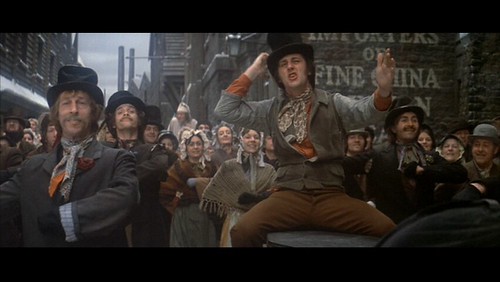
At least a little bit naughty. For instance, my favorite Scrooge (one I've watched every December since I was a tot) is the 1970 version with Albert Finney. It features decaying ghouls and a tour of hell along with the obligatory jolly, dancing British people - a good reminder that Dickens' story, and the holiday, are as much about religious guilt and keeping our wintry demons at bay as they are about tinsel and elves.
3) Ida Lupino or Mercedes McCambridge?
Ida Lupino
4) Favorite actor/character from Twin Peaks
My first thought was Audrey Horne swaying to Angelo Badalamenti's "dreamy" music at the Double R Diner. But The Little Man From Another Planet also deserves mention.
5) It’s been said that, rather than remaking beloved, respected films, Hollywood should concentrate more on righting the wrongs of the past and tinker more with films that didn’t work so well the first time. Pretending for a moment that movies are made in an economic vacuum, name a good candidate for a remake based on this criterion.
Kindergarten Cop. Great premise, bland execution. I'd love to see what Terry Zwigoff would do with it.
6) Favorite Spike Lee joint.
Do the Right Thing
7) Lawrence Tierney or Scott Brady?
"Why am I Mr. Pink?"
"Because you're a faggot, alright?"
8) Are most movies too long?
I'm much more likely to criticize a movie for being too rushed. I rarely understand the "too long" complaint - to paraphrase The Age of Innocence, it seems like people are faster to leave a movie than to go to one.
9) Favorite performance by an actor portraying a real-life politician.
Fred Willard as Ron Alberston as President McKinley.
10) Create the main event card for the ultimate giant movie monster smackdown. Brundlefly vs. Blairmonster: Requiem. Christmas 2010.
11) Jean Peters or Sheree North?
Sheree North
12) Why would you ever want or need to see a movie more than once?
The movie stays the same, but I change. Plus, I like movies.
13) Favorite road movie.
Badlands
14) Favorite Budd Boetticher picture.
Alas, I haven't seen any.
15) Who is the one person, living or dead, famous or unknown, who most informed or encouraged your appreciation of movies?
My mom, who encouraged my early interest in film by sharing her favorite movies, discussing them with me and encouraging me to form my own opinions and preferences.
16) Favorite opening credit sequence. (Please include YouTube link if possible.)
Vertigo. Can't beat Saul Bass.
17) Kenneth Tobey or John Agar?
Kenneth Tobey
18) Jean-Luc Godard once suggested that the more popular the movie, the less likely it was that it was a good movie. Is he right or just cranky? Cite the best evidence one way or the other.
Godard is wrong about a lot of things. Some great movies are inherently divisive, while others touch a collective nerve. The best evidence I can think of is E.T.'s premiere at Cannes, where it recieved rapturous applause from the toughest possible audience.
19) Favorite Jonathan Demme movie.
The Silence of the Lambs
20) Tatum O’Neal or Linda Blair?
I really like one performance of theirs apiece, so on that basis...Linda Blair.
21) Favorite use of irony in a movie. (This could be an idea, moment, scene, or an entire film.)
Haven Hamilton singing "200 Years" in Nashville. Actually, all of Nashville. Actually, Altman's entire body of work.
22) Favorite Claude Chabrol film.
Never seen any Chabrol either. Couldn't you have asked for my favorite Renny Harlin?
23) The best movie of the year to which very little attention seems to have been paid.
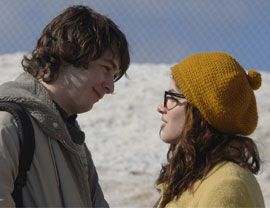
When I caught up with Snow Angels this fall, I was surprised to find that it's subtler and more moving than its mixed reviews would suggest, with a strong central performance by Sam Rockwell. While it's more conventional than Green's previous work, the bittersweet contrast of the idealism of young love and a marriage gone tragically awry rang true to me. Pineapple Express was good for a laugh, but this is the best DGG movie of the year.
24) Dennis Christopher or Robby Benson?
Christopher, for his performance as Eddie Kaspbrak in the miniseries adaptation of It.
25) Favorite movie about journalism.
Zodiac
26) What’s the DVD commentary you’d most like to hear? Who would be on the audio track?
The conversation between Werner Herzog and Crispin Glover on Even Dwarfs Started Small is pretty great. I'd love to hear Herzog interview Glover on What Is It? (actually, I'd just like to finally see What Is It?).
27) Favorite movie directed by Clint Eastwood.
Unforgiven
28) Paul Dooley or Kurtwood Smith?
A few years ago, my wife recognized Kurtwood Smith walking by, and he responded by kissing her on the cheek. So I'll go with Dooley, for not being a homewrecker.
29) Your clairvoyant moment: Make a prediction about the Oscar season.
Heath Ledger will win the 2009 "Montage of the Dead" applause contest.
30) Your hope for the movies in 2009.
That, after a so-so 2008, a year that brings new Scorsese, Malick and Tarantino lives up to its potential.
31) What’s your top 10 of 2008? (If you have a blog and have your list posted, please feel free to leave a link to the post.)
I'm going to have to ask for an extension on this one, Professor - limited release strategies prevent me once again from catching some of the highest-profile winter releases until mid-January. So far, I've awarded two movies an A+ this year: The Dark Knight and Wall-E.
BONUS QUESTION (to be answered after December 25):
32) What was your favorite movie-related Christmas gift that you received this year?
The New World is bookended by quiet, immersive nature sounds that begin before the first image (running water enveloping the frame) and continue after the last (light peering through trees). We don't begin this story so much as join it in progress - the tragic romance between Captain John Smith (Colin Farrell) and Pocahontas (Q'Orianka Kilcher) as a microcosm of a world that, director Terrence Malick reminds us, began and will go on long after the movie (and our time) is over. The movie's title is bitterly, beautifully ironic, with the movie's point of view belonging not to Smith but to Pocahontas, sharing her perception of this world without beginnings or endings - out of time, eternal. This could be florid, pretentious stuff in the wrong hands, but Malick is one of the cinema's few poets and, I suspect, incapable of making a bad movie; at turns meditative, hallucinatory and plain breathtaking, The New World is one of the rare films that touches the infinite.
The prelude to Wagner's Das Rheingold (like Malick's film, a work that anticipates the end of gods) announces the arrival of English colonists, led by Captain Newport (Christopher Plummer), to what will become known as Jamestown (though the film largely avoids names and other historical cataloguing). The meeting between Europeans and "naturals" is rescued from paternalistic cliche by Malick and DP Emmanuel Lubezki's vibrant, immersive images (particuarly astounding on the big screen), which lend our country an otherwordly quality that allows us to see the narrative through fresh eyes. Focusing on the brief, fleeting romance between Pocahontas (Q'Orianka Kilcher) and John Smith (Colin Farrell), The New World both revises and honors the affair's status as a myth of Paradise Lost. The film is steeped in metaphor, using a language of images to explicate the film's meaning in place of conventional dramaturgy. Words are of secondary importance here; the dialogue is largely sparse and functional, and the use of voiceover, as in all of Malick's films, is not meant to explain but to show the gap between what the characters say and what they mean. By decontextualizing Smith and Pocahontas (who is never referred to by name), focusing instead on their fleeting intimacy, Malick paradoxically says worlds about the nature of diaspora.
The production design (by the great Jack Fisk) and careful recreation of Algonquin culture reveal a strong commitment to authenticity, but it would be inaccurate to say that Malick is striving for realism. Malick is after a poetic, romantic truth, his camera constantly darting and weaving around his actors like a silent, disembodied observer. The performers rise to the occasion admirably - Farrell is underrated for his willingness to find vulnerability in his action-man persona, and Christian Bale, as John Rolfe, excels at playing an uncomplicated, genuinely good man (harder than it seems). But the movie belongs to Kilcher, a then-14-year-old acting novice who is completely believable as she navigates her character's journey through first love, separation, banishment, heartbreak, migration and transcendence. Thanks to Kilcher, Pocahontas is at once a personification of Malick's ideals of purity and oneness with the world and a typical lovestruck kid. With The Thin Red Line, Malick seemed to have lost interest in the individual, observing his characters from such a distance that they became a collective, hard to distinguish from the foliage. Pocahontas is a return to his more humanistic '70s work; a direct descendant of Badlands' Holly and Days of Heaven's Linda, she's an innocent who (like the film itself) gives life to the world she inhabits.
The marketing for The New World sold the film as something it wasn't - the above poster is going for sweeping romance, while the horrible DVD cover tries to make it look like an action movie (though the one battle scene demonstrates that Malick could make a great action movie if he wanted to). The result was that the film was hated by people for what it isn't and overlooked by people who would appreciate it for what it is, and it promptly bombed. And there's no question that Malick's esoteric approach to storytelling is too much for most people - almost everyone I've shown the film has nodded off, citing either the deliberate pace (which affords every moment the same importance) or half-complaining that it's "too rich." But I don't think The New World is inaccessible, or even a primarily intellectual experience; I showed the movie last Thanksgiving to a group of mentally challenged people that I work with, and most were engaged, curious, and asking questions (this doesn't happen when we show Firehouse Dog). Perhaps The New World works best when it's less analyzed than experienced; if you let it wash over you, the film's aesthetic and emotional power is indelible. It'd be nice if Malick was more prolific (though with Tree of Life coming out next year, perhaps he's picking up the pace), but when each of his films give us enough to experience and discuss for decades, it's hard to complain.
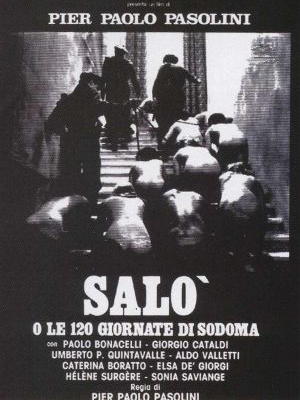
Is it inappropriate to refer to Salò, or the 120 Days of Sodom as funny? I've been putting off watching the film for years and had a pretty good idea of what I was getting into. But while Salò more than lives up to its reputation as a deliberately offensive gross-out, I'd read little that prepared me for how thought-provoking, skillfully crafted and - at points - blackly funny the film would be. During the infamous "Circle of Shit" sequence, just when I thought I couldn't take any more, one of the pervy middle-aged fascists reponsible for the film's horrors flashes an adoring smirk, his face flecked with feces, as he plants a kiss on one of his young prisoners; all at once, my nausea turned to uncontrollable laughter at the film's sheer insanity. Salò pushes bodily horror to such an extreme that it becomes completely absurd, translating political outrage into a sustained scatological outburst (the Mr. Creosote scene in Monty Python's The Meaning of Life is its direct descendant). While Pasolini may have intended Salò as an anti-entertainment, it's a shame to see the movie get lumped in with dreck like Cannibal Holocaust and I Spit On Your Grave on "Most Disturbing" lists. Though I can only recommend Salò to cinephiles who can stomach just about everything, it's an uncompromising work of art that is well worth the challenge of sitting through it.
Transplanting the Marquis de Sade's book The 120 Days of Sodom to fascist Italy, where four men - the Duke, the Bishop, the Magistrate and the President - kidnap 18 young men and women, capturing them in a palace and putting them through all forms of torture and degradation. The Republic of Salò was created near the end of WWII as a puppet state, and Pasolini's film is an aggressive dramatization of the unchecked decadence that signifies the end of an empire. Pasolini, like Bertolucci and Vischonti, dramatizes Wilhelm Reich's theory that fascism is a form of sexual repression; the exuberant depictions of budding sexuality shown in the director's Trilogy of Life appear only briefly, as a forced performance that is quickly interrupted. The frequent nudity of Pasolini's young, beautiful captives has a disorienting effect - if the desire towards beauty and vitality is natural, is the desire to corrupt and destroy also natural? Pasolini's deliberately distancing techniques only serve to further obscure the answer to that question, as does the captives' suprisingly passivity in the face of annihilation, the strange affection evident in the captors' faces, and the scenes where an aging maitresse entertains the captives with winsome stories of her humiliation and abuse. Whether or not these horrors are natural, Pasolini argues, we accept them without hesitation.
Pasolini's use of theatrical alienation also adds a kinky metatextual layer to the film. A performance between the older and younger maitresse late in the film calls attention to the sadomasochistic dynamic between the actors and their director. All have willingly taken on the roles of torturers and victim, with Pasolini frequently revealing to his actors the nature of a scene just before shooting. While this is an extremely manipulative approach, I haven't read any stories about actors quitting the film. Salò carries an perverse but undeniable charge as an experiment in how far its actors were willing to go, and if they might in some cases be enjoying their respective roles; I must admit that I found myself frequently observing whether the actors were visibly aroused as they assumed dominant or submissive roles. Like de Sade, Pasolini is exploring the darkest areas of sexuality, but while the Marquis was having a wank, Pasolini examines the lizard brain with a critical eye. The dark side of his Arabian Nights and the entire flood of '70s Europorn, Salò introduces a cinema born out of the sexual revolution and the liberation of content that is not an endless Bacchanalic orgy but also the release, Pandora-like, of the basest qualities of human nature.
About the shit-eating: 30+ years after after Salò and Pink Flamingos, after Jackass and the birth of "extreme" as a selling point, when corprophagia can be found in a studio-released comedy like American Wedding, once-transgressive content exists as nothing more than a dare between giggling teens (or, frighteningly, people my age) looking to prove how desensitized they've become. How is it, then, that Salò has lost none of its power? This can partly be attributed to the very convincing shit - a mixture of chocolate and orange marmalade - but what really sets Salò apart from its descendants in gross-out is that, to quote Videodrome, it has a philosophy. With the film newly available on DVD, it'd be great if it gained a reputation as a triple dog dare for the Goatse/"Two Girls One Cup" crowd, unexpectedly blindsiding its new audience with its lacerating indictment of their late-empire decadence. That is, if they can get past the weird gay stuff.
Paul Clark has tagged me with The Alphabet Meme that orignated at Blog Cabins. The original concept - to pick a favorite movie to represent each letter of the alphabet - has been tweaked by various authors who've written about alternate favorites, guilty pleasures, underseen movies and movies they'd like to revisit (or see for the first time). But I'm going to be boring and stick with the "favorite movies" idea - the appeal of memes like this, to me, is to follow the formula and discover anomalies. I like the idea of this list as an alternate all-time top 26. It's not really Bizarro me, but a me-not-me who I basically agree with but has omitted a few favorites and (thanks to Q and X) has a special place in his heart for Marvel adaptations and Australian sci-fi.
Apocalypse Now Blue Velvet Carrie Dawn of the Dead E.T. the Extra-Terrestrial The Fly The Godfather Part II Halloween Inferno Jaws Kill Bill vol. 2 Lawrence of Arabia The Man Who Fell to Earth Nashville One Flew Over the Cuckoo's Nest Persona The Quiet Earth Raging Bull The Shining 2001: A Space Odyssey Un Chien Andalou Vertigo Wings of Desire X2 Y tu mama Tambien Zodiac
Edited to add: Oh yeah, I forgot to pass this on. Let's go with Neil, Greg, Allen, Jess and Jess.
This is my contribution to Nathaniel's Musical of the Month at the Film Experience.
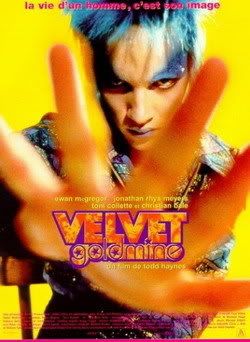
You can count on one hand the pop soundtrack cues that match the exhilarating high of Brian Eno's soaring "Needles in the Camel's Eye" played over images of throngs of young, tarted-up glitter kids in perpetual motion, serving as track 1, side 1 of Todd Haynes' glam rock fantasia Velvet Goldmine. The movie hits the ground running and never loses momentum - Haynes depicts the glam scene as no less than a teutonic shift in our cultural and sexual identity. Of course, the real heyday of artists like David Bowie, Roxy Music and T. Rex was nowhere near as huge as depicted here; Bowie was essentially a cult star who found his biggest success in the '80s with "Let's Dance," and much of the music from the period is largely dismissed as pretentious and silly today (at least by many of the passengers in my car). But the genius of Haynes' film is that it treats its subject as big, capturing the thrilling immediacy of being part of (or wanting to be a part of) a subculture, the feeling that your own revolution is - or can be - everyone's.
Named after Bowie's horniest song, Velvet Goldmine starts with the delivery of an infant Oscar Wilde to earth via spaceship before jumping to the staged assassination of Brian Slade (Jonathan Rhys-Meyers), a Bowie-inspired, androgynous pop idol who has his own Ziggy Stardust in alien persona Maxwell Demon. Ten years after the hoax and Slade's disappearance, rock journalist Arthur Stuart (Christian Bale) is assigned a "Where are they now?" piece about Slade; his investigation starts a Citizen Kane-like story where we learn pieces of the Slade story from those who knew him. At the heart of the film is Slade's doomed romance with American rocker Curt Wild (Ewan McGregor) - two parts Iggy Pop and one part Lou Reed, Wild gleefully wags his privates for his audience one moment before setting fire to the stage the next. The combustible affair between the openly bisexual Slade and the sexually malleable Wild, and the breakdown of Slade's relationship with wife Mandy (Toni Collette)* set the stage for Haynes' kaliedoscopic, visually stunning meditation on sex, performance, identity, drugs, celebrity, genderfuck and - above all - music. Haynes correctly identifies glam, wedged between the misogyny of the "free love" '60s and the defiantly aesexual rise of punk, as the moment when sex was a means of personal revolution. That this sexual revolution was rendered superficial through its contrived nature is arguable, but Haynes uses surfaces to argue for a deeper truth; when Wild and Slade, driving through a light show, serenade each other with a lip-sync of Lou Reed's "Satellite of Love," the moment becomes swooningly romantic precisely because of its obvious unreality.
Velvet Goldmine is filled with precisely such surface pleasures, from the wonderfully over-the-top costumes by Sandy Powell to the marvellously intricate sound design. Haynes is, above all, an aesthete; having studied semiotics at school, his films are like two-hour lessons in signs and signifiers, only they're actually fun to watch. When Haynes appropriates the out-of-time editing of Nicolas Roeg, the visual excesses of Ken Russell or the long-abandoned use of the zoom lens (Oh God, the zooms! Why did they ever go out of style?!), it's more than mere homage. Velvet Goldmine so thoroughly reenacts the sonic and visual textures of the period that each shot, each cut takes on an erotic charge. To the charge that the film is too cerebral, I can only respond that thinking can be very sexy - this is part of glam's appeal, descending not just from Wilde but from Rimbauld, the idea that the divide between introspection and experiential realities is a false one. What I mean to say is that this movie is really fucking hot.
To access the emotions of the film, one has to pay attention to Bale's journalist - the film is punctuated by Arthur's memories of the early '70s, as an awkward teen prone to hiding in his room listening to The Ballad of Maxwell Demon. When Arthur, watching Slade at a press conference on tv, imagines exclaiming "That's me!" to his parents right before Slade opines that we're all bisexual, it reminds all of us of our own adolescent identification with a particular rock star, and what it taught us about ourselves (if you claim you never obsessed over a rock star, you're probably lying). When the film arrives at a tryst between Wild and a young Arthur that may be real or imagined, Haynes doesn't shy away from the intensely personal attachment one can feel towards an artist who, in a sense, deflowers us (the scene is also bound - and Haynes couldn't have anticipated this - to take on special meaning to slash fiction fans as a visual record of Obi-Wan Kenobi buggering Batman). Velvet Goldmine is, more than anything, about what it feels like (to borrow from Almost Famous) to love some silly piece of music so much that it hurts. More than any movie I've seen, it captures the pure high of playing your favorite record (as the opening titles demand) at maximum volume.
* Sidenote: McGregor, Bale, Meyers, Collette - might this be the sexiest cast ever? I couldn't find a way to fit this into the review proper, but it's worth noting.
- A must-read: Walter Chaw's interview with Charlie Kaufman, who articulates (better than I could hope to) about a dozen things I've been thinking/feeling/worrying about lately. I've talked to people who've loved everything Kaufman has done and hated Synecdoche, New York, so I really have no idea what to expect, which makes me more anxious to see it.
- I skipped reviewing The Happening because I'd just be hitting the same points most critics did in June. But when Shyamalan cut to Mark Wahlberg as a science teacher asking his students about disappearing bees, Jess and I laughed hard and didn't stop until the movie was over. Can anyone think of a more dramatic directorial flameout than M. Night Shyamalan? I hate to kick a guy when he's down, but Jesus...
- After I wrote about Mother of Tears, Paul Clark sent along a link to his recent review of Tenebre - fine reading, and I'm envious that Paul just had the pleasure of seeing Tenebrefor the first time. Big agreement that Argento's best at his craziest.
- Phil Nugent shares a personal appreciation of Two-Lane Blacktop(via GreenCine Daily). His memories of late-night movies as "one of the things that settle and restore my soul" hit home particularly hard, as TV-38's Movie Loft had much the same role in my formative years. I'll write about it more sometime, perhaps - seems like kids raised on satellite, On Demand and a multitude of options are missing out.
- Between the movie shoot and Tommy's arrival, I didn't devote as much time to Halloween as I would have liked. Hopefully I'll be able to make up for this next year; in the meantime, here's a montage of gore courtesy of barringer82:
In the winter of 1997, as audiences were making Titanic the highest-grossing movie of all time, a smaller but no less moving film about a tragedy was also playing. The Sweet Hereafter, the story of a small town in Canada reeling from the loss of its children in a schoolbus accident, uses its nonlinear narrative to circle around the accident without showing it for its first half. When the moment finally comes, in an extreme long shot, we only see the bus in the distance as it skids across the ice and rests on its surface for a terribly pregnant moment before silently falling through. The moment is restrained but not detached; when I saw The Sweet Hereafter shortly after going crazy for Titanic, it was an important lesson in my cinematic education - that a few moments of silence can have as much emotional impact as three hours of spectacle.
Based on the novel by Russell Banks, the film follows lawyer Mitchell Stevens (Ian Holm) as he travels to the town in order to convince the grieving parents to sue the bus company for damages. Through Stevens we learn about the lives of the parents and the survivors of the accident - bus driver Dolores Driscoll (Gabrielle Rose) and teenager Nicole Burnell (Sarah Polley), who has been confined to a wheelchair. In one of the movie's best scenes, Stevens delivers an impassioned speech to one couple about the need to search for justice; while it would have been easier to write the lawyer as a cynical opportunist, Banks and screenwriter/director Atom Egoyan choose to depict Stevens as an essentially good man who believes his work is just even as he is shaken by frequent phone calls from his own troubled, drug-addicted daughter. Though there is no clear cause for the accident, Stevens argues repeatedly that someone must be at fault and must pay; as we observe (again, at a distance) the parents and people of the town, their need to find answers in the face of incomprehensible loss is painfully identifiable.
Though the snowy landscape practically imposes a somber tone on most Canadian films, Egoyan uses the surroundings to particuarly strong effect here. The camera obsessively follows the image of the yellow bus against the blinding white snow, retracing its route over and over as if trying to unveil a clue it won't find. Coupled with Mychael Danna's icy score, the film - which juggles chronology, taking as its framing device the Pied Piper story - is remarkable for its sustaned austerity. Where other directors would fall victim to forced sentiment or false uplift with this material, Egoyan is attempt to let the story and performances unfold and trust in the strength of his source. This discipline occasionally works against the film, giving it a hermetic quality, particuarly when we learn that Nicole was sexually abused by her father (Tom McCamus). Egoyan reveals this fact in a shot of daughter and son embracing in a hayloft, by candlelight - the film hesitates at really dealing with the implications of this provocative image. Since Nicole's actions towards the end of the film are apparently motivated by her relationship with dad, Egoyan satisfies some insight into Nicole in the name of good taste. Thankfully, Sarah Polley's terrific performance, her piercing eyes serving as our own through the film, tells us all we need to know about Nicole.
I used to think The Sweet Hereafter was a masterpiece; watching it again, I found it to be merely an excellent one. What remains perfect is Ian Holm's performance. One of the most underrated actors, Holm is able to find as much truth in a simple gesture - standing before a mirror, peering at himself through his hands - as most actors can only begin to find in an extended monologue. At one point, we hear Stevens' story about having saved his daughter's life when she was still young; we can hear the bitterness and undying love for his child choking at Holm's throat. The question of whether any life is worth saving hangs, unanswered, in the air, and though Egoyan doesn't placate us with easy answers, his film finds dignity and even grace in our uncertainties.
The other day, I was wondering whether it's still possible to bring people together and work towards a common goal. Tonight I got my answer. As incredible as it is to casually refer to "President Obama," it's the sight of thousands upon thousands of people - maybe a million! - flooding Grant Park that makes me go all misty-eyed. While I've been hoping for a Barack Obama victory since 2004, I realize that the real test lies ahead. I'm confident that Obama will meet the challenges ahead with intelligence, clarity and strength of character, but he's not Superman (though this is still kickass) and besides, not even Kal-El could fix all the horrifying mistakes of the past eight years. The true measure of an election is what it says about us, and tonight is, for me, resounding proof that in America, change is not only possible, it's happening. Thanks, America, and don't let this be a fluke - let it be a beginning.
Selfishly, I'm happy for two reasons. One, the candidate I've liked all along actually won, which is surreal. Two, I can sleep more soundly knowing that the world Luna and Tommy are growing up in makes a little bit more sense tonight.
And whoever you voted for, the fact of a black man being elected President of the U.S. is a beautiful and long-overdue thing, and something we can all be proud of. Bush apparently congratulated Obama by saying "What an awesome night for you." Actually, George, it is pretty awesome.






 Happy new year, everyone!