Friday, September 26, 2008
I'm not set up to mold hard rubbers.
Monday, September 22, 2008
Here we are at the edge of the world of human history.
Director Ruggero Deodato frames Cannibal Holocaust from the start as a commentary on representations of violence in the media. The movie starts with a team led by an anthropology professor (Robert Kerman) who travel deep into the Amazon to find a missing documentary crew. They return with the crew's footage, and the second half is a first-person account of the shocking practices of the native tribes and the manipulative and cruel steps the filmmakers take to improve their footage. Deodato's explicit point is that more "civilized" Westerners are no less capable of cruelty than the "savages," literally ending with the professor's line "I wonder who the real cannibals are." Any claim to sociological importance is deflated by Deodato's sleazy approach to the material. When the rescue team observes the ritualistic rape of a woman guilty of adultery, the camera is less unflinching than prurient - prolonged shots of the woman's writing, mud-caked body give the impression that Deodato isn't commenting on the image as much as he's getting off on it. The entire movie is just as crass, demanding to be taken seriously even as it caters to the lowest common denominator. Worse still, the film's criticism Vietnam-era media is incoherent, as the images of wartime atrocities broadcast on the nightly news was largely responsible for ending the war. I can appreciate disturbing material employed for a purpose, but Cannibal Holocaust says very little as loudly and obnoxiously as possible.
That the film has been taken seriously by some very intelligent film writers suggests the level to which shock has lost all meaning. We can see its influence in unexpected places; watching 4 Months, 3 Weeks and 2 Days, I was struck by the lingering close-up of an a bloody aborted fetus late in the film, after the filmmakers had earlier opted to cut away from a tense but conventional sex scene. Interesting how sex is deemed exploitative and gratuitous, yet the fetus, which offers no insight into the film's meaning, is worthy of inclusion. Cannibal Holocaust is similarly disconnected from any pleasure (the consensual sex is literally dirty) or anthropological interest in the tribes beyond shock value. The difference, of course, is that 4 Months, 3 Weeks and 2 Days is serious-minded and skillfully crafted; Cannibal Holocaust is devoid of any real perspective on its subject beyond the simplistic nihilism that is currently trendy in my generation. Both versions of Funny Games are similarly didactic, but Haeneke is able to make the same points with precision and tension (and with little gore) because we're invested in his characters and scenario. And a sense of humor would have helped - Eli Roth cited Cannibal Holocaust as an influence on Hostel and Hostel: Part II, but those movies work well as gallows satires of Western arrogance and unchecked masculinity. Only Riz Ortolani's hilariously deadpan score offers any such pleasures here.
But even on the level of its shallow aspirations, Cannibal Holocaust is a failure. The actors can't pull off the transition from "civilized" to "primitive," and when they turn violent, it's arbitrary and difficult to buy. Deodato is terrible at generating tension - without any suspense or investment in the movie's outcome, it just made me feel annoyed and grossed-out, like I was eight again and hanging out with dumb kids who like to torture animals. And while the movie is frequently cited as a predecessor of The Blair Witch Project, it can't hold a camera to that movie in terms of believability. I', all for using shocking material to make a point, or even to entertain. Cannibal Holocaust takes a dump on the floor and gets in your face to argue that the smell is your fault.
Sunday, September 14, 2008
I believe God is a sadist, but probably doesn't know it.
Sam Peckinpah reportedly viewed Stanley Kubrick as his rival through much of his career. Why he felt he was in competition with a director whose work had little in common with his is unclear, but Peckinpah probably didn't feel the need to explain his grudges. With this in mind, it's easy to see 1977's WWII drama Cross of Iron as Peckinpah's Paths of Glory. Both films have as their protagonist a strong, rebellious officer at ideological odds with an officious, conformist superior, and both feature a pivotal scene where the protagonist tells a seemingly sympathetic commanding officer that he's a hypocrite. But where Paths of Glory unfolds with chess-like precision, Cross of Iron is more tuned to the chaos of battle. It's a shaggy, sometimes aimless, but always entertaining variation on one of Peckinpah's favorite kinds of stories - the rugged individualist vs. the world.
Sargeant Rolf Steiner (James Coburn) is the archetypal Peckinpah hero, a fearless soldier with no allegiance to ideology. Steiner commands a Wehrmacht platoon on the Eastern Front; the platoon is being pummeled by the Russians, and the German commanders we meet, like the pragmatic Brandt (James Mason) and the disillusioned Kiesel (David Warner), are not the nefarious, mustache-twisting Nazis we're used to. Peckinpah is less interested in the inexplicable evil of Hitler and his devout followers than in the nationalistic pride and conformity that enabled the party's rise. This is personified by Captain Stransky (Maximillian Schell), whose single-minded desire to win the Iron Cross and bring honor to his family name leads to his corruption. The opposition between Steiner and Stransky is not unlike the one between Pike Bishop and Deke Thorton, with self-reliance (and huge balls) held up as the only reasonable choice in a corrupt society.
The tension between Stransky and Steiner is effectively played by Coburn and Schell, and Cross of Iron appears to be headed towards an epic battle of wills between the two men. Then the film takes a left turn midway and never really regains its focus. Whether the troubled production or Peckinpah's own demons are to blame, Cross of Iron becomes an uneasy mix between an allegory of the absurdity of war and a meat-and-potatoes combat movie. The film lacks the poetry of Peckinpah's best work, with his trademark preoccupations seeming more crude than usual as a result. Steiner's heroism in stopping the rape of a Russian hostage is weakened by Peckinpah's obvious distrust of women. The implication that fascism is a form of repressed homosexual desire, provocative in Bertolucci's 1900, is only a cartoonish expression of hetero panic. Yet Peckinpah is blissfully oblivious to the homoerotic undertones of the slow-mo, bullet-riddled martyrs' deaths he awards his heroic soldiers. The romantic quality that defined these scenes in The Wild Bunch and Pat Garrett & Billy the Kid becomes so predictable and protracted that it feels like self-parody.
Still, Cross of Iron is worth seeing as an example of a kind of action movie that doesn't exist anymore. If the sensory assault of Saving Private Ryan is the logical end to what Peckinpah began, than it follows that there was no where to go except the aestheticized, hyperreal action of The Matrix and its imitators. In Cross of Iron, when a tank crashes through a brick wall, we know it's a real tank and a real wall, and the physical reality alone lends the film the kind of tension that a computer can only simulate (it hasn't been taught about the flesh). Cross of Iron isn't the smartest or most elegant of Peckinpah's films, but it has guts, and guts is enough.
Sunday, September 07, 2008
How do you like that, dad?
Part of the franchise's distinctive style can be attributed to New Line Cinema's protectiveness of what was, until Rush Hour and The Lord of the Rings, its biggest cash cow. Rumor has it that the company developed Freddy's Revenge and the far superior A Nightmare on Elm Street 3: Dream Warriors at the same time, then rushed the former into production to keep awareness of Freddy high and put more time and effort into the latter. Whether or not this is exactly what happened, Freddy's Revenge, which opened just under 12 months after the first film, does feel like a rush job. The plot, which follows teen Jesse (Mark Patton) as he is possessed through his dreams by Freddy (Robert Englund), betrays a basic misunderstanding of what made the first movie scary and memorable. The atmospheric, Bunuel-inspired imagery of Craven's film is gone - here, the dream sequences amount to Freddy yelling variations of "Kill for me, Jesse!" while Patton emits high-pitched squeals. The biggest sequence in the movie takes Freddy into the real world to terrorize a pool party, but surrounding him with Tiki torches sort of downplays his fearsome persona. Director Jack Sholder made the entertaining slasher movie Alone in the Dark before Freddy's Revenge and followed it with the awesome alien cop movie The Hidden, but here his attemps at scaring us - a melting record, an exploding parakeet - mostly just provoke unintentional laughs. There are few mentions of Freddy as a child killer, and his creepy boiler room hangout is replaced with a dreary industrial park. And while it's not necessary for the lead in a slasher movie to be female, Patton's histrionic performance makes for an awkward Final Girl.
Of course, the performance makes sense if you accept the popular subtextual reading of Freddy's Revenge. It's been noted by many writers before me that Freddy's Revenge can be interpreted as the story of a teen struggling with his repressed homosexuality. It's not even subtext, really; the first time I watched the movie, when classmate Ron (Robert Rusler) pulls down Jesse's pants during gym and wrestles him to the ground, I thought to myself, "Don't be immature." When Jesse falls asleep in class and summons a python around his neck, I thought, "That wasn't supposed to be a penis." When Jesse sleepwalks into a leather bar and gets busted by his leather-clad gym teacher, I thought, "Okay, that's actually really gay." When Jesse, possessed by Freddy, ties his teacher up, naked, in the gym shower and violently towel-whips him - well, if that isn't gay, neither is Querelle. The filmmakers claim the subtext is unintentional, and though I find this hard to believe, it'd be amazing if, in the rush to get a sequel out, they accidentally made a movie where Freddy is the personification of one teen's confused sexual desire. Sidenote: my first boyfriend was a slasher film nut, but when I mentioned Freddy's Revenge's hidden meaning, he had no idea what I was talking about.
But whether one reads Freddy's Revenge as a progenitor of New Queer Cinema or simply a quick cash-in, it's worth watching for scenes so inexplicable that they're practically Lynchian (Hope Lange, who plays Jesse's mother, would go on to play Jeffrey Beaumont's mom in Blue Velvet the following year). There's the weird framing sequence that tries to make a bus ride into a hellish desert scary but instead suggests a bad peyote trip. Or the single silliest dance montage of the '80s (no small feat), as Jesse, cleaning his room, prances around like a hyperactive 8-year-old, at one point using a plastic cup-and-ball toy as a phallus. Or my personal favorite moment, the completely ridiculous scene after the bird explodes, as Jesse's dad (Clu Gulager) accuses him of somehow having rigged the bird to spontaneously combust in an attempt to tear the family apart. As I said before, A Nightmare on Elm Street 3 is the more logical continuation of the series, and it's actually better than the original in some ways. But sometimes I find myself more in the mood to watch Freddy's Revenge - it's a sublime failure, one that does everything wrong in all the right ways.
Thursday, September 04, 2008
Top 5: Movies Within Movies
But I digress. One of the highlights of Tropic Thunder is the mock trailers that open the movie. After a commercial for rapper Alph Chino's (Brandon T. Jackson) energy drink Booty Sweat that elicited a "Wait - what?" from my wife, we're treated to a sneak peak at action hero Tugg Speedman's (Stiller) ripped-from-the-headlines climate change disaster epic Scorcher VI, comedian Jeff Portnoy's (Jack Black) CG-and-latex extravaganza The Fatties: Fart 2 and, best of all, Oscar winner Kirk Lazarus (Robert Downey Jr.) and Tobey Maguire in Satan's Alley, an awards-season film about unrequited love between Irish monks. Each trailer is frighteningly believable, and honestly, I'd Satan's Alley, and so would a lot of gay comic fans (who would be the top, Iron Man or Spider-Man?). Here are five other fake movies that I'd pay to see.
1. Habeas Corpus Pitched by a pair of high-minded screenwriters (Richard E. Grant and Dean Stockwell), to venal exec Griffin Mill (Tim Robbins), this thriller about a woman on death row starts as an indictment of our judicial system that ends on an uncompromisingly depressing note. After a disastrous test screening, it becomes a love-conquers-all crowdpleaser. The biggest laugh in Robert Altman's The Player is the final scene of Habeas Corpus, as Bruce Willis gets to save the day, sweep Julia Roberts off her feet and deliver the frighteningly authentic one-liner, "Traffic was a bitch."
2. Thanksgiving Of course, Tropic Thunder's fake-trailers gimmick was also used to awesome effect in last year's Grindhouse. Edgar Wright's Eurohorror-inspired Don't was the popular favorite, and Machete and Werewolf Women of the SS are both terrific. But my personal favorite is Eli Roth's Thanksgiving, a grimy holiday-themed splatter movie that feels exactly like one of the cheap Halloween knockoffs released at the tail of the slasher film's popularity. Maybe it's the sleazy juxtaposition of blowjobs and decapitation, or maybe it's my nostalgia for the underrated Creepshow score used to great effect here. Either way, if Thanksgiving were real I'd probably own the 2-disc Blue Underground DVD.
3. Angels Live in My Town A porno-action hybrid starring Dirk Diggler (Mark Wahlberg) as sexy crime fighter Brock Landers and Reed Rothschild (John C. Reilly) as his partner, Chest Rockwell as they dispatch of bad guys before getting "some of that Saturday Night Fever." Angels Live in My Town allows Paul Thomas Anderson to address porn's misogyny while still depicting the relative sweetness of '70s adult movies, with Brock torturing information out of female suspects by making love to them. "You don't fuck with Chest and Brock" - indeed you don't.
4. Mant! Joe Dante's Matinee is a loving tribute to the low-budget monster movies that wowed Dante as a kid, and its highlight is Mant!, an atom-age creature feature "based on scientific fact" according to its producer, "master of movie horror" Lawrence Woolsey (John Goodman), a loving tribute to all-time great movie showman William Castle. Best of all, it's presented in Atomovision!
5. On High in Blue Tomorrows A southern Gothic melodrama revolving around a tragic affair starring Nikki Grace (Laura Dern) and Devon Berk (Justin Theroux), On High in Blue Tomorrows is also notable for being cursed. A remake of a Polish film that was never completed due to the deaths of the principals, On High in Blue Tomorrows is known to trigger strange, psychosexual odysseys through real and possible worlds, punctuated by out-of-nowhere dance numbers. I suspect that The Fatties: Fart 2 has the same effect.
Sunday, August 31, 2008
Lumet, Lazarescu, Ringwald
Another season, another movie quiz at Sergio Leone and the Infield Fly Rule. This one comes courtesy of interstellar explorer and fop Dr. Zachary Smith. Read on, and take the quiz over at SLIFR if you dare, you bubbleheaded booby.
1) Your favorite musical moment in a movie
Awesome Mix Tape #6 serving as a perfect Greek chorus to a drug deal gone terribly wrong at the end of Boogie Nights.
2) Ray Milland or Dana Andrews
The Man with X-Ray Eyes.
3) Favorite Sidney Lumet movie
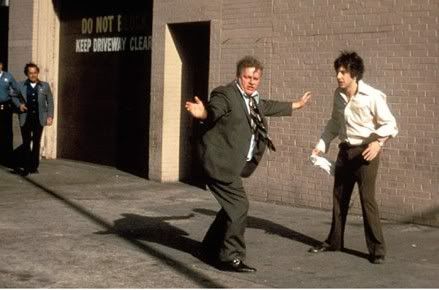
Dog Day Afternoon, easily. Lumet's always great at directing actors, but the heavyhandedness that occasionally creeps into otherwise great movies like 12 Angry Men and Network is totally absent in Dog Day Afternoon. It's a pitch-perfect character study, one of the most entertaining movies ever made, with an ending that breaks my heart.
4) Biggest surprise of the just-past summer movie season
I can't honestly say there were any surprises. While I enjoyed all of the big movies I'd been highly anticipating to varying degrees, this summer really lacked an out-of-nowhere sleeper for me to get excited about. And, as an art house projectionist, I can't remember a summer in at least five years with such a dearth of interesting indie counterprogramming. I did love Encounters at the End of the World, but that's Herzog, so hardly a surprise.
5) Gene Tierney or Rita Hayworth
Rita Hayworth
6) What’s the last movie you saw on DVD? In theaters?
On DVD, Amelie - I've been testing out different movies with my one-year-old daughter (she loved the Amelie-as-little-girl opening, but lost interest with Audrey Tautou). In theaters, Encounters at the End of the World (still thinking about that poor, crazy penguin).
7) Irwin Allen’s finest hour?
Gene Hackman cursing God as he does a parallel bars routine in the upturned bowels of the Poseidon.
8) What were the films where you would rather see the movie promised by the poster than the one that was actually made?
The teaser poster for Jaws 2, with the sun setting over a blood-red sea, is far cre
9) Chow Yun-Fat or Tony Leung
Tony Leung
10) Most pretentious movie ever
Pretentious is one of the most horribly misused terms in talking about movies. I might not like all the movies of Michael Haneke or Oliver Assayas, but they're still intelligent and coherent enough to be worthy of argument. A truly pretentious movie is Aria - a murderer's row of directors making shorts scored to famous arias for NO APPARENT REASON.
11) Favorite Russ Meyer movie
Beyond the Valley of the Dolls, but I really need to see more.
12) Name the movie that you feel best reflects yourself, a movie you would recommend to an acquaintance that most accurately says, “This is me.”
You're asking someone who personalizes the movies he watches to an unhealthy degree. I think of of the reasons that Blue Velvet is my favorite movies is because it's like watching my psyche projected onto the screen. Make of that what you will.
13) Marlene Dietrich or Greta Garbo
Marlene Dietrich
14) Best movie snack? Most vile movie snack?
Best - Reese's Pieces. Most vile - any form of malted milk balls.
15) Current movie star who would be most comfortable in the classic Hollywood studio system
When Vanity Fair did that Hitchcock gallery earlier this year, Naomi Watts made an absolutely perfect Tippi Hedren.
16) Fitzcarraldo—yes or no?
Absolutely!
17) Your assignment is to book the ultimate triple bill to inaugurate your own revival theater. What three movies
Pretension alert: lately I've been realizing that most of my favorite movies - and, by extension, my cinematic ideal - are movies that render the divide between high art and pop meaningless. So, three movies that do just that: Psycho, Chinatown and Altman's Popeye.
18) What’s the name of your theater? (The all-time greatest answer to this question was once provided by Larry Aydlette, whose repertory cinema, the Demarest, is, I hope, still packing them in…)
Well, I already used the Vista. I'd love to be the one in charge of programming the Mohawk, an old movie house that my town is gradually raising funds to renovate. I think I'd keep the name.
19) Favorite Leo McCarey movie
Duck Soup
20) Most impressive debut performance by an actor/actress.
Malcolm McDowell in if...
21) Biggest disappointment of the just-past summer movie season
Well, Mamma Mia! was terrible, but I can't say I was disappointed, exactly...
22) Michelle Yeoh or Maggie Cheung
Maggie Cheung
23) 2008 inductee into the Academy of the Overrated
The Death of Mr. Lazarescu
24) 2008 inductee into the Academy of the Underrated
Smiley Face
25) Fritz the Cat —yes or no?
Not really.
26) Trevor Howard or Richard Todd
Trevor Howard
27) Antonioni once said, “I began taking liberties a long time ago; now it is standard practice for most directors to ignore the rules.” What filmmaker working today most fruitfully ignores the rules? What does ignoring the rules of cinema mean in 2008?
I think the most meaningful examples of this today don't happen in alternative cinema, but in mainstream films that deviate from the rules in meaningful ways. Three of the best films of the past few years - There Will Be Blood, Zodiac, No Country For Old Men, The Dark Knight - were partly defined by their defiance of expectations. And the response to their left turns, particularly in the case of No Country For Old Men, continue to reverberate not only in the cinephile community but among everyday moviegoers who were genuinely shaken.
28) Favorite William Castle movie
The Tingler
29) Favorite ethnographically oriented movie
One of my favorite things about the work of Jim Jarmusch is its unspoken study and celebration of cultural diversity in microcosm. Down By Law is probably the best example of this.
30) What’s the movie coming up in 2008 you’re most looking forward to? Why?
The Curious Case of Benjamin Button. Fincher's coming off Zodiac, and the trailer's a beauty.
31) What deceased director would you want to resurrect in order that she/he might make one more film?
That's sort of a sad question, isn't it? Reminds me of the ending of A.I. Hey, let's go with zombie Kubrick's Napoleon.
32) What director would you like to see, if not literally entombed, then at least go silent creatively?
It's reassuring to see so many people citing Brett Ratner before I did. Just rewatched Red Dragon - only Ratner could take that cast and source material and make something so hacky.
33) Your first movie star crush
Friday, August 29, 2008
Now which would you rather be, an anal bead or a dragon?
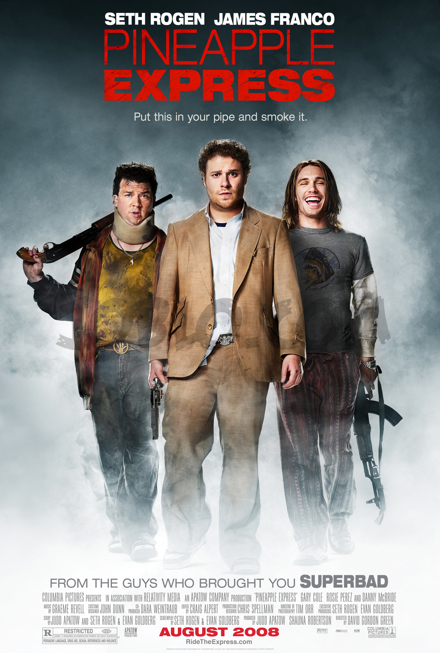
A mash-up of '80s-inspired action and stoner comedy that treats both genres not with hipster derision but with genuine affection, Pineapple Express follows process server Dale Denton (Seth Rogen) and his dealer Saul (James Franco) as they find themselves on the run after Dale witnesses a corrupt cop (Rosie Perez) and Saul's supplier Ted Jones (Gary Cole) commit a murder. Saul is mistakenly placed at the scene by Pineapple Express, a rare strain of marijuana left behind by the panicked Dale; the Express is the proverbial "good shit," so rare that, according to Saul, smoking it is "like killing a unicorn." Dale and Saul's attempts to save themselves are frequently interrupted by the Pineapple Express, making the film a charming hybrid - a high-octane chase that reminds its target audience how helpless they'd be in the same situation. The choice of All the Real Girls director David Gordon Green proves to be an inspired one; Green (who recently outed himself as an avowed Seagalologist) clearly had a blast directing against type, and his car chases and shootouts would make George P. Cosmatos proud. Green's improvisational method of filmmaking proves well-suited to the Judd Apatow repertory company, while finding room for moments, like a leisurely scene of Saul and Dale frolicking in the woods, that give the movie a goofy poetry absent from other Apatow productions (though one can see Apatow striving for it in his own films). If it's less identifiably personal than his earlier work, it presents the exciting possibility that Green may become the new Hal Ashby, comfortably shifting between genres while adding his own gentle authorial touch.
Monday, August 25, 2008
The Trim Bin #72
- I'm officially a Paul Proulx fan. Paul's new blog, Bennett Media, promises to bring us many more director tributes (check out the new David Fincher compilation), episodes of the hilarious WOWMANWOW, and other projects from one of the sharpest, most original editors around.
- The latest installment of Steve Hyden's "Song and Vision" series focuses on the "Tiny Dancer" scene in Almost Famous. TMI alert: the missus and I made out to that scene on our third date. Eight years and two kids later, and in addition to being one of the best Obvious Movie Music Moments (as Hyden terms it), it packs a hell of a nostalgic wallop.
- Lauren Wissot interviews Malcolm McDowell for The House Next Door.
- Speaking of THND, from founding editor Matt Zoller Seitz comes this endlessly amusing (and appropriately titled) compilation, The Explanation:
Friday, August 22, 2008
Tonight the Super Trooper lights are gonna find me
Monday, August 18, 2008
Sunday, August 17, 2008
Monday, August 11, 2008
I think maybe Mr. Newton has had enough, don't you?
Like Brueghel's Icarus (referenced early in the film), the arrival of Thomas Jerome Newton (Bowie) on our planet goes mostly unnoticed. Newton's mission is to find a way to bring water back to his dying planet; to do this requires great wealth, so he sets about using his advanced knowledge of technology to make a fortune as an inventor. Whether Newton is literally an alien or, as Buck Henry (who plays Newton's befuddled business associate Oliver Farnsworth) suggests, a human genius who lives in a dissociative state, he is what Chuck Klosterman calls "Advanced" - a few steps ahead of the rest of us, destined to be co-opted and misunderstood. One of the rare movies of its kind to adapt the perspective of the visitor rather than the humans who encounter him, The Man Who Fell to Earth sees the world through Newton's eyes: Roeg and DP Anthony Richmond find ways to make buildings, automobiles, televisions and everything manmade look completely alien in their sheer arbitrariness. Newton's mission (with water the source of life and, by extension, meaning) is thwarted by a world that prefers gratification and distraction - tv, booze, sex and religion - to something more sustainable (a world, as Newton observes of tv, that shows us everything but doesn't tell us everything). His flight is cut short not by the heat of the sun but by our banality and contempt for anyone who seems different, even if they have something to teach us.
All of this is present in Tevis' book, which is also more overtly political. But while Roeg's film is critical of humanity's foibles, it's never didactic - Newton never lectures us or orders us to change our ways like Klaatu did (though I love The Day the Earth Stood Still for different reasons). As Newton admits to college professor Nathan Bryce (Rip Torn), "We'd have probably treated you the same if you'd come over to our place." Roeg admits that there is something seductive about apathy; as Tommy sits, wasted, watching fifteen TVs at once and screaming "Get out of my mind!" it's impossible to avoid our own addiction to distraction. Roeg is sharp but never unsympathetic; the film's love/hate affair with humanity is embodied in the character of Mary-Lou (Candy Clark), a motel cleaning lady who becomes Tommy's lover. As played by Candy Clark, Mary-Lou is sweetly innocent, and their sex scenes (as with all such scenes in Roeg's work, explicit but never dirty) suggest a real connection. But Mary-Lou is also naive and needy; in one of my favorite images from the film, as Mary-Lou asks Tommy if he doesn't think there must be a God up there somewhere, Roeg gives equal value in the frame to Tommy's bemused expression and Mary-Lou's wide-eyed Spielbergian wonder. When Tommy reveals himself to Mary-Lou, her idealism is confounded by the (literally) sticky reality of her lover; Roeg, who emphasizes the distance between people, suggests that it's our repulsion at the slimy, primal truth of difference and attraction, that keeps us from truly connecting.
In Roeg's hands, sci-fi tropes like "space" and "time" take on a radical new context. Time becomes meaningless in the narrative, its passage marked only by the aging of the human characters as the world stays permanently 1976. Roeg's images only seem random until you see them as a form of dialogue within the film; when he juxtaposes Bryce's rough sex games with a student with a Kabuki swordfight, the collision of dissonant images and sounds is at once sexy, disturbing, and theatrical, saying more about sex, violence and performance than either scene would on its own. Roeg's free-associative approach, a collage of allusions, symbols and double meanings accompanied by the ambient soundscapes of John Phillips and Stomu Yamash'ta, is a risky one - when it fails, as it would later with 1983's Eureka, the result is nearly impossible to decipher (though still very entertaining). But when it succeeds, as it does here and through the rest of his remarkable filmmaking streak from Performance to Bad Timing, his films substitute traditional continuity for what Dennis Cozzalio terms "graphic continuity," a highly subjective approach that, at its best, strikes at the heart of how we are knowing what we are seeing.
And at the heart of the film is Bowie, playing the part he'd been rehearsing for all of his life. One can sense the loneliness of "Space Odyssey," the glam contrivances of Ziggy Stardust and the ambisexual hedonism of Diamond Dogs in the odd, detached Mr. Newton. Bowie's performance is internal, understated, but there isn't a moment we don't believe him in the role. Part of this is the baggage Bowie brings to the film, but Roeg is doing more than exploiting Bowie's public persona; as he did with Mick Jagger's sexual ambiguity and would do with Art Garfunkel's quiet egghead image, he locates the complex nature of Bowie's appeal. When Tommy, stirring a glass of champagne with a gun, declares "I see women and men," it's a brilliant fusion of character, actor and celebrity, our identification with the alien forcing us to consider our own feelings of otherness (it's also kind of hot). This creative symbiosis would continue with Bowie's Low, which began as a soundtrack to The Man Who Fell to Earth and is Bowie's best and most innovative album. Neither Low nor The Man Who Fell to Earth It's not for everyone, but nothing truly great can please everyone; as Tommy tells Bryce, who admits he doesn't like the alien's foray into music, "I didn't make it for you."
Thursday, August 07, 2008
I used to smoke weed with Johnny Hopkins.
Sunday, August 03, 2008
Saturday, August 02, 2008
You can suck my ectoplasmic Schwanzstücke!
Monday, July 28, 2008
Sunday, July 27, 2008
Nothing to Do with Anything
There's a strange new trend emerging of remakes that aren't really remakes. Two trailers that ran before The Dark Knight, The Day the Earth Stood Still and Death Race, each share titles and basic premises with genre classics. I'm not automatically anti-remake - there have been a number of remakes worth mentioning alongside the earlier films, and some of the best remakes (The Fly, The Thing) deviate wildly from the originals in fascinating ways. But not only do these two movies have almost nothing in common with their respective sources, they also demonstrate contempt for everything that makes the originals worth remaking in the first place.
Paul Bartel's Death Race 2000 is one of the best example of B-movies' ability to fly under the radar - its pitch-black humor and sharp social commentary were (and remain) practically nonexistant in mainstream American movies. Set in a near future where a totalitarian government pacifies the proles with a deadly cross-country race, Death Race 2000 is brilliantly self-reflexive exploitation, slyly indicting its audience for our passivity and appetite for violent, shallow entertainment. A big-budget studio remake that retains the orignal's distrust for authority could be a lot of fun in the hands of Robert Rodriguez, fellow Corman protege Joe Dante, or a few hundred directors more qualified to balance action and satire than Paul W.S. Anderson, the director of Soldier and Aliens vs. Predator. Judging by the trailer, Anderson's Death Race is completely toothless, with the original's villianous president replaced by an unamused-looking Joan Allen (redundant, I know) as a prison warden, with criminals forced to compete replacing the original's celebrity drivers, who earn bonus points by running down pedestrians. With very little at stake story-wise, Anderson seems more focused on screeching tires and things that blow up good. Iconic antihero David Carradine is replaced by Jason Statham, a boring doofus that medium-budget action movies keep trying to sell as cool. The trailer is filled with fetishistic close-ups of pimped-out death cars interspersed with leering T&A shots that completely betray the original's deadpan, free-spirited attitude towards sex and nudity. In other words, it looks like exactly the kind of mindless spectacle Bartel was making fun of.
There are also plenty of explosions (or, at least, the suggestion of shit blowing up good) in the trailer for The Day the Earth Stood Still. Which is funny, because the original has barely any action - it's sci-fi driven by ideas, with alien visitor Klaatu's encounters with and message to humans meant as a comment on the political climate in '50s America. Here, Klaatu - a member of an intellectually advanced race - is played by Keanu Reeves. And while Keanu lets us know in his most ominous attitude that we should listen to him, the trailer cuts to hamhanded 9/11 imagery as some sort of vague CGI blur (nanobots? locusts?) prepare to do...something. Maybe the lights go out and the rest was a dream sequence; either way, it's hard to imagine with Keanu in the lead that The Exorcism of Emily Rose director Scott Derrickson's movie will be anywhere near as talky as Robert Wise's.
The really weird thing is, it'd be easy in either of these cases to make a movie that both respects the orignal and has wide commercial appeal. These remakes appear so dumbed down that one wonders why they even bothered buying the rights to the originals. Neither Death Race 2000 or The Day the Earth Stood Still has much relevance to the young male audience their remakes are targeting, so why not alter the plots just a little more, keep the money and not insult the fans? If the trailers are accurate, these pseudo-remakes are too stupid for fans of the original to possibly enjoy, and anyone who will enjoy these probably hasn't heard of the original; they are, essentially, movies for nobody.
That said, I'd like to offer a few of my pitches for any studio execs that happen to read this:
Knightriders George A. Romero's movie about a troupe of motorcycle-riding Medieval Faire performers is ripe for a remake in the age of geek chic. Except you shouldn't cast real geeks, like in the original. And lose all of the anti-corporate stuff, because we all know how well that worked out for Speed Racer. Replace Ed Harris with Vin Diesel, get Rob Cohen to direct and change "Medieval Faire" to "Vegas Stunt Spectacular," and you're looking at a 30 million opening weekend (35 if you can get Evanescence to do the soundtrack).
Zardoz John Boorman's trippy sci-fi movie is perfect for a remake because it has lots of boobies and shooting. But all the religion stuff would probably be annoying for an audience today, so instead, have Zardoz control the brutals with extreme sports. The Rock can play Sean Connery and still have a lot of sex with the Immortals, but instead of freckly European ladies, they should be Jessica Alba and a bunch of other hotties. The stone Zardoz head can stay, but the Rock should blow it up at the end. Neil Marshall directs.
The Red Shoes Replace ballet with crunk. Fifty million in the bank.
Friday, July 25, 2008
Monday, July 21, 2008
You remind me of my father.
Warning - geeked-out hyperbole ahead. There's just no other way.Using Batman Begins' epilogue as a jumping-off point, The Dark Knight finds Lieutenant Gordon's (Gary Oldman) warning to Batman/Bruce Wayne (Christian Bale) about the threat of escalation manifested in the Joker (Heath Ledger), who emerges without a past or explanation with a single-minded, anarchic purpose. Let me tell you what you already know: Ledger is mesmerizing as the Joker, a Nietzschian force of nature worthy of mention alongside all-time great movie villains from Hans Becker to Anton Chigurh. An early scene where the Joker makes a pencil disappear elicited spontaneous applause from the audience, and deservedly so - it's impossible to take your eyes off Ledger whenever he's onscreen, and to attribute this to his untimely death is both crass and inaccurate. The hissing tongue, the Jimmy Stewart from Mars voice, the ugly-duckling way he walks in the nurse's uniform (probably my favorite moment) and every other detail he gives the Joker are more than a bag of self-conscious actorly quirks. Ledger's performance is a triumph of extremes that succeeds in making us believe in a villain who is both completely mad and frighteningly logical about his identity and purpose - when the Joker tells Batman "You complete me," we're left with the disturbing implication that in this round of good vs. evil, the bad guy has the upper hand.
This Joker provides more than enough conflict for one movie, but he's just the prime mover of Nolan and his brother Jonathan's marvelous, intricately plotted script. A bank manager (William Fichtner) complains that criminals used to believe in something; this Gotham is a city of dying ideals, and its good guys are measured by how they protect these ideals while still effectively doing their jobs. At the heart The Dark Knight is the contrast between idealistic D.A. Harvey Dent (Aaron Eckhart, less showy than Ledger but just as effective) and Wayne (Bale, underrated for his subtle work here), who accepts his own corruption as a means to an end. The choices these two men, as well as Lieutenant Jim Gordon (Gary Oldman, endearingly square), Dent's girlfriend/Wayne's former squeeze Rachel Dawes (Maggie Gyllenhaal - upgrade!) make are never simple, and Nolan doesn't provide us with easy answers. In a time when big-budget movies are designed to be as reassuring to an audience's assumptions as possible, it's sort of amazing that Nolan was able to make a superhero movie this complex. Gotham (as played, stunningly, by Chicago) is a labyrinth of moral ambiguity, and Nolan challenges us to question our own assumptions about heroism and decency in a way that couldn't be more relevant (I'm only beginning to process the film's many layers of meaning).
But while mine is one in a sea of raves for The Dark Knight, I was confused by the number of reviews that claim the movie is no fun. It's wildly fun, almost dangerously so since most of the film's most entertaining moments arise from the shock of how far Nolan lets his Joker go. Balancing dazzlingly executed action sequences with carefully composed emotional beats (Gyllenhaal's delivery of the word "Listen" kills me). It's exhausting in the end, to be sure, but only because it's such a complete moviegoing experience - immersive, visceral, technically perfect (DP Wally Pfister, editor Lee Smith and composers Hans Zimmer and James Newton Howard all deliver their best work) and flat-out astounding. Nolan reveals an ambition unseen not only in most comic book adaptations but in most movies, period. It feels like his entire career has been building to this, as he reveals himself to be one of the great cinematic storytellers, and The Dark Knight an unqualified masterpiece.
Sunday, July 20, 2008
Thursday, July 17, 2008
I wanted to explode, light the sky for an instant and disappear.
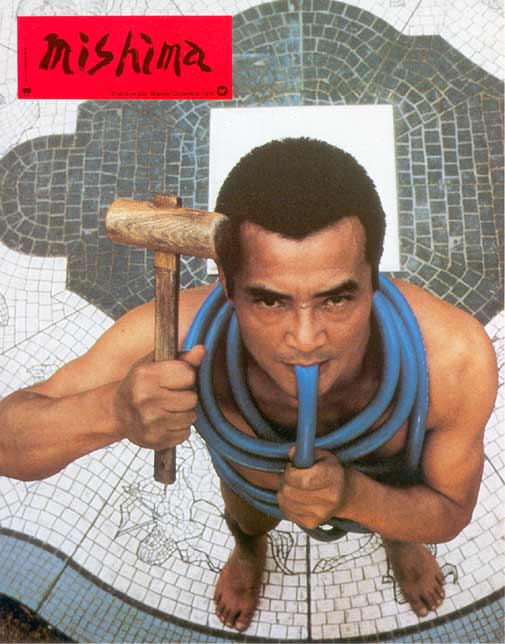
Schraders also juggles contrasting visual strategies for each section, giving the film an out-of-time feeling that serves its anachronistic subject well. Schrader's worship of Ozu can be felt in the rigid classical compositions of Mishima's stifling childhood; the 1970 scenes have a hand-held immediacy evoke a '60s radicalism that already felt like ancient history in 1985; and the scenes from The Temple of the Golden Pavilion, Kyoko's House and Runaway Horses couldn't be more contemporary. While Ogata is great as Mishima, the star of the film is production designer Eiko Ishioka, whose bold, expressive use of color and space (remastered and gorgeous on the new Criterion release) makes for a thrilling cinematic realization of Mishima's fantasies. The overt theatricality of these scenes frames the biographical sections as another form of performance, Mishima's obsession with perfecting his body and his life's final act as a transformation of his own life into a work of art (and suggests why, for some smart, socially alienated young males, samurai iconography has the same power as trenchcoats and death metal do for some of their angrier peers). For Schrader, whose filmography is filled with protagonists prone to violent acts as a statement and whose own life has been largely devoting to contriving his own persona, this venture into extremely personal territory results in his best work as a director.
But while Mishima is undoubtedly the work of an auteur, it's also a remarkable collaboration between its creative leads. Ishioka's sets, John Bailey's sharp cinematography, the precise editing by Michael Chandler and Philip Glass' exhilarating score (perhaps his best) result in a cinematic experience that is both intellectually provocative and a sensory delight. To say it's the kind of film they don't make any more would ignore the fact that films like Mishima have always been rare; one of exective producers George Lucas and Francis Ford Coppola's acts of atonement for their lavish success, it's the rare American film driven entirely by the strength of its ideas. Mishima is the kind of movie you let wash over you, its stunning images proving that, though rare, it is possible for cinema to serve as a marriage of art and action.
Sunday, July 13, 2008
It doesn't hurt to fall off the moon.
With its virtuosic opening sequence introducing us to Céline (Juliet Berto) and Julie (Dominique Labourier) through a very long game of tag, the film announces itself as an elaborate tease. As the bookish Julie and the waifish Céline meet, form a quick bond and are drawn into a completely different movie - a melodrama about a wealthy, mysterious family - Rivette and his actors (who wrote most of the film, with their director as an editor) create a series of puzzles with no definitive solutions. Rivette repeatedly blurs the line between reality and fiction, favoring a loose, informal visual strategy and natural sound. The film is less concerned with either of its narratives than with the act of storytelling - here, a state of hypnosis for a voluntary audience. I wasn't surprised to read that Rivette is a Twin Peaks fan; both directors are preoccupied with the power of imagination, but if the creative process is often dark and unsettling in Lynch's work, for Rivette it is a funhouse of endless possibilities.
The film also repeatedly references Lewis Carroll and other fairy tale tropes, but without the overt symbols of the following year's Black Moon. The magic candy that Céline and Julie ingest to jump between worlds hints at the sexual subtext of children's fantasies, but Rivette sidesteps psychoanalysis in favor of a playful approach that compliments his wide-eyed heroines, who ultiumately stand in for any writer, performer or director (after all, it takes a certain kind of person to play make believe for a living). The film's success hinges on the leads' fearlessly silly performances. Berto, who reminds of a Gallic Shelley Duvall, projects both innocence and an offbeat sex appeal - when Céline takes a shower, Berto's breasts are upstaged by her childlike unselfconsciousness. And Labourier's Julie is a marvelous comic performance, a tightly wound collection of nervous habits and compulsions undone by her new (old?) friend. The bond that the two women form is a return to innocence that, ultimately, arrives at an understated moment of epiphany before doubling back to start a new game.
In both its style and its meaning, Céline and Julie Go Boating is a liberating experience, the kind of movie that expands one's concept of cinema's possibilities. As Céline and Julie return to the movie's central mystery, hoping that maybe this time will be different, Rivette locates the source of cinema's intoxicating power - the promise of seeing through different eyes. When Céline and Julie finally go boating, it becomes clear that Rivette wants to remind us that life is indeed a dream. Maybe so; either way, dreams are rarely as sweet as this.
Thursday, July 10, 2008
The Trim Bin #71
- I finally saw Iron Man a few weeks ago, about $300 million past the point where a full review seems relevant. To summarize: big thumbs up to Robert Downey Jr., an even bigger thumbs up to Jeff Bridges, awesome robot suit business that puts Transformers to shame, funny, unpretentious, politically muddled and a bit choppy. A good time, and hopefully the sequel will be to the first as Spider-Man 2 is to Spider-Man.
- I'm usually bad at self-promotion, but with the Self-Involvement Blog-a-thon currently underway, it feels like an appropriate time to point out that I was recently the subject of Adam Ross' Friday Screen Test. Thanks, Adam, for your generous introduction - a "wanderer," eh? Interesting...
- Tom Sutpen at If Charlie Parker Was a Gunslinger... has shared an invaluable resource - the original recordings of the famous Hitchcock/Truffaut interview tapes.
- I don't write about music much because I'm just not good at it, but I have to mention an album I'm currently in love with, M83's Saturdays = Youth. It's must-listening stuff for children of the eighties, using the unmistakable sound of movies and music of the decade not as an homage or parody but to evoke the way that our lives, the songs we hear and the films we see become one in the rear view of memory. It's brainy, catchy and oddly moving - check out the video for "Graveyard Girl."