Tuesday, October 25, 2011

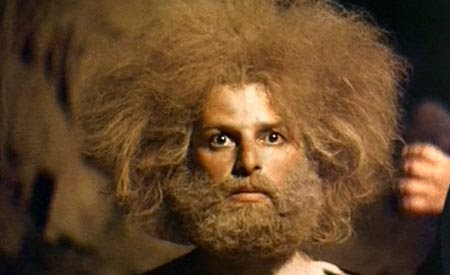
Scariest Characters in Cinema #10 - Captain Howdy


A confession: while The Exorcist is an excellent film and I've always admired it, it's never been one of my favorite horror movies. There's no denying that the adaptation of William Peter Blatty's book is brilliantly crafted, but I've always found it to be cold, calculated and difficult to fully embrace. I've always felt that Stephen King's misguided assessment of Stanley Kubrick ("I think he really wants to make a movie that will hurt people") is actually true of William Friedkin, whose directorial style is bluntly manipulative and betrays little feeling for his characters. His direction is plot-driven in the worst way, barely stopping to allow the brilliant, empathetic performances by Ellen Burstyn and Jason Miller to breathe and never really engaging with the questions of the nature of faith that it raises. Hearing the stories of how Friedkin tortured his actors - firing shotguns to startle them, verbally berating them and, at one point, slapping the real-life priest who played Father Karras' friend to get a convincingly shaky reaction shot - just make him sound like an asshole with confused priorities. None of this means The Exorcist isn't a great film, but I roll my eyes when I see it at the top of "all-time best horror movie" list instead of movies that are just as well-made but are much deeper and richer in feeling.

That said, The Exorcist is still a pretty damn impressive of what Pauline Kael called a "boo movie" - its scares are perfectly timed, and I admire how little Regan MacNeil's deterioration from a cute 11-year-old to a foul-mouthed, demon-possessed monster happens at a gradual, almost imperceptible rate. By the time she's peeing on the rug, the film's horror has crept up on us; we're as startled as her mother Chris and her party guests at the girl's personality shift. Regan's possession by an unknown demon she calls "Captain Howdy" leads to the still-startling scenes of the young girl letting out torrents of profanity and having the most blasphemous Judy Blume moment ever with a crucifix. Dick Smith's incredible makeup work, the head-spinning effects and the projectile pea soup all add to the film's effectiveness, but it's the demon's vulgar sexuality as portrayed by an adolescent girl that is responsible for its enormous, enduring popularity. This isn't a new observation, but it's true that Captain Howdy's possession of Regan is the worst-case scenario of every parent's fear of what happens when their special little girl grows up.

Blair must have been a young woman of incredible maturity, and not just for making it through what was by all accounts an ordeal of a film shoot. The believability of the story depends entirely on the performances, especially Blair's, and she is totally convincing as the possessed young girl (Eileen Dietz as Regan's stand-in in some of the more explicit shots and Mercedes McCambridge as the demon's voice deserve credit too). Blair didn't fare as well in John Boorman's Exorcist II: The Heretic, which is fascinating in the way that complete trainwrecks tend to be. Blatty's own The Exorcist III, despite studio interference, is very effective, with the emotional resonance the original lacks. It also has its own memorable monster - Brad Dourif as the resurrected Gemini Killer - and one of the best jump scares of all time. The troubled story of Paul Schrader's troubled prequel and Renny Harlin's pseudo-remake has been well-documented, and while Schrader's isn't totally without interest, neither one is very memorable. None have touched the original in terms of cultural impact - though I'm nitpicking one of the best-loved horror movies, there's no denying that it was the right scary story for its time, or that Captain Howdy still has the ability to shake us.

Monday, October 24, 2011

Dawn of the Curse of the Abominable Centipede


In case it hasn't been abundantly obvious, I love Halloween. Fall is my favorite season, and I love how, for one month, there are witches, ghosts and goblins on people's front lawns, horror marathons on TV and kids are excited to dress up as monsters and demand candy from their neighbors. Being a horror movie fan was my gateway into being a cinephile, and I love that for one month my interests, which sometimes strike people as a preoccupation with the morbid, are shared by everyone. So Dennis Cozzalio's surprised horror-themed movie quiz at Sergio Leone and the Infield Fly Rule, presented by Vincent Price's disfigured, revenge-seeking Dr. Phibes, is a very pleasant surprise. Thanks, Dennis, for another fun quiz and an excellent way to get into the holiday spirit!

1) Favorite Vincent Price/American International Pictures release.
The Abominable Dr. Phibes, as a matter of fact.

2) What horror classic (or non-classic) that has not yet been remade would you like to see upgraded for modern audiences?
The Funhouse - such a great premise, and the original is a lot of fun but not so iconic that a remake would feel like sacrelige.

3) Jonathan Frid or Thayer David?
Jonathan Frid

4) Name the one horror movie you need to see that has so far eluded you.
The Curse of Frankenstein

5) Favorite film director most closely associated with the horror genre.
John Carpenter

6) Ingrid Pitt or Barbara Steele?
Ingrid Pitt

7) Favorite 50’s sci-fi/horror creature.
The "Id Monster" from Forbidden Planet.

8) Favorite/best sequel to an established horror classic.
Dawn of the Dead

9) Name a sequel in a horror series which clearly signaled that the once-vital franchise had run out of gas.
Hellraiser IV: Bloodline

10) John Carradine or Lon Chaney Jr.?
Lon Chaney Jr.

11) What was the last horror movie you saw in a theater? On DVD or Blu-ray?
In a theater, Fright Night. On DVD, Scream 4.

12) Best foreign-language fiend/monster.
Klaus Kinski in Nosferatu.

13) Favorite Mario Bava movie.
Black Sunday

14) Favorite horror actor and actress.
Donald Pleasance and Sigourney Weaver. For all the reputable movies as she's appeared in, her performances as Lt. Ellen Ripley remain her best work.

15) Name a great horror director’s least effective movie.
Ghosts of Mars

16) Grayson Hall or Joan Bennett?
Joan Bennett

17) When did you realize that you were a fan of the horror genre? And if you’re not, when did you realize you weren’t?
Around 4 years old, sneaking into the living room late at night and glimpsing a few scenes from Halloween. I had my had my hands over my eyes for most of it, I had nightmares for a month and I couldn't wait to see the whole movie.

18) Favorite Bert I. Gordon (B.I.G.) movie.
Earth vs. the Spider

19) Name an obscure horror favorite that you wish more people knew about.
Mario Bava's Shock (AKA Beyond the Door II)

20) The Human Centipede-- yes or no?
I haven't seen it yet. I will soon, at Jason Alley's request.

21) And while we’re in the neighborhood, is there a horror film you can think of that you felt “went too far”?
One of the purposes of the horror genre is to go to far - many of the very best horror movies explore transgressive ideas and situations. That said, I have a problem with the killing of real animals in Cannibal Holocaust and a few others.

22) Name a film that is technically outside the horror genre that you might still feel comfortable describing as a horror film.
Eraserhead

23) Lara Parker or Kathryn Leigh Scott?
Lara Parker

24) If you’re a horror fan, at some point in your past your dad, grandmother, teacher or some other disgusted figure of authority probably wagged her/his finger at you and said, “Why do you insist on reading/watching all this morbid monster/horror junk?” How did you reply? And if that reply fell short somehow, how would you have liked to have replied?
I had a few teachers, over the years, who "tsk-tsked" my reading Stephen King and EC Comics, or sharing VHS copies of horror movies with classmates. At the Christian school I attended for a few years, I was told more than once that Jesus would disapprove of my fascination with horror. If I could go back in time, I'd let them know that, a few years later, Jesus would be a subject of a grisly splatter movie that is also the highest-grossing Christian-themed movie of all time. I doubt they'd believe me.

25) Name the critic or Web site you most enjoy reading on the subject of the horror genre.
Stacie Ponder

26) Most frightening image you’ve ever taken away from a horror movie.
From The Shining: The woman in Room 237, cackling maniacally as she reaches out for a petrified Jack Nicholson.

27) Your favorite memory associated with watching a horror movie.
Watching The Shining for the first time with my mom and dad. It was one of the first movies that, before I had the correct terminology to describe what I was seeing, I started to notice what a director does.

28) What would you say is the most important/significant horror movie of the past 20 years (1992-2012)? Why?
Scream. Before it was released, horror had been mostly stagnant for several years. Everything since Scream is either influenced by, borrowing or stealing from it (the long list of postmodern or self-referential horror), or a direct reaction to it (the deliberate move away from the postmodern in the form of torture porn, J-horror, etc.). This is made obvious in Scream 4, which is partly about how the series seems like an ancient relic now that the genre and its fans have completely absorbed and integrated its sense of ironic detachment (I can't tell if I admire or hate Scream 4 for being about its own irrelevance).

29) Favorite Dr. Phibes curse (from either film).
Locusts!

30) You are programming an all-night Halloween horror-thon for your favorite old movie palace. What five movies make up your schedule?
The Haunting, Suspiria, The Evil Dead, Creepshow, They Live

Sunday, October 23, 2011

Scariest Characters in Cinema #11 - Pennywise


I'm a bit of a snob about TV movies, generally refusing to group them in with feature films - while Angels in America, for instance, was among the best movies of 2003, it's a miniseries, it's its own thing, and it doesn't make sense to me to put it on a ten best list with films that are essentially a different medium. However, I have to make an exception for this list, which just wouldn't be complete without Tim Curry as Pennywise the Clown in the 1990 miniseries of Stephen King's It. The book is one of King's strongest, and Pennywise - the shape-shifting embodiment of the element of fear itself, which for some reason favors the persona of a clown as its default avatar - is King's most terrifying creation. Pennywise preys on the fears of children in the fictional small town of Derry, Maine before devouring them; set in the 1950s, the book is about a group of friends who manage to defeat Pennywise before having to return to the town 30 years later to face the clown again. Mixing moments of pulpy horror, a Lovecraftian mythology that encompasses universal good and evil, and a sensitive, Bradbury-influenced story of childhood's end, It is King's magnum opus (no small feat given he has never been into the whole brevity thing).

The miniseries is good but limited by the restrictions of network censorship, discarding the darker and more esoteric aspects of the book. Still, it's a strong effort with a good cast - the adult members of the "lucky seven" are mostly played by TV stars like John Ritter and Harry Anderson, and you can tell they're relishing being given the opportunity to play such well-crafted characters. And if there's one thing the miniseries gets absolutely right, it's the casting of Tim Curry as Pennywise. Curry has never balked at playing larger-than-life characters or creating a character beneath heavy makeup, whether the role is Dr. Frank-n-Further or Legend's Darkness. Beneath white grease paint and a flaming red wig, Curry makes hairpin turns from aw-shucks geniality to blood-curdling menace; he's one of the few actors who could be believable as a murderous supernatural clown. And director Tommy Lee Wallace, a protégé of John Carpenter, does a great job of making Pennywise's appearances unpredictable, often framing him in wide shots as the clown occupies the frame with the same uncanny quality as Michael Myers.

I watched It on its original two-night airing, when I was six; Pennywise was all I and the other kids in the neighborhood who had parents questionably permissive enough to allow them to watch It could talk about. While I can see the low-budget seams more clearly as an adult, Curry's performance still gives me the willies. I don't know whether coulrophobia was common before It - whether King was influenced by a collective fear of clowns or if his book was the impetus for the "evil clown" trend. In any case, It would make an excellent teaching tool to encourage one's children not to accept balloons from strange clowns.

Scariest Characters in Cinema #12 - Henry


I didn't really like Henry: Portrait of a Serial Killer the first time I saw it. I was put off by the banality of the characters and story - inspired by the confessions (many of which were proven false) of real-life serial killer Henry Lee Lucas, the film follows its Henry (Michael Rooker) as he kills several people, takes his dopey roommate Otis (Tom Towles) under his ring and has the saddest almost-relationship imaginable with Otis' sister Becky (Tracy Arnold). I felt Henry's crimes were shot flatly, without suspense, and the film had little to say about why Henry is the way he is. Seeing it again on 35mm last year at the terrific, greatly missed Shaun Luu Horror Fest in Syracuse, I realized the banality is the point - director John MacNaughton aims for verisimilitude, and Henry and Otis' murders are presented as pointless, sad and difficult to watch. MacNaughton seems to be withholding analysis because, ultimately, there's no explanation of Henry's actions that justifies their ugliness. He just is what he is.

The movie's most important moment is the most depressing bonding scene ever, as Henry and Becky talk about the different ways they've been physically and sexually abused. Henry confesses to having stabbed his mother, listing the ways she abused him as a child. But as he wraps up his story, he says that he shot her; Becky questions this, and he flatly corrects himself - "Oh yeah, that's right. I stabbed her." While Henry has certainly been affected by his traumatic childhood, we can't hope to explain him; he can't explain himself. Rooker's performance led to higher-profile roles and his long-running career as a reliable character actor, and deservedly so; he's totally committed to the role, never winking at the audience or playing for our sympathies. Whether Henry's buying a pack of smokes or reviewing a video recording of the night he and Otis murdered an entire family, he's consistently emotionless, cold, without remorse or self-reflection.

That the film was given an X rating by the MPAA, despite being less graphic than your average Friday the 13th sequel, says a lot about how the ratings board works. By taking violence and its consequences seriously, Henry was deemed less appropriate for teens than movies that present violence purely for entertainment. Henry: Portrait of a Serial Killer is definitely a difficult movie to watch and appreciate, but it's also an important one and, if you're in the right frame of mind, it's a fascinating, disconcerting experience.

Saturday, October 22, 2011

Scariest Characters in Cinema #13 - Billy


Black Christmas is, famously, one of the films that set the template for slasher movies. While great directors like John Carpenter built upon the techniques director Bob Clark uses here - scenes shot from the killer's POV, a Ten Little Indians-style story structure in an isolated setting, the use of a holiday as ironic backdrop - and other, less creative filmmakers simply imitated them, what's remarkable is how fresh Black Christmas still feels. The characters, young women living in a sorority house, are well-drawn and sympathetic; we feel they have lives outside of waiting to get killed in a horror movie (I'm partial to Margot Kidder as the boozy, raunchy Barb). The house itself is a marvelously gothic location, the lighting is cold and ominous, the (often handheld) camerawork and editing and atonal score work to keep us on edge. And Clark does an excellent job of creating a menacing atmosphere from the chilly underside of the holiday; Christmas carolers have never sounded so grim.

The prototypical slasher here is "Billy," a maniac who has been making obscene calls to the sorority sisters for some time and, as we see in the opening scene, is actually hiding in the attic. I'm not sure if this is the first movie to play on the old "the calls are coming from inside the house" story, but it predates When a Stranger Calls and it's certainly the best variation on that old campfire tales. We learn little about Billy during the movie; from his calls, we hear fragments of Billy adapting the voice of "Agnes" and other family members, wanting to know what happened with "the baby" - the clues we're given are more frightening because they remain unanswered (actually, there's a lot of Billy in Session 9's Mary Hobbes). And we barely see Billy, save for a few terrifying close-ups of his eye. He remains a complete mystery to us, even as the end credits roll; as Carpenter and other directors would later grasp, the scariest monsters are often the ones that remain beyond our comprehension.

Speaking of incomprehensible, Bob Clark's career went on to include A Christmas Story (where the only monster is Scott Farkus), Porky's I and II, the Sylvester Stallone/Dolly Parton vehicle Rhinestone (the only film he made that is scarier than Black Christmas) and Baby Geniuses 1 and 2 (scratch that last parenthetical remark). At least Clark, who died in a car accident a few years back, will forever have two Christmas-themed classics to his name. I haven't seen the Black Christmas remake; reading about the plot on Wikipedia, apparently Billy is given an elaborate back story that is, in part, about his being abused by his mother due to his severe jaundice. Yeah, that's clearly what the original lacked.


Thursday, October 20, 2011

Scariest Characters in Cinema #14 - Mary Hobbes/Simon


The Danvers State Hospital, the location of Brad Anderson's Session 9, was a real piece of work. A psychiatric hospital that opened in the late-19th century, Danvers State closed in the 1980s as mental health care moved away from institutionalization in favor of assisted living and community-based programs. There have long been rumors and horror stories about abusive treatment of patients, shock therapy and lobotomies used to control the hospital's populace, and since its closure it had the definite aura of a "bad place," as Stephen King would put it. Danvers is about 40 miles from my house, and it wasn't uncommon for teens to sneak onto the hospital's premises late at night looking for cheap scares.

Session 9
was filmed at the hospital, and filmmaker Brad Anderson uses the location to marvelously creepy effect. As the hospital's interiors are explored by a small asbestos removal company hired to clean up the building, the crumbling walls, labyrinthine corridors and overall decay mirror the hospital's dark past and the mental strain of the film's characters, who are dealing with financial pressure and trouble at home with their wives and spouses (this tension results in the best delivery of the line "Fuck you" in the history of cinema). The film has an almost unbearable sustained atmosphere of dread, particularly on the tapes that one member of the team, Mike (Steven Gevedon, also the movie's screenwriter) discovers and listens to over the course of the film. These tapes are records of nine sessions with a patient named Mary Hobbes, a woman suffering from dissociative identity disorder. As we meet hear from Mary's multiple personalities - the childlike Princess and the protective Billy - and their unwillingness to discuss another personality, the absent Simon, we're given suggestions that something Mary has done something terrible. This is mirrored in the main plot which, like Don't Look Now, is constantly giving us fragmented visual clues pointing towards something very bad that has happened in the narrative's present.

We eventually hear from Simon, who speaks in a low, masculine voice that is nothing like Mary's. This is something I can't really analyze, but disembodied, threatening male voices in a horror movie are one of the quickest and easiest ways to freak me the hell out. Even a pretty silly movie like Insidious can still prompt me to turn the lights on once Rose Byrne hears that creeepy male voice on her baby monitor (eeagh...). When we learn what Simon did, and what is really going on with our protagonists, Session 9 becomes disturbing in a very tragic way - when Simon tells us he lives in "the weak and the wounded," the line and everything it implies is very hard to shake. Session 9 is the scariest horror movie in the last ten years, and one of the few movies that I absolutely cannot watch by myself. As for Danvers State, it was torn down a few years back. There are now condominiums where it stood - tell me that doesn't beg for a sequel.

Wednesday, October 19, 2011

Scariest Characters in Cinema #15 - Anton Chigurh


Way back in 2007, I described Anton Chigurh as "a villian of elemental violence who cuts a bloody path towards his prey with a dogged, businesslike precision." I'm hopefully a bit less prone to overwriting than I used to be, but otherwise I still agree with my assessment of the character. Revisiting No Country for Old Men recently, I admired how the Coens are unable, in a "serious" thriller, to go for the throat with a villain who would be equally at home in a slasher movie. Everything about Chigurh (Javier Bardem) - his pallid skin, his death rattle of a voice, his quiet determination, that damn haircut - is seemingly engineered to get under our skin, and Bardem gives us the impression that Chigurh is happy for the opportunity to do so.

That's the scariest thing about Chigurh - his complete disdain for humanity and any kind of code or order outside of the maddening, self-reflexive one he has created for himself (one arbitrary enough to hinge on a literal coin toss). Yes, it's scary that he's capable of pitiless violence and cruelty, especially since he has a device that can smash your brain before you know what's happened. That's upsetting. But it's scarier knowing that he's not a psychopath or a supernatural monster but a hired hand doing terrible things in the service of his own ghastly but logical-unto-itself way of life. He's nothingness personified (say what you will about the tenets of socialism, at least it's an ethos). And worse still, for everything Chigurh is capable of, he's not the worst we have to fear. As the film's pitch-black ending suggests, he's only the messenger.

Scariest Characters in Cinema #16 - Candyman


One of Clive Barker's greatest talents is his insight into the significance of horror archetypes even as he employs them to terrifying effect. Helen Lyle (Virginia Madsen), the protagonist of Candyman (adapted from Barker's short story "The Forbidden") is a grad student who, in conducting interviews for her thesis on urban legends, hears repeated references to the Candyman, a vengeful African-American ghost with a hook for a hand who, like "Bloody Mary," appears when summoned by repeating his name five times into a bathroom mirror. The Candyman is a mixture of standard tropes of urban legends and our uneasy knowledge of our national history of racism and oppression. As Helen's research on Candyman leads her into the most dangerous housing projects of early-'90s Chicago, the film has a good deal to say about the role of oral tradition in our culture, how supernatural fears can be representative of real-life fears anxieties over poverty, crime and racial tension (Candyman was filmed during the Rodney King trial and released months after the L.A. riots).

And just as the film has successfully deconstructed urban legends and put its boogeyman in a larger social context, the Candyman (Tony Todd) appears to Helen and us to assert his existence with a vengeance. Director Bernard Rose's elegant, restrained direction does an excellent job, as Candyman stalks Helen, of blurring the line between reality and nightmares. Rose even hypnotized Madsen for her scenes with the Candyman (a technique previously used by Werner Herzog for Heart of Glass) to give her performance a hallucinatory quality. As we learn more about the Candyman's origin, the story becomes an intersection of the darkest aspects of our culture's notions of race, gender and sexuality - the Candyman is a very real manifestation of our collective guilt. But Candyman isn't just a treatise - it's a great, gory, terrifying ghost story, with a boogeyman (played with gravitas by the gravel-voiced Todd) who both elicits our sympathy and scares the bejesus out of us. The sequels don't work at all, but the original, which kept me up all night after a slumber-party screening in the fifth grade, is still deeply unsettling.

Monday, October 17, 2011

Scariest Characters in Cinema #17 - Norman Bates


Psycho is one of those movies I avoid writing about in this blog because, really, there's nothing I can say about it that you don't already know ("This just in: The Godfather is great!"). And yet this list wouldn't be complete without Norman Bates, so I'll just talk about my favorite thing about Psycho - namely, the accumulation of details pointing to its macabre punchline. There's Norman's bedroom, with its collection of toy horses, classical records and children's wallpaper, seemingly unchanged since his childhood. Or Norman's meal for Marian - sandwiches and milk - that he feels would be most comfortably enjoyed in the parlor. The way he trips over the word "invalid" when talking about his mother. The candy corn he munches compulsively during his interrogation by Detective Arbogast. And my favorite, the three (at least) meanings of the line "My hobby is stuffing things." All of these little details that seem at first endearing, once you've seen the film, reveal themselves on repeat viewings to be unmistakable signs of Norman's deeply repressed, nature and their manifestation in his relationship with his mother.

I don't mean to sound like Simon Oakland, but while Psycho is hardly a film of psychological realism (nor is it meant to be), it does pay fantastic attention to the details that make Norman, and what happens to him, completely believable and compelling within the context of the movie, as well as being darkly hilarious. Anthony Perkins is amazing as Norman, completely mesmerizing in the wordless sequence where he cleans up the mess Mother has made in the shower, culminating in that wonderful moment, before Marian's car fully submerges in the swamp, when we share Norman's tension that it will not sink, then realize how perversely Hitchcock has twisted our sympathies. As I said, you know this already, but Psycho is one of those rare movies that actually gets better with age and familiarity.

Sunday, October 16, 2011

Scariest Characters in Cinema #18 - Francis Dolarhyde


A common trait of the performances on this list is a stillness, a confident quietness that underlines the villain's sinister authority. This is definitely true of Tom Noonan's performance as Francis Dolarhyde in Manhunter, Michael Mann's adaptation of Thomas Harris' Red Dragon (the first and still the best of Harris' books featuring Hannibal Lecter). From his introduction to a captive soon-to-be-victim ("Well, here I am."), Noonan dominates the frame, both thanks to his large, imposing figure and the calm, methodical nature he uses to suggest the character's icy remove from humanity. Even when Dolarhyde is absent from the screen during FBI profiler Will Graham's (William Peterson) search for the man known as the "Tooth Fairy" by his pursuers because of the bite marks he has left on his victims (two families thus far), we feel his presence due to the elusive quality he brings to the character.

While films and TV shows often try to understand the mind of a killer - TV's "Dexter," for instance, has provided us with the title character's inner monologue for six seasons - and Harris provides a good deal of Dolarhyde's background in the book, Mann chooses to pare our understanding of the character down to the essentials. We know Dolarhyde has a corrected cleft palate, and can infer how this may have contributed to his emotional detachment from others. And we know, thanks to his stylish apartment, that for a serial killer he has outstanding taste in interior decoration (this says less about him being a serial killer than it does about him being a character in a Michael Mann movie). Other than that, he's an unknowable force to us, a mysterious Other that may well be the embodiment of the William Blake painting "The Great Red Dragon and the Woman Clothed in The Sun," which Dolarhyde idolizes and emulates - the devil as a creature of perfect strength and purpose. When Dolarhyde flirts with an actual relationship with Reba (Joan Allen), a blind co-worker, Noonan does an amazing job with such a verbally inexpressive character, suggesting Dolarhyde's desire to connect but also the constant rage he can't suppress. He's reminiscent of Boris Karloff in Frankenstein, isolated in his monstrousness.

He's the perfect counterpoint for Graham, who has warily left retirement to find Dolarhyde, disturbed by his uncanny ability to think like a monster. And also by Lecter (Brian Cox), who was caught by Graham and who, in Mann's film, is not the charismatic, darkly funny Lecter played by Anthony Hopkins; here, he's a reptile in a vivarium, and his contempt for all humankind (not just the rude and distasteful) is palpable. The good and bad guys share a brilliant understanding of their work process and a greater difficulty relating to others. This is a common theme in Mann's work, and it is evident in the methodical distance of Mann's filmmaking style (I used to regard this as a problem, now I see it as honest self-reflection on the director's part). While the 2002 film Red Dragon boasts an excellent cast, it's a hamhanded, clumsily staged film that never comes close to Manhunter's visual brilliance and thematic depth (director Brett Ratner was dismissive of Mann in interviews when the movie was released, though a couple of shots are lifted directly from the earlier film). And Noonan has played many other memorably creepy characters over the years, including (appropriately) Frankenstein's monster in the following year's The Monster Squad, the mysterious Mr. Ullman in The House of the Devil and, hilariously, Caden Cotard's lifelong stalker and imitator Sammy Barnathan in Synecdoche, New York. And thanks to Noonan and Mann, "In-a-Gadda-da-Vida" has never been the same.

Saturday, October 15, 2011

Scariest Characters in Cinema #19 - The Pale Man


Of all the amazing monsters and strange creatures born from the imagination of Guillermo del Toro, the Pale Man is the most frightening. Although Pan's Labyrinth is more of a dark fantasy than a horror film, we meet del Toro's scariest creation during 12-year-old Ofelia's quest to complete three tasks the titular faun has assigned her to prove she is the reincarnation of the princess of the underworld. She is sent to retrieve a dagger from the lair of the Pale Man, a tall, gaunt figure with drooping white skin, sharp teeth, and clawlike fingers. Most disturbing are his eyeless, featureless face and the eyes that are set, instead, in the palms of his hands. When Ofelia disregards one of the faun's instructions and plucks a grape from the Pale Man's banquet spread, he gets pretty pissed about it. He wakes up, bites the heads off two fairies who were helping Ofelia and stalks her down the long hallway to her exit; Ofelia barely escapes.

The Pale Man's appearance only takes up about five minutes of running time, but he's unforgettable. On one level, he's a great metaphor for the decadence of fascist Spain during WWII, the movie's setting. On the other hand, he works because HE BITES THE HEADS OFF OF FAIRIES, he has a horrible, unnatural howl and, when he raises his hands to his face to see, the image has a perfectly uncanny quality. He's like a Fuseli painting brought to life, the horribly perfect end result of some strange alternate thread of evolution. And he's not going to share his grapes; he's saving them for later.

Friday, October 14, 2011

Scariest Characters in Cinema #20 - Eli


Once I referred to the movie Let the Right One In as a sweet movie, and the person I was talking to said, "I wouldn't say it was sweet." Well, I said sweet and I meant it - Let the Right One In captures in aching detail the feeling of being a weird, lonely kid who, for the first time, thinks he's found someone who understands him. Based on the book by John Ajvide Lindqvist and set in a small town in 1980s Sweden, the film is about 12-year-old Oskar (Kare Hedebrant), who secretly acts out violent revenge fantasies against the schoolyard bullies who are cruel to him in the way that only kids can be. Oskar begins a tentative friendship with Eli (Lina Leandersson), a mysterious girl who lives in his apartment building, only comes out at night and isn't bothered by standing barefoot in the snow. Eli at first tells Oskar they cannot be friends, but eventually they start to form a peculiar sort of bond. She encourages Oskar to stand up for himself, and he helps her to have more fun being a kid. Which she's not, of course - she's a vampire who feeds on the locals, she's hundreds of years old and, as she informs Oskar, she's not even really a girl. None of this matters in the long run to Oskar, of course. Love is blind, particularly first love.

Eli is a sympathetic character, but she's also very monstrous and frightening. While we mostly see her as a beautiful young girl, director Tomas Alfredson perfectly times brief glimpses of the monster inside Eli. Her voice and face distort themselves subtly, only for moments, and we're reminded that Eli is primarily driven by her insatiable hunger. In Eli's human helper, a sad-eyed man in his fifties named Hakan (Per Ragnar), we are given ominous hints of what will happen to Oskar if he sticks with Eli. It's difficult to determine how much Eli is depending on Oskar to survive and how much she truly cares for him, but their relationship is a perfect metaphor for young love as a result - they boy's getting used, and he loves her for it. The title, taken from a Morrissey song, refers to the rule that vampires need to be invited into your home, and it's also an important word of caution to anyone falling in love. Besides, Eli is there for Oskar when it matters (those of you who have seen the movie know exactly what scene I'm thinking of). Matt Reeves' remake Let Me In is worthy transplant of the original to the American idiom, with strong performances and a stunning sequence set to Blue Oyster Cult. But Alfredson's original is one of the best films of the past decade, a movie that becomes deeper, more moving and more chilling every time I see it.

Also, it's like a thousand times better than Twilight.


Wednesday, October 12, 2011

Scariest Characters in Cinema #21 - The Tall Man


Phantasm is one of the best examples of the virtues of independent filmmaking, particularly with genre films. It involves a scary morgue, killer dwarves, interdimensional travel, Dune references and smooth jams - somehow, all of these strange elements, which would have never survived the development process of the studio system, work together beautifully. Its many endearing idiosyncrasies feel like they have sprung whole from the mind of writer/director Don Coscarelli, who began with the goal of scaring the pants off audiences and, in the process, created one of the most unique ongoing mythologies in horror cinema. Even when the Phantasm sequels become a bit too silly (the shotgun-wielding 10-year-old in Phantasm III, for instance) they're never generic retreads; each film legitimately continues and expands the universe developed in the first film. They're so stubbornly rooted in 1979, like the movie adaptation of the greatest stoner rock album cover ever, that I can't help but kind of love them.

Phantasm is best known, of course, for two things - the deadly flying silver spheres that deliver impromptu lobotomies to their victims and Angus Scrimm as the Tall Man, the mysterious mortician that has diabolical plans involving the aformentioned killer dwarves and parallel universes. The 6'4" Scrimm wore platform shoes to further emphasize the Tall Man's imposing figure; his disproportionate size, especially in contrast to the first film's adolescent protagonist (A. Michael Baldwin) emphasizes the way Coscarelli cleverly plays on children's fear of authority figures (Phantasm is the perfect horror movie for 10-year-olds). It's a nearly dialogue free-performance, and Scrimm's is a physical performance worthy of Max Schreck. He stalks through Phantasm's surreal universe like he owns the place - which, actually, he sort of does.

Tuesday, October 11, 2011

Scariest Characters in Cinema #22 - Asami Yamazaki


I debated whether or not to include Audition on this list. It's a film I don't have a lot of affection for, one of a particular brand of horror films that have cropped up over the last ten or so years that emphasize pain and degradation over imagination and atmosphere. The common categorization of "torture porn" isn't totally accurate, as some of the films that could be called torture porn (especially Eli Roth's Hostel movies) do possess a certain twisted humor and affection for the genre. It's more the breed of misanthropic horror that is only about endurance, proving to your friends how much disturbing shit you can take (sort of the cinematic equivalent of Warheads). It's worse when horror fans attempt to defend these movies on a subtextual level - while horror is often rich with social commentary, in these films it feels like a pretense to justify an empty experience.

I have no doubt that, in Audition, director Takashi Miike meant for the torture middle-aged widow Shigeharu Aoyama (Ryo Ishibashi) endures at the hands of the mysterious, sadistic Asami Yamazaki (Eihi Shiina), to be some form of comeuppance for his earlier objectification of the woman in his search for a new wife. But I think it's also fair to say that Shigeharu's punishment far outweighs his crime, which makes it hard to take Audition seriously as a commentary on gender politics. While it's suggested that Asami may be damaged by traumatic experiences in her youth, none of it really explains where the movie ends up. She's just a crazy bitch - I won't accuse Miike of flat-out misogyny, but if he is truly concerned about sexism in contemporary Japan, Audition is a weird way to show it.

On the other hand, I can't deny that it's a very frightening, effective movie. The last 20 minutes are almost impossible to watch, at one point teasing us with the possibility of an exit before plunging us back into the nightmare. Miike, whose other films mostly seem like the work of a hyperactive, antisocial 9-year-old scribbling grotesque revenge fantasies in his Trapper Keeper, demonstrates a surprising mastery of sustained tension here. I admire the banality of the first 30 minutes, gradually developing a sense that something is deeply wrong, until the brilliant "bag scene." Shiina is beautiful, which makes for a disturbing contrast with her sadism - I still get chills when I think of her softly chanting "kiri kiri kiri" (a Japanese onomatopoeia for "pain"). And she's creepiest at the very end, after so much ugliness, as she clearly still adores poor Shigeharu. Ain't love grand?

Monday, October 10, 2011

Scariest Characters in Cinema #23 - John Doe


The coolest thing Kevin Spacey has ever done - 15-year-old spoiler alert! - was to insist that he be uncredited in the (amazing) opening titles of Seven and kept out of the trailers and marketing materials. As John Doe, the serial killer with a Biblical agenda that Detectives Mills and Somerset (Brad Pitt and Morgan Freeman) are hunting, Spacey is barely seen or heard for the first three-quarters of the movie. When he enters the movie, covered in blood and calmly introducing himself to his pursuers ("Detectiiiive!"), it serves as much more than a "Hey, that's Kevin Spacey!" moment. For most of the movie we've seen the evidence of his grisly mission to cleanse his city of sinners, details of his brilliant, exacting and methodical nature (this is also our proper introduction to director David Fincher's flair for darkness [thematic and literal] and procedure-oriented drama). When he introduces himself to Mills and Somerset, our attention shifts from the grisly investigation to dread at how John Doe's surrender fits into his plan.

Much of the film is set up as a series of Socratic dialogues between Mills, who believes in his ability to do good in the world, and his older, more jaded partner, who believes that the world is beyond helping. When John Doe, in the back of a squad car on the way to uncover his final victims (claims) joins the conversation, he's terrifying because he clearly believes his murders are making the world a better place - he's the dark reflection of Somerset's cynicism and Mills' self-righteousness. For a murderous psychopath, he's pretty perceptive. Spacey is soft-spoken and centered (I love his delivery, when Somerset discovers a dead dog, of the line "I didn't do that"), and as he turns the tables on the detectives in horrible fashion, his obvious pleasure at the plan he's executed not only provokes Mills' wrath but ours too. The still-shocking ending (which Brad Pitt insisted in his contract not be changed by the studio) continues to disturb not just because of what's in the box but because of what it tells us about how we act upon our own morality. I'd do exactly what Mills does, and I'm not entirely comfortable with that knowledge, which is exactly as John Doe would want it.

Saturday, October 08, 2011

Scariest Characters in Cinema #24 - Mystery Man


While the films of David Lynch mostly defy genre classification, they're often as unnerving as any horror film. And Lynch's dark imagination has given us many memorable monsters - Frank Booth, Henry Spencer's baby, the monster behind Winky's - that seem as if they emerged straight from his and our collective unconscious. The scariest is the Robert Blake as the "mystery man" (as he is credited) who approaches Fred Madison (Bill Pullman) at a party in Lost Highway and informs him they've met before. Blake serves as the creepy center of one of Lynch's most elusive films, present in both storylines/universes and serving as - what? A conscience? A manifestation of Fred/auto mechanic Pete Dayton's guilt? The devil? I can't definitively put a word to what the mystery man is, which - as is often the case with Lynch's films and characters - makes him even more disturbing. We may not be able to diagram an explanation for everything that happens in Lost Highway with any certainty, but the feeling that the film is proceeding with a self-contained logic controlled by forces beyond our understanding - and the mystery man is certainly one of these - is what makes it such a disconcerting experience.

Beyond that, the mystery man is creepy because of his Kabuki makeup and lack of eyebrows, and because of Robert Blake's gravelly laugh, and because he might be at your house right now (call him). And while there's no doubt that the real-life murder of Blake's wife makes the character even more disturbing in retrospect, he's still creepy as hell even if one isn't aware of the real-life parallel between Blake and Fred Madison. There's a moment when the mystery man stalks through Lynchian darkness as he approaches Fred, camera in hand. With his other, he reaches towards Fred, laughing. Even though I know he won't touch Fred, it never fails to make me flinch.

Friday, October 07, 2011

Scariest Characters in Cinema #25 - Count Orlok


Of all the many iconic cinematic incarnations of Dracula, from Bela Lugosi to Christopher Lee to Gary Oldman, the best and most frightening remains the original, unauthorized version, Count Orlok (Max Schreck). In F.W. Murnau's silent classic Nosferatu, eine Symphonie des Grauens (a Symphony of Terror), Schreck portrays the count not as a seductive aristocrat but as a ravenous animal. With his unnaturally pale skin, clawlike hands and rodentlike teeth, he's a pitiful but nevertheless frightening creature motivated only by his hunger. The look of the character remains iconic, but the movie also remains effective 90 years later due to Schreck's eerie screen presence - Orlok's unnatural stillness, stooped posture, weirdly fluid movement and his joyless, purposeful expression as he feeds on humans make for a believably cursed and insatiable monster.

In Werner Herzog's 1979 remake of the film, Klaus Kinski gives Orlok a sort of poetic loneliness that is very affecting, and Herzog's film is in many ways the better one. And Willem Dafoe's Schreck-as-Orlok performance in the pseudo-making-of film Shadow of the Vampire is a hoot. But it remains Schreck, lurking in the corridors of his castle of the Carpathian mountains, that lingers most strongly in our memory. Aided by Murnau's masterful interplay of light and shadow, Schreck's performance is one of the key foundations for every movie monster that followed.

Thursday, October 06, 2011

Scariest Characters in Cinema #26 - Reverend Harry Powell


I never knew before reading up on The Night of the Hunter today that the book's author Davis Grub was inspired by Harry Powers, a real-life serial killer who was hanged in 1932 for the murders of two women and three children. Powers was suspected of killing up to fifty other women; of his murders, he is reported to have said, "It beat any cat house I was ever in." Powers' fictional counterpart, the Reverend Harry Powell, is just as cold-blooded. A predator who uses religion to conceal his evil nature, Powell marries, then kills the widow of a recently executed robber (Shelly Winters) in order to get closer to the woman's two kids, John and Pearl (Billy Chapin and Sally Jane Bruce), believing they know where their dad hid his loot. In the dreamlike South of Charles Laughton's film (the only one he ever directed), Powell is a snake in the grass, a devil worthy of Milton, his charm and eloquence turning on a dime into terrifying cruelty.

Mitchum is the perfect choice for Harry Powell; as the story goes, Laughton explained the character to Mitchum as "a diabolical shit," and Mitchum responded "Present!" As with his Max Cady in the original Cape Fear, Mitchum is suave, strong and able to insinuate through the force of his presence that he is capable of terrible things. He's the perfect wolf in sheep's clothing, as he's described by Rachel Cooper (Lillian Gish), an elderly women who runs a home for orphaned and abandoned children and provides sanctuary for John and Pearl. Cooper is the light to Powell's darkness in a confrontation of Biblical proportions, and it's interesting that once Powell is drawn into the light of Cooper's home, he seems less frightening, almost ridiculous. That said, I've never quite bought the cozy Christmastime denouement and Gish's monologue about the strength of the innocents. It's hard to believe that Powell is truly vanquished, that the wolf in sheep's clothing isn't merely waiting for a new disguise.

Wednesday, October 05, 2011

Scariest Characters in Cinema #27 - Severen


Any member of the family of bloodsucking rebels from Near Dark could have just as easily occupied this space. It's a movie that grew on me over the years, and as good as The Hurt Locker was, I still think this is Kathryn Bigelow's best movie. A sort of romantic vampire western, Near Dark has stood the test of time thanks to its stunning atmosphere and a strong ensemble that, guided by Bigelow's understated directorial hand, is at once fearsome, believable and totally badass. Lance Henriksen as grizzled paterfamilias Jesse, Jeanette Goldstein as matriarch Diamondback and Joshua Miller as the perpetually childlike Homer are all spooky and effective in different ways.

But it's always Severen that I think of the most when I think of Near Dark. Bill Paxton plays the hotheaded member of the family with a cocky swagger, a perpetual shit-eating grin and an all-around don't-give-a-fuck attitude. Severen is afraid of nothing and capable of anything, a self-assured predator, unfazed even when he's missing half his face. In an age of moody, self-pitying vampires who are more interested in romancing teenage waifs in the Pacific Northwest than in feasting on the living, it's kind of refreshing to watch a vampire who enjoys being a vampire as much as Severen does. And when all hell breaks loose in the film's classic barroom slaughter scene, Severen stays cool, delivering an absolutely perfect reading of the line "Finger lickin' good!" For this and so many other reasons, Bill Paxton has definitely earned a pinball machine made in his honor.

Tuesday, October 04, 2011

Scariest Characters in Cinema #28 - Decker


One of three movies on this list based on the work of Clive Barker, Nightbreed is about a young man named Boone (Craig Sheffer) who (after being framed for murder) discovers Midian, an underground city populated by an eclectic community of monsters and supernatural beings. Directed by Barker and based on his excellent novel Cabal, Nightbreed was famously meddled with by its producers, and the movie definitely feels compromised (a two-and-a-half-hour cut was screened at a Horrorhound Weekend in Indianapolis last year). Yet it retains the strength of Barker's imagination and feels like a precursor to the films of Guillermo del Toro - as with many of del Toro's films, Nightbreed has a lot of sympathy for its monsters.

It's the human characters that are truly monstrous, particularly Dr. Phillip Decker (David Cronenberg), Boone's therapist, who frames Boone for the murders that he, in fact, committed. Casting Cronenberg as a murderous sociopath was a brilliant choice; the coolly rational director is different from most horror filmmakers in that he has little interest in the supernatural. No characters from Cronenberg movies appear on this list, because the horrors in his movies are rarely personified - the monsters in a Cronenberg film are things like disease, insanity and death. Cronenberg's soft-spoken, well-mannered presence is the perfect exterior for a character who uses reason to conceal unspeakable evil. And Decker's mask, faceless except for button eyes and a zipper mouth, never fails to creep me out.

Monday, October 03, 2011

Scariest Characters in Cinema #29 - ? (red hood)


It's hard to explain the character pictured (barely) in this slide without spoiling everything that makes Don't Look Now such a haunting and memorable film. The film is about John and Laura Baxter (Donald Sutherland and Julie Christie), a married couple staying in Venice following the accidental death of their young daughter Christine. They meet a blind woman (Hilary Mason) who claims to be clairvoyant and calmly informs Laura that she can see Christine. The subtle accumulation of visual clues and juxtapositions director Nicolas Roeg, in his signature fragmented editing style, uses to keep us off-balance for most of the film come together with devastating clarity when this character appears.

I first saw Don't Look Now eight years ago at the Harvard Film Archives. I was completely absorbed by the film - the way Venice is at once beautiful and threatening, the tender and realistic portrait of a marriage, the frankness of the sex scene (which was uncommon even 30 years later), and the escalating sense of dread that makes sense when this character turns and...it would be wrong to say anything else. If you've never seen Don't Look Now, check it out.


Sunday, October 02, 2011

Scariest Characters in Cinema #30 - Samara Morgan


A horror movie doesn't need to be great cinema to be effective. The Ring, the Gore Verbinski-directed remake of Hideo Nakata's Ringu, suffers from gaping plot holes and characters who make very annoying decisions. And yet it works, thanks to its ominous atmosphere, surreal imagery and the monster at the heart of the story, a dead 10-year-old girl named Samara Morgan (Daveigh Chase). Samara's spectral projections are captured on videotape by some dudes, carrying a terrible curse that the ghost notifies the cursed about via telephone. Wackiness ensues.


You know the premise, and it's a fairly silly one, but one which Ringu made believably eerie. Nakata's film is probably the better one, but I must admit that it's the remake that gives me the willies. I love the chilling moment when Naomi Watts' clairvoyant, frustratingly cryptic son (David Dorfman) asks, "Why did you help her?" And, thanks to Rick Baker's outstanding effects work, Verbinski's attention to details like the water seeping menacingly from a TV and actor Martin Henderson's convincingly terrified performance, Samara's entrance remains one of horror cinema's most memorably creepy payoffs.


Friday, September 30, 2011

Scariest Characters in Cinema #31 - Hans Beckert


Fritz Lang's M is a masterpiece of suggestion. A story about a manhunt for a child murderer, Lang's film never shows us any details of the murders. Instead, haunting symbolic images - a stray ball, a balloon caught between telephone lines - leave us to imagine the worst. And we don't get a full look at killer Hans Beckert until halfway through the movie - his threatening presence as he stalks his prey is intimated by shadows, glimpses of a shoulder and his creepy, persistent whistling of Grieg's "In the Hall of the Mountain King." Creating as much menace through his absence from the frame as with his presence, Beckert is a very unsettling cinematic phantom that proves there's truth to the cliche that what we don't see can be as frightening as what we do see.

Much of M is focused on the process of police, civilians and the criminal underground working to catch the killer, and today's procedural dramas, from Zodiac to the many CSIs and Law and Orders, owe a debt to Lang. When the vigilante mob catches up to Beckert, his mock trial presents a cynical view of our collective thirst for vengeance. As M was made during the rise of Nazi Germany (Lang would flee for France a few years later before ending up in Hollywood), the film's distrust of mob mentality is hardly surprising. As Beckert pleads his case to his "court," claiming that he cannot change his nature, the character becomes more human and more frightening for his pathetic submission to his terrible nature.

Peter Lorre is fantastic as Beckert; the childlike eyes and high-pitched voice that would serve him well in films like Casablanca and The Maltese Falcon and, later, Roger Corman's Poe adaptations are used to chilling effect here. When his gaze is fixed on a child, Lorre is able to communicate volumes about the monster beneath his deceptively benign surface and the unspeakable urges that drive him. And though Grieg has become a huge cliche in horror movie trailers, it has never been as effective.

Wednesday, September 28, 2011

Rise of the Transforming Penguins: Part II - What I Saw On My Summer Vacation


This summer went by far too quickly. That isn't a complaint; actually, it was the best summer I can remember. After a hectic couple of years, I was finally able to relax and have a lot of fun with my family. This is why I missed writing more about summer movies as they were released; of course, it didn't help that the movies themselves were such a blur. Both the good and bad movies arrived, received a ton of press, and were on their way to the Wal-Mart bargain bin in a few weeks, replaced by the next big thing. Even the record-breaking final Harry Potter movie was gone from most of the local multiplexes by Labor Day. What little there was to say about the summer blockbusters had already been said many times over by the time I got a chance to see them. Now that things have slowed down and before the fall movie season kicks into high gear, I'll try to recap my impressions of the summer.

In May, my girlfriend Jen and I ventured to the Milford Drive-In for the one-two sucker punch of Pirates of the Caribbean: On Stranger Tides and Thor. On Stranger Tides was the worst kind of blockbuster sequel, a completely soulless machine desperately trying to keep alive a series that ran out of interesting ideas two movies ago. The previous sequels were equally pointless, but they were at least mildly interesting thanks to director Gore Verbinski's knack for appropriately epic images and grandiose setpieces. Thanks to Oscar-nominated hack Rob Marshall, On Stranger Tides looks and feels like a half-assed TV show, just like his other movies (it's stunning that this guy is a huge Bob Fosse fan). The plot is instantly forgettable and the "humor" rests entirely on the mistaken notion that Johnny Depp is inherently hilarious as Captain Jack Sparrow - in order for the character to work, he needs a real movie to subvert, not a 140-minute sketch designed to worship him. It was painful that On Stranger Tides made a billion dollars, and worse that so many of my friends gave it a pass solely because of their affection for Depp. Stop being enablers, guys.

Thor wasn't nearly as bad, but I was sort of baffled about its glowing reviews. It's half epic CGI-loaded kitschfest - Flash Gordon without the irony - and half fish-out-of-water comedy that worked better in Star Trek IV. Director Kenneth Branagh could have made this work - most of his movies, good or not, are kind of campy. But it also has to set up the Avengers movie, meaning it stops in its tracks for lots of dull exposition about SHIELD (it's good to be Clark Gregg right now). Honestly, Jen slept through most of it and I nodded off for a good portion of the middle. It was still a fun night - it was the drive-in, after all - but it's not a good sign when the tall evergreens behind the screen become more compelling to look at than the feature.

As far as comic book movies go, X-Men: First Class was much more successful. The biggest surprise of the Matthew Vaughn-helmed prequel was how much fun it is - even at their best, X-Men and X2 had a weighty self-importance (or a self-important weightiness?) that kept me from completely loving them. The dumbed-down X3 certainly wasn't preferable, but First Class is fueled by a healthy appreciation for pulp, from the sick reveal of Nazi villain Kevin Bacon's office to the snazzy retro production design to the appropriation of the Cuban Missile Crisis as the backdrop for a mutant origin story. The cast is strong, particularly Michael Fassbender as a young, angry Magneto on his way to becoming the mutant freedom fighter played by Ian McKellan. There's a cameo that ranks among the all-time best. And how can I not love a movie where (SPOILER) Kevin Bacon can absorb energy? (END SPOILER)

One of the movies I was most looking forward to was Super 8, J.J. Abrams' homage to Spielberg's '70s/'80s aesthetic. The trailer promised a throwback to the magic of E.T., Close Encounters and Joe Dante's Explorers. And it hits that sweet spot in the relationship between young protagonist Joe (Joel Courtney) and his dad (Kyle Chandler) as they struggle with the loss of Joe's mother, and in Joe and his friends' quest to finish their no-budget zombie movie. The relationships between the kids are handled sensitively and believably, and it made me nostalgic for my childhood friends and our own earnest attempts to realize our dreams. The movie's not quite the classic it wants to be, mostly because the extraterrestrial aspects of the story never quite cohere with the kids' emotional journey (as E.T. does so beautifully). But it's still a lot of fun, and the scene where Joe and the girl he's smitten with (Elle Fanning) run lines for the zombie movie takes on unexpected emotional resonance.

Probably the biggest shock of the summer is that Transformers: Dark of the Moon wasn't completely terrible. The limitation of the 3D cameras force Michael Bay to tone down his ADD-spectacular editing style and design actual shots with a purpose. The result is some surprisingly striking images and one of the few 3D movies to justify the extra dimension (the others being Avatar and Piranha). Of course, the movie's still coked-up, obnoxious, crass and frequently stupid. But Bay traded the previous movie's Minstrelbots for a bronzed John Malkovich, so on the whole it's an improvement. Now let us never speak of it again.

Then there's Harry Potter and the Deathly Hallows: Part II (or, as one local theatre's marquee called it, Harry Potter 2), which I heard more than one person my age describe as the defining movie experience of our generation. The midnight screening I attended certainly felt like geek Woodstock, and it was exciting to have that collective experience with a rapt audience. It's been hard to write about the Harry Potter series without repeating myself because the movies are so consistent - well-crafted prose with occasional moments of poetry (The Prisoner of Azkaban , Order of the Phoenix and the Nick Cave scene in Deathly Hallows: Part I remain the highlights). I was happy they left in Mrs. Weasley's best line, and genuinely moved by Snape's memories and Harry's meeting with the spirits of his family and teachers (both book and film series can be read as a gradual acceptance of the inevitable loss of all of our mentors). It may not be the defining movie of my generation, but it's easy to see why the boy wizard's speaks to grown-ups as much as kids.

If there's one thing that was disappointing this summer, it was the relative lack of solid counter-programming. There was The Tree of Life, a movie I've already argued about and will write about in greater detail once I can wrap my head around it. And Midnight in Paris, which I sadly missed. And Bridesmaids (which I wrote about here) was of course fantastic (I haven't seen The Hangover: Part II, and I hope it's better than I've heard). I thought One Day would be a nice, light romantic alternative, but it was surprisingly crappy. The biggest problem is Dexter (Jim Sturgess), the prick who is best friends with Emma (Anne Hathaway). As they engage in a 20-year will-they-or-won't-they, Dexter proved to be such a repugnant character, so completely devoid of any attractive or redeeming qualities, that I couldn't figure out why Emma would want to spend 15 minutes with the guy, let alone spending decades of her life pining for him. Hathaway's all-around loveliness can't save One Day from the couple's lack of chemistry, a gimmicky structure that thinks it's more clever than it is and a painfully cliched ending that renders the whole movie nihilistic (and not in a good way). Oh well, at least I have Hathaway as Catwoman to look forward to.

Besides The Tree of Life and Bridesmaids, the two best movies of the season were both late-summer surprises. After the brutal disappointment of Tim Burton's Planet of the Apes remake, I tried not to get too excited for Rise of the Planet of the Apes. I had nothing to worry about, as the Rupert Wyatt-directed prequel is everything I wanted it to be and more. James Franco stars as a terrible scientist who injects apes with genius genes in order to find a cure for Alzheimer's, completely fails at finding a cure and creates awful consequences for humanity in the process. As his pal Cesar, a super-smart chimp whose cruel mistreatment by humans motivates him to organize the ape uprising, Andy Serkis gives his best motion capture performance yet. The effects wizards at WETA do an outstanding job of making Cesar and his fellow revolutionaries believable characters. But what's terrific about the movie is that the effects and action setpieces are completely at the service of the story. The movie has a solid screenplay that intelligently engages with the "oppressed minority" subtext that made the original movies so great. By the end of the movie, you're actively rooting for the apes to beat the bejesus out of the humans; in an age of empty CGI spectacle, it's startling to be this moved by completely artificial characters. Here's hoping for a sequel - Viva la Revolucion!

I was also uncertain about Fright Night - I'm very fond of the original, and the remake's trailer was very iffy. Luckily, writer Marti Noxon and director Craig Gillespie remain expand upon the themes that made the original so memorable. Here, vampire-next-door Jerry Dandridge (Colin Farrell) is a sexy, charismatic threat to teenage nerd Charlie Brewster (Anton Yelchin). It's no coincidence that Charlie is a virgin; Jerry, who threatens to seduce and corrupt Charlie's out-of-his-league girlfriend Amy (Imogen Poots), would be Charlie's worst nightmare even if he wasn't a vampire. The movie understands the anxieties of geeky teenage boys all too well; Jerry's monologue about his girlfriend's "scent" is one of Ferrell's and best moments; he's sleazy and horny and clearly having a ball throughout the movie. The script is clever, David Tennant (the former Doctor Who) is hilarious as a Criss Angel-esque "dark magician," the desert atmosphere of the Las Vegas setting is very effective and there are a handful of great "Boo!" moments. Fright Night died quickly at the box office, so here's hoping it eventually finds the audience it deserves.


The most fun I've had at the movies this year, hands down, have been the times Jen and I have taken the kids with us. Luna and Tom's first trip to the movies was in July, to see Winnie the Pooh, and it was the perfect choice. It's a wonderful throwback to the classic Disney shorts, and Tom sat, popcorn in hand, eyes glued to the screen the entire time. Luna was just as interested with the theatre itself, and spent much of the movie checking out the vast, cavernous auditorium. Their second trip was a bargain matinee of Mr. Popper's Penguins, and while they weren't as into that one, Tom is now very interested in penguins - Happy Feet has joined the daily rotation with other favorites like Fantastic Mr. Fox, Toy Story, Spider-Man and Tron: Legacy (both kids are fascinated at the concept of travelling INSIDE the computer).

Luna's tastes are a bit more sophisticated - she asks me to save episodes of Louie and Curb Your Enthusiasm to watch with her. But she's not too mature to enjoy childish things - my best memories of the summer are the time spent at the playground, the awed look on their faces when Toot and Puddle visited the local library, our first trip to the beach and the near-religious experience Luna had at her first carnival. And when we recently took them to see The Lion King, they were both riveted. Everything I love about movies can be summed up in the moment, as the lights came up, when Luna exclaimed, "That was great!"