Sunday, March 12, 2006

The Trim Bin #18


- After spring break, I'll be hosting a three-week screening series on Tuesday and Wednesday nights in the library viewing room. The theme is comic adaptations. I've figured out five of the six movies I'm going to show, but I'm uncertain about the sixth slot. I could use the help of my loyal readers, so I've listed the options I'm kicking around in my head, along with their pros and cons:

Hellboy
Pros: It's a great, great movie and a smashingly successful adaptation.
Cons: I'm afraid of overwhelming the scheduele with superhero movies; I'm also honestly not sure how much there is to discuss apart from "This is so awesome." The design elements, perhaps?

From Hell
Pros: Alan Moore is the king of the genre, and he's disavowed adaptations of his work. It could be intriguing to use From Hell as a springboard to discuss why Moore feels so strongly about the inability of moviemakers to capture the essence of his work.
Cons: From Hell is a mixed bag, absolutely stunning in some scenes and sort of aimless in others. It certainly doesn't measure up to the novel; I find that flawed films can make for the most interesting discussions, but it depends on the group. When I brought it up in class, I was met with indifference except for the suggestion that we watch LXG instead.

The Crow
Pros: To me, this is the most unheralded adaptation; it really captures the undiluted grief that makes James O'Barr's comic so potent. Plus, the DVD has a fascinating, strange interview with O'Barr where he discusses his process.
Cons: The superhero thing; also, apprehension about the kind of Crow fans that might attend.

American Splendor
Pros: It's inarguably great.
Cons: It's sort of familiar around these parts, especially after the MoCA screening.

I look forward to hearing what you guys think.

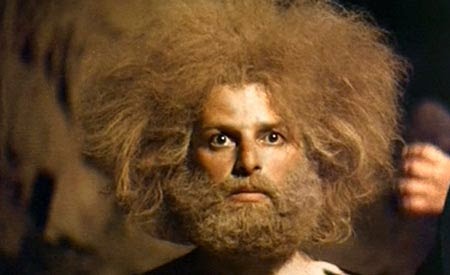
- Speaking of Alan Moore, check out this interview with the man himself from BBC2's Culture (1, 2, 3, 4, 5, 6). Moore speaks about his books, his influences, and movie versions of his work. He comes off as sharp-witted, acidic, and a bit of a prick; in other words, just the way he should be. Plus, best beard ever.

- Just got a 35mm trailer of Freddy's Dead: The Final Nightmare from eBay; played it at work the other night, and it's a beaut. Trailers are one of my most beloved forms of cinematic ephemera; I think I feel as strongly about faded 35mm as the folks behind Samurai Dreams do about VHS. But then, both formats are part of the larger state of film, aren't they? A film no longer exists as a singular work of art; each release sends waves of peripheral cultural artifacts - posters, tv spots, making-ofs, billboards, fast food tie-ins, novelizations, soundtracks, video games, toys - through our collective consciousness. These things become inextricably linked with experience; when I watch the Freddy's Dead trailer, I remember how very badly I wanted to see the film but, thwarted by my horror-fearing dad, was forced to content myself with the 3-D special issue of Fangoria (wish I still had that around). Similarly, when I saw the Children of the Corn trailer at Cinemark a few weeks ago, I reflected on how Corn was released when I was still a baby, and I was sitting there having an experience identical to one that I couldn't have possibly had when it was culturally relevant twenty-two years ago (!). It's a very potent form of nostalgia, to be sure; it's also a powerful gateway, like Proust's madeliene or Tony Soprano's capicola.

Question: Were people always nostalgic? Did people in the 1460s fondly remember the way things were in the 1430s? Or is this a new development in human experience?

Friday, March 10, 2006

Top 10: Anticipation


Now that the awards business is over, it's time to look ahead to the rest of 2006. Below are the films I can't wait to see (trailers are linked where applicable). Note that Snakes on a Plane is not included, because it is so obviously going to be the most important movie of the year that I didn't think it was even fair to compare it against mere cinema.

1. The Departed - Martin Scorsese is back in Goodfellas territory with this remake of the great Infernal Affairs, transplanted to Boston. This is the first time Scorsese has worked with Jack Nicholson, which should be a delight. Plus, I'm in it (sort of). November
2. A Prairie Home Companion - Recently honored master Robert Altman brings Garrison Keillor's cultural staple to the big screen. Perhaps the best cast of the year, featuring Woody Harrelson, Meryl Streep, Kevin Kline, John C. Reilly, Virginia Madsen, and (ahem) Lindsay Lohan. June 9
3. A Scanner Darkly - Richard Linklater returns to the style of rotoscoping used to beautiful effect in Waking Life for this adaptation of the Phillip K. Dick novel. Keanu, as always, could go either way, but it also stars Robert Downey Jr., and that's always a plus. July 7
4. The Prestiege - Christopher Nolan's adaptation of Christopher Priest's novel stars Christian Bale and Hugh Jackman as dueling magicians. Scarlett Johansson also stars, but the reason I can't wait is the presence of David Bowie as Nikola Tesla - genius. October 20
5. Grindhouse - Quentin Tarantino and Robert Rodriguez' trash double feature (complete with fake trailers!) looks to be the best junk food of the year. September 22
6. Superman Returns - KAL-EL. June 30
7. Art School Confidential - Daniel Clowes and Terry Zwigoff reteam for this raspberry aimed at art school pretensions; early reviews have been mixed, but if it's half as good as Ghost World, I'll be content. April 28
8. Marie-Antoinette - The trailer for Sofia Coppola's take on the famed headless queen hints at an audacious and just plain hip period piece. October 13
9. Zodiac - After a long hiatus, David Fincher takes on the notorious San Francisco serial killer; Gary Oldman, Jake Gyllenhal, and (yuss) Robert Downey Jr. star. September 22
10. The Fountain - Darren Aronofsky's long-gestating sci-fi/romance is finally unleashed upon us; the teaser hints at a truly mindblowing experience, so let's hope the film delivers. Fall

Thursday, March 09, 2006

I'm not too sure about her.


The most brilliant thing about Bubble is the doll factory. The characters in Steven Soderbergh's most recent "small" film spend their days removing disembodied baby heads from a press, airbrushing their skin tone and plugging in plastic eyes. The images which bookend the film of lifeless eyes staring at us say more about the fusion of the real and the manufactured in everyday life than a thousand words can. The factory is also key to understanding the people who work there, particularly Martha (Debbie Doebereiner), a character who strives for transcendence yet is bound by routine, a deadening sameness echoed in the piles of identical doll parts cluttered in corners of the frame.

Martha works at the factory with Kyle (Dustin Ashley), a soft-spoken young stoner who lives with his mother (Laurie Lee). Martha clearly adores the oblivious Kyle, but their quiet friendship is interrupted one day by the arrival of Rose (Misty Dawn Wilkins) a single mother who Kyle quickly falls for. Bubble is about these three characters, but it is also about the small Ohio town where they live, which is the sort of formless assembly of nondescript homes and prefabricated buildings that compose so much of America today. Soderbergh's film is shot on hi-def digital video, and the sharp yet fragmented quality of the format compliments the flat, yellowing texture of the locations wonderfully. In one scene, Martha accompanies Rose on a house-cleaning job; the house is one of those newly built, off-white numbers, yet Martha cannot stop raving about the beauty of it to Kyle. These characters exist in a world where a dream home need only be clean and spacious. Yet Soderbergh manages to avoid the classist condescension that damages the work of Alexander Payne; Bubble is clear-eyed, but never judgemental.

The leads are all non-actors (Doebereiner, for instance, manages a KFC), and Soderbergh elicits effective, authentic performances all around. Ashley has an understated sweetness that hints at pools of unexpressed emotion; Wilkins' sweet girl-next-door aura becomes truly grotesque as the film progresses. But Doebereiner is the real find here. As Martha, she carries her weight and emotional baggage (Martha lives at home with her elderly father) with a quiet, haunting grace. An early scene where we find Martha at church, engaged in a silent moment of - what? prayer? communion? - could have come off as unbearably arch, but Doebereiner finds a conviction in the moment that is rare among all actors, trained or otherwise. Martha remains an enigma; her face as she delivers her final line lingers beyond the closing credits.

Soderbergh isn't quite as successful at pulling off the procedural aspects of the second half. As various characters respond to a crucial plot development, the attempt at authentic responses becomes unintentionally contrived. I think I understand what Soderbergh was trying to do - underline the passivity of the characters - but even the most laconic person would probably be more expressive in such a situation. Perhaps I'm mistaken. Soderbergh seems to be attempting a minimalist approach to drama, but Gus Van Sant, for instance, pulled this sort of thing off with more clarity in Elephant. It's not enough to sink the movie, but the monotonous inevitability of the second half is a bit simpler than I think it was meant to be. In saying this, however, I do intend to return to Bubble down the line; there remains the lingering feeling that there's more going on here than meets the eye.

Soderbergh, once the golden boy of indie cinema, has been a bit underappreciated as of late. In both small films like this one and big-studio tentpoles like Ocean's Twelve (an extremely misunderstood film), he maintains a consistent vision and an unwillingness to kowtow to conventional audience demands. I suspect that, more than anything, he was attracted to the simultaneous-release model of Bubble as a means of tossing a fig at the Hollywood machine. And while I value the big-screen experience over everything and I'm not sure that Marc Cuban's answer is the right one, I'm at least glad that someone is challenging the exhibitors to fight back; we in the audience can only benefit from the outcome. Soderbergh has long rejected the title of auteur, but I'm afraid he just might have to accept it; I can't imagine Bubble being made by anyone else.

Sunday, March 05, 2006

The Trim Bin #17


NOTE (Added on Monday at 9:45): If my count is correct, a whopping two of my choices won the gold. Question - who's more culturally irrelevant, the Academy or me?

William Hurt recently described the Academy Awards as "penguins salivating over gold dildos," and that about sums it up. Still, it's a nice feeling to see recognition going to films that really deserve it. So while I suck at Oscar predictions, I figured I'd share who I'd like to win. I've excluded categories, such as animated short, to which I am obviously ignorant. You can see the full nominees list here.

Best Picture: Brokeback Mountain is the front-runner, and it's a good choice, both because it's a great, heartfelt romance and because it would be a big step towards such stories not having to carry silly sociopolitical baggage. Crash, on the other hand, would be a regression - it's a simplistic, overrated faux-indie with an empty head. Good Night and Good Luck is earnest but a touch hollow; Capote is technically superb but cold. So it'd be nice to see long-shot Munich take home the gold, but I have a feeling that Spielberg's best movie in ages will grow in reputation over time.
Best Director: I never see the point of dividing the picture and director awards, so Steven Spielberg. Ang Lee will probably win tonight, and he deserves it for this film as well as over a decade of underappreciated, subtle work. George Clooney is good, but Confessions of a Dangerous Mind was better. Bennett Miller is lucky to have Phillip Seymour Hoffman as a high school buddy. Paul Haggis can't direct traffic.
Best Actor: Front-runner Phillip Seymour Hoffman should have three Oscars by now, but I'm not really enthusiastic about Capote; his performance as the manipulative author is technically superb, but it feels like more of an exercise than his superlative work in Happiness or Boogie Nights. I'd like to see Heath Ledger win; unlike Hoffman, I'd never liked him in anything before, but his Ennis is a understated, devastating performance. David Strathairn is good, but limited by the screenplay, which uses Edward R. Murrow as a symbol instead of a person. Joaquin Phoenix is very good in Walk the Line, but not quite Cash. Haven't seen Hustle and Flow.
Best Actress: The best female performances (Naomi Watts, Maria Bello, Q'Orianka Kilcher) aren't here, so I'm a bit indifferent to this category. Reese Witherspoon is good as June Carter, and she'll probably win, but I honestly don't get the big deal (maybe I'm biased by memories of Cruel Intentions). Out of the nominess, I'd have to go with Keira Knightley, who was at least charming in Pride and Prejudice. Haven't seen Transamerica or North Country but, unfortunately, I have seen Mrs. Henderson Presents.
Best Supporting Actor: Perhaps the strongest category of the evening, with no clear front-runner. George Clooney did fine work in Syriana; his weary eyes said more than twenty endless monologues about foreign oil dependency. Jake Gyllenhal was great in Brokeback Mountain and even managed to triumph over his horrible porno 'stache. Matt Dillion is a likeable enough guy, but I'd rather have seen him win for Drugstore Cowboy (or The Flamingo Kid, for that matter) than Crash. Haven't seen Cinderella Man. So I'll be rooting for an out-of-nowhere win for William Hurt's funny, creepy, daffy performance in A History of Violence.
Best Supporting Actress: Thankfully, much stronger than the lead actress category. Rachel Weisz was good in The Constant Gardener, but after a string of mediocre performances, I can't find myself too enthusiastic that she finally made an effort. Catherine Keener is wonderful and does a fine job as Harper Lee in Capote, but she's underused and I would have preferred to see her nominated for The 40-Year-Old Virgin. I wasn't a big Junebug fan, but Amy Adams' wide-eyed, God-loving Ashley was the best thing about it, and I can only imagine that her acceptance speech would be adorable. But I really want to see Michelle Williams win; it's really clear that she poured her heart and soul into Brokeback Mountain's Alma, and the film wouldn't work without her.
Best Original Screenplay: Crash will win, and it shouldn't. How great would it be if The Squid and the Whale pulled a surprise upset?
Best Adapted Screenplay: Brokeback Mountain and A History of Violence are both deserving, but Tony Kushner and Eric Roth's Munich screenplay is the best of the year; it veers almost effortlessly between high tension and quieter, contemplative moments without ever becoming heavyhanded.
Best Cinematography: I'm almost tempted to root for Batman Begins for its brilliant use of light and anamorphic lenses, but Emmanuel Lubezki's work on The New World is simply amazing.
Best Editing: Munich. It has unbelievable momentum. Please not Crash, please.
Best Art Direction: The jaw-dropping recreations of 1930's New York place King Kong heads and shoulders above everything else.
Best Costume Design: Johnny Depp's attire in Charlie and the Chocolate Factory is, if nothing else, amusing.
Best Music: John Williams' work on Munich is his subtlest, most haunting work in years.
Best Song: I haven't actually heard any, but let's go with "It's Hard Out Here For a Pimp," because I like the idea of Three Six Mafia having Oscars.
Best Makeup: Revenge of the Sith; remember that weird planet of Cenobites ruled by Bruce Spence? I know I do.
Best Sound: When the tripods roared, I shat my pants. War of the Worlds.
Best Sound Editing: Giving King Kong a voice was a phenomenal achievement.
Best Visual Effects: Kong was steller, but a handful of the effects (the brontosaurus stampede) looked rushed. War of the Worlds, on the other hand, is frighteningly convincing in every shot.
Best Animated Film: Front-runner Wallace and Gromit was fun, but Corpse Bride was an astounding visual achievement with a sweet story (and a boon for Hot Topic sales).
Best Foreign Film: I've only seen Paradise Now, and it was good. So, Paradise Now.
Best Documentary: Without Grizzly Man this category doesn't really matter, so I'll go with the scrappily likeable Murderball.
Best Dead Person:
Applause for the "In Memoriam" segment will likely favor Johnny Carson, but I'd like to see Don Knotts win the death popularity contest. He's earned it.

Saturday, March 04, 2006

Jesus, what teeth you have!


The language of cinema is uniquely suited to the logic of dreams. So it is exciting whenever a filmmaker achieves a state that echoes our dream lives. Neil Jordan did just that The Company of Wolves, which does not so much revise as flesh out the Little Red Riding Hood tale with the dizzying intensity of a fever dream.

Rather than relating the Brothers Grimm story in a straightforward manner, Jordan and co-screenwriter Angela Carter (upon whose story the film is based) utilize a complex structure of dreams, hallucinations, and stories told to our young Riding Hood surrogate Rosaleen (Sarah Patterson) by her grandmother (Angela Lansbury). Rosaleen's older sister has been killed by wolves in the opening sequence; right off the bat, Jordan cuts between dreams and waking life, blurring the line between the two. The film is in many ways a kindred spirit to A Nightmare on Elm Street (released the same year); both films conjure perverse, sexualized boogeymen as a manifestation of their protagonists' confused adolescent fears and desires. But if Nightmare is a straightforward horror story - Freddy Kreuger is the rebellious force that must be overcome with repression - than The Company of Wolves is much thornier.

Early on, Granny tells a story about two young newlyweds whose marriage is cut short when the lupine groom (Jordan favorite Stephen Rea) must answer "the call of nature." The bride (Kathryn Pogson) remarries, and her husband eventually returns, monstrous and enraged that she has not been faithful. Here, the monster represents not rebellion but repression; while the werewolf emerges from carnal rage, the triggering incident is his wife's violation of a social contract. A later scene, where an aristocratic dinner party turns into a beastly orgy, hints at the hypocrisy of the upper class which manifests itself in a grotesque manner.

But then, I'm making this sound like a thesis paper, when it's actually a great deal of fun. Jordan is dealing with the meaning beyond the archetypes of our fairy tales and nightmares, yet rather than succombing to literal-minded theorizing, he drives these ideas home with the potency of his images. I particularly loved the haunting motif of blood staining white - a bucket of milk, a flower - that comes into focus when a "purer" character is killed and does not bleed. It can be read as violence (the sheer panic we experience when wounded) or as sex (menstruation, a torn hymen). Either way, Jordan understands that images can communicate worlds more than words can hope - language exists to categorize and encapsulate, while images are much more direct and undiluted. The Company of Wolves exists in a time that resembles the nineteenth century but never really existed; it is assembled from our collective memories of youth and crystallized by the pain of puberty.

In the end, the film departs from the conventions of the horror and fairy tale genres significantly; the malevolent force (the werewolf) is neither triumphant nor defeated. A movie about the stories we scare ourselves with, The Company of Wolves addresses the unavoidable and important truth that we create our own demons. I've often woken after a particuarly incomprehensible or fantastic nightmare and been startled by the realization that the monsters I encountered were my own creation. We fear that which is within us the most; Jordan's film reaches the conclusion that the werewolf (stand in for all that is unruly, horny, and anarchic) exists in us all. A priest, upon encountering a young werewolf, wonders whether she came from God or the Devil before concluding it makes no difference: "After all, you're just a girl." Ah, but in The Company of Wolves, we are shown that there is no such thing.

Friday, March 03, 2006

Top 10: Homo Superior


Much has been written about Brokeback Mountain as a breakthrough gay romance in mainstream cinema; it's certainly notable in that it's a movie featuring man-on-man action that my dad would love (if I could convince him to see it). Along with other films like Capote and Transamerica, the Oscar season has been dominated by talk about greater acceptance of gay characters in film; however, long before Jack and Ennis, a number of breakthrough films set the stage for the current cinematic climate. There has always been and probably been a lot of dreck in gay-themed cinema - Go Fish, anyone? But the films listed below all transcend the label of Queer Cinema, telling their stories with sensitivity and compassion.

1. My Own Private Idaho - Mike (River Phoenix)'s simple declaration of love to Scott (Keanu Reeves) by a campfire - "I really want to kiss you, man" - is one of the most achingly romantic moments in cinema, gay or otherwise.
2. My Beautiful Laundrette - Stephen Frears juggles racism and class divides in Thatcher-era England along with the sweet love story between laundromat manager Omar (Gordon Warnecke) and the flamboyant Johnny (Daniel Day Lewis). Day Lewis' performance, still his best, is the very definition of brave, and the film is unapologetically funny and sweet.
3. The Crying Game - If the twist were just a twist, than this would have been forgotten soon after the hype settled down. What makes The Crying Game a great film is the way that director Neil Jordan guides Fergus (Stephen Rea) and Dil (Jaye Davidson) to a believable and heartfelt resolution; the final scene is a lovely and understated grace note.
4. Heavenly Creatures - While it's debatable whether Pauline Rieper (Melanie Lynskey) and Juliet Hume (Kate Winslet) were gay, they were clearly passionately in love, and Peter Jackson's best film is swept up in the mad, swooning frenzy of their relationship. The tragedy of their crime is compounded by the notion that in a more permissive society, everything would have been different.
5. Hedwig and the Angry Inch - John Cameron Mitchell uses Aristotle's speech in Plato's Symposium as the heart of a sexy, sad, and just plain kickass rock epic - transplanted brilliantly from the stage - about a singer stuck between genders and borders. Better than Rent in every possible way.
6. The Beaver Trilogy - What begins as a weird story about a lanky midwestern kid who loves Olivia Newton-John becomes an insightful study of one sexually ambivalent kid (shown in documentary and played by both Sean Penn and Crispin Glover) who expresses something through drag that he could never otherwise put into words.
7. Naked Lunch - A bitter pill compared to most on this list, Cronenberg's interpretation of Burroughs' book nails the author's tortured sexual ambivalence. Peter Weller is vastly underrated here; he communicates worlds about Bill Lee's self-perception with the smallest gesture.
8. Boys Don't Cry - I'm going to have to disagree with my friend Rory's summary of this film - "I'm a transvestite. Bang. Plop." - and suggest that Kimberly Pierce's debut film is more complicated than it looks. The film proceeds with a devastating air of inevitability to its brutal conclusion; few films have hammered the inhumanity of hate crimes home with greater clarity and truth. Plus, I don't care what anyone thinks: Hilary Swank and Chloe Sevigny's love scenes are jaw-droppingly sexy.
9. Waiting For Guffman - Corky St. Clair (Christopher Guest) is a fop, no doubt. But the brilliance of Guffman is that while we laugh, we are also forced to question why we laugh. Guest's deft touch results in a preening community theatre director that is sublimely ridiculous as a person, not as a stereotype. To think otherwise, you would have to be a bastard person.
10. Philadelphia - This is more of a personal choice. Yes, the courtroom structure is familiar, and it would have been nice had the relationship between Andrew Beckett (Tom Hanks) and Miguel Alvarez (Antonio Banderas) been explored in greater detail. But Jonathan Demme's subjective visual style compliments both Beckett and Joe Miller (Denzel Washington), whose gradual change from Beckett's homophobic lawyer to his friend never feels forced for a moment. The "La Mamma Morta" scene is one of the great moments in cinema; seeing Philadelphia at the age of nine, I concluded that acceptance is the only reasonable and human path. The verdict is out whether cinema can move the hearts and minds of the masses, but it certainly works for me.

Sunday, February 26, 2006

The Trim Bin #16


Next week I'll devote this space to my Oscar picks, but this week I'd like to highlight some of the most overlooked work of the year. The films listed in the categories below have one thing in common: none were nominated in their respective categories, and they should have been.

Picture: A History of Violence Cronenberg's best film in almost twenty years is a massive achievement; its reputation will likely grow to classic status over time.
Director: David Cronenberg, A History of Violence I've never seen any sense in dividing the picture and director awards, and as I've said already, it's his best film since The Fly.
Actor: Cillian Murphy, Breakfast on Pluto Neil Jordan's film is good if uneven, but Murphy (also great in Batman Begins and Red Eye) gives a totally believable, heartfelt performance as Kitten, a lonely transvestite prone to daydreaming. The guys from Brokeback Mountain have been frequently hailed as "brave," but this is a truly daring role.
Actress: Q'Orianka Kilcher, The New World Terrence Malick's Pocohontas never betrays her newcomer status; Kilcher is endearing, then heartbreaking.
Supporting Actor: Mickey Rourke, Sin City My favorite perfomance of the year, hands down. Rourke takes a fearsome mug that Frank Miller once described as "Conan in a trenchcoat" and invests Marv with humanity and grace.
Supporting Actress: Catherine Keener, The 40-Year-Old Virgin Better here than in Capote, Keener helps steer a sex comedy into mature waters; the result could have been pretentious, but thanks to her performance and her genuine chemistry with Steve Carrell, the result is perceptive and sweet.
Original Screenplay: Broken Flowers Misunderstood as Jim Jamusch's stab at mainstream success, the story of Don Johnston is instead a subtle meditation on love, aging, and the unknown. It's his most emotional (and funniest) screenplay.
Adapted Screenplay: King Kong Remaining reverent to the 1933 film without veering into stale faithfulness, the same trio that wrote The Lord of the Rings tells a great ape story with even more interesting shades of meaning and wild ambition than the celebrated trilogy (and that's really saying something).

Also:

Cinematography: Jarhead
Art Direction: Batman Begins
Editing: The Squid and the Whale
Score: A History of Violence
Makeup: Land of the Dead
Visual Effects: Revenge of the Sith

Stay tuned for more Oscar fodder. P.S.: Don Knotts, you are missed.

Saturday, February 25, 2006

I'm head of the geek patrol.


Breasts make their first appearance about thirty seconds into Hardbodies (a title Patrick Bateman would approve of), and the first sex scene occurs immediately after the opening credits. More than Risky Business or even The Last American Virgin, Hardbodies is the quintessential 80's teen sex comedy. The filmmakers are so blatant in their goal to cram as much leering soft-core porn into eighty minutes that they forget the "comedy" aspect completely and unconsciously steer the narrative into very dark places.

Scotty (Grant Cramer) is a vapid slut who has just been evicted from his apartment. After a few nights of sleeping on the beach, Scotty is hired by Hunter (Gary Wood), Ashley (Sorrels Pickard) and Rounder (Michael Rapport), three middle-aged men who have just moved into a lavish beach house. The men offer to pay Scotty and let him live in the house; in exchange, Scotty shows them the tricks apparently required to pick up - you guessed it - hardbodies. The three men are horrifying for different reasons; Hunter represents Reagan-era oiliness, Rounder is a standard-issue horny fat guy, and Ashley, the scariest of all, is a quiet, pot-smoking doofus in a stetson. Because ladies love stoned cowboys, right?

The first hint of subtextual ugliness occurs early in Hardbodies, when Scotty's girlfriend Kristi (Teal Roberts) opens his refridgerator only to find a rotting mess reminiscent Christian Bale's fridge in The Machninist. Kristi's face registers genuine horror and disgust; Scotty unconvincingly laughs off his filthy life, and then the moment is forgotten, Harrison Bergeron-style. In Nicolas Roeg's Bad Timing, a squalid apartment is similarly used to represent a character's messed-up soul; the difference is that here, Scotty's filthiness is held up as a virtue. We learn that Scotty hasn't paid his rent for three months, and yet when he is evicted, he acts as though it's his landlord's fault. Scotty spends most of the film manipulating and deceiving women, yet there is no moment when the filmmakers indicate anything but complete enthusiasm for this horrible beach bum.

Scotty's best friend Rag (Courtney Gains) has perhaps the most off-putting introduction I've ever seen in a film, swaying stupidly while he puckers a cigarette between his lips like a duck. It's disgusting. Later, Rag jokingly offers to keep a female character company, and she responds that she isn't lonely. Rag adds, "But I am," and a genuine look of emptiness washes over Gains' face. Most of the characters in Hardbodies - the middle-aged men, the "geeks" that prowl the beach, and of course most of the women - are motivated by genuine sadness and desperation. Perhaps this explains why Scotty is being celebrated; his brainlessness leaves him too pure to be sad.

The thorniest sequence occurs when Hunter attempts to rape Candy (Crystal Shaw) on the beach. Scotty interrupts and stops Hunter, making it clear that he's going too far. What disturbs me is that the filmmakers even needed to have their main character articulate the difference between himself and a rapist. Because actually, Scotty's not all that different - he goes on to quietly chastise Candy for flirting with men in the first place. She agrees, which is no surprise as the women in this film wander around vacantly as though they're waiting to be violated. No matter how sleazy the men in this film are, they are only gently chastised by the female characters and described as "sweet" and "funny." The result is a film with a philosophy of male/female relationships that is slightly more insightful than Leisure Suit Larry.

I'd like to point out at this point that Hardbodies grossed about eight million dollars in 1984 (equivalent to fifteen today), enough to generate a sequel two years later. Not a huge hit, but it did have an audience. If it were just about breasts, than I could shrug it off, but there's something unusually mean-spirited about this one - I prefer gentler 80's sex comedies like Revenge of the Nerds. A film like this shouldn't leave you feeling vaguely depressed; to paraphrase Cybill Shepard in Taxi Driver, Hardbodies is about as exciting as saying "Let's fuck."

Friday, February 24, 2006

Top 10: Film Scores


It is a futile thing, I think, to articulate the qualities of music in writing. The best scores seem not written to but born from images; the results are haunting and indelible.

1. Vertigo - Alternately swooning, nightmarish, and melancholy, Bernard Herrmann's score brilliantly evokes the swirling, labyrinthine story of Alfred Hitchcock's most naked film.
2. To Kill a Mockingbird - By the time the opening titles are done, I'm already teary-eyed from Elmer Bernstein's lyrical ode to childhood.
3. Jaws - With two notes, John Williams tapped into our most primal sense of dread. Less talked about are the jauntier themes of the second half, which compliment the film's study of male relationships as pointedly as they announce the shark's presence.
4. Once Upon a Time in the West - Ennio Morricone's most dense, complex, rich score. Not only does it give the film almost unbearable momentum and match Sergio Leone's staggering compositions, it also tells us worlds about an near-wordless character's world-weariness and appetite for revenge.
5. Psycho - The propulsive "thriller" score of the first half gives way to the quick, sparse, piercing shower scene; Hitchcock and Herrmann manage to pioneer a brand new genre in about forty-five seconds.
6. E.T. - Steven Spielberg smartly tweaked the editing of the last reel to better suit John Williams' score, and for good reason; there is no better example of music as the emotional spine of a film. Stirring without ever being clumsily manipulative, the score goes from subtle to comic to heartbreaking to soaringly triumphant.
7. Blue Velvet - The opening theme matches the titular fabric draped across the screen; lush, and subtly strange. Angelo Badalamenti masterfully guides us through the hilarious and disturbing twists and turns of David Lynch's suburban mystery.
8. The Third Man - Overbearing to contemporary ears, Anton Krasker's odd zither score highlights shades of absurdist humor in Carol Reed's Vienna-set mystery.
9. Carrie - Pino Donaggio alternates between airy romance, rubbery porno-synth, Herrmann-inspired stingers, and dreamy, sad melodies. It should be ridiculous, and in a way it is, but it also matches Brian De Palma's menstrual horror film brilliantly.
10. Edward Scissorhands - Delicate as the title character and reassuring as a lullaby, Danny Elfman's score leads us through Tim Burton's fairy-tale suburbia with imagination, humor, and grace.

Wednesday, February 22, 2006

Play the game (2/22/06)


Last week: The Man Who Fell To Earth

Monday, February 20, 2006

The Trim Bin #15


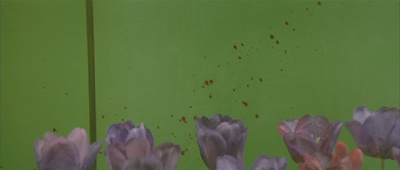
- I correctly identified the above frame-grab (from Dune) and won a copy of Class of 1984 courtesy of Film Freak Central. I've never won anything at random, let alone with a correct guess, so it put a spring in my step. I haven't seen Class of 1984 - possible writing material?

- Things are sluggish around here; the trip to Boston was a blast, but there are a dearth of good or even subtextually interesting new movies out. Consider the number-one movies in America during the last five weeks: Eight Below, The Pink Panther, When a Stranger Calls, Big Momma's House 2, and Underworld: Evolution. There's always the hope that the winter/spring doldrums will contain a surprisingly great film - The Silence of the Lambs, released in February 1991, is the best example. But more often, this is the time when we collectively bend over for a cinematic paddling before exclaiming "Thank you sir, may I have another?"

- I've had a few discussions with people lately about trying to choose a great director's worst movie, the true sign of a great filmmaker being that his/her worst film will be at least interesting and possibly better than most directors' best work. Which brings me to the next logical question: what are the best movies by terrible directors? I'll throw one out for starters: if I absolutely had to choose, I'd say that Michael Bay's best movie is The Rock.

- Writing (or pre-writing, really) is going well; dots are being connected, images are emerging. This is in many ways the most frustrating time for me, because all I want to do is share my enthusiasm at the possibilities of a blank slate (or screen) with everyone around me. But summarizing the feeling of a movie that doesn't exist yet is a poor substitute for the real thing. Any perceived tension is probably the result of this conflict. It's time to get to work.

Yessir, could be a pip.


Saturday, February 18, 2006

Top 10: Robots and Cyborgs


1. Roy Batty (Rutger Hauer), Blade Runner
2. Gigolo Joe (Jude Law), A.I.
3. Ash (Ian Holm), Alien
4. Edward (Johnny Depp), Edward Scissorhands
5. T-800 (Arnold Schwarzenegger), The Terminator
6. R2-D2 (Kenny Baker), Star Wars et. al.
7. Gort (Lock Martin), The Day the Earth Stood Still
8. T-1000 (Robert Patrick), Terminator 2
9. Robbie the Robot (Himself), Forbidden Planet
10. Johnny Five (Tim Blaney), Short Circuit 1&2

Thursday, February 16, 2006

Blood - your beautiful blood!


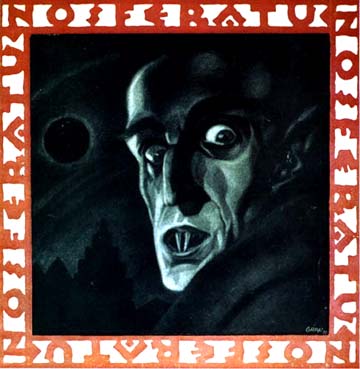
Viewing Nosferatu in the darkened cave of the Brattle, I was reminded of Henry Fuseli's painting The Nightmare. The goblin-like figure, who has taken and destroyed the beautiful woman, inspires both pity and repulsion. Yet the title also suggests that the monster is the woman's own creation; beauty and beast are inextricably linked in the nightmare cycle. Count Orlok (Max Schreck) inspires the same mixed emotions. A professor of semantics from BU argued after the film that Schrek's evil stems from his only possessing love of self, rather than love of God or of the world. Yet who amongst us has never acted out of self-gratification with unfortunate results?

The plot, well-known from countless versions of Stoker's Dracula but first filmed here, follows Hutter (Gustav von Wagenheim), a broker who travels to Orlok's castle in the Carpathian Mountains. Orlok intends to buy a home in Bremen, but when he sees a picture of Hutter's wife Ellen (Greta Schroder), he is overcome with desire. Orlok imprisons Hutter and travels aboard a ship to Germany, bringing a strange plague with him. As with most silent films, the plot is by necessity secondary to the images themselves, which achieve a singularly otherwordly atmosphere; Murnau's film feels like a waking nightmare.

The filmmaking on display here is remarkable, particularly for its time; when most films were static and uncomplicated, Murnau's film is filled with odd uncomfortable angles, and the camera is often in fluid motion. This is a horror film from before such genre distinctions were cemented, and its influence on countless filmmakers to come is evident in almost every frame. The interplay of shadow and light alone make for a definitive study of the genre. But if the main virtue of Murnau's film were its importance, than it would be a chore to watch. Instead, it remains a haunting, grandly entertaining "Boo!" movie.

The key is Max Schreck. A bit player before Murnau discovered him, Schreck is frighteningly believable as Orlok (of course, Shadow of the Vampire brilliantly played off of his verisimilitude). This is partly due to the crude but effective makeup job - the protruding canines, clawed hands and skeletal frame which Herzog and Kinski smartly chose to recreate in their remake. But Schreck also inhabits the vampire with a soulfulness that is both otherworldly and human. When he consumes a victim, there is little aggression in his manner; he almost appears to be nursing. There's a weird innocence to his crooked smile as he emerges from a coffin; his creeping walk is made more unnerving by the vacant look in his eyes. In The Nightmare, where the creature's fearsome appearance is offset by his diminutive size; similarly, Orlok is both monster and child, and it would be possible to say he deires Ellen as a lover, mother, food, or all of the above.

Ellen gives herself to the monster, and the audience at the Brattle had differing interpretations of her motives. Some saw it as a pure act of self-sacrifice, coaxing Orlok into sunlight to spare the village from the plague. Others saw it in more erotic terms, and Murnau certainly gives us visual clues earlier to support this claim. But whether or not Ellen wishes to be seduced, Orlok does not assume the role of seducer that other actors, from Bela Lugosi to Gary Oldman, would in the Dracula role. Note how little Orlok struggles against his eventual fate; one could chalk this up to awkward staging, but I prefer to think that his relative indifference to his own survival is exactly the point. It can't be much fun going through life doomed to consume everything you find beautiful; watching Nosferatu, I found myself wondering about the ways in which we doom ourselves to the same fate.

Wednesday, February 15, 2006

Play the game (2/15/06)


Last week: Friday the 13th: The Final Chapter

Monday, February 13, 2006

I'd rather be lucky than good.


Everything that does and doesn't work in Match Point can be traced back to the opening shot of a tennis ball floating back and forth over a net. It's a great, stylish moment that reminds us that Woody Allen, best known for his dialogue, can also be a nimble visual storyteller - think of the opening of Manhattan, or the entirety of the underrated Shadows and Fog. Yet the image also represents luck, as Chris Wilton (Jonathan Rhys-Meyers) informs us in voiceover. We could have guessed as much ourselves, but Allen gets his point - that life is all about luck - across in the first few moments, and proceeds to hammer it home for the next two hours. It's like a five-point essay; he tells us what he's going to tell us, tells us, and then tells us that he's told us.

Chris is a tennis pro ready to throw in the towel, and we meet him at an exclusive country club, where he teaches wealthy clients. We soon enter Patricia Highsmith country, as Chris befriends Tom Hewett (Matthew Goode) and becomes close with Tom's wealthy family, eventually marrying Tom's sister Chloe (Emily Mortimer) and going to work for their father, Alec (Brian Cox). This is complicated, naturally, by Chris' attraction to Nola Rice (Scarlett Johansson), Tom's fiancee. The two engage in a series of trysts (eew - baby oil!), deception and intrigue occur, and thematically appropriate operas are attended. All of this is familiar territory, of course. The question is, does Allen - who has tackled infidelity on numerous occasions, though usually for laughs - make this variation on a familiar theme worthwhile? Yes and no.

Allen lets his plot unfold gradually, so that when a central character makes a potentially unbelievable leap in the second hour, we can believe it (although said leap is overly telegraphed with an earlier nod to Crime and Punishment - whether Allen meant to reward or spoil the fun for a sizable chunk of the audience, I cannot say). As with Highsmith, Match Point creates tension in the experience of a newcomer's introduction to status and priveledge, which the newcomer must them go to drastic lengths to protect. The performers - including Penelope Wilton, biting and daffy as matriarch Eleanor - hit the right notes all around. But this is particularly true with Scarlett Johansson; her Nola would be easy to mistake for a conventional femme fatale if not for the details - the way she holds a cigarette, her gaze's betrayal of her words - that make her a sad, haunting character. Johansson's performance reveals Nola's bitter recognition that she and Chris are both visitors in a world they are not fit to inhabit. Consider, in the end, whether Chris has gained anything, on even a shallow level, that he is not doomed to lose.

However, as I've said, these issues are apparently secondary to Allen, who presses on with his monotonous theory of luck. Here is where the film goes awry, as very little of the story has anything to do with luck. Chris is not a passive recipient of good or bad fortune; almost from the beginning, he is the prime mover of the plot's machinations, and instigates every major plot development. Is it really luck if you do it on purpose? I know that sounds obvious, yet Allen presses on with a more simplistic version of a worldview he has depicted before, most successfully with Crimes and Misdemeanors. In that film, the Martin Landau character argues that we are all alone in the universe, and this leaves us capable of anything; the Rhys-Meyers character here represents the same notion, but in a less compelling manner. It's a frigid, misanthropic concept, played incoherently here, resulting in a film that works nicely as a potboiler (I loved Rhys-Meyers' fumbling scene in the police station) but poorly as an argument. There is a slight hint in the final scene that Allen understands the central contradiction, but it isn't defined enough to be clear whether that is indeed the case or if I'm just hoping it is.

I realize that this piece reads rather negatively for a film I did enjoy, particularly for Johansson's performance (and gams). Partly this is a baffled response to the critical consensus of Match Point as a bold departure for Allen; it all seemed rather familiar to me. Yes, it's set in England and there's no Woody-esque character, but aren't these changes rather superficial? Of his recent films, I greatly prefer Anything Else, which was panned for being too familiar; this is my way of expressing my confusion out of being out of step with collective opinion. To echo that opening shot, I feel like I've landed on one side of the fence while everyone else has landed on the other.

Sunday, February 12, 2006

The Trim Bin #14


- I can learn a lot from a well-written review arguing an opinion contrary to my own. Walter Chaw's two-star review of Munich was possibly the most insightful take on personal choice for the best film of 2005. However, I really must point you towards Cinemasalon blogger Steve Satullo's take on Spielberg's film, which I found to be, er, lacking (for starters, his is the first review I've read to draw a comparison to Ocean's Eleven). Satullo is a fellow Images Focus contributor, so I've tried to save my venom out of tact; I recommend you browse his, um, distinctive reviews and discover the Satullo experience for yourself (note that comments are disabled; like Brian O'Blivion, he prefers monologue).

- Another reason to love Spike Jonze: he helmed this nifty Gap commercial.

- Talladega Nights: I'm there.

- Yesterday I went with Jess, Jack, Max and Carol to screenings of Nosferatu and Rosemary's Baby at the Brattle. As part of something called the Faith and Film Festival, the films were followed by guest lecturers from BU and moderated audience discussion. The first one was thought-provoking and brought out a lot of the subtext of the film; the second, not so much. Still, it's good that the Brattle has secured its future through this year, and hopefully they'll meet their goals to stay open permanently; such film havens are vital. Greg mentioned in his blog and here that Video Stop, a charming little store in Bennington, will be gone within a few weeks, and it's a palpable loss. Film is at its best a communal experience, and while this internet business seems to have a future, we can only hope that there will always be places for us cinephiles to dwell.

- Okay, it's impolite but I can't resist - I have to leave you with my favorite Satulloism. From his review of The Upside of Anger:

"My mentor in film study, Professor Charles Samuels of Williams College, used to be notorious for walking out of movies in the first five or ten minutes. He was determined to see everything worth seeing, but not to waste a minute on trash. I, however, determined not to cut the performance short on anything I went into with some presupposition of quality. So if I decide to watch something, I usually watch it to the end. My god, I even made it to the end of Lethal Weapon, though it made me feel unclean to do so (but I had the sense to go nowhere near LW2 or 3 or 4.) "

Doesn't that just scream "monocle"? I'm just saying...

Friday, February 10, 2006

Top 10: Twu Wuv


Whether you plan to spend Tuesday on some gay romp with a luvah or getting drunk and crying over your Cocoa Puffs, here are some perfect films for Valentine's Day.

1. Harold and Maude - Hands-down the greatest cinematic romance. Bud Cort's death-obsessed teen meets Ruth Gordon's lively septugenarian at a funeral (they're both aficionados), and they engage in a brief, bittersweet affair. If you haven't seen this yet, you really need to - it's one of the important ones.
2. Punch-Drunk Love - The film that will make you fall in love with Adam Sandler (?!). P.T. Anderson works here with his favorite type of characters - emotionally wounded souls looking for love and acceptance - but departs from his usual operatic heaviness, creating a delicate, swooning love story set brilliantly to Shelley Duvall's rendition of "He Needs Me."
3. Sid and Nancy - Everyone's favorite idiot junkies in love. Brutal, darkly funny, and ultimately heartbreaking, Alex Cox's punk rock romance makes you ache for two extremely off-putting people, and that's the film's miracle.
4. Wild at Heart - The rowdy, violent story of Sailor and Lula is told with David Lynch's trademark surrealist panache. Dark and lush in equal measure, with searing images of fire and overwhelming color, this is one of the sexiest movies ever.
5. Say Anything - Cusack with boombox. Gabriel sing. Yes.
6. True Romance - Because if you're not willing to blast your way out of a coke-deal-turned-firefight with your guy or gal by your side, than you're not really in love.
7. Moulin Rouge - Unabashedly cheesy, over-the-top and in-your-face, yet I'll be damned if I don't love every minute of it. Yes, it's more MTV than Michael Powell, but if you let it in, your inner cornball will thank you.
8. In the Mood For Love - The anti-Moulin Rouge. Every subtle moment in Wong Kar-wai's best film is underplayed to devastating effect. There is more chemistry in a quiet moment between Tony Leung and Maggie Cheung than in your average full-blown sex scene.
9. The Terminator - Alright, don't laugh. At the heart of this movie is the story of a guy who travels through time, risking everything, motivated by love for a woman he's never even met. It's Somewhere in Time, only much, much better. I like Titanic alright, but this is easily James Cameron's most romantic movie.
10. The Purple Rose of Cairo - Although I've vowed never to revise, I must confess that it was a criminal oversight to leave this off my 1985 list. One of Woody Allen's best movies, the story of a Depression-era dreamer (Mia Farrow) romanced by a dashing adventurer (Jeff Daniels) who literally steps off of a movie screen to be with her. Funny and sad, it reminds us why our hearts connect to characters on a flickering screen; we acknowledge cinematic love to be true, and beautiful, and all too fleeting.


Thursday, February 09, 2006

Cannibal.


Film is more successful as a visual medium than as a literary one. While plotting and story structure are of course important, a great film's strength will most frequently lie in its images. Peter Greenaway's films are perfect examples of this. Like Lynch and Kurosawa, Greenaway is a painter, and this is evident in every exquisitely rendered frame of his best films. In the case of The Cook the Thief His Wife & Her Lover, his best film, Greenaway even changes the color of his female lead's costume to match each room she passes through - green for the kitchen, white for the loo, red for the dining hall. The fine-tuned opulence of the mise-en-scene not only serves as a striking juxtaposition to the cruelty and sadism on display, it is also where the heart of Greenaway's angriest film lies.

Albert Spica is a loudmouthed, vulgar, racist, boorish gangster who verbally and physically abuses everyone around him, particularly his wife Georgina (Helen Mirren), on a regular basis. The majority of the film takes place at a restaurant that Albert has forcefully taken over, to the chagrin of the long-suffering cook and rightful owner, Richard Borst (Richard Bohringer). One night, Georgina locks eyes with Michael (Alan Howard), a diner in the restaurant who sits alone every night, reading. Before long, Georgina and Michael have engaged in a passionate affair, meeting every night in the restrooms and pantries of the restaurant as Albert carries on obliviously (as Georgina notes, "It's better if it's right under his nose"). Eventually, the game is up, and the second half of the film is concerned with Albert's revenge and eventual comeuppance. The plot is relatively simple - the above summary could just as easily describe your average pulp novel. What sets The Cook... apart is its extraordinary method of storytelling, at once artificial and visceral, cerebral and emotional, beautiful and revolting.

Gambon is nothing short of brilliant in the role, delivering Albert's long, asinine diatribes about food, culture and sex with gusto. Albert is one of the most hateful villains ever created, both loathsome and pitiful. The most popular explanation of The Cook... is that this big-talking, petty crook is a stand-in for the Thatcher administration, the cook for the working class, Georgina for Britannia, and Michael as the ineffectual left. While this reading is a little too on-the-nose for me, it does point towards the palpable anger in Greenaway's film. The characters' outrage towards Albert seems muted; this is a man who pummels and humiliates his wife every night, who has left Georgina unable to bear children, and who controls everyone around him not through reason or even charm but by sheer bullying. And yet the other leads carry on as though this were to be expected ("Your husband is quite a character," Michael observes, and Georgina chuckles). They know he's stupid and evil, but they accept his presence matter-of-factly, just as we shrug our shoulders at the liars and crooks who assume control of our world. What are you gonna do?

Yet if this were merely a cerebral exercise, it would not work. Mirren is phenomenal here; in her eyes we can see a woman who gave up a long time ago, yet whose passion is reignited by an unassuming bookworm. The way Georgina holds one of Michael's books in her hands, delicately and reverentially, is heartbreaking. The sex scenes are explicit, but not exactly arousing; they are motivated by an essential need to feel, to live. The sex is mirrored in how the characters eat. Georgina is careful, noting the difference between one of Richard's works in progress before and after an extra pinch of sugar. Albert rarely stops talking long enough to eat; we see him play with his food more than enjoy it (Georgina mentions that he's not much interested in sex either). Albert remarks that "It's all shit in the end," and yet it's not to Greenaway - he lights a pepper as sensually as Mirren and Howard's nude bodies, finding a vitality and a meaning in these most essential human acts. In the end, the Richard, Georgina and Michael are victorious over Albert in that they're at least alive; he's decaying inside, just like the rotting trucks of cheap meat he deposits outside the restaurant and promptly forgets.

The Thatcher analogy breaks down for me in characterizing Michael as ineffectual; he's as much a victim of circumstance as Georgina. Three of the four leads are aesthetes, and stand in for Greenaway in various ways; this is particularly true with Michael, whose eventual fate is the result of Greenaway's frustration at - well, not quite ineffectualism, but rather impotence. Art may change people's hearts, but it does not sway governmental policy - it does not change the world, even if it should and we all hope that someday it will. So the grand guignol ending is as much Georgina's gift to Michael as it is her revenge on Albert. The theif's heart cannot be changed; surrounded as he is by fine cuisine and the awesome classical beauty of Hals' "The Banquet of the Officers of the St. George Militia of Haarlem," he still carries on with his barbarism. If Michael (and Greenaway) cannot change Albert, he can at least serve as a means to make the theif puke. It's true that Albert's comeuppance doesn't go as far as our vengeful sides would like; Georgina's control is as important as the act itself. It is enough to humiliate Albert and then be done with him. Greenaway has revealed our modern monsters for what they are; laughable creatures. It's a great, vicious "Fuck you" to the theives of the world.