Saturday, March 31, 2007

Top 10: Final Girls


I recently read Carol J. Clover's Men, Women, and Chain Saws: Gender in the Modern Horror Film, an excellent critical analysis of slasher, possession and rape-revenge movies. Clover's book challenges the conventional wisdom that horror movies are inherently misogynistic, arguing instead that they instead do a great deal to challenge traditional gender roles - it's insightful and unpretentious, the rare tome that both Slavoj Zizek and Joe Bob Briggs could appreciate. In a neat coincidence, the same day I finished the book, I read Quentin Tarantino praising the book in Fangoria as hands-down the best of its kind.
Clover's book has a great deal to say about the Final Girl - the female character who confronts the monster and lives to fight another day. The Final Girl is often but not always chaste; she survives because she is resourceful, quick-witted and perceptive. Since Tarantino's Death Proof looks to be a tribute to the Final Girl, here are some of the best examples of the archetype:


1. T. Ellen Ripley (Sigourney Weaver), Alien While most horror films telegraph their survivors early on, Ripley emerges as the Final Girl gradually - she's stoic and remote, and not as immediately likeable as fellow crew member Lambert (Veronica Cartwright). But as her shipmates are picked off one by one, Ripley remains strong and decisive when Lambert can only sob helplessly. The final twenty minutes of Alien contain almost no dialogue, but our fear is sustained largely by Weaver's sweaty, wide-eyed, unforgettable performance as she outwits the tituar xenomorph before literally blowing it away. Ripley would live to fight, die, be reborn and fight again in the subsequent films, emerging as one of the greatest characters not only in horror but in all cinema.


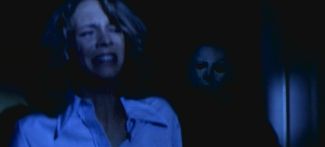
2. Laurie Strode (Jamie Lee Curtis), Halloween A self-described Girl Scout who spends Halloween babysitting while her friends are busy drinking and screwing, Laurie is perhaps the beginning of the "good girls don't die" cliché. But, as Carpenter himself has pointed out, Laurie survives not because she's chaste but because she's full of repressed sexual energy, which ties her to Michael Myers and makes her a formidable foe. Whatever the Lacanian reading may be, she's deadly with a wire hanger. Curtis, of course, reprised the Final Girl role to great effect in several films, including The Fog, Road Games and Halloween II.


3. Suzy Bannion (Jessica Harper), Suspiria Suzy is the archetypal fairy-tale heroine, an innocent lost in the haunted woods (Germany's Black Forest) and trapped at a dance school run by witches (what an awesome premise!) who have mysterious but no doubt horrible plans for her. Harper is one of the great underusedd actresses of the 70's, and the sight of her delicate, almost alabaster features shrinking at the unknown horrors surrounding her enhances our own terrifying feeling of vulnerability. The final shots of Suzy's smiling escape are wonderfully triumphant, her relief mirroring ours.


4. Fran (Gaylen Ross), Dawn of the Dead As if trying to survive the start of a worldwide zombie epidemic weren't enough, Fran is also in the early stages of pregnancy. But rather than allowing her boyfriend and their virile companions to rescue her, Fran insists on learning to fly their helicopter, fire a gun and take care of herself. When her self-reliance pays off at the film's end, it's impossible not to applaud her.


5. Sally Hardesty (Marilyn Burns), The Texas Chain Saw Massacre Sally survives through pure endurance - for nearly half the film, she does not stop running as she flees Leatherface and his demented family. Managing to escape a particularly unpleasant dinner party, Sally escapes, though sadly, she's gone completely bananas. Burns' hysterical laughter at the film's end is one of the most unsettling (and imitated) moments in horror cinema.


6. Sue Snell (Amy Irving), Carrie Sue is unique in that her survival is particuarly grim - her well-intentioned attempt to do a good deed for poor Carrie White leaves her the only surviving member of her class. Like Sally, Sue isn't in great shape at the end, and Irving's screams punctuate cinema's definitive "Boo!" scare.


7. Nancy Thompson (Heather Langenkamp), A Nightmare on Elm Street A uniquely 80's heroine, Nancy reacts to the threat of a spectral child molester who threatens to kill her in her dreams by studying booby traps and makeshift weapons - many Final Girls have confronted their monsters, but few have whacked them in the groin with a sledgehammer. It is Nancy's ability to turn her back on Freddy that ultimately defeats him, though not for good - Langenkamp would return to give oddly stitled performances in two sequels.


8. Betty (Cristina Marsillach), Opera The young diva that finds herself caught in an endless, gooey mindfuck in Argento's best giallo is memorable for her kinks. Just minutes after witnessing her boyfriend's brutal murder, she's calmly chatting about her sexual hangups; as the film proceeds, we learn more about Betty's strange family history and how it connects her with the killer. Argento literalizes the repression theme that Carpenter implied in Halloween, and the result is a marvelously twisted slasher with a Final Girl who proclaims her love of all things warm in fuzzy in a final scene that would make David Lynch proud.


9. Alice Hardy (Adrienne King), Friday the 13th
The virginal (though not drug-free) Alice isn't the most distinctive of characters, but she deserves inclusion here for three reasons. First, she kills Mrs. Voorhees and is therefore responsible for motivating her mentally challenged son - thought to be dead but apparently just wandering around the woods of Crystal Lake for two decades for no particular reason - to slaughter ten films' worth of horny teens in revenge. The second reason is her involvement in the first film's goofily perfect final scare, but less celebrated is her subsequent demise at the start of Friday the 13th Part 2, which began a tradition of slasher films' cheerfully cynical disregard for their protagonists.


10. Stretch (Caroline Williams), The Texas Chainsaw Massacre 2 The Texas DJ who runs afoul of Leatherface and his kin is referenced a great deal in Clover's book, and for good reason. While Hooper's spoofy take on his own masterpiece is uneven (and that's putting it very generously), I have an enormous amount of affection for it, largely due to the scene where Stretch neutralizes Leatherface by almost literally making love with his saw (the scene plays like the revenge of Cixous). Williams also gleefully recreates the final shot of the the first film with her own chainsaw dance - it's not the subtlest filmic representation of contemporary gender theory, but it is the grooviest.

Sidenote: while researching this Top 10, I stumbled across this completely awesome blog. I highly recommend that you check it out.

(almost) Friday Title Card #7

Sunday, March 25, 2007

Friday, March 23, 2007

Freedom isn't free.


300 is a rare thing: an utter failure of both form and content. The film, an adaptation of the graphic novel by Frank Miller and Lynn Varley, is a constant visual assault - a mishmash of iconic hero tableaux punctuated by lovingly rendered moments of decapitation and dismemberment and accompanied by a deafening cock-rock soundtrack. All of this is apparently designed to repeatedly hammer home two points: the Spartans were awesome and the Persians were homos. This is very faithful to the novel, and to Miller's xenophobic, phallocentric and frankly ridiculous worldview. But the comic form serves as a perfect frame for Miller's one-dimensional brand of storytelling, which finds a proper context in a broadly representational medium. Robert Rodriguez was smart to adapt Sin City with a healthy dose of irony - as 300 repeatedly proves, this hogwash can't be played straight. Where Rodriguez' film worked as an amoral thrill ride, director Zach Snyder (who showed promise with 2004's Dawn of the Dead) makes the grave mistake of telling this story with a straight face. The result is a film that Leni Riefenstahl would have made if she had an iMac.

The film, like the graphic novel, recounts the Battle of Thermopylae in the simplest possible terms: 300 Spartans, led by King Leonidas (Gerard Butler), manage to stand against the massive Persian army for three days. That's more or less the plot, but this should not suggest that 300 tells a story, although an omnipresent narrator spells out practically every single moment should you get confused. The bulk of the film is an extended battle sequence in which the Spartans stand up against increasingly daunting opposition from their enemies (the film is in many ways reminiscent of Mike Tyson's Punch-Out). This non-narrative is matched by Snyder's monotonous visual strategy, which mimics Rodriguez' techniques but not the director's style or wit. Glance at 300's IMDb trivia page and you'll find a wealth of information about all the cutting-edge effects programs used on the film; unfortunately, these tools are not put to use in an imaginative way. The film's images lack a proper sense of scale - every shot is big and loud (and usually slo-mo), and the result is dramatically inert and aesthetically boring.


The film also rests uneasily in a gray area between fantasy and historical fiction, making it unclear whether we are to take its thornier messages at face value. It feels almost too obvious to dwell on 300's hatred of non-whites, women and the disabled, especially since Snyder has repeatedly protested that those who dare to analyze his film as a text have "missed the point" (an interesting statement, as it implies that 300 has a point). If the film's incendiary messages were the result of a singular vision, as with The Passion of the Christ, the result would at least be perversely fascinating. But Snyder's defiant anti-intellectualism is actually far more disturbing - if the film lacks a real authorial perspective, then it becomes a sort of Rorshach test upon which the audience can project its worst instincts. The Persian army, which is inferior to the Aryan superheroes, may not be intended as a comment on its modern-day descendants, but for Snyder to ignore the ways that his film might resonate with towelhead-fearing patriots is not only irresponsible, it's pretty frigging stupid.


If there's one theme in 300 that cannot be written off as unintentional, it's the film's fear of sexual deviance. The Persians are depicted as a bunch of faggots, dykes and perverts engaging in all forms of decadence (menage a trois - shock horror!), and Xerxes is a slender, deep-throated pretty boy with a perfect manicure. When one considers how much of the film's action hinges on who will or will not kneel before Xerxes, it becomes clear that the Spartans are not fighting for freedom so much as trying to escape submission in any form. 300 is ultimately a movie about every red-blooded American male's deep-seated, unshakable fear of getting fucked in the ass. As the foundation for a narrative, it's completely retarded. But had the filmmakers followed in the example of Walter Sobchak, they could have at least had a hell of a tagline.

Friday Title Card #6

Tuesday, March 20, 2007

The Trim Bin #55


- It's time for another quiz over at Sergio Leone and the Infield Fly Rule, administered this time by Professor Irwin Corey (if you just said "who?", then Dennis can fill you in). For the uninitiated, these quizzes are a lot of fun, very thought-provoking, and have plenty of room for both Wim Wenders and Short Round.

- In my Zodiac review I described Jake Gyllenhaal as "not a great actor." After Nathaniel at the Film Experience Blog reminded me of this moment, I must admit that I may soon be forced to change my tune.

- Boston-area readers: the Harvard Film Archive is screening Roman Polanski's version of Macbeth on April 9. It's a great, unheralded movie, and I can't imagine it screens on 35mm all that often, so I highly recommend checking it out.

- While the writing at Ain't It Cool News is notoriously indefensible, I can't help but appreciate their enthusiasm. They just started a retrospective series about the summer of 1982 (a high point for geeks), and the piece on E.T. does a fine job of capturing what makes that film so perfect.

- Finally, this video from the set of I Heart Huckabees has been all over the web today, and I couldn't resist passing it along. How very zen:

Wednesday, March 14, 2007

Nonlinear Equations with Verbal Kint


Kevin Spacey rules.

Last week, I got a call from Billy Dowd, the casting director and Massachusetts native who previously cast me as an extra in War of the Worlds and The Departed. Billy asked if I wanted to work for two days on an untitled movie (which I'll refer to by its working title, 21) starring Mr. Spacey, Lawrence Fishburne and Kate Bosworth. That Saturday, I woke at 2:45 and left soon after to begin the three-hour ride to Boston. By 8:30, I was sitting in a classroom at Boston University about five feet away from Lex Luthor. What follows are some memories from the next two days - they may be a bit scattered, as I'm still catching up on my sleep, and because I just worked with Kevin Fucking Spacey.

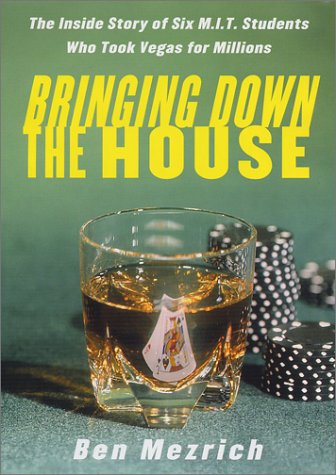
After arriving at BU and signing in, I caught up a bit with Billy and then chatted with other extras in holding. The group was a mix of experienced actors and relative newcomers like myself - I even ran into a former high school classmate who is finishing up her last semester at Emerson. We were then brought to set and given a description of the scene. The film is a somewhat fictionalized adaptation of the book Bringing Down the House, the story of a group of MIT students (BU is standing in as a location) who used their talents to make boatloads of money counting cards in Las Vegas and soon found themselves fleeing the city's heavies. The scene being filmed comes early in the film, as Spacey's character, a professor, is subtly testing his students to find the perfect recruits for his blackjack team. We were assigned seats in the classroom, the master shot was lit using stand-ins, and the actors were brought to set.

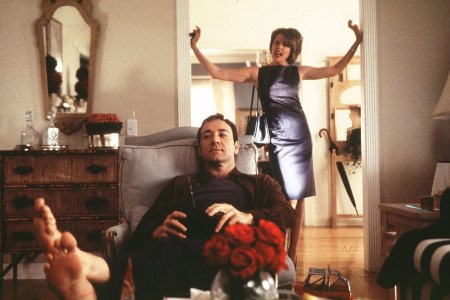
A bit of personal context: I saw American Beauty when I was fifteen, which is pretty much the perfect age to see American Beauty. And while I can objectively admit the film has dated a bit, I'm almost embarrassed to admit that it will always be one of my favorite movies - I think there's real magic in the film and particularly in Spacey's pitch-perfect performance. Add in Glengarry Glen Ross, The Usual Suspects, L.A. Confidential and Seven, and it's clear the guy was on a roll in the nineties. Of course, his recent work has been decidedly mixed, so while I was excited to work on the film, my enthusiasm was a bit muted until I began to watch Kevin Spacey work. I then spent the following two days trying not to act like a giggling thirteen-year-old girl.

The coolest thing about Kevin Spacey is that he carries not one whiff of egotistical-movie-star bullshit. While an AD gave us the standard "Do not talk to the actors" spiel, he spent a good deal of time between takes chatting with the extras, asking us where we went to school, whether we were pursuing acting professionally and whatnot. And when I said that I worked with Spacey, that wasn't hyperbole; he offered us suggestions on how to react to the scene and cracked awful jokes (the worst was a pun involving Newton the scientist and the cookie) to loosen us up. He, along with the entire crew, made us feel like an integral part of the production - after all, it would be odd if Spacey's character was lecturing to an empty classroom. I appreciate it when the extras aren't ignored (on The Game Plan, we were left to our own devices), not only because it puts us at ease, but because it's good for the movie as well, suggesting a great deal of attention to even the littlest details.

Because my job was basically to sit, stare and laugh at a few jokes, I was able to just observe Spacey develop the scene with the director and crew. His first few takes were tentative, and he fumbled a good deal of his lines ("So Kantorovich's theory of quadratic convergence states that...I don't know what the fuck I'm doing"). But as the day progressed, he began to try out slight variations on the dialogue with each take and sponatenously punctuating one line with a tossed piece of chalk. It appeared that his goal was to eliminate any actorly artifice and play the scene intuitively, to allow us to watch the character's thought process without a lot of external business. His improvisations were well chosen, too; a brief scene shot on Monday where the lead character (played by Jim Stafford, who in a nice coincidence was also the lead in Across the Universe, which my friend Kate worked on) confronts his professor wasn't very well-written, but around the third take, he ended the scene with a throwaway line ("You should get that eye checked out") that got to the heart of the scene better than any of the scripted dialogue.

Spacey can be scary when he wants to be, though. On the second day, he responded to an unsolicited line reading, telling the director, "If you're going to do that, you can't mumble." He was quiet and polite, but he might as well have said "I'm going to cut off your head and FedEx it to Brad Pitt."

Other than that moment, however, I must admit that I was pleasantly surprised by the director, Robert Luketic. I wasn't expecting much from the director of Legally Blonde and Monster-in-Law, but he possesses many of the qualities every director should have - patience, enthusiasm, imagination and almost manic energy. A young, dimunutive Australian, Luketic has a very craftsmanlike style on the set, building a scene shot-by-shot and encouraging ideas from all parties. This is in contrast to, say Michael Bay - one of the PAs had worked on Transformers and described working with Bay as a constant barrage of profanity, hubris and verbal abuse. I think that Luketic has it in him to make a good movie, and (selfishly, of course) I hope it's this one.

The most educational moment came on the second day, when I was seated next to the very kind, friendly actress Liza Lapira and found myself in the midst of the entire crew as they lit her closeup. The director of photography, Russell Carpenter, shot both Titanic and The Wizard of Speed and Time, so I paid close attention to his lighting strategy (which seemed to rely mostly on Kino Flos, diffusion and muted colors to create a soft, understated palate). I slipped in an occasional "Hey, what's that for?" when I felt I could do so without being annoying. After lunch, I spent most of the afternoon walking down a hallway past Kate Bosworth (she's pretty and sociable, but needs to eat a few cheeseburgers). And during the down time, I got a chance to talk with the former president of the Screen Actors Guild in Boston. I earned two SAG vouchers on 21, one away from being eligible to join the union. This opens up a lot of opportunities and makes acting as a career seem much more possible, but it also prevents you from doing a lot of lower-paying but potentially rewarding work. So it was valuable to have the chance to talk with someone experienced about finding your confidence as an actor and choosing the right moment to make that leap.

The oddest moment: emerging from a stall and washing my hands in an otherwise empty men's room, I glance in the mirror and notice Mr. Spacey, back towards me, relieving himself. It took all of my willpower not to say "You know, you were really good in K-Pax."

If you're wondering why the stars didn't have private bathrooms, that's what made this set so unique. There were no divisions between the stars, crew and extras, or between union and non-union - everyone ate the same meals, got the same breaks and was afforded the same level of respect. Spacey, who is also producing 21, has made a lot of noise about wanting to support new talent, and it's nice to see him put his (or Sony's, anyway) money where his mouth is. It seems that he hasn't forgotten what it was like to be just starting out and hungry for the opportunity to work even for a day. I can't say whether the movie will be any good (though I think it has a chance), but it was the most generous, positive moviemaking experience I've had in my miniscule career. And both times we broke for lunch, it took all of my willpower not to quote this scene:

Sunday, March 11, 2007

Dave, I want a gun.


Zodiac begins with a familiar scenario: a young couple parked in a secluded spot get the heebie-jeebies when they recognize a car that has been following them (the car takes the role usually occupied by a strange noise). The outcome of the scene is unsurprising, but our anticipation of violence creates immediate tension, which director David Fincher sustains with subtletly, reducing the scene to its barest visual and narrative elements, creating a moment of stark horror. Donovan's haunting "The Hurdy-Gurdy Man" joins the deafening noise of gunfire on the soundtrack as we are introduced to the titular killer ("the roly-poly man"), a villain without a face, permanently cloaked in shadow; the scene at once appeals to and subverts our expectations for the film, a meticulously crafted variation on the police procedural subgenre. Zodiac is deeply, persistently creepy in a way that few films are, obsessed as it is with our primal, deep-seated fear of unsolved mysteries and, by extension, the unknown - it's a film that deserves mention next to such masterpieces of paranoia as The Conversation and Blow Out.

The film follows the search for the Zodiac killer from the perspective of three men - San Fransisco Chronicle columnist Paul Avery (Robert Downey Jr.), detective Dave Toschi (Mark Ruffalo) and Robert Graysmith (Jake Gyllenhaal), a cartoonist for the Chronicle who ultimately wrote a book about the Zodiac that is the basis for the film's screenplay. The film's narrative spans years, then decades, chronicling all the clues, dead ends and unanswered questions accompanying the case. The first half of the film recreates the Zodiac's crimes in unflinching detail, captured in razor-sharp HD by cinematographer Harris Savides (who also shot Gus Van Sant's Elephant, a spiritual cousin to Fincher's film), and documents his years-long correspondence to the Chronicle and the SFPD, taunting their inability to uncover his identity. But as the years pass and film progresses, the Zodiac's crimes stop and his contact with his pursuers trails off - the killer is a disembodied spectre hanging over the film, and the true villain is not any of the suspects we meet but rather the aimless, dislocated feeling of dread stemming from the lack of a pat resolution. A terrifying scene set in a possible culprit's home (Who Framed Roger Rabbit will never be the same) is undercut by the failure of the evidence to incriminate said suspect. The film teases our desire for an answer, fetishistically recreating in minute detail a newsroom straight out of All the President's Men and using its intrepid protagonists as archetypal figures in the search for truth. But Fincher is ultimately concerned with how this search consumes and destroys each man. A scene where Toschi criticizes Dirty Harry (loosely based on the case) for its fascistic wish fulfillment forces us to confront our own need for retribution, which, as Fincher subtly reminds us, is rarely the same as resolution.

Zodiac's ambiguities are mirrored in the film's narrative techniques, particularly the conflict between the film's digital medium and its rigidly analog narrative structure. Zodiac is a long film, but never a bloated one - the story unfolds at a quick pace, a barrage of facts loaded into every scene. Yet Fincher raises more questions than answers - for instance, he employs titles indicating the passage of time as Kubrick did in The Shining, using repetition to underline time as an abstract concept that we collectively employ to assign continuity to our lives. When we meet the prime suspect (John Caroll Lynch) during an interrogation, the camera remains at a distance, allowing us to read whatever we choose into his guarded mannerisms and halting, defensive speech. At one point, Graysmith tells his wife (Chloe Sevigny, underused in a standard worried wife role that is the film's only weak point) that he needs to look the Zodiac in the eye and know that it's him, yet the film uses images to challenge the idea that seeing is believing. Taking place at a moment in time when modes of information were rapidly expanding, Zodiac shows us everything but explains nothing; in a sense, is the perfect horror movie for empiricists.

The performances are stellar all around - Downey is characteristically brilliant as a hipster reporter whose seeming ironic detachment is a defensive measure against his very real fears, and Ruffalo is sympathetic as a good cop beaten by the weight of time. Gyllenhaal, who has publicly bitched about Fincher's demanding methods, is like the director's Shelley Duvall; he uses the actor's earnestness to create a progagonist with ambiguous motives. Graysmith devotes decades to the pursuit of the Zodiac, putting his family's safety at risk - while other characters frequently comment on his guilelessness, his goodness (and, consequently, his identity) is defined in relation to his elusive subject. Graysmith needs to know Zodiac in order to know himself; while Gyllenhaal isn't a great actor, he works brilliantly as a character who isn't quite there.

But the real star of the film is Fincher, for whom this film marks a major step forward. This is not a dismissal of his earlier films - Seven and Fight Club are brilliant and endlessly rewatchable, but they're didactic and relatively accessible, their strength residing in the sheer visceral impact of the images. With Zodiac, Fincher takes a more subtle, disciplined approach and reveals that, in addition to his technical gifts, he's also a great storyteller. When he allows for a visual flourish such as a time-lapse shot of the Transamerica Pyramid being built brick by brick, the images have a meditative, poetic quality that enhance the film in surprising ways. Zodiac may be the film that ends up defining Fincher - it's a masterpiece, sometimes terrifying, sometimes maddening, and competely spellbinding. In an interview, Downey compared Fincher to Kubrick; he's begun to live up to the comparison, so let's just hope that he's a bit more prolific - the world needs more films as insistently alive as Zodiac.

Saturday, March 03, 2007

The padrone is dead! He told me to tell you!


The films of Bernardo Bertolucci follow protagonists who find their individual desires in conflict with the changing world around them. In Last Tango in Paris, this theme is played out in microcosm, as a middle-aged man and a young woman demolish standards of sex, love and propriety within the confines of a cramped apartment; his next film, Novecento (1900), occupies a far more sprawling canvas. The film follows its characters over the first half of the 2oth century, set against the backdrop of the struggle between Communism and Fascism in a newly unified and rapidly changing Italy. It's easy to see why this story would be appealing to the director, and intriguing to consider the ways that the film itself is a struggle between Bertolucci the classicist and Bertolucci the revolutionary. While the result is not always successful, it is endlessly fascinating.

1900 begins at the end of WWII before moving to its titular year, on the day of Verdi's death, as two children are born to two different families. The aging padrone (Burt Lancaster) of a wealthy land-owning family invites one of his laborers (Sterling Hayden) to drink with him to celebrate the birth of their grandsons on the same day. The film follows these two boys as they grow into men, the wealthy Alfredo (Robert de Niro) reminiscent of Henry V as he leads a naively hedonistic life before inheriting his role as the new padrone, and his childhood friend Olmo (Gerard Depardieu) becomes a leader in the Communist movement. Olmo and Alfredo's story, which follows them from their childhood friendship through old age, would be enough for one film, but Bertolucci's vision is staggering in scale. 1900 unfolds deliberately, allowing plenty of time for supporting characters like Lancaster and Hayden's patriarchs and stopping to observe moments like the killing and butchering of a pig. There's no doubt that Bertolucci, fresh off the international success of Last Tango in Paris and equipped with a cinematic "Get Out of Jail Free" card, is being wildly self-indulgent. But I must confess that for me, self-indulgent is not always a dirty word; a film should be to some extent a catalog of a filmmaker's preoccupations, desires and turn-ons. So while 1900 often sacrifices narrative clarity in favor of spectacle, the result is a uniquely immersive cinematic experience that is as emotionally rich as it is intellectually rewarding.

The images in 1900 are painterly yet unsentimental, evoking a kind of clear-eyed nostalgia for the then-recent past. Bertolucci and cinematographer Vittorio Storaro linger on sweeping landscapes and bucolic scenes from life in rural Italy - the frame is filled with soft greens, yellows and browns that recall the early modernists (the opening credits play over Pellizza da Volpedo's "The Fourth Estate"). At the same time, the camera often stops to linger on the grungy details of everyday life - a horse defectating, frogs twitching on the end of a string, the juice of a smashed watermelon dripping down the lens. Bertolucci uses these details to portray the Communists as more vital, connected as they are by their livelihoods to "milk and shit" (Lancaster's summary of the earth's fruits), while the bourgeois live a relatively cloistered existence, their refinements disconnecting them in some elemental way from their humanity. And yet it's clear that the director is in love with the beautiful surfaces of the aristocracy, going so far as to eroticize wealth in the form of Alfredo's petulant but mesmerizing wife Ada (Dominique Sanda) while allowing Olmo's wife (Stefania Sandrelli) to disappear without warning during the intermission. At the center of the film is the conflict between Olmo and Alfredo as the former becomes driven by his cause while the latter grows apathetic, doing nothing to help his friend; while Bertolucci's political allegiance is with the former, it's clear that he has sympathy for the latter, and 1900 is perhaps best viewed as a filmmaker's battle between his moral convictions and his aesthetic fetishes.


And this being a Bertolucci film, sex is used as a means to lay bare the characters' motivations and unspoken desires. This is most apparent when Olmo and Alfredo end up in bed together with a prostitute (Stefania Casini) - the scene leaves nothing to the imagination, yet it is not at all exploitative. It makes clear Alfredo's unspoken attraction to Olmo, and in particular Olmo's life, and Olmo's provincial morality, which prevents him from becoming a total radical. Both actors are winningly vulnerable (De Niro in particular is surprisingly earnest), and Bertolucci's lens renders them not only physically but also spiritually naked - the rest of the film hinges, in a sense, on this scene. In particular, it establishes the separation of both men from Attila (Donald Sutherland), the leading fascist in the town. Sutherland is incredible in the role, an embodiment of the Reichian notion of sexual repression as the root of fascism (an idea that also drives Pasolini's Salo). When Attila traps and does perverse things to a young boy in response to a slight from his employer, Alfredo, the gory climax of the scene is an orgasm of sorts, demonstrating in stark terms how sex has been transformed into violence. Few filmmakers have taken "Make Love Not War" to heart as Bertolucci has, and while one can question his methods, it's impossible to doubt their visceral impact.


There has been much debate about 1900's ambiguous, seemingly out-of-left-field ending. While such a whimsical note seems at first ill-fitting, the moment of levity actually serves to reframe the film in a fascinating way. Bertolucci allows the clash of ideologies to extend beyond the frame - this is, after all, a story that has not yet reached its end. Ultimately, 1900 is a celebration of the moment in time when it became possible for ideas to rule the world. Perhaps it is inevitable that such subject matter can only lead to a staggering, often unwieldly work of cinema. But if that is the case, than perhaps it is also true that this is merely a reflection of the world live in, when empires rest on ideals like elephants balancing on the head of a pin.

Monday, February 26, 2007

Sunday, February 25, 2007

It's just a dumb movie.


In the pre-credits opening of Hardbodies 2, a bird shits on James Karen (playing the director of the dumb softcore flick within this dumb softcore flick). The moment is an obvious self-critique from the filmmakers, who are also responsible for the first Hardbodies; throughout the film, Karen's boorish, idiotic director is similarly humiliated, abused and mocked. Hardbodies 2 is a horrible movie made by people who know they make horrible movies, and while this doesn't make it any less horrible, it is at least perversely interesting.

Scotty (Brad Zutaut, replacing Grant Cramer), the protagonist of the first Hardbodies, arrives in Greece to make a T&A picture. No explanation is given for how this character became an actor, and he's a curious choice for a marquee idol, looking like Jeff Daniels and Martha Plimpton took a trip through Seth Brundle's pods together. Like Inland Empire, the plot of the film-within-a-film dovetails with Scotty's story, burdened as he is with a fiancee (Brenda Bakke) who doesn't realize how hard it is to be a giant walking erection. Groins are kicked, gas is passed and mullets are ubiquitous. While none of this is surprising, the suggestion that the filmmakers are intelligent enough to realize that they suck makes things even worse. If they had demonstrated the wit to actively parody the first film, that would at least make them more recognizably human; instead, they deliver even the most horrid "jokes" with a shit-eating grin, implying that the joke is, in fact, on us for being too pretentious to enjoy the simple, old-timey pleasures of gay jokes and boner fodder.

While Karen (uncharacteristically bad here, though Orson Welles probably couldn't do better) flails about like an enormous ass, the filmmakers aren't poking fun at their incompetence so much as their doofishness. It's clear that they idolize Scotty, who is presented as a straightforward romantic hero (the word "love" is invoked in alien ways here). Towards the beginning, it seemed that at least the film wouldn't spiral into total misogyny, allowing Scotty's fiancee to voice her frustration at his womanizing. But of course, this is just a setup for her inevitable humiliation and rejection, the explicit message being that guys who score a lot are awesome and women who have multiple partners are deplorable sluts.

While none of this is surpising, it's still unusually pathetic compared to superior 80's teen sex comedies of the at least make some reference to the emotional consequences of sex (The Last American Virgin) or take time to grant women the right to sexual pleasure (Porky's). And Russ Meyer proved that breasts can be enough of a subject to sustain an entire film. But the Hardbodies movies are far worse than that; they're not motivated by eroticism, but by a desire to entrap, objectify and dominate women using the camera as a weapon. Hardbodies 2 hates sex, women and movies. If you like this movie, you are probably a chimp.

Friday, February 23, 2007

Thursday, February 22, 2007

It's time for the awards - the Hollywood Awards!


In attempting to write commentary for my Oscar preferences this year, I find that my thoughts keep returning to one basic truth:

The Departed for Best Picture. Scorsese for director. He's the best American director working today, and The Departed is everything a Best Picture winner should be - big, entertaining, smart, visceral, full of stars doing terrific work and destined to become a classic. If The Departed wins, it will be the coolest choice since The Silence of the Lambs. It's just that great.

Please, AMPAS, get it right this time. You owe me after the merciless gutpunch that was Crash. Do it for Queenan.


The rest (at least, the ones I have an informed opinion on):

Actor: Forrest Whitaker, The Last King of Scotland Not a great movie, but by far the strongest performance in a weak field.
Actress: Kate Winslet, Little Children Never going to happen, but a guy can dream.
Actor: Jackie Earle Haley, Little Children Wouldn't mind Wahlberg or Arkin winning either.
Supporting Actress: Rinko Kikuchi, Babel Not a fan of the movie, but Kikuchi does moving work with pretty horrid material.
Original Screenplay: Pan's Labyrinth Wouldn't mind a Letters From Iwo Jima win here.
Adapted Screenplay: The Departed Children of Men is the better film, but William Monahan's script is close to perfect.
Animated Feature: Monster House Why not?
Documentary Feature: Jesus Camp I'm not really crazy about any of the nominees; I'm going with Jesus Camp mostly because it's the only one I've seen that doesn't reek of self-importance.
Foreign Language Film: Pan's Labyrinth ¡El hombre pálido!

Cinematography: Children of Men Go Chivo!
Art Direction: The Prestige Tesla's Colorado hideaway is jaw-droppingly cool.
Editing: The Departed I heart Thelma.
Visual Effects: Superman Returns Even if Supes bored you to tears, you have to admit it looked pretty nifty.

Costume Design: Marie Antoinette Sneakers and all.

Makeup: Pan's Labyrinth Fuck Click.

Sound Mixing: Pirates of the Caribbean: Dead Man's Chest Mostly for the ominous "THUMP" of Davey Jones' pegleg.

Sound Editing: Letters From Iwo Jima Not just for its explosions, but for its moments of silence.

Best Score: Pan's Labyrinth A great score as integral to the narrative as Close Encounters of the Third Kind.

Sunday, February 18, 2007

The most beautiful things in the world are most useless - peacocks and lilies, for instance.


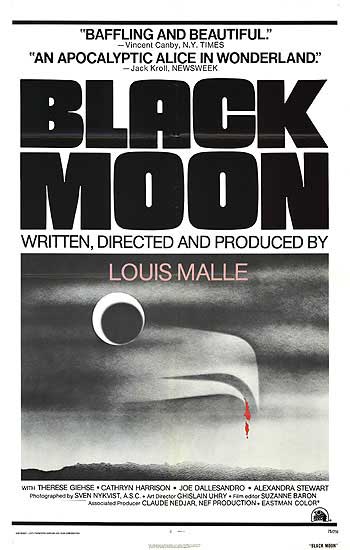
Black Moon alludes heavily to Alice's Adventures in Wonderland and Through the Looking Glass, which makes perfect sense; Lewis Carroll's books are progenitors of a long line of absurdist works, and Louis Malle's film succeeds in this tradition. And while Black Moon is a strange, elusive and haunting success in its own right, it is even more impressive when placed in the context of Malle's other work, which is characterized by precise insight into the human condition but remains firmly rooted in a world that is recognizably our own. Here, Malle takes his recurring themes and concerns and disappears down a rabbit hole; the result is a brilliant realization of the uncanny.


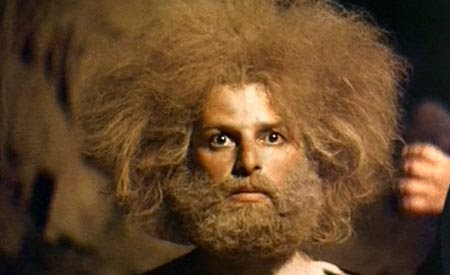
Lily (Cathryn Harrison) is a teenage girl roaming through an overcast countryside; civilization has collapsed (or is perhaps yet to begin), and gas-masked men summarily execute women on sight. After conversing with some insects, Lily escapes to an isolated farmhouse where she meets a bedridden elderly woman (Thérèse Giehse) who talks into a two-way radio connected to the infinite when she isn't conversing in an unknown language with a rat named Humphrey. Also coming and going are a mute young man (Joe Dallesandro) and his sister (Alexandra Stewart), who is cruel to Lily for unknown reasons and who provides the old woman with a puzzling form of nourishment. Characters die and are born again, a gang of naked feral children herd pigs, and a unicorn appears out of thin air to mock Lily's assumptions about the world she finds herself in. The proceedings are delibrately strange, but Malle uses the Alice connection to provide us with the foundation for a frame of reference. But Black Moon's most drastic departure from its source is its lack of a clear delineation between reality and fantasy; the world that Lily escapes may or may not be our own, the farm may be a microcosm of that larger world, and each world constantly threatens to collapse upon the other. The old lady and the unicorn each deny the other's existance, but Malle gives no clue as to whether either or both are telling the truth; by avoiding a binary opposition between the real and the unreal, Malle opens his film up to a whole other realm of tantalizing possibilities.


There's an argument to be made for a Freudian reading of the film, as Lily is frequently mocked for her emerging sexuality - her panties have a habit of falling down no matter how hard she tries to keep them on, the young man's horny gaze is repeatedly equated with violence, and snakes have a tendency to pop out of unexpected places. But Malle is not bound by a strictly analagous reading of his film (note the absence of a father figure), allowing characters to contradict one another and the laws of the film's reality to constantly shift. Black Moon can be handily read, like Malle's later film Pretty Baby, as the story of a young woman's resistance to her inevitable induction into a phallocentric world (making the Alice connection, given Carroll's sexual proclivities, tantalizingly kinky). But more broadly, it's about the disconnect from the world around us that we feel at moments of personal (and societal) transition - adolescence, for one, but also aging, death and rebirth. Lily ultimately gives herself to the old woman in a way that suggests her acceptance of this constant state of uncertainty; Malle smartly denies us an easy summation of the film's meaning, but he does leave us with the suggestion that for Lily, at least, real understanding is at least a bit more attainable.


Black Moon was shot by Sven Nykvist, Ingmar Bergman's frequent collaborator, and he films the rural settings in a way that makes them remarkably tactile (this is partly why I prefer the film to Godard's Weekend, an intelligent film set in a similar world that sacrifices our engagement for self-satisfied trickery). Nykvist's work is reflected in the strategy of the entire film, which presents its fantastic characters and situations matter-of-factly; by using literal narrative methods (hard cuts, natural light), Malle makes his unicorns and talking animals all the more disturbing for their complete lack of artifice. The sound design is brilliant as well, creating a disconnect between what we see and what we hear (a slug crawling across a log has the volume of a tank rolling along a hill). By constantly playing with our perspective, Malle forces us to consider the value we place in our own assumptions about the nature of the world around us. The result is a mesmerizing sensory experience that would make Lewis Carroll proud; as the author himself once admonished, "Be what you would seem to be - or, if you'd like it put more simply - never imagine yourself not to be otherwise than what it might appear to others that what you were or might have been was not otherwise than what you had been would have appeared to them to be otherwise."

Friday, February 16, 2007

Thursday, February 08, 2007

Top 10: 2006


2006 was a contemplative way for film, as both highbrow and junk movies considered notions of heroism, cultural identity and the always uncertain future in subtle and surprising ways. After Fahrenheit 9/11 and the subsequent wave of self-conscious agitprop bound to topical content, the cinema of 2006 represented a return to something more timeless. So while several of the films on this list couldn't be more prescient, they're also well-told stories that will likely have a shelf life beyond today's headlines.

There's a sense of urgency in the films listed below; while there was plenty of disposable filler this year, there's also the feeling that storytelling is more important than ever. That feeling is evident with 60-year-old filmmakers experimenting with their craft as though they were film students just getting their hands on the camera. It can also be felt in the sudden leaps forward of promising young directors who have established their importance, and with relatively new filmmakers just beginning to introduce themselves to us. As the methods of filmmaking and exhibition are changing, the possiblities are becoming virtually endless; the films listed below are the work of directors who have chosen to seize the day.

1. Children of Men The perfect marriage of form and content. We'll be talking about Children of Men for years, not just because it's an astounding technical achievement, but also because there isn't one shot, one cut, one movement of the camera that isn't loaded with meaning. Alfonso Cuaron has made the rare science-fiction film that understands that ideas, not CG bells and whistles, should drive the narrative. The result is a film with worlds to say about where we've been and where we're going, connected by the basic truth that we're all responsible for the world that our children inherit. It's not a message, it's an ongoing question, and one that Children of Men poses brilliantly - while the film plunges us into absolute horror, it also inspires genuine optimism.

2. The Fountain The film that made me a trembling mass of jelly. To call Hugh Jackman's space-chi-practicing, tree-sperm-drinking space odyssey ridiculous is to miss the point completely; what's amazing to me is that Darren Aronofsky had the guts to be ridiculous enough to court the sublime. Because The Fountain is really about the stories we create to express our hope in life after death - these stories are silly at face value, but it'd be foolish to dismiss their significance. A film deeply rooted in the power of myth, The Fountain is also a smart enough film to understand that nothing gives our existential concerns more fuel than the fear of losing one's soulmate. It's great speculative fantasy, and (largely thanks to powerful performances from the leads) it's also a devastating love story. While Aronofsky is smart enough not to provide pat resolution to the questions he raises here, The Fountain does what all great art should do; it reminds us that meaning is ours to create.

3. The Departed It's annoying to see detractors of The Departed, who argue that it's not "important Scorsese" and split hairs over its thematic depth, ignore what a completely fucking entertaining movie it is. Every actor is at the top of his/her game, the script is perfect, the soundtrack rocks and it's funny as hell. Scorsese made a genre movie that succeeds on every level without compromising his vision in the process - if that doesn't deserve a Hollywood award, than I don't know what does. And the rat isn't just a cheap joke; it's a brilliant cheap joke.

4. Inland Empire I'd be lying if I told you I "got" this movie, but I have little patience for anyone quick to dismiss Lynch as inaccessible. His movies have always proven to be coherent no matter how fragmented they appear; he just makes the audience work a little harder than we're used to. So while his three-hour, grainy DV epic of identity dislocation left me emotionally and intellectually exhausted by its final dance number, I'd never call it a chore. It's already clear that Inland Empire has a great deal to say about filmmaking, performance and the self, and if you're willing to go along with Lynch's methods, than the film opens up new ways of experiencing cinema. It's a welcome return to his experimental roots, and it contains the performance of the year in Laura Dern, who embodies all of our confusion and is a wonderful guide through Lynch's strange world.

5. Pan's Labyrinth Hooray for nerds! In Guillermo del Toro's collision of horrors both fantastic and real, one can see the influence of not only fantasy literature and film but also video games, Dungeons and Dragons, and possibly prog rock. The story of a young girl (Ivana Banquero, brilliant here) who journeys between a world filled with fairies and monsters and the war-torn Spanish countryside could have been unbearably arch, but Del Toro doesn't have a pretentious bone in his body. You can feel his mad geekiness in every frame; it takes a true believer in the importance of fairy tales to make a fantasy this exciting, creepy, and ultimately devastating.

6. United 93 The one film on this list that I haven't reviewed elsewhere on this blog - it's just too emotionally devastating. Suffice to say that, if a 9/11 movie needed to exist, I can't imagine a better one than this. Paul Greengrass and his terrific cast wisely underplay the kind of mawkish sentimentality that ruined this year's other September 11th movie, allowing a subtle, unsensational form of emotional truth to shine through. United 93 is an extraordinary act of verisimilitude, coming as close as any film likely can to sharing what the last moments of United 93's passengers must have been like. The result is a brutal experience that isn't for everyone, but it probably shouldn't have been any other way.

7. Shortbus For me, 2006's signature moment in cinema has to be the sight of one man singing the national anthem into another's ass. In a fall movie season loaded with "serious" but forgettable awards bait, John Cameron Mitchell's pansexual ode to peace, love and all things kinky was a welcome breath of fresh air. Shortbus is a radical movie not only for its explicit sex but because, in telling a sweet story about a group of sexually and emotionally confused New Yorkers for whom sex is only the gateway to a deeper emotional journey, it's a passionate cry for a shift towards tolerance, community and peace. Has there ever been a sweeter reason to make a movie containing autofellatio?

8. The Proposition The first great western since Dead Man. Nick Cave's screenplay contains the same stark poetry found in his lyrics, and director John Hillcoat perfectly captures Cave's vision, with all its hellfire and brimstone. While some found the film too solemn, I admired the visceral strength of its images - the violence is remarkable not because of its explicitness but because one can practically feel the impact of each gunshot. And yeah, the wages of sin are well-trod territory for westerns, but the filmmakers and cast (it's been a good year for Ray Winstone) respond to the gravity of the material with such unselfconscious conviction that I can't help getting caught up in its grim tale of frontier justice.

9. Superman Returns You probably hated this, and I can't blame you. Bryan Singer's rebooting of the Superman franchise eschews most of the payoffs we've come to expect from a comic book movie in favor of something more lyrical. It's not nearly as fun as Spider-Man 2 or Batman Begins; all I can say is that something about its melancholy version of Superman as a lonely, detached hero who is in the world but not of it resonated deeply with me. It's a superhero movie of unusual scope and ambition, a marriage of art and popcorn; the result may be unwieldly, but I can't help loving it.

10. Little Children The most difficult film on this list, but one I can't seem to forget. Todd Field's adaptation of the Tom Perrotta novel is a curious, often confounding work that is both deeply sarcastic and completely sincere. It contains some of the strongest performances this year - Kate Winslet and Patrick Wilson as the young marrieds flirting with disaster are a perfect mirror of Jackie Earle Haley as a man at war with his own nature. It's funny, insightful, and best of all, it has faith in its audience's intelligence.


For more best-of-2006 goodness, check out the Muriel Awards, an informal poll of various film bloggers whose creators were kind enough to invite me to participate. And, of course, I look forward to hearing your takes on the best of 2006.

Saturday, February 03, 2007

The Trim Bin #54


- Solveig Dommartin, longtime romantic and creative partner of Wim Wenders, passed away in January at the age of 45. I'll remember Dommartin fondly for her performance and work on the screenplay of the vastly underrated Until the End of the World (will we ever see the director's cut on DVD in the US?), Marion, the lonely trapeze artist who becomes the object of an angel's affections in Wings of Desire. In a 1995 interview with Richard Reitinger, Dommartin had this to say about the meaning of her character's unforgettable final monologue:

"It's really our story today. Who has become the woman, who has become the man, and the way that love depends today for its construction as much on the woman as on the man. This is, after all, a fairly recent development. And for me, that's what it's about. A description of something new, belonging to our century, or even to the end of this millennium, where all of a sudden the woman can make a declaration of love. The woman can say: "There, it's you. I have recognized you." Fifty years ago, this would have been unthinkable. I find it very encouraging that this new possibility exists."

- I enjoy following the Oscars, but ultimately, they're a game. So while it'd be nice if their choices reflected my own for the best of 2006 (come on, couldn't The Fountain at least gotten Sound Editing or something?), I'm just happy to see some strong choices in there. I'll be rooting for Children of Men, The Departed and Pan's Labyrinth on the 25th, as well as hoping that Babel isn't this year's Crash. There are smart nominations and baffling ones (Leo for "bling bang" and not The Departed?), but I'm just looking forward to popping some popcorn, enjoying the Ennio Morricone tribute, and applauding Martin Scorsese's long-overdue and inevitable victory (right? right?).

- The North Adams Movieplex 8 opened this past weekend - five of its eight screens were up and running, anyway. There are still some kinks that need ironing out - the screen was new enough to have some creases, and there was some distortion on the low end of the sound system - but the projection was excellent, the seating was comfortable, and best of all, it's an honest-to-goodness multiplex. I may never see another movie at the mall, and that's a beautiful thing.

- Walter Chaw calls Diane Keaton a vagina dentata.

- Finally, the trailer for Across the Universe, Julie Taymor's Beatles musical, has hit the web. My friend Kate was a background actor in this, and she said it looked to be an incredible film. This trailer, which I've watched three times, promises the same - it's like Sgt. Pepper's Lonely Hearts Club Band, only good!