Saturday, May 31, 2008

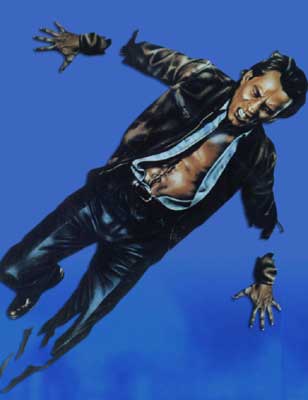
Terrible what passes for a ninja these days.


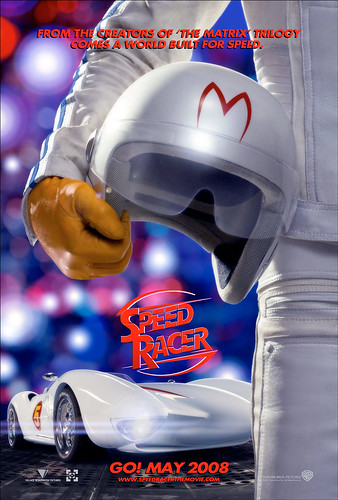
Some of my best memories of childhood are the marathon sessions I spent playing Super Mario Kart in battle mode with my friend Garrison for six-plus hours at a time. Around 3am, fueled by Pepsi and Doritos and with Black Sabbath blowing out our eardrums, Garr and I would reach a state of geek transcendance - almost completely wordless, the clicking noises of our thumbs tapping the controls forming their own conversation as our connection to game became kinesthetic. So when I defend Speed Racer as a kids' movie, I don't mean that as a dismissal - the Wachowski brothers have created a tactile, candy-colored world seemingly taken straight from the unconscious of a Pixie-Stix-addled 9-year-old who could kick my ass on the PS3. Until Dennis and Paul both recommended it I'd been actively avoiding the film, assuming that the Wachowskis would approach the video game aesthetic with the same suffocating self-importance that killed the Matrix sequels. So it was a welcome surprise that the brothers have rediscovered their sense of playfulness, crafting a movie both visually nifty and winningly sincere - finally, a movie for the indoor kids.

A cartoon-within-the-movie serves as a basic primer for those unfamiliar with the anime aesthetic that Speed Racer translates into live-action; the world inhabited by the titular driver and his family is deliberatly flat and two-dimensional, its color palette limited to the 16-crayon box. What looked grating in the trailer is surprisingly good eye candy in the feature, the kaledoscopic racing sequences are the Wachowskis' most successful attempt at the hyperreal since the first Matrix. While my own preference is for the tangible cartoon worlds of Robert Altman's Popeye or Warren Beatty's Dick Tracy, Speed Racer shares with those films an admirable fidelity to its own delibarately silly internal logic (aided immensely by another infectiously zippy Michael Giacchino score). The movie must average fifty edits a minute, but the Wachowskis never sacrifice coherence as far too many action filmmakers happily do - the primary aim here is momentum, and though the result is occasionally wearisome, it's also thrilling in its peculiar way.

Speed Racer is particularly notable in how well the flesh-and-blood performers are integrated into the computer-generated world. While otherwise talented actors working with digital sets often end up looking vaguely confused, the performances here find the right tone - tongue-in-cheek but not condescending, exaggerated but not obnoxious. Emile Hirsch smartly plays Speed Racer as a stoic, wide-eyed youngster single-mindedly obsessed, like Ricky Bobby, with going fast. Standouts in the rest of the cast include John Goodman as Pops, who smartly lets his mustache do the acting; Matthew Fox as the mysterious Racer X, who between this and Lost makes me wonder what makes him so great at playing complete dicks; and Christina Ricci, cute as a button as Speed's devoted girlfriend Trixie. And mention must be made of Paulie Litt as Speed's chubby, sugar-fuelled little brother Spritle, a character that could have easily made the film unwatchably obnoxious had the Wachowskis not found such a likable kid - Litt, who looks like a young Peter Boyle, is clearly just having fun being in a movie, and his enthusiasm is infectious.

And fun is the key reason to see a Speed Racer movie - despite its surprisingly subversive anti-capitalist message and sophisticated narrative structure, this is essentially a movie for 6-year-olds. So it's refreshing to see that the Wachowskis have rediscovered their ability to entertain on a grand scale; I wouldn't be surprised if, once kids discover this on video, it means as much to them as The Goonies or Willy Wonka and the Chocolate Factory do to people who saw them at precisely the right age. A confession: last year I had the chance to audition for Speed but opted not to, not only because the idea of me as Speed Racer is completely ridiculous but because, from the script pages they gave me for the casting call, I thought the film would be a dull, leaden failure. It turns out the Wachowskis knew exactly what they were doing; Speed Racer isn't a perfect movie by any means, but once people catch up to it, it's going to defy a lot of expectations.

Thursday, May 29, 2008

Your reality is already half video hallucination.


Another season, and another pop quiz arrives over at SLIFR. This one comes from media prophet Professor Brian O'Blivion - I don't know what kinda of information Prof. O'Blivion is gathering from my preferences of character actors, but I imagine he'll be sending me a tape soon enough.

1) Best transition from movies to TV (actor, actress, producer/director, movie/show)

Definitely David Lynch (see #9)

2) Living film director you most missing seeing on the cultural landscape regularly

Nicolas Roeg. His films from Performance to Bad Timing are as good a run as as any filmmaker's ever had, and I'd like to think he has another movie up to that level in him.

3) Eugene Pallette or Charles Coburn

Eugene Pallette

4) Fill in the blank: “I pray that no one ever turns _____________ into a movie.”

Dance Dance Revolution

5) Jane Greer or Veronica Lake

Veronica Lake, no contest.

6) What was the last movie you saw in a theater? On DVD? And why?

In a theater, Indy 4, because it's freaking Indiana Jones. On DVD, I'm Not There, because some friends hadn't seen it (and it gets better every time I see it).

7) Name an actor you think should be a star

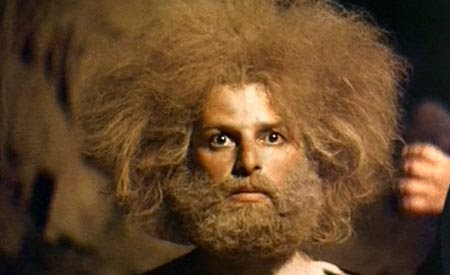
Bruno S.

8) Foxy Brown or Coffy

I'm embarrassed to admit that I haven't seen either. I guess I need to catch up on blaxploitation.

9) Favorite TV show still without its own DVD box set

On the Air

10) Jack Elam or Neville Brand

Jack Elam

11) What movies would top your list of movies you need to revisit, for whatever reason?

I can't wait for the new Criterion DVD of Mishima: A Life in Four Chapters.

12) Zodiac or All the President’s Men

Zodiac, but both are great.

13) Using our best reviewer-speak, what is an “important” film comedy? And what is to you the most important film comedy of the last 35 years?

An "important" film comedy does what an "important" drama does - reveal an emotional truth - from a different angle. Waiting for Guffman is a perfect comedy because, in poking fun at the earnest, frequently awful community theatre experience, it underlines the absurdity of the pretensions and insecurities most of us share.

14) Describe the ideal environment for watching a movie.

As Max Cherry would say, as long as it starts soon and looks good, I'm all set.

15) Michelle Williams or Eva Mendes

Michelle Williams

16) What’s the worst movie title of all time?

"ffolkes"

17) Best movie about teaching and/or learning

Henry: Portrait of a Serial Killer. Not really, though. Rushmore.

18) Dracula (1931) or Horror of Dracula (1958)

Horror of Dracula

19) Why do you blog? Or if you don’t, why do you read blogs? (Thanks, Girish)

I started blogging about movies because I suspected my single-mindedness was starting to tire my friends out. I was hoping to connect with a few like-minded people, and was pleasantly surprised to develop a small base of readers. I'm greatful for anyone who stops by Cinevistaramascope and leaves a comment, so I write now to keep the conversation going.

20) Most memorable/disturbing death scene

Carrie White's mom moaning and writhing in a state of religious/sexual ecstasy post-impalement.

21) Jason Robards or Robert Shaw

Both are great, but only one was Quint.

22) A good candidate for Most Blasphemous Movie Ever

I saw a '70s porno once that featured Jesus receiving oral pleasure while walking across water.

23) Rio Bravo or Red River

Rio Bravo

24) Werner Herzog is remaking Bad Lieutenant with Nicolas Cage—that’s reality. Try to outdo reality by concocting a match-up of director and title for a really strange imaginary remake.

Tony Scott's Barry Lyndon

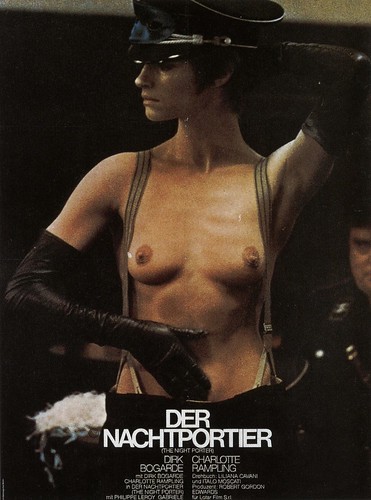
25) Bulle Ogier or Charlotte Rampling

My friend was watching the Academy Awards with his then-girlfriend when she observed, "Helen Mirren is really sexy for her age." To which he corrected, "Helen Mirren is sexy, period." That's how I feel about Charlotte Rampling.

26) In the Realm of the Senses— yes or no?

I'll give it a pass, but it was sort of a letdown.

27) Name a movie you think of as your own (Thanks, Jim!)

Whenever anyone dismisses E.T. as creepy, sentimental or manipulative, I get irrationally protective.

28) Winged Migration or Microcosmos

Microcosmos

29) Your favorite football game featured in a movie

Son of Flubber

30) Wendy Hiller or Deborah Kerr

Wendy Hiller

31) Dirtiest secret you have that is related to the movies

My screenplay.

32) Name a favorite film and describe how it is illuminated and enriched by another favorite film.
My appreciation of Popeye deepened when I realized it's essentially McCabe and Mrs. Miller for kids.

33) It’s a Gift or Horsefeathers

It's a Gift

34) Your best story about seeing a movie at a drive-in

I saw Who Framed Roger Rabbit at a drive-in in Maine while my family was on vacation. My dad fell asleep halfway through, so my mom decided to let him sleep and find her way back to our room. We were nearly at the Canadian border before she realized she must have made a wrong turn somewhere.

35) Victor Mature or Tyrone Power

Victor Mature

36) What does film criticism mean to you? Where do you think it’s headed?

I don't know where it's headed, but I do think the recent turbulence in the profession is the result of film criticism moving away from monologue and towards discussion. I know that my aforementioned small group of readers motivates me to examine my ideas with greater clarity and consideration. If anything's going to keep film criticism going, it's the need to resist experiencing art in a vacuum. Either way, I'll keep writing as long as people keep reading.

Friday, May 23, 2008

Yes. Questions.


"I saw a segment of Douglas Trumbull's special effects for Blade Runner on the KNBC-TV news. I recognized it immediately. It was my own interior world. They caught it perfectly." - Philip K. Dick

The thing that struck me most deeply about Blade Runner upon seeing it for the first time on the big screen is its profound sense of loneliness. The theatrical experience, part of the Berkshire International Film Festival, made it clearer than ever why Ridley Scott's masterpiece couldn't hack it as a summer blockbuster; its a film that requires its audience to stay tuned in to its muted, melancholy emotional frequency, its astounding visual effects meant to provoke introspection rather than thrills. Its silences, shadows and ambiguities are as challenging as they've ever been - even with its monumental reputation, I could hear much of the audence shifting impatiently in their seats - and yet it's the film's uncompromising fidelity to its bleak, enigmatic core that explains its enduring relevance. When I say that Blade Runner on the big screen is an isolating experience, I mean it in the best way.

Much of Blade Runner's success can be attributed to Douglas Trumbull, whose job it was to transform artist Syd Mead's mind-blowing visions of Los Angeles circa 2019 into a believable, lived-in reality. Trumbull's effects are the most lyrical of his contemporaries' work - he's responsible for the balletic scenes of space travel in 2001 and Star Trek: The Motion Picture (his effects are easily the best part of the latter film), the mindbending finale of Kubrick's film (the slipstream idea being Trumbull's, and one that Kubrick originally scoffed at) and the religious experience that is the finale of Close Encounters of the Third Kind. While those films had a sleek, elegant futuristic design, Blade Runner required Trumbull to realize Mead's and writer Philip K. Dick's concept of a future defined by collision, decay and entropy. There was also the challenge of breaking new ground in visual effects; as Trumbull put it, "If a filmmaker wants something that's never been done before, it's my job to figure out how to do it."

Though Trumbull's presentation before the screening would be mostly familiar for anyone who's read Future Noir or seen Dangerous Days or any of the multiple making-ofs and retrospectives devoted to the film, it was a thrill to hear him talk about the painstaking process of combining intricately detailed models, paintings, and front-projected images to create a possible future. New to me was the fact that Blade Runner benefited heavily from advances in effects photography and lighting models from Close Encounters, and the bursts of flame that open the film were leftover from a planned apocalyptic ending of Zabriskie Point, which Trmbull was fired from when Antonioni became frustrated with the process and decided to blow up a house instead. Trumbull also praised Ridley Scott for having the strongest understanding of visual effects of any director he'd worked with, which coming from a guy who's worked with Kubrick and Spielberg is no small compliment. Blade Runner is one of the best examples of film as a collaborative art - as Trumbull talked over stills of the modelmaking and photography process, it was clear what a staggering accomplishment it is to keep a team of craftsmen and technicians focused on an extremely specific concept, and how the work of every person responsible for brass etchings or painting tiny cityscape panels is comptely astonishing.

The film was projected digitally, and while it took a while for the purist in me to adjust to its uncanny lack of imperfections ("More human than human," indeed), it was a thrill to see the film in such a pristine condition. While I'm reluctant to attempt a full-blown review so soon after Walter Chaw's comprehensive article (excellent except for the tedious stab at Spielberg), I will say that Blade Runner is a movie that absolutely has to be seen on the big screen to be appreciated. I'd always loved the film, but on video and DVD it's a somewhat remote experience, one that is intellectually and aesthetically edifying yet always seemed emotionally detached. What a surprise to find that this couldn't be further from the truth - seen on the proper scale, Blade Runner reveals itself to be an emotionally devastating experience. With the massive industrial decay of L.A. 2019 towering over me, I began to really feel the despair that the film's humans and replicants feel - the movie only seems detached because the characters are so totally cut off from feeling. Pithy to say that we're all replicants, yet in Blade Runner, this does feel like something of a revalation. Fascinating to realize how often Scott eschews narrative logic for a different kind of visual understanding - it makes no sense, for example, for Pris to step away from Deckard for a gymnastics routine, allowing herself to get shot, yet somehow the moment feels right. It's also astonishing in the way it upturns our expectations, with a villain who earns our sympathies over the ineffectual hero (Rutger Hauer's performance is really one for the ages) and a love scene that, even as Vangelis' score implies sensuality, actually carries far kinker implications. Blade Runner is, above all else, about death - our denial of it and, finally, the beauty of accepting one's mortality - so, yeah, it never stood a chance against a Spielberg movie that gives us the resurrection Scott denies us (though E.T. is a masterpiece in its own way - it's the Tao and all that). Honestly, though, if I were given a choice between a hit and a movie people are still talking about and arguing over 25 years later, it'd be no choice at all.

The Q&A after the movie was disappointingly predictable, the audience sprinkled with the sort of pseudo-cinephiles whose questions reek of smug entitlement. One person asked bluntly what Trumbull's been doing for the past 25 years with no apparent knowledge of his decades-long work on interactive multimedia experiences or virtual sets (I was relieved when he clarified that his concept is more Sin City than Beowulf). Another waved her hand and called Trumbull's name urgently, only to ask, with a superior grin, why, at one point, a rooftop is dry when it had been raining. Trumbull's reply was simply, "I don't know. It's a movie. Next question." It was a shame to have a living legend in the room and not even begin to touch on his various other achievements, including the two features he directed, Silent Running and Brainstorm, both examples of sci-fi driven by ideas rather than bells and whistles. Still, it was an honor to hear Trumbull talk about his work, and a welcome reminder (as is Blade Runner) of cinema's myriad possibilities.

Monday, May 19, 2008

KALI MA!

The following is my contribution to Cerebral Mastication's Indiana Jones Blog-a-Thon.

Ask the average person what makes the Indiana Jones movies so awesome and they'll probably tell you it's the action, the special effects, the humor, Harrison Ford, the hat and the whip and so on and so forth. One thing people don't talk about as much, but is just as crucial to Indy's enduring appeal: horrifying violence.

While one of the main charms in the Indy movies is their view of the world as a place where wondrous, even magical things are waiting to be discovered - Dr. Jones deserves a world of credit for making archaeology look cool and sexy - it's also a world of unknown horrors waiting to snare unsuspecting adventurers. From the surprisingly (in retrospect) somber opening moments of Raiders of the Lost Ark, Indy's adventures are defined less by the MacGuffins he pursues than by the always-escalating death traps he manages to evade even as mere mortals like Alfred Molina's greedy Sapito/Satipo/Saripo are punished for their haste and hubris with arrows through the head (and not in a goofy, Steve Martin way). If Raiders is an escapist masterpiece, its largely because Spielberg and Lucas are constantly raising the stakes in an often literal sense. Raiders realizes our most nightmarish fears (the shot of a boaconstrictor slithering out of a desiccated corpse's mouth still gives me the willies) even as it thrills and delights us; it's this undercurrent of darkness, the tension between fear and awe, that gives Spielberg's pop fantasies resonance. This is nowhere more evident than in Raiders' climax, an orgasmic display of melting flesh and exploding heads brought to us courtesy of a pissed-off Old Testament God - while it's every bit as graphic as a similar scene in the same year's Scanners, Cronenberg's film is perceived as more disturbing for its emphasis on bodily horror. In Raiders the gore is morally justifiable (as it's generally agreed that Nazis should explode), so it's considered fun for the whole family and becomes, along with Jaws, a child's introduction to the red, red kroovy.

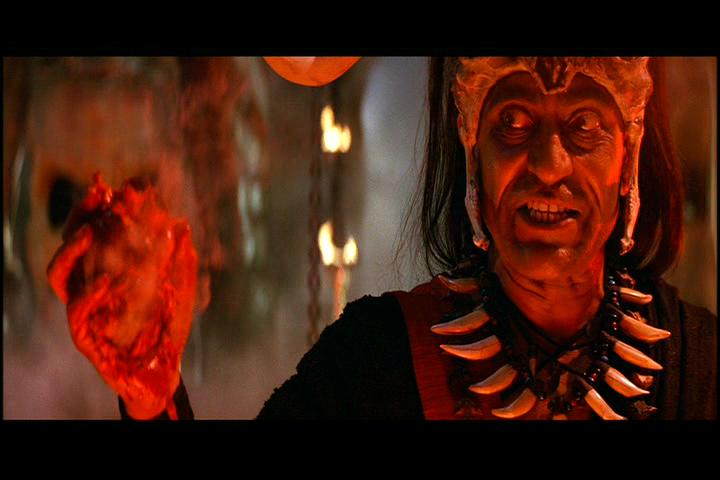
Still, Raiders is as harmless as a Flash Gordon serial compared to its borderline-nihilistic prequel. Appreciating the much-maligned Temple of Doom has a lot to do with the age at which one first saw it; where an adult might see a cynical, gratuitous exercise in sadism, my four-year-old self could only see the coolest haunted house ever. The highlight, of course, was the infamous heart-ripping scene that triggered so much parental ire - I knew I was seeing something terribly wrong, something I wasn't supposed to see, but in a PG movie (my four-year-old brain considered the ratings system to be God's Law). I was grossed-out yet I was exhilarated by the scene's visceral impact, and I wasn't the only one. I've often wondered if the outcry over Temple of Doom's darkness and the subsequent creation of the PG-13 rating was the result of kids being frightened or parents' startled, Tom Atkins-in-Creepshow realization that their kids were actually enjoying this demented crap.

Last Crusade is relatively tame, except for the awesome moment when Grail-seeker Donovan chooses poorly and rapidly ages and disintegrates in glorious stop-motion, and Kingdom of the Crystal Skull looks like it will follow in its predecessor's gentler vein. And that's understandable; times have changed, and parents have become more precious about what their kids are "exposed" to - I remember being completely baffled by the oft-repeated question of whether Jurassic Park was appropriate for kids, because I had seen, survived and loved movies like Alien, The Shining and Halloween before I could tie my shoes. And while that admittedly seems a bit strange to me now that I'm a parent (don't call DSS yet), I don't want Luna and TBD to be total sissies either. I look forward to a day five or six years from now, after enduring Shrek 5, when I teach the kids about how violence can be fun.

Friday, May 16, 2008

The Trim Bin #69


- Werner Herzog is directing a remake of Bad Lieutenant starring Nicolas Cage. Does. Not. Compute.

- Speaking of Herzog: in what would be the oddest film news any week that didn't also bring the announcement of a Herzog-directed Bad Lieutenant remake, David Lynch will be exec-producing (through his production company, Absurda) My Son, My Son, a "horror-tinged drama" to be directed, on DV and guerilla style, by Herzog. Absurda will also be behind Alejandro Jodorowsky's long-awaited return to directing, King Shot, starring Nick Nolte, Asia Argento, Marilyn Manson and Udo Kier. Though a frame of film has yet to be shot, this is clearly a frontrunner for the Academy Award for "Best Movie Ever Made."

- Welcome to all the new readers here from the More Than This: The Original Source For Everything Jim and Pam message board! While I imagine most of you are primarily interested in what I have to say about John Krasinski, I hope some of you decide to hang around for a while. In exchange, this blog will feature 20% more Krasinski-related content. And to answer the speculation: yes, when I said he was a goofy-looking guy, I meant it in a good way.


- I missed Blade Runner: The Final Cut when it played at the Brattle last year because apparently that's not an appopriate way for a baby to share her first Christmas with mom and dad. But it's playing at the Mahaiwe in Great Barrington this Sunday as part of the Berkshire International Film Festival, and it was worth the wait, as the screening will be followed by a Q&A with Berkshire resident Douglas Trumbull. When I was an 8-year-old, guys like Trumbull, Phil Tippett and Dennis Muren were like rock stars to me, and the physical reality of their accomplisments remains more awe-inspiring to me than even the most impressive CGI. I can't wait for Sunday, and I'll try to ask Trumbull why he made Edgar Wright cry.


- Dennis Cozzalio's epic defense of Speed Racer has to count as some kind of masterpiece of film criticism, because it has actually gotten me interested in seeing a movie I'd completely dismissed even before its collective critical panning. I don't know if I'll side with Dennis or the majority, but if there's anything in the film as cool as this I'll be happy:


Wednesday, May 14, 2008

Mayonaise is sick.


The narration of Paranoid Park, a letter written by 16-year-old skater Alex (Gabe Nevins) attempting to understand his involvement in the accidental death of a security guard - has a halting, awkward quality, as Alex confesses that he's not a very good creative writer. Nevins, like most of the cast, is an acting neophyte cast through MySpace, yet Paranoid Park is more than a Warholian stunt. Alex's tentative voice is at the core of Gus Van Sant's film, filtered as it is through a haze of adolescent confusion. While Paranoid Park has many stylistic similarities to Van Sant's recent death trilogy, it also represents a bracing departure for the filmmaker. While the earlier films share a rigid sense of composition and a detached, almost clinical perspective, Paranoid Park finds Van Sant once again inhabiting the delicate uncertainties of his protagonist's world.

While a violent death is at the center of the film, Paranoid Park bypasses thriller conventions in favor of a quiet close-up of one teen's discassociation from his own reality. Alex is an average kid - he eats at Subway, hangs out at the mall, borrows his mom's car on the weekend and hopes he'll be a good enough skater to hang out at the titular skatepark. His parents are divorcing, but this fact doesn't seem to be affecting him as much as they assume; he's not particularly happy or unhappy, seemingly unable to relate to his own life not in a pathological sense but in a way consistent with his age. Van Sant is at his best when dealing with essentially passive protagonists, and his subjective approach places Paranoid Park closer to his masterpiece My Own Private Idaho than any of his other films. Aided immensely by Christopher Doyle's fragile images and the nervous, echoey soundscapes designed by Leslie Shatz, Van Sant's newfound affinity for narrative inertia finds its clearest focus yet in portraying the moment just before adulthood when everything remains indefinite.

While Paranoid Park is, in this sense, a coming-of-age story (and it is adapted from a novel by popular young-adult lit writer Blake Nelson), it avoids both the nostalgia and writerly compartmentalizing of teenage emotion typical of the genre. A well-meaning cop (Daniel Liu) attempting to learn more about the "skateboarding community" is met with confused snickers by a classroom of potential witnesses for whom concepts like community are completely alien (Van Sant defies this kind of categorizing with the soundtrack, which has room for both Elliot Smith and Nino Rota). While Alex frequents Paranoid Park, he doesn't think he's good enough to skate there - his detachment is not just a form of rebellion, it's a detachment from even desirable experience. When Alex loses his virginity, the moment is kept out of focus; we never know how Alex feels about his girlfriend because he doesn't know. The familiar begins to take on an air of unreality, and it is with this in mind that the central death scene comes into focus. The scene has been repeatedly described as a metaphor first homosexual experience, but there isn't much to support this reading other than the knowledge of Van Sant's sexual orientation; more importantly, it's the first real moment in Alex's life, one that he not only cannot ignore but is partly responsible for. The gory aftermath of Alex's accident has a painterly quality, remarkably still, as it will remain in his memory - a jarring first step into adulthood.

It's interesting to note that some reviews of the film refer to this central moment as an accident while others call it murder. Van Sant avoids moralizing in one way or the other, instead choosing understanding. This has always been true of his films, but here he achieves an emotional directness that suggests new, exciting possibilities. In moments like the one where Alex, after fleeing the scene of the crime, hangs his head in the shower, water droplets rolling off his face as a cacaphony of birds overwhelms the soundtrack, have a simple sort of cinematic purity. It's clear in Paranoid Park that Van Sant has achieved something he's been working towards for years - this is pure film, a collage of small visual gestures that are at once contemporary and timeless, capturing something as ephemeral as the sight of skateboarders suspended in midair, frozen, as if they'll never return to earth.

Friday, May 09, 2008

Farlanders: 15 Observations


1. Maggie Gyllenhaal is pretty.

2. Farlanders, the new Sam Mendes-directed, Dave Eggers-scripted movie I did background work on this Tuesday, was the first "indie division" movie I've worked on, and it really did represent the best of both work. While the smaller crew made for a few more mistakes than usual, it also meant more setups - there was time to do fourteen or fifteen takes of an extended tracking shot in the morning. And yet Farlanders, which will be released by Focus, is a pseudo-indie with a multi-million-dollar budget, which meant there was still plenty of room for perks like -

3. - the food. Baked salmon, pasta, rice, mixed vegetables and pie. I always appreciate it when us non-SAG folks get the same menu as SAG extras. Of course, we have to wait until they've been served, but it still makes me feel less like livestock.

4. The scenes being filmed were set on a college campus, with the Taft School, a $40000-a-year prep academy, subbing for a university in Wisconsin. Between this and 21, I've gotten a big kick out of returning to the kinds of places I couldn't get accepted to and doing exactly the kind of work I wanted to do anyway. Any hint of petty working-class resentment is strictly intentional - maybe I voted for the wrong candidate?

5. The aforementioned tracking shot followed Gyllenhaal, her onscreen kids and leads John Krasinski and Maya Rudolph mid-conversation as they pass by a student protest against the CIA and military recruiters (I was a bit vague on the details). I was given a t-shirt that read "COLLEGE - NOT COMBAT," a sign that read the same, and told to silently mime protesting. Shades of The Exorcist, but on a much smaller scale. Loved the idea of twentysomething actors pretending to be socially conscious, when most were just looking for a check between commercial residuals.

6. Chatted with a few extras from New York (most were bused in from the city) when were placed in the far background for depth. As soon as I mentioned I was from rural Mass, we couldn't help compare notes on our respective life choices. The condensed version: they get steady work, I get trees. I'm always torn over whether I should have gone straight to New York after college - the opportunities are there, but it takes a superhuman resolve to keep afloat, and my hat's off to anyone (including my friend Kate) who can hack it.

7. That Connecticut was subbing for Wisconsin, as Boston recently did for Paris in The Pink Panther 2, is encouraging; it means that New England isn't just used for location-specific shooting anymore, and has actually become a viable choice for studios. The new Hollywood? Not yet, but definitely the new Vancouver!

8. After three big-budget star-driven movies in a row (including the upcoming Revolutionary Road, partly shot in Connecticut), Sam Mendes seemed to be relishing the opportunity to work on a smaller scale. There wasn't an once of pretension about the guy - he listened intently to his crew's suggestions, maintained a very low-key, enthusiastic presence, and a willingness to try new things (filming was stopped at one point to accomodate the actors' ideas on tweaking the dialogue and blocking). He even gave the extras some direction, er, directly, which is something that's usually left to the assistant directors - again, the benefits of a smaller-scale show.

9. My co-workers at the day job got kick out of it when I told them Maggie Gyllenhaal was in the movie. A while back, some shitwit made a feeble attempt at hurting my feelings by anonymously placing a note declaring my sexual orientation in my boss' mailbox. As this isn't a secret and I haven't particularly struggled with it since the 11th grade, I just found this laughably lame, as did my boss and most of my co-workers. I responded by pinning pictures of Maggie and Jake above my desk, so the anonymous jerk would have be confronted by scary, scary bisexuality every time he or she asked me a question. So for them, this was a symbolic victory, and the subsequent goodwill meant a lot to me.

10. John Krasinski is one goofy-looking guy. This is encouraging.

11. I wanted to tell Maya Rudolph what a genius her husband is, but I then I figured that, having made a baby with P.T, she's already aware of this.

12. Best overheard conversation of the day: a stoned, conventionally "hot" extra talking with two other stoned extras about how, for some reason, she's been directed to make out with other women on multiple gigs. "I had to - acting is about total commitment."

13. The afternoon was spent doing inserts - walking multiple times along the same path without any of the leads present for shots that probably won't make it into the movie. It's here that my total commitment came in; I thought about where my character had been, and where he was going, and at what pace he should be going there. I can confidently say that I walked very well, but I was a little confused about why we were still referred to as "background" - if there are no actors in the frame, aren't we foreground?

14. I must be getting old; while it was fun and educational as always to be on a set, some of the best parts of the day were when I was in holding between shots. I streched out on a hill overlooking Watertown, closed my eyes and took in the sun on what was a perfect May afternoon. I'm working as hard at my dreams as I ever have, but I'm finding it more important than ever to remember stop and dwell in those dreams sometimes.
15. Maggie likes Diet Coke.

Wednesday, May 07, 2008

I don't want to do nothin' neither.


The War Game is disturbing in a way that only a story told with uncompromising logic can be. This is precisely what made Peter Watkins' pseudo-documentary, which was banned by the BBC (under pressure from the government, according to Watkins) only to be released theatrically to awards and heated debate, so controversial. The film's depiction of a hypothetical nuclear attack simply shows us what is already apparent - that such an attack would have devastating consequences almost beyond our comprehension - with precision and honesty, and these qualities alone proved threatening to a media institution committed to downplaying or ignoring obvious truths of the nuclear race. Watkins' film reminds that sometimes all one needs to do to create an uproar is state the obvious, which The War Game does with horrifying clarity.

The film is roughly divided into to parts - the first a depiction of the preparation for nuclear attack from the Soviet Union following a pre-emptive strike by NATO, the second dramatizing the potential aftermath of a nuclear blast in Kent. With a detached sense of irony, Watkins juxtaposes images of residents calmly preparing for attack - evacuating their homes, stockpiling supplies (one subject matter-of-factly shows us the shotgun he fully intends to use if necessary) and piling sandbags - against the total chaos of the film's deliberately heavyhanded second half. The graphic images of charred skin and dismembered bodies are shocking for their time, but completely justifiable; Watkins' approach is confrontational, using pure image as an inarguable response to the justifications of nuclear war he intercuts with the mounting carnage and despair. These interview scenes, with both actors performing pro-war arguments taken from real-life government and clergy figures as well as the misinformed opinions of citizens interviewed on the street, are shot with a flat aesthetic faithful to the talking-head approach of journalism that Watkins is challenging. When cut against the shaky, fragmented post-attack scenes, they create a powerful statement on the media's ability to create the illusion of security in the face of total chaos.

It's worth noting how the mainstream media has repurposed precisely the kind of shock effects that are so radical here for precisely the opposite purpose - one cannot watch cable-news coverage of the cyclone in Myanmar, for instance, without being bludgeoned with images of dead children. If the media of the 1960's aimed to pacify and distract the public, it now aims to shock us into apathy; as Watkins' uses shocking images to provoke reflection and debate, the co-opting of his aesthetic without any representational distance to silence us is infuriating. Perhaps this is why the most disturbing aspect of The War Game to this contemporary viewer is the omnipresent narration, calmly listing off names and numbers and figures against images of pure horror as if any truth could be found in statistics, reminding us repeatedly of what could be and might be and has been, the dryly informative approach only increasing our anxiety. If The War Game couldn't have been more prescient when it was made, it remains relevant for its deeper, more enduring horror - the constant barrage of information in the absence of real truth.

Saturday, May 03, 2008

Top 5: Concert Movies


Martin Scorsese's Shine a Light was clearly a lark for the director, a chance to capture a band that has so deeply influenced his films in concert, and it shines with the infectious enthusiasm of a true fan. It's a lot of fun if you like the Rolling Stones (who, even in their sixties, rock harder than most mainstream acts less than half their age), perfectly shot by a superteam of cinematographers and set in an intimate venue that smartly sidesteps most of the off-putting bloat of a contemporary Stones tour (suspiciously young, photogenic audience aside). If the critical response has been a bit muted, it's largely because Scorsese and the Stones are competing against their own definitive contributions to the concert movie genre, the best of which are listed below.


1. The Last Waltz Scorsese's film of The Band's 1976 farewell concert is indelible not only for its impressive roster of guest performances but also as a portrait of the end of an era. In the moments between the unapologetic hedonism and rebellion of the previous years and the self-serving materialism of the decade to come, Scorsese's film plays like the end of a decade-long party - the performers look tired, but there's still the music, and the effect is unforgettably bittersweet.


<
2. Woodstock
An movie with the proper scale and length for its subject. If The Last Waltz is a eulogy than Woodstock is an orgy - of music, drugs, mud and out-of-control idealism. Overstuffed, overblown and a total blast; they say if you can remember the 60's you weren't there, so it's a good thing someone thought to bring a camera along.


3. Ziggy Startdust and the Spiders From Mars
Bowie's early-70's sci-fi kabuki theatrics as seen through a grainy, handheld point of view. The result is a stunning collision of the deliberate contrivances of glam and director D.A. Pennebaker's verite aesthetic: immediate and wondefully strange.


4. Gimme Shelter
The concert movie as horror film, the Maysles' document of the ill-fated Altamont concert is an unflinching record of the violent implosion of the peace-and-love generation.


5. Stop Making Sense
From the awesome opening performance of "Psycho Killer," Jonathan Demme finds the perfect stripped-down aesthetic to capture the Talking Heads' hyper-conceptual brand of art rock. It's Woodstock for eggheads - when we showed this at Images last year, both old-school Talking Heads fans and those of us who were babies when this was released were dancing in the aisles.

Wednesday, April 30, 2008

You and your appointment.

Ang Lee's greatest strength as a filmmaker is his affinity for minutiae. As his repressed, internal characters rarely lend themselves to dramatic broad strokes, the filmmaker instead allows the narrative weight of his films to reside in a painstakingly precise accumulation of details, his best films arriving at simple images - a family waiting on a train station platform, a jacket carefully hung on a closet door - that have a devastating emotional impact. On the surface, Lust, Caution is a showcase for the director; it's a film where lipstick traces on a teacup weave their own sensual spell. Lust, Caution is Ang Lee's most visually handsome film, but it's also oddly cold and unengaging - too remote to generate much real suspense or eroticism, it ultimately fails to deliver on the promise of its seductive surfaces.

Set in WWII-era China, the film follows wide-eyed drama student Wong Chia Chi (Tang Wei) as she is recruited by a group of young radicals in their plot to assassinate Mr. Yee (Tony Leung), an interrogator in the collaborationist government. In a plot point familiar from everything from Notorious to last year's Black Book, Chia Chi's mission is to first befriend Yee's wife (Joan Chen), then seduce the hard-to-reach Mr. Yee. The two leads are both excellent; Leung is a model of restraint, subtly suggesting Mr. Yee's capacity for violence beneath his mannered exterior, and first-time film actress Wei is a revalation in a role that sees Chia Chi transform from an idealist who cries at the movies to a woman who sacrifices her dignity and identity to a cause she understands less and less. In the film's first half, Lee creates a palpable tension between the two that swerves between sexual attraction and the threat of something darker - by the time the film reaches its high point, a bloody and protracted assassination, Lust, Caution had me on the edge of my seat with its uneasy balance of sex and death.

And then the film reaches its much-publicized sex scenes, which Lee has described as the heart of the film. While I admire Lee for accepting the much-dreaded NC-17 reading and all for serious explorations of sex in cinema, it's here that Lust, Caution let me down. The couplings between Leung and Wei are certainly comprehensive, but they don't really tell us anything about the characters we couldn't have already guessed. Neither erotic nor suspenseful, the scenes rely on a tired collection of S&M tropes that seemed too familiar in Basic Instinct fifteen years ago (redeemed in that film by Paul Verhoeven's knowing trash aesthetic). Instead of revealing the characters' inner lives, Lee only manages to make the nature of their connection murkier - the scenes go on and say so little that they frankly start to feel gratuitous. And in a film that has built to such a confrontation for nearly two hours, the effect is a real cold shower.

I held out hope that Lee was going somewhere with this - that he had yet to reveal the detail that would bring his characters and story into focus. Unfortunately, all Lust, Caution arrives at is a final ten minutes as lazy and haphazardly executed as a run-of-the-mill Hollywood take on this kind of material (including a shot of a man diving into a car that provoked unintentional laughter). Worse, they hinge on a character making a decision that, with everything we've learned about the character, I couldn't believe at all. With final moments that end with the wrong character and reveal a misanthropic side to everything we've seen, Lust, Caution fails to deliver on its own promise. It's not a bad movie - its first half is spellbinding - and yet what works about it works so well that I expected a lot more than Lee ultimately delivers. And while Lee tries to arrive at another all-encompassing signifier, a diamond ring simply doesn't have the same impact as Jack Twist's jacket.

Sunday, April 27, 2008

Thursday, April 24, 2008

We are running out of time.


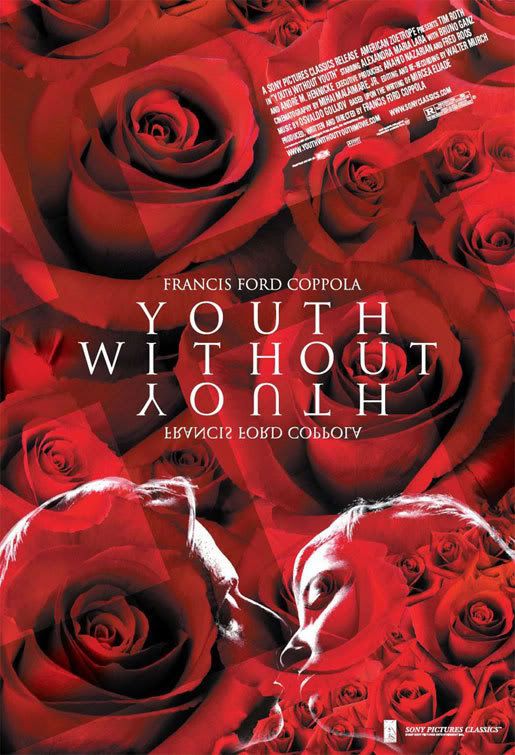
There are only a few filmmakers who have had a creative run as astonishing as Francis Ford Coppola's four-film string of masterpieces in the 1970s. Given that his subsequent output has been at best uneven and at worst a staggering fall from greatness, it makes sense that the 70-year-old director, vintner and raconteur would be preoccupied with the theme of returning to one's youth to change the present. It's a theme that was used for light humor in Peggy Sue Got Married, for baroque romance in Dracula, and to physically hurt the audience with Jack. In Youth Without Youth, Coppola's most intimate film since the critically panned (and ripe for rediscovery) One From the Heart, the idea of starting over and finishing old business is at the heart of a sprawling discourse on philosophical, metaphysical and esoteric notions that have presumably been on Coppola's mind this past decade. As a film it's alternately compelling and confounding, but as an extension of Coppola's towering persona - at once visionary, pompous, epic, kitschy and nakedly personal - it's fascinating.

Opening in 1938, Coppola's film finds as his surrogate a 70-year-old linguistics professor, Dominic Matei (Tim Roth), whose plans to end his own life are interrupted by a bolt of lightning (an unintentionally hilarious moment). As he recovers in a local hospital, Dominic is informed by his doctor (Bruno Ganz) that he is undergoing a remarkable physical transformation - while his mind still contains the memories and knowledge of an elderly man, his body has rejuvinated itself, transporting him to the physical state of his youth. It's a concept that Coppola has a good deal of fun with in its early stages, turning Dominic into a kind of egghead superhero who uses his supernatural cognitive powers to evade Third Reich scientists eager to exploit his mysterious abilities while also using his rediscovered libido to bed a Nazi spy (Alexandra Pirici) - it's fantastically pulpy stuff, and Coppola's fearless enthusiasm is infectious.

The narrative grows more complicated as time progresses and Dominic encounters Veronica, a similarly gifted young woman (Alexandra Maria Lara) who reminds of his long-lost love and is given the opportunity to finish his life's work, the discovery of a "proto-language" Dominic believes will return humanity to some essential form. Adapted from a novella by religious historian Mircea Eliade, this is heady literary material for a film, and it's a pleasure to watch the director mirror his protagonist in a story that weaves between genres and forms and touches upon philosophy, theology and mythmaking with the wide-eyed enthusiam of a 20-year-old liberal arts student. The filmmaker's uncanny sense of rhythm and the employment of recurring symbols (roses, in this case) remind of his once-unparalleled grasp of such filmic flourishes. If Coppola's goal was to start over than he's succeeded - the film has the stylistic abandom of a first-time director - and yet it's his maturity, his willingness to embrace his film's hermetic interior world, that leaves a lasting impression.

While the ideas on display here are worthy of discussion, they don't always translate effectively to cinema. The ongoing dialogue between Dominic and his double (also Roth), composed of matching shots of the actor and canted angles, reminds too strongly of Gollum to work and quickly grows irritating. And while Coppola's earnestness is admirable, it sometimes leads to unfortunate guffaws, as when Dominic matter-of-factly informs Veronica "that stranger in your dream was probably Shiva." The conflict that drives the final part of the film - whether Dominic should complete his work at the expense of Veronica's life or choose love - is interesting conceptually but lacks dramatic impact. Most of this is probably attributable to Coppola's long absence from filmmaking; I can't wait to see his next film to find out if he's gotten the lead out.

The sweetest and most enduring thing about Youth Without Youth is how it works as a return to forgotten cinematic languages. Shot in hi-def, the film nevertheless begins with old-fashioned title cards and journeys through noir, sci-fi and romantic scenes all filtered through a nostalgic haze. In paying homage to the movies of his youth, Coppola succeeds in making his film a tribute to the childlike wonder of cinemagoing - the idea of film-as-magic-show he's returned to over the years - that reminds that Coppola is perhaps cinema's greatest living romanticist. The clunkier aspects of Youth Without Youth are made forgivable by its willingness to fail in search of a cinematic proto-language, an aim at once grandiose and humble. More than anything, Youth Without Youth lingers in the mind as the work of a once-lost cinematic master who has found his voice again, and (hopefully) the promise of more masterpieces to come.

Tuesday, April 22, 2008

The Trim Bin #68


- That's what I looked like a few weeks ago when Jess and I found out another kid was on the way. The abbreviated version: big, highly improbable surprise, lots of incoherence and cursing out of both God and science, a more serious discussion of our options than anything in Knocked Up or Juno, more incoherence, and finally the decision to prematurely rob Luna of her only-child status (she loves other kids, at least). We're terrified, of course, but we couldn't ask for a better daughter and, as my friend Kate pointed out, our aggro-fertility will help combat an Idiocracy-like future. Plus, I get to name this one! Can't wait to meet you, little Mordecai or Cloris.

- Walter Chaw's latest post from The Trench: cranky, arrogant and genuinely provocative.

- CHUD's You Got It All Wrong series: cranky, arrogant and completely pointless.

- Culture Snob has a fascinating take on the elusive appeal of The Shining (thanks to Film Experience for the link). This is why The Shining is one of my very favorite movies - like most of my favorites, it continue to reveal itself to new interpretations and approaches many years after its release.

- Paul Clark's post on Amadeus, a part of his Movies of My Life series, perfectly sums up why it's more than the boring costume drama it seems to be written off as lately, and particularly why it means so much to people in Paul's and my demographic (for some reason Amadeus was very popular in my third-grade class).

- Tried to write a top 10 of the best transformation scenes per the request of my friend Michael, but I could only come up with 9 (and I only had much to say about 3 or 4). The list was exclusively made up of '80s movies, the golden age of latex, prosthetics and K-Y slime following the apex of the subgenre - when it comes to transformations, there's An American Werewolf in London and there's everything else. Any other favorites worth mentioning?

- Finally, with There Will Be Blood hitting DVD last week and a wider audience discovering its insane brilliance, the glut of Plainview parodies and milkshake jokes is only going to keep growing (see Patton Oswalt's prediction that Plainview will be the go-to impersonation for hack comics). This one is my favorite: it's simple, I couldn't tell you why it's funny, and I can't stop watching it:


Friday, April 18, 2008

Wednesday, April 16, 2008

Such was McTeague.


Greed, like many of the silent film classics, is remarkable not only for its considerable cinematic qualities but also for everything it anticipates. As the definitive example of a deeply personal masterpiece butchered by the studios, Greed (like The Magnificent Ambersons and Touch of Evil and Once Upon a Time in America) cannot be viewed or discussed without committing the intentional fallacy. For a contemporary viewer, the experience of the movie cannot be separated from its troubled history; that the Greed which exists is only a fragment of Von Stroheim's original, destroyed vision forces us to consider what it isn't as much as what it is. In its 130-minute version (I hope to see the 1999 reconstruction soon), there are hints in nearly every scene of a bigger, stranger masterpiece; luckily, what remains is a stark, technically stunning morality play with a powerful emotional impact.

Erich von Stroheim's adaptation of the Frank Norris novel McTeague is an intimate epic, a simply plotted character study played out on a vast chronological and aesthetic scale. The story revolves dentist John McTeague (Gibson Gowland), his best friend Marcus (Jean Hersholt), and his wife Trina (Zasu Pitts), and the ways their lives are changed when Trina wins $5000 in a lottery. What begins as a romantic vision of human behavior - Marcus, who is courting Trina when Mac meets her, selflessly steps aside for his friend - quickly turns sour as Trina's money becomes a source of envy and distrust for all three parties. Even in 1924 it was hardly a new idea to trace the corrupting influence of money; what astonishes in Greed is von Stroheim's unsparing eye, which creates an emotional directness rare for the silent era. When an impoverished, bitter Mac responds to Trina's plea "Don't you love me?" by clocking her, the moment is so sharp that, even after eighty-plus years of far stronger and more graphic violence, one cannot help but wince. Von Stroheim observes his characters' spiritual decay with a clinical gaze, letting the story unfold with a methodical pace that gives every moment equal time and resonance; one can see in Greed the beginnings of a classical approach to cinema that anticipates the formal innovations of Welles, Hitchcock and Kubrick, among others.

Should it sound too much like a dry academic exercise, Greed is also filled with exuberant moments of cinematic play. Throughout the film, von Stroheim uses animals to underscore the cruelty of his characters, Mac's affection for birds culminating in an image of a cat pouncing at a canary that punctuates the news of his sudden misfortune. Von Stroheim is cynical but never dour, observing the psycholocial violence his characters inflict not with moralism but with a wry detachment. The film is also a visual marvel, Von Stroheim's preference for deep focus making each penetrating moment impossible to overlook. When the film arrives at its ending, set in Death Valley, Von Stroheim manages to reduce his drama to its most essential elements, with the external landscape mirroring the characters' internal emptiness. While I fear that comparing the final moments to those of a certain recent film involving drainage will make me seem like the archetypal 21st-century film student unable to decipher old movies without reference points to stuff I saw three months ago, I did make that connection and it only made me appreciate the remarkable ongoing influence of von Stroheim's nearly century-old film.

It's impossible to know what the ideal form of Greed might have been; certainly this one feels cruelly abbreviated in places, though nine hours honestly strikes me as an Empire-like exercise in tedium. Perhaps the ideal is somewhere in the middle, but the tragedy is that we'll never be able to make this decision for ourselves. And while the entire concept of a "director's cut" has been co-opted as a marketing tool - a way to screw the director and squeeze out more showtimes during a film's theatrical run while goosing DVD sales later - the disdain shown by MGM to von Stroheim is unimaginable today. Little did the studio execs know that, in cutting apart Greed, they were guranteeing endurance for a film that is as relevant as it has ever been.