Monday, October 27, 2008


Who wants to eat the girl?
 The recent work of Dario Argento reminds of Trainspotting's Sick Boy and his theory that all great artists decline with age. Watching Argento, a master stylist, reduced to making thrillers involving internet poker makes one approach each new film with trepidation. This is especially true of Mother of Tears, the long-awaited conclusion of Argento's "Three Mothers" trilogy. The first two chapters, Suspiria and Inferno, are perfectly realized cinematic nightmares made by a more inventive, audacious Argento, and there was hope that Mother of Tears would mark a bold return to form. Unfortunately, Mother of Tears is a missed opportunity, a sometimes entertaining splatterfest that never comes close to the earlier films' macabre elegance.
The film opens with the discovery of an ancient urn that, when opened by art student Sarah Mandy (Asia Argento), unleashes an evil force spreads chaos and sensless violence Rome and threatens the return of Mother Lachrymarum (Moran Atias) and a "second age of witches." An early scene that ends with a curator strangled with her own innards is impressively sick, and Sarah's subsequent escape from the museum promises some of the fairytale atmosphere that made Suspiria and Inferno so distinctive. Sadly, any sustained atmosphere is in short supply here - visually, Mother of Tears is flat and strangely generic. The baroque cinematography and bold color palettes of Argento's best work is replaced here with an perfunctory visual strategy straight out of a Sci-Fi Channel movie. The scenes of ordinary citizens committing random acts of violence were a perfect opportunity for Argento to recapture the hallucinatory mayhem that made Inferno so brilliant, but he eschews tension, even creative bloodletting, for matter-of-fact gore. Mother of Tears is a thuddingly literal-minded betrayal not only of the earlier films' marvelously sustained dream logic but of Argento's initial inspiration - shouldn't any work inspired by de Quincey at least aim for the uncanny?
The absence of any of Argento's strengths also makes his weaknesses more obvious. The setup could have been effective, but when the "age of witches" is represented by a bunch of sneering Goths led by a usually-topless Mother of Tears, it's more hokey than eerie. The cast, even the usually interesting Asia Argento, look bored as they go through the paces. And while Argento has done wonderful things with low-tech special effects in the past, CGI proves to be an uncomfortable fit - it's obvious and only draws further attention to Argento's distressingly anachronistic attempts to be hip and contemporary. Worst of all, Goblin's Claudio Simonetti trades the unnerving soundscapes of Deep Red and Suspiria for a loud, oppressive and completely forgettable score.
There are a few things to enjoy in Mother of Tears: there are a few impressively sickening moments, and the orgies Mother Lachrymarum hosts in an underground dungeon are impressively kinky. There's also some fun to be had in spotting Argento's recurring fetishes and obsessions - Asia has another questionable gratuitous nude scene shot by her dad, Argento's still working through tortured relationship with Daria Nicolodi (Asia's mother in the movie and real life), and monkeys are still threatening. And when Argento nods to his past successes - the recitation of the Three Mothers passage that opened Inferno, Asia wading through a pool of human decay exactly like the one in Phenomena, the self-consciously too-happy ending reminiscent of Opera - I got a slight buzz remembering those films. Unfortunately, those moments play less like a variation on familiar themes (as they often did to great effect in Inferno) and more like a slapped-together greatest hits collection for an underserved fan base. Mother of Tears is just good enough to hope that Argento has another classic up his sleeve, but bad enough to realize what an unlikely bit of alchemy that would be.
Thursday, October 23, 2008
Thomas Jerome Bemis


Born on Tuesday at 7:10 AM. Mom and baby are good, we're all exhausted but having a great time getting to know this delightful new member of our family.
Sunday, October 19, 2008

Saturday, October 18, 2008
Top 101 (2008 Edition)
Things that have changed in the past year: I've shot a feature and my second child is weeks (maybe days) from arriving. Things that have not changed: my near-fetishistic love of '70s cinema and my preference for movies that aren't afraid to go big, whether in scale, ambition or emotion. This list is a reflection of what I value most in the movies in 2008; that said every year making the list becomes less pleasurable and more difficult. While anything beyond 101 feels like cheating, I must note that any list that doesn't include Pulp Fiction, The Cabinet of Dr. Caligari, A.I. and Birth (to name a few) can't properly be called a list of my favorites (I always joke to people who comment on our large DVD collection that they're my 800 favorite movies). This is the VIP list, the movies that have become such a part of me that I wonder how I ever went without having seen them.

1. Blue Velvet (David Lynch, 1986)
2. The Shining (Stanley Kubrick, 1980)
3. Nashville (Robert Altman, 1975)
4. 2001: A Space Odyssey (Stanley Kubrick, 1968)
5. E.T. the Extra-Terrestrial (Steven Spielberg, 1982)
6. Vertigo (Alfred Hitchcock, 1958)
7. Raging Bull (Martin Scorsese, 1980)
8. There Will Be Blood (Paul Thomas Anderson, 2007)
9. Blade Runner (Ridley Scott, 1982)
10. Apocalypse Now (Francis Ford Coppola, 1979)

11. Carrie (Brian De Palma, 1976)
12. Boogie Nights (Paul Thomas Anderson, 1997)
13. Kill Bill vol. 2 (Quentin Tarantino, 2004)
14. Kill Bill vol. 1 (Quentin Tarantino, 2003)
15. Jaws (Steven Spielberg, 1975)
16. Taxi Driver (Martin Scorsese, 1976)
17. Alien (Ridley Scott, 1979)
18. The Man Who Fell to Earth (Nicolas Roeg, 1976)
19. Persona (Ingmar Bergman, 1966)
20. The Elephant Man (David Lynch, 1980)

21. Nosferatu: Phantom der Nacht (Werner Herzog, 1979)
22. Barry Lyndon (Stanley Kubrick, 1975)
23. My Own Private Idaho (Gus Van Sant, 1991)
24. Psycho (Alfred Hitchcock, 1960)
25. Badlands (Terrence Malick, 1973)
26. Halloween (John Carpenter, 1978)
27. A Clockwork Orange (Stanley Kubrick, 1971)
28. Children of Men (Alfonso Cuaron, 2006)
29. Lawrence of Arabia (David Lean, 1962
30. El Topo (Alexandro Jodorowsky, 1970)

31. The Empire Strikes Back (Irvin Kershner, 1980)
32. Jules and Jim (Francois Truffaut, 1962)
33. Dawn of the Dead (George A. Romero, 1978)
34. Chinatown (Roman Polanski, 1974)
35. Don't Look Now (Nicolas Roeg, 1973)
36. The Fly (David Cronenberg, 1986)
37. Aguirre the Wrath of God (Werner Herzog, 1972)
38. Fargo (Joel Coen, 1996)
39. The Godfather Part II (Francis Ford Coppola, 1974)
40. The Last Temptation of Christ (Martin Scorsese, 1988)

41. The Conversation (Francis Ford Coppola, 1974)
42. Eraserhead (David Lynch, 1977)
43. Dead Man (Jim Jarmusch, 1996)
44. 8 ½ (Federico Fellini, 1963)
45. The Thing (John Carpenter, 1982)
46. Touch of Evil (Orson Welles, 1958)
47. Ran (Akira Kurosawa, 1985)
48. Brazil (Terry Gilliam, 1985)
49. Schindler's List (Steven Spielberg, 1993)
50. GoodFellas (Martin Scorsese, 1990)

51. Mulholland Drive (David Lynch, 2001)
52. The Third Man (Carol Reed, 1949)
53. Inferno (Dario Argento, 1980)
54. All That Jazz (Bob Fosse, 1979)
55. Close Encounters of the Third Kind (Steven Spielberg, 1977)
56. Sid and Nancy (Alex Cox, 1986)
57. One Flew Over the Cuckoo's Nest (Milos Forman, 1975)
58. The Seventh Seal (Ingmar Bergman, 1957)
59. McCabe and Mrs. Miller (Robert Altman, 1971)
60. Cries and Whispers (Ingmar Bergman, 1972)

61. Blow Out (Brian De Palma, 1981)
62. Manhattan (Woody Allen, 1979)
63. Days of Heaven (Terrence Malick, 1978)
64. Dr. Strangelove or How I Learned to Stop Worrying and Love the Bomb(Stanley Kubrick, 1964)
65. Rashomon (Akira Kurosawa, 1950)
66. Citizen Kane (Orson Welles, 1941)
67. Once Upon a Time in America (Sergio Leone, 1984)
68. City Lights (Charles Chaplin, 1931)
69. Raiders of the Lost Ark (Steven Spielberg, 1981)
70. The Godfather (Francis Ford Coppola, 1972)

71. Last Tango in Paris (Bernardo Bertolucci, 1972)
72. The American Friend (Wim Wenders, 1977)
73. Betty Blue (Jean-Jacques Beneiex, 1986)
74. The Searchers (John Ford, 1956)
75. Harold and Maude (Hal Ashby, 1971)
76. Eyes Wide Shut (Stanley Kubrick, 1999)
77. Miller's Crossing (Joel Coen, 1990)
78. Magnolia (Paul Thomas Anderson, 1999)
79. Rushmore (Wes Anderson, 1998)
80. Orphee (Jean Cocteau, 1949)

81. Once Upon a Time in the West (Sergio Leone, 1968)
82. The Assassination of Jesse James by the Coward Robert Ford (Andrew Dominik, 2007)
83. Wings of Desire (Wim Wenders, 1987)
84. Y tu mama tambien (Alfonso Cuaron, 2001)
85. Heavenly Creatures (Peter Jackson, 1994)
86. No Country For Old Men (Joel and Ethan Coen, 2007)
87. Black Moon (Louis Malle, 1975)
88. Zodiac (David Fincher, 2007)
89. Stroszek (Werner Herzog, 1977)
90. Punch-Drunk Love (Paul Thomas Anderson, 2002)

91. Invasion of the Body Snatchers (Philip Kaufman, 1978)
92. Pat Garrett & Billy the Kid (Sam Peckinpah, 1973)
93. Belle de Jour (Luis Bunuel, 1967)
94. Ed Wood (Tim Burton, 1994)
95. Macbeth (Roman Polanski, 1971)
96. Phantom of the Paradise (Brian De Palma, 1974)
97. The Fountain (Darren Aronofsky, 2006)
98. Hedwig and the Angry Inch (John Cameron Mitchell, 2001)
99. The Big Lebowski (Joel Coen, 1998)
100. Eternal Sunshine of the Spotless Mind (Michel Gondry, 2004)
101. Popeye (Robert Altman, 1980)
1. Blue Velvet (David Lynch, 1986)
2. The Shining (Stanley Kubrick, 1980)
3. Nashville (Robert Altman, 1975)
4. 2001: A Space Odyssey (Stanley Kubrick, 1968)
5. E.T. the Extra-Terrestrial (Steven Spielberg, 1982)
6. Vertigo (Alfred Hitchcock, 1958)
7. Raging Bull (Martin Scorsese, 1980)
8. There Will Be Blood (Paul Thomas Anderson, 2007)
9. Blade Runner (Ridley Scott, 1982)
10. Apocalypse Now (Francis Ford Coppola, 1979)

11. Carrie (Brian De Palma, 1976)
12. Boogie Nights (Paul Thomas Anderson, 1997)
13. Kill Bill vol. 2 (Quentin Tarantino, 2004)
14. Kill Bill vol. 1 (Quentin Tarantino, 2003)
15. Jaws (Steven Spielberg, 1975)
16. Taxi Driver (Martin Scorsese, 1976)
17. Alien (Ridley Scott, 1979)
18. The Man Who Fell to Earth (Nicolas Roeg, 1976)
19. Persona (Ingmar Bergman, 1966)
20. The Elephant Man (David Lynch, 1980)

21. Nosferatu: Phantom der Nacht (Werner Herzog, 1979)
22. Barry Lyndon (Stanley Kubrick, 1975)
23. My Own Private Idaho (Gus Van Sant, 1991)
24. Psycho (Alfred Hitchcock, 1960)
25. Badlands (Terrence Malick, 1973)
26. Halloween (John Carpenter, 1978)
27. A Clockwork Orange (Stanley Kubrick, 1971)
28. Children of Men (Alfonso Cuaron, 2006)
29. Lawrence of Arabia (David Lean, 1962
30. El Topo (Alexandro Jodorowsky, 1970)

31. The Empire Strikes Back (Irvin Kershner, 1980)
32. Jules and Jim (Francois Truffaut, 1962)
33. Dawn of the Dead (George A. Romero, 1978)
34. Chinatown (Roman Polanski, 1974)
35. Don't Look Now (Nicolas Roeg, 1973)
36. The Fly (David Cronenberg, 1986)
37. Aguirre the Wrath of God (Werner Herzog, 1972)
38. Fargo (Joel Coen, 1996)
39. The Godfather Part II (Francis Ford Coppola, 1974)
40. The Last Temptation of Christ (Martin Scorsese, 1988)
41. The Conversation (Francis Ford Coppola, 1974)
42. Eraserhead (David Lynch, 1977)
43. Dead Man (Jim Jarmusch, 1996)
44. 8 ½ (Federico Fellini, 1963)
45. The Thing (John Carpenter, 1982)
46. Touch of Evil (Orson Welles, 1958)
47. Ran (Akira Kurosawa, 1985)
48. Brazil (Terry Gilliam, 1985)
49. Schindler's List (Steven Spielberg, 1993)
50. GoodFellas (Martin Scorsese, 1990)

51. Mulholland Drive (David Lynch, 2001)
52. The Third Man (Carol Reed, 1949)
53. Inferno (Dario Argento, 1980)
54. All That Jazz (Bob Fosse, 1979)
55. Close Encounters of the Third Kind (Steven Spielberg, 1977)
56. Sid and Nancy (Alex Cox, 1986)
57. One Flew Over the Cuckoo's Nest (Milos Forman, 1975)
58. The Seventh Seal (Ingmar Bergman, 1957)
59. McCabe and Mrs. Miller (Robert Altman, 1971)
60. Cries and Whispers (Ingmar Bergman, 1972)

61. Blow Out (Brian De Palma, 1981)
62. Manhattan (Woody Allen, 1979)
63. Days of Heaven (Terrence Malick, 1978)
64. Dr. Strangelove or How I Learned to Stop Worrying and Love the Bomb(Stanley Kubrick, 1964)
65. Rashomon (Akira Kurosawa, 1950)
66. Citizen Kane (Orson Welles, 1941)
67. Once Upon a Time in America (Sergio Leone, 1984)
68. City Lights (Charles Chaplin, 1931)
69. Raiders of the Lost Ark (Steven Spielberg, 1981)
70. The Godfather (Francis Ford Coppola, 1972)

71. Last Tango in Paris (Bernardo Bertolucci, 1972)
72. The American Friend (Wim Wenders, 1977)
73. Betty Blue (Jean-Jacques Beneiex, 1986)
74. The Searchers (John Ford, 1956)
75. Harold and Maude (Hal Ashby, 1971)
76. Eyes Wide Shut (Stanley Kubrick, 1999)
77. Miller's Crossing (Joel Coen, 1990)
78. Magnolia (Paul Thomas Anderson, 1999)
79. Rushmore (Wes Anderson, 1998)
80. Orphee (Jean Cocteau, 1949)

81. Once Upon a Time in the West (Sergio Leone, 1968)
82. The Assassination of Jesse James by the Coward Robert Ford (Andrew Dominik, 2007)
83. Wings of Desire (Wim Wenders, 1987)
84. Y tu mama tambien (Alfonso Cuaron, 2001)
85. Heavenly Creatures (Peter Jackson, 1994)
86. No Country For Old Men (Joel and Ethan Coen, 2007)
87. Black Moon (Louis Malle, 1975)
88. Zodiac (David Fincher, 2007)
89. Stroszek (Werner Herzog, 1977)
90. Punch-Drunk Love (Paul Thomas Anderson, 2002)

91. Invasion of the Body Snatchers (Philip Kaufman, 1978)
92. Pat Garrett & Billy the Kid (Sam Peckinpah, 1973)
93. Belle de Jour (Luis Bunuel, 1967)
94. Ed Wood (Tim Burton, 1994)
95. Macbeth (Roman Polanski, 1971)
96. Phantom of the Paradise (Brian De Palma, 1974)
97. The Fountain (Darren Aronofsky, 2006)
98. Hedwig and the Angry Inch (John Cameron Mitchell, 2001)
99. The Big Lebowski (Joel Coen, 1998)
100. Eternal Sunshine of the Spotless Mind (Michel Gondry, 2004)
101. Popeye (Robert Altman, 1980)
Saturday, September 27, 2008
hiatus

The movie shoot starts today - I'll try to post on its progress at The Black Light Journals. Other than that, I'll be too busy to write until after Columbus Day. Expect a review of The Sweet Hereafter, notes on working as an extra on Taking Woodstock, and a proper appreciation of Paul Newman when I get back. The image-guessing game will resume in November.
Friday, September 26, 2008
I'm not set up to mold hard rubbers.
 I've never talked about politics much in this blog except when relevant to the movie I'm discussing. While I enjoy the political rants Jeffrey Wells and Dave Poland mix in with their box-office rants, I don't really feel qualified to publish my opinions on the subject, and I don't want to end up stammering through a segment on The O'Reilly Factor. Plus, while I'm for one candidate, I've never found it constructive to focus one's energy on being against the other, so a poster in the sidebar has felt like enough. However, there's been something in the air for a while - let's say since, I don't know, August 29 - that has made it harder not to vent my suspicion our country actively becoming more ridiculous. For that reason, Burn After Reading, the Coens' latest comedy, is not only a pleasure as a return to form after the disappointment of Intolerable Cruelty and The Ladykillers, but as a series of cathartic belly laughs. The Coens take dead aim at a type of anti-intellectualism, self-absorption and willfull ignorance that is, sadly, uniquely American in character. It's cynical, even smug, but it couldn't have come at a better time.
Reminding of an absurdist version of Syriana, the movie revolves around dim-bulb gym employees Linda (Frances McDormand) and Chad (Brad Pitt) as they find a disc containing the memoirs of recently fired CIA analyst Osbourne Cox (John Malkovich). Mistaking Cox's memoirs and financial statements for top-secret information, Linda and Chad attempt to blackmail the pompous, alcoholic analyst. Cox's wife Katie (Tilda Swinton) and her lover, womanizing federal marshal Harry Pfarrer (George Clooney) are eventually drawn into a plot through a chain of events too nonsensical to describe, and I mean "nonsensical" as a compliment. Since Blood Simple, the Coens have returned again and again to the idea of plans gone awry, becoming masters of the convoluted plot. In Burn After Reading, it's the characters' superficial, self-centered natures that spirals the plot into levels of comic absurdity. The film's comic approach recalls Dr. Strangelove, starting as a straight-faced thriller before the plot is led astray by plastic surgery, sex toys and Dermut Mulroney. No less a comment on the state of our union than No Country For Old Men, the Coens' newest comes with the suggestion (like an R-rated version of the second half of Wall-E) that our self-destruction will be brought about by our desire to have things newer, faster, easier, cheaper and now.
Handsomely shot by DP Emmanuel Lubezki, Burn After Reading actually works pretty well as an example of the genre it's subverting. Exposing the essential arbitrariness of the topical thriller, the Coens succeed at deflating the self-importance of the "serious" thrillers that have become fashionable in recent years. Many of those star Clooney, of course, who gleefully sends up his macho appeal here - Pfarrer is like a comic flipside of Michael Clayton (the Coens would have correctly seen that film's protagonist as a schmuck), a barrel-chested masculine archetype who, at heart, wants his mommy. There are no heroes in the film, and no Lebowskis either; the only reasonable and decent character, gym manager Ted (Richard Jenkins, on a roll this year), is eventually punished for his decency. The audience's only surrogates are two CIA officers (David Rasche and J.K. Simmons, both brilliant) left to pick up the pieces. If we don't see ourselves in the buffoons, we're left, like Simmons, to lean back in our chairs and exclaim, "Jesus fucking Christ."
It'll be interesting to see if Burn After Reading improves after repeat viewings. The first time I saw The Big Lebowski I liked it, but it only revealed its brilliance around the third or fourth time. Right now, Burn After Reading seems like a top-notch comedy, its sharp dialogue worthy of Hawks and Wilder complete with the needless vulgarity their movies would certainly contain were they working today. It's a movie filled with acidic pleasures, among them Malkovich's upper-class twit, Swinton's low-key sadism, and Pitt, as much of a revelation playing a perpetually upbeat moron as he was playing Jesse James. Best of all is Frances McDormand as Linda, who, with her shallow, self-serving provincialism, tendency to act before thinking and lack of understanding about contemporary U.S. relations with Russia, reminded me exactly of - well, it was a much-needed laugh.
Monday, September 22, 2008

Here we are at the edge of the world of human history.
 First, a confession: I opted to watch the animal cruelty-free version of Cannibal Holocaust. I have a high tolerance for shock, but actual death is too much for me, and the death of adorable turtles and monkeys is even worse. While my view of nature is closer to Herzog than Pocahontas, I want to know that if I'm going to see cute little animals offed, it's for a valid artistic reason. And though the movie's defenders claim that the animal snuff add to the movie's verisimilitude, I don't expect to rewatch it to find out. Cannibal Holocaust's crass mix of vulgarity and self-importance places it near the bottom of the barrel even by grindhouse standards.
Director Ruggero Deodato frames Cannibal Holocaust from the start as a commentary on representations of violence in the media. The movie starts with a team led by an anthropology professor (Robert Kerman) who travel deep into the Amazon to find a missing documentary crew. They return with the crew's footage, and the second half is a first-person account of the shocking practices of the native tribes and the manipulative and cruel steps the filmmakers take to improve their footage. Deodato's explicit point is that more "civilized" Westerners are no less capable of cruelty than the "savages," literally ending with the professor's line "I wonder who the real cannibals are." Any claim to sociological importance is deflated by Deodato's sleazy approach to the material. When the rescue team observes the ritualistic rape of a woman guilty of adultery, the camera is less unflinching than prurient - prolonged shots of the woman's writing, mud-caked body give the impression that Deodato isn't commenting on the image as much as he's getting off on it. The entire movie is just as crass, demanding to be taken seriously even as it caters to the lowest common denominator. Worse still, the film's criticism Vietnam-era media is incoherent, as the images of wartime atrocities broadcast on the nightly news was largely responsible for ending the war. I can appreciate disturbing material employed for a purpose, but Cannibal Holocaust says very little as loudly and obnoxiously as possible.
That the film has been taken seriously by some very intelligent film writers suggests the level to which shock has lost all meaning. We can see its influence in unexpected places; watching 4 Months, 3 Weeks and 2 Days, I was struck by the lingering close-up of an a bloody aborted fetus late in the film, after the filmmakers had earlier opted to cut away from a tense but conventional sex scene. Interesting how sex is deemed exploitative and gratuitous, yet the fetus, which offers no insight into the film's meaning, is worthy of inclusion. Cannibal Holocaust is similarly disconnected from any pleasure (the consensual sex is literally dirty) or anthropological interest in the tribes beyond shock value. The difference, of course, is that 4 Months, 3 Weeks and 2 Days is serious-minded and skillfully crafted; Cannibal Holocaust is devoid of any real perspective on its subject beyond the simplistic nihilism that is currently trendy in my generation. Both versions of Funny Games are similarly didactic, but Haeneke is able to make the same points with precision and tension (and with little gore) because we're invested in his characters and scenario. And a sense of humor would have helped - Eli Roth cited Cannibal Holocaust as an influence on Hostel and Hostel: Part II, but those movies work well as gallows satires of Western arrogance and unchecked masculinity. Only Riz Ortolani's hilariously deadpan score offers any such pleasures here.
But even on the level of its shallow aspirations, Cannibal Holocaust is a failure. The actors can't pull off the transition from "civilized" to "primitive," and when they turn violent, it's arbitrary and difficult to buy. Deodato is terrible at generating tension - without any suspense or investment in the movie's outcome, it just made me feel annoyed and grossed-out, like I was eight again and hanging out with dumb kids who like to torture animals. And while the movie is frequently cited as a predecessor of The Blair Witch Project, it can't hold a camera to that movie in terms of believability. I', all for using shocking material to make a point, or even to entertain. Cannibal Holocaust takes a dump on the floor and gets in your face to argue that the smell is your fault.
Sunday, September 14, 2008

I believe God is a sadist, but probably doesn't know it.

Sam Peckinpah reportedly viewed Stanley Kubrick as his rival through much of his career. Why he felt he was in competition with a director whose work had little in common with his is unclear, but Peckinpah probably didn't feel the need to explain his grudges. With this in mind, it's easy to see 1977's WWII drama Cross of Iron as Peckinpah's Paths of Glory. Both films have as their protagonist a strong, rebellious officer at ideological odds with an officious, conformist superior, and both feature a pivotal scene where the protagonist tells a seemingly sympathetic commanding officer that he's a hypocrite. But where Paths of Glory unfolds with chess-like precision, Cross of Iron is more tuned to the chaos of battle. It's a shaggy, sometimes aimless, but always entertaining variation on one of Peckinpah's favorite kinds of stories - the rugged individualist vs. the world.
Sargeant Rolf Steiner (James Coburn) is the archetypal Peckinpah hero, a fearless soldier with no allegiance to ideology. Steiner commands a Wehrmacht platoon on the Eastern Front; the platoon is being pummeled by the Russians, and the German commanders we meet, like the pragmatic Brandt (James Mason) and the disillusioned Kiesel (David Warner), are not the nefarious, mustache-twisting Nazis we're used to. Peckinpah is less interested in the inexplicable evil of Hitler and his devout followers than in the nationalistic pride and conformity that enabled the party's rise. This is personified by Captain Stransky (Maximillian Schell), whose single-minded desire to win the Iron Cross and bring honor to his family name leads to his corruption. The opposition between Steiner and Stransky is not unlike the one between Pike Bishop and Deke Thorton, with self-reliance (and huge balls) held up as the only reasonable choice in a corrupt society.
The tension between Stransky and Steiner is effectively played by Coburn and Schell, and Cross of Iron appears to be headed towards an epic battle of wills between the two men. Then the film takes a left turn midway and never really regains its focus. Whether the troubled production or Peckinpah's own demons are to blame, Cross of Iron becomes an uneasy mix between an allegory of the absurdity of war and a meat-and-potatoes combat movie. The film lacks the poetry of Peckinpah's best work, with his trademark preoccupations seeming more crude than usual as a result. Steiner's heroism in stopping the rape of a Russian hostage is weakened by Peckinpah's obvious distrust of women. The implication that fascism is a form of repressed homosexual desire, provocative in Bertolucci's 1900, is only a cartoonish expression of hetero panic. Yet Peckinpah is blissfully oblivious to the homoerotic undertones of the slow-mo, bullet-riddled martyrs' deaths he awards his heroic soldiers. The romantic quality that defined these scenes in The Wild Bunch and Pat Garrett & Billy the Kid becomes so predictable and protracted that it feels like self-parody.
Still, Cross of Iron is worth seeing as an example of a kind of action movie that doesn't exist anymore. If the sensory assault of Saving Private Ryan is the logical end to what Peckinpah began, than it follows that there was no where to go except the aestheticized, hyperreal action of The Matrix and its imitators. In Cross of Iron, when a tank crashes through a brick wall, we know it's a real tank and a real wall, and the physical reality alone lends the film the kind of tension that a computer can only simulate (it hasn't been taught about the flesh). Cross of Iron isn't the smartest or most elegant of Peckinpah's films, but it has guts, and guts is enough.
Sunday, September 07, 2008
How do you like that, dad?
 On the recent subject of remakes we'd like to see, reader Matthew H. suggested an Alfonso Cuaron-helmed Nightmare on Elm Street, since that series generally served as a showcase for new directors. And he's right - taken as a whole, the Elm Street series is the strongest of the big three slasher franchises, largely because of each film's distinct personality. While some are better than others, they never become generic like the later Friday the 13th and Halloween sequels. Even the low point in the series, A Nightmare on Elm Street 2: Freddy's Revenge, is interesting, albeit for reasons its makers didn't really have in mind.
Part of the franchise's distinctive style can be attributed to New Line Cinema's protectiveness of what was, until Rush Hour and The Lord of the Rings, its biggest cash cow. Rumor has it that the company developed Freddy's Revenge and the far superior A Nightmare on Elm Street 3: Dream Warriors at the same time, then rushed the former into production to keep awareness of Freddy high and put more time and effort into the latter. Whether or not this is exactly what happened, Freddy's Revenge, which opened just under 12 months after the first film, does feel like a rush job. The plot, which follows teen Jesse (Mark Patton) as he is possessed through his dreams by Freddy (Robert Englund), betrays a basic misunderstanding of what made the first movie scary and memorable. The atmospheric, Bunuel-inspired imagery of Craven's film is gone - here, the dream sequences amount to Freddy yelling variations of "Kill for me, Jesse!" while Patton emits high-pitched squeals. The biggest sequence in the movie takes Freddy into the real world to terrorize a pool party, but surrounding him with Tiki torches sort of downplays his fearsome persona. Director Jack Sholder made the entertaining slasher movie Alone in the Dark before Freddy's Revenge and followed it with the awesome alien cop movie The Hidden, but here his attemps at scaring us - a melting record, an exploding parakeet - mostly just provoke unintentional laughs. There are few mentions of Freddy as a child killer, and his creepy boiler room hangout is replaced with a dreary industrial park. And while it's not necessary for the lead in a slasher movie to be female, Patton's histrionic performance makes for an awkward Final Girl.
Of course, the performance makes sense if you accept the popular subtextual reading of Freddy's Revenge. It's been noted by many writers before me that Freddy's Revenge can be interpreted as the story of a teen struggling with his repressed homosexuality. It's not even subtext, really; the first time I watched the movie, when classmate Ron (Robert Rusler) pulls down Jesse's pants during gym and wrestles him to the ground, I thought to myself, "Don't be immature." When Jesse falls asleep in class and summons a python around his neck, I thought, "That wasn't supposed to be a penis." When Jesse sleepwalks into a leather bar and gets busted by his leather-clad gym teacher, I thought, "Okay, that's actually really gay." When Jesse, possessed by Freddy, ties his teacher up, naked, in the gym shower and violently towel-whips him - well, if that isn't gay, neither is Querelle. The filmmakers claim the subtext is unintentional, and though I find this hard to believe, it'd be amazing if, in the rush to get a sequel out, they accidentally made a movie where Freddy is the personification of one teen's confused sexual desire. Sidenote: my first boyfriend was a slasher film nut, but when I mentioned Freddy's Revenge's hidden meaning, he had no idea what I was talking about.
But whether one reads Freddy's Revenge as a progenitor of New Queer Cinema or simply a quick cash-in, it's worth watching for scenes so inexplicable that they're practically Lynchian (Hope Lange, who plays Jesse's mother, would go on to play Jeffrey Beaumont's mom in Blue Velvet the following year). There's the weird framing sequence that tries to make a bus ride into a hellish desert scary but instead suggests a bad peyote trip. Or the single silliest dance montage of the '80s (no small feat), as Jesse, cleaning his room, prances around like a hyperactive 8-year-old, at one point using a plastic cup-and-ball toy as a phallus. Or my personal favorite moment, the completely ridiculous scene after the bird explodes, as Jesse's dad (Clu Gulager) accuses him of somehow having rigged the bird to spontaneously combust in an attempt to tear the family apart. As I said before, A Nightmare on Elm Street 3 is the more logical continuation of the series, and it's actually better than the original in some ways. But sometimes I find myself more in the mood to watch Freddy's Revenge - it's a sublime failure, one that does everything wrong in all the right ways.
Thursday, September 04, 2008
Top 5: Movies Within Movies

While I'd been looking forward to Tropic Thunder, it actually exceeded my expectations a bit. More than just Three Amigos in 'Nam, it's a deceptively silly satire not only of action-movie cliches but of the state of the film industry in 2008, from the self-delusion of stars to the cynicism of movie execs who greenlight disposable crap to the base expectations of the moviegoing audience. It's the best-looking comedy of the summer (John Toll was an inspired choice of DP) and well-acted across the board, with the standouts being Robert Downey Jr.'s brilliantly self-depricating performance as method actor Kirk Lazarus and, surprisingly, Tom Cruise as a foul-mouthed exec (I wondered if Tom got the meta-joke of his presence in the film; either way, it's his best work since Collateral). Perhaps director/star Ben Stiller is paying penance for Night at the Museums past and yet to come; while it's not unique among contemporary comedies in its unapologetic vulgarity, it does in a surpisingly pointed and even subtle way. Too subtle, perhaps; as an employee of one of the agencies that protested the film for its Simple Jack subplot, I can only conclude from conversations with coworkers that nobody gets irony anymore (exploiting special needs kids for political gain is apparently a-ok, though).
But I digress. One of the highlights of Tropic Thunder is the mock trailers that open the movie. After a commercial for rapper Alph Chino's (Brandon T. Jackson) energy drink Booty Sweat that elicited a "Wait - what?" from my wife, we're treated to a sneak peak at action hero Tugg Speedman's (Stiller) ripped-from-the-headlines climate change disaster epic Scorcher VI, comedian Jeff Portnoy's (Jack Black) CG-and-latex extravaganza The Fatties: Fart 2 and, best of all, Oscar winner Kirk Lazarus (Robert Downey Jr.) and Tobey Maguire in Satan's Alley, an awards-season film about unrequited love between Irish monks. Each trailer is frighteningly believable, and honestly, I'd Satan's Alley, and so would a lot of gay comic fans (who would be the top, Iron Man or Spider-Man?). Here are five other fake movies that I'd pay to see.
1. Habeas Corpus Pitched by a pair of high-minded screenwriters (Richard E. Grant and Dean Stockwell), to venal exec Griffin Mill (Tim Robbins), this thriller about a woman on death row starts as an indictment of our judicial system that ends on an uncompromisingly depressing note. After a disastrous test screening, it becomes a love-conquers-all crowdpleaser. The biggest laugh in Robert Altman's The Player is the final scene of Habeas Corpus, as Bruce Willis gets to save the day, sweep Julia Roberts off her feet and deliver the frighteningly authentic one-liner, "Traffic was a bitch."
2. Thanksgiving Of course, Tropic Thunder's fake-trailers gimmick was also used to awesome effect in last year's Grindhouse. Edgar Wright's Eurohorror-inspired Don't was the popular favorite, and Machete and Werewolf Women of the SS are both terrific. But my personal favorite is Eli Roth's Thanksgiving, a grimy holiday-themed splatter movie that feels exactly like one of the cheap Halloween knockoffs released at the tail of the slasher film's popularity. Maybe it's the sleazy juxtaposition of blowjobs and decapitation, or maybe it's my nostalgia for the underrated Creepshow score used to great effect here. Either way, if Thanksgiving were real I'd probably own the 2-disc Blue Underground DVD.
3. Angels Live in My Town A porno-action hybrid starring Dirk Diggler (Mark Wahlberg) as sexy crime fighter Brock Landers and Reed Rothschild (John C. Reilly) as his partner, Chest Rockwell as they dispatch of bad guys before getting "some of that Saturday Night Fever." Angels Live in My Town allows Paul Thomas Anderson to address porn's misogyny while still depicting the relative sweetness of '70s adult movies, with Brock torturing information out of female suspects by making love to them. "You don't fuck with Chest and Brock" - indeed you don't.
4. Mant! Joe Dante's Matinee is a loving tribute to the low-budget monster movies that wowed Dante as a kid, and its highlight is Mant!, an atom-age creature feature "based on scientific fact" according to its producer, "master of movie horror" Lawrence Woolsey (John Goodman), a loving tribute to all-time great movie showman William Castle. Best of all, it's presented in Atomovision!
5. On High in Blue Tomorrows A southern Gothic melodrama revolving around a tragic affair starring Nikki Grace (Laura Dern) and Devon Berk (Justin Theroux), On High in Blue Tomorrows is also notable for being cursed. A remake of a Polish film that was never completed due to the deaths of the principals, On High in Blue Tomorrows is known to trigger strange, psychosexual odysseys through real and possible worlds, punctuated by out-of-nowhere dance numbers. I suspect that The Fatties: Fart 2 has the same effect.
But I digress. One of the highlights of Tropic Thunder is the mock trailers that open the movie. After a commercial for rapper Alph Chino's (Brandon T. Jackson) energy drink Booty Sweat that elicited a "Wait - what?" from my wife, we're treated to a sneak peak at action hero Tugg Speedman's (Stiller) ripped-from-the-headlines climate change disaster epic Scorcher VI, comedian Jeff Portnoy's (Jack Black) CG-and-latex extravaganza The Fatties: Fart 2 and, best of all, Oscar winner Kirk Lazarus (Robert Downey Jr.) and Tobey Maguire in Satan's Alley, an awards-season film about unrequited love between Irish monks. Each trailer is frighteningly believable, and honestly, I'd Satan's Alley, and so would a lot of gay comic fans (who would be the top, Iron Man or Spider-Man?). Here are five other fake movies that I'd pay to see.
1. Habeas Corpus Pitched by a pair of high-minded screenwriters (Richard E. Grant and Dean Stockwell), to venal exec Griffin Mill (Tim Robbins), this thriller about a woman on death row starts as an indictment of our judicial system that ends on an uncompromisingly depressing note. After a disastrous test screening, it becomes a love-conquers-all crowdpleaser. The biggest laugh in Robert Altman's The Player is the final scene of Habeas Corpus, as Bruce Willis gets to save the day, sweep Julia Roberts off her feet and deliver the frighteningly authentic one-liner, "Traffic was a bitch."
2. Thanksgiving Of course, Tropic Thunder's fake-trailers gimmick was also used to awesome effect in last year's Grindhouse. Edgar Wright's Eurohorror-inspired Don't was the popular favorite, and Machete and Werewolf Women of the SS are both terrific. But my personal favorite is Eli Roth's Thanksgiving, a grimy holiday-themed splatter movie that feels exactly like one of the cheap Halloween knockoffs released at the tail of the slasher film's popularity. Maybe it's the sleazy juxtaposition of blowjobs and decapitation, or maybe it's my nostalgia for the underrated Creepshow score used to great effect here. Either way, if Thanksgiving were real I'd probably own the 2-disc Blue Underground DVD.
3. Angels Live in My Town A porno-action hybrid starring Dirk Diggler (Mark Wahlberg) as sexy crime fighter Brock Landers and Reed Rothschild (John C. Reilly) as his partner, Chest Rockwell as they dispatch of bad guys before getting "some of that Saturday Night Fever." Angels Live in My Town allows Paul Thomas Anderson to address porn's misogyny while still depicting the relative sweetness of '70s adult movies, with Brock torturing information out of female suspects by making love to them. "You don't fuck with Chest and Brock" - indeed you don't.
4. Mant! Joe Dante's Matinee is a loving tribute to the low-budget monster movies that wowed Dante as a kid, and its highlight is Mant!, an atom-age creature feature "based on scientific fact" according to its producer, "master of movie horror" Lawrence Woolsey (John Goodman), a loving tribute to all-time great movie showman William Castle. Best of all, it's presented in Atomovision!
5. On High in Blue Tomorrows A southern Gothic melodrama revolving around a tragic affair starring Nikki Grace (Laura Dern) and Devon Berk (Justin Theroux), On High in Blue Tomorrows is also notable for being cursed. A remake of a Polish film that was never completed due to the deaths of the principals, On High in Blue Tomorrows is known to trigger strange, psychosexual odysseys through real and possible worlds, punctuated by out-of-nowhere dance numbers. I suspect that The Fatties: Fart 2 has the same effect.
Sunday, August 31, 2008
Lumet, Lazarescu, Ringwald

Another season, another movie quiz at Sergio Leone and the Infield Fly Rule. This one comes courtesy of interstellar explorer and fop Dr. Zachary Smith. Read on, and take the quiz over at SLIFR if you dare, you bubbleheaded booby.
1) Your favorite musical moment in a movie
Awesome Mix Tape #6 serving as a perfect Greek chorus to a drug deal gone terribly wrong at the end of Boogie Nights.
2) Ray Milland or Dana Andrews
The Man with X-Ray Eyes.
3) Favorite Sidney Lumet movie
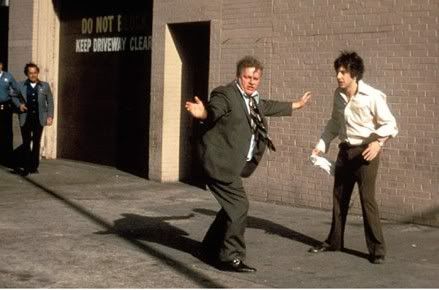
Dog Day Afternoon, easily. Lumet's always great at directing actors, but the heavyhandedness that occasionally creeps into otherwise great movies like 12 Angry Men and Network is totally absent in Dog Day Afternoon. It's a pitch-perfect character study, one of the most entertaining movies ever made, with an ending that breaks my heart.
4) Biggest surprise of the just-past summer movie season
I can't honestly say there were any surprises. While I enjoyed all of the big movies I'd been highly anticipating to varying degrees, this summer really lacked an out-of-nowhere sleeper for me to get excited about. And, as an art house projectionist, I can't remember a summer in at least five years with such a dearth of interesting indie counterprogramming. I did love Encounters at the End of the World, but that's Herzog, so hardly a surprise.
5) Gene Tierney or Rita Hayworth
Rita Hayworth
6) What’s the last movie you saw on DVD? In theaters?
On DVD, Amelie - I've been testing out different movies with my one-year-old daughter (she loved the Amelie-as-little-girl opening, but lost interest with Audrey Tautou). In theaters, Encounters at the End of the World (still thinking about that poor, crazy penguin).
7) Irwin Allen’s finest hour?
Gene Hackman cursing God as he does a parallel bars routine in the upturned bowels of the Poseidon.
8) What were the films where you would rather see the movie promised by the poster than the one that was actually made?
The teaser poster for Jaws 2, with the sun setting over a blood-red sea, is far cre
 epier and more atmospheric than anything in the movie.
9) Chow Yun-Fat or Tony Leung
Tony Leung
10) Most pretentious movie ever
Pretentious is one of the most horribly misused terms in talking about movies. I might not like all the movies of Michael Haneke or Oliver Assayas, but they're still intelligent and coherent enough to be worthy of argument. A truly pretentious movie is Aria - a murderer's row of directors making shorts scored to famous arias for NO APPARENT REASON.
11) Favorite Russ Meyer movie
Beyond the Valley of the Dolls, but I really need to see more.
12) Name the movie that you feel best reflects yourself, a movie you would recommend to an acquaintance that most accurately says, “This is me.”
You're asking someone who personalizes the movies he watches to an unhealthy degree. I think of of the reasons that Blue Velvet is my favorite movies is because it's like watching my psyche projected onto the screen. Make of that what you will.
13) Marlene Dietrich or Greta Garbo
Marlene Dietrich
14) Best movie snack? Most vile movie snack?
Best - Reese's Pieces. Most vile - any form of malted milk balls.
15) Current movie star who would be most comfortable in the classic Hollywood studio system
When Vanity Fair did that Hitchcock gallery earlier this year, Naomi Watts made an absolutely perfect Tippi Hedren.
16) Fitzcarraldo—yes or no?
Absolutely!
17) Your assignment is to book the ultimate triple bill to inaugurate your own revival theater. What three movies
 will we see on opening night?
Pretension alert: lately I've been realizing that most of my favorite movies - and, by extension, my cinematic ideal - are movies that render the divide between high art and pop meaningless. So, three movies that do just that: Psycho, Chinatown and Altman's Popeye.
18) What’s the name of your theater? (The all-time greatest answer to this question was once provided by Larry Aydlette, whose repertory cinema, the Demarest, is, I hope, still packing them in…)
Well, I already used the Vista. I'd love to be the one in charge of programming the Mohawk, an old movie house that my town is gradually raising funds to renovate. I think I'd keep the name.
19) Favorite Leo McCarey movie
Duck Soup
20) Most impressive debut performance by an actor/actress.
Malcolm McDowell in if...
21) Biggest disappointment of the just-past summer movie season
Well, Mamma Mia! was terrible, but I can't say I was disappointed, exactly...
22) Michelle Yeoh or Maggie Cheung
Maggie Cheung
23) 2008 inductee into the Academy of the Overrated
The Death of Mr. Lazarescu
24) 2008 inductee into the Academy of the Underrated
Smiley Face
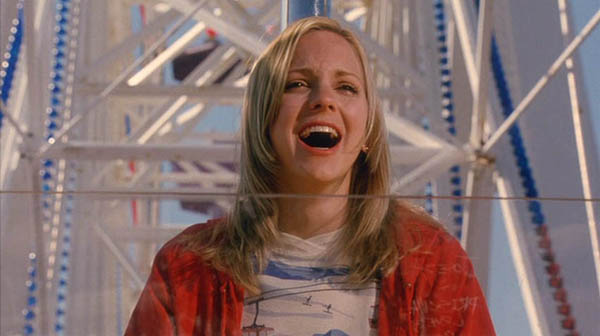
25) Fritz the Cat —yes or no?
Not really.
26) Trevor Howard or Richard Todd
Trevor Howard
27) Antonioni once said, “I began taking liberties a long time ago; now it is standard practice for most directors to ignore the rules.” What filmmaker working today most fruitfully ignores the rules? What does ignoring the rules of cinema mean in 2008?

I think the most meaningful examples of this today don't happen in alternative cinema, but in mainstream films that deviate from the rules in meaningful ways. Three of the best films of the past few years - There Will Be Blood, Zodiac, No Country For Old Men, The Dark Knight - were partly defined by their defiance of expectations. And the response to their left turns, particularly in the case of No Country For Old Men, continue to reverberate not only in the cinephile community but among everyday moviegoers who were genuinely shaken.
28) Favorite William Castle movie
The Tingler
29) Favorite ethnographically oriented movie

One of my favorite things about the work of Jim Jarmusch is its unspoken study and celebration of cultural diversity in microcosm. Down By Law is probably the best example of this.
30) What’s the movie coming up in 2008 you’re most looking forward to? Why?
The Curious Case of Benjamin Button. Fincher's coming off Zodiac, and the trailer's a beauty.
31) What deceased director would you want to resurrect in order that she/he might make one more film?
That's sort of a sad question, isn't it? Reminds me of the ending of A.I. Hey, let's go with zombie Kubrick's Napoleon.
32) What director would you like to see, if not literally entombed, then at least go silent creatively?
It's reassuring to see so many people citing Brett Ratner before I did. Just rewatched Red Dragon - only Ratner could take that cast and source material and make something so hacky.
33) Your first movie star crush
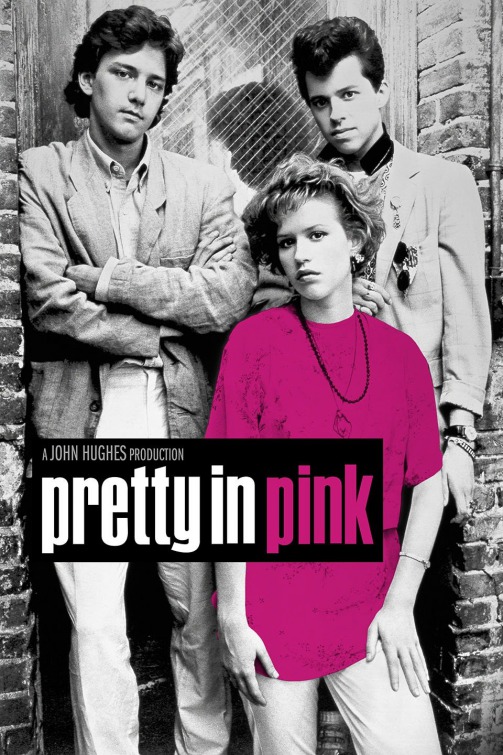 I wish I had something cool to say, like I was really into Anna Karina at five. But really, Molly Ringwald.
Friday, August 29, 2008
Now which would you rather be, an anal bead or a dragon?
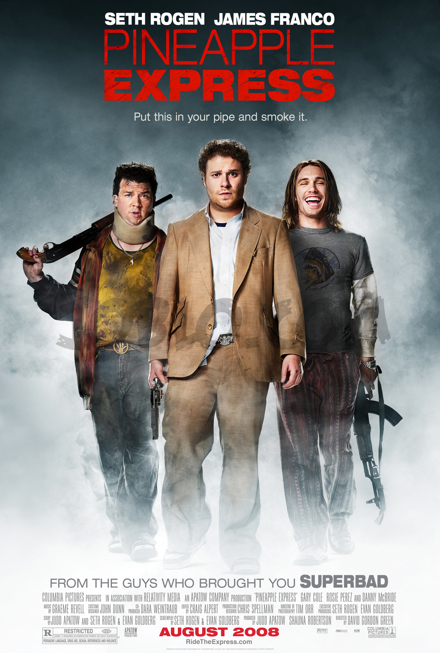 My first laugh at Pineapple Express came as I entered the theatre and was overwhelmed by the musky odor of patchouli. It was as if every member of the movie's target audience had thought to themselves, "Man, if I don't do something, everyone's gonna know I'm high!" At a movie where just about everyone was high. And sure enough, the movie's black-and-white, '30s-set prologue - an unapologetic tribute to the pleasures of pot and a condemnation of anyone who disagrees as a joyless narc - had the audience roaring with approval. That said, it's not exactly a big accomplishment to make a pothead laugh; I'm happy to report that, even if you're sober, Pineapple Express is hilarious.
A mash-up of '80s-inspired action and stoner comedy that treats both genres not with hipster derision but with genuine affection, Pineapple Express follows process server Dale Denton (Seth Rogen) and his dealer Saul (James Franco) as they find themselves on the run after Dale witnesses a corrupt cop (Rosie Perez) and Saul's supplier Ted Jones (Gary Cole) commit a murder. Saul is mistakenly placed at the scene by Pineapple Express, a rare strain of marijuana left behind by the panicked Dale; the Express is the proverbial "good shit," so rare that, according to Saul, smoking it is "like killing a unicorn." Dale and Saul's attempts to save themselves are frequently interrupted by the Pineapple Express, making the film a charming hybrid - a high-octane chase that reminds its target audience how helpless they'd be in the same situation. The choice of All the Real Girls director David Gordon Green proves to be an inspired one; Green (who recently outed himself as an avowed Seagalologist) clearly had a blast directing against type, and his car chases and shootouts would make George P. Cosmatos proud. Green's improvisational method of filmmaking proves well-suited to the Judd Apatow repertory company, while finding room for moments, like a leisurely scene of Saul and Dale frolicking in the woods, that give the movie a goofy poetry absent from other Apatow productions (though one can see Apatow striving for it in his own films). If it's less identifiably personal than his earlier work, it presents the exciting possibility that Green may become the new Hal Ashby, comfortably shifting between genres while adding his own gentle authorial touch.
Green also meshes nicely with his two leads, whose adorable "bromosexual" chemistry drives the movie (the unspoken, awkward affection between male friends is perhaps the central theme in the Apatow ouevre). Rogen is effective in a role he rarely plays, the straight man - spending most of the movie confused, terrified or exasperated at Franco, he makes an excellent Abbott. It's Franco who gets to run with the stoner antics, and he's surprisingly hilarious; I've talked some shit about the guy in the past, and I'm officially prepared to take it back. He's a good actor, but his pretty-boy looks have gotten him repeatedly miscast in square-jawed roles, but between Freaks and Geeks and Pineapple Express, it's pretty clear that he should play fuckups more often. The first time we see Saul, he's watching 227 and Krull at the same time; five minutes later, he repeats a line from 227 to himself, and whether the moment was improvised or written, Franco's delivery is so perfectly offhanded that we feel like we've known this guy for years. Franco deserves a lot of credit for making Saul not just a stoner caricature but a sweet, slightly sad dude with a comendable sense of loyalty - I must admit, he reminded me of a friend of mine (who is not a dealer), and his performance made me appreciate my friend in a new light. You don't usually get that kind of insight from pot movies.
The rest of the ensemble is as strong - Danny McBride (memorable as Bust Ass from All The Real Girls) as Lando Calrissian surrogate Red has been signaled out by most of the reviews, and he is pretty hilarious. But I also appreciated Ed Begley Jr. (who gets the best line in the movie) as the father of Dale's teenage girlfriend and especially Craig Robinson as an effete hitman. That teen girlfriend (played by Amber Heard) is one of several threads that falls victim to the meandering plotting that is perhaps inevitable in a pot movie, but that's also one of the film's charms. When Dale announces that maybe he and Saul should quit smoking and grow up, I feared the film would fall victim to the clumsly moralism that shows up a lot in Apatow productions; thankfully, the characters soon forget this, as well as the fact that they've killed several people (the climax's unapologetic bloodletting going further than Hot Fuzz would allow itself). Pineapple Express plays out like the high that the titular weed promises; you don't quite remember, when the ending arrives, how you've gotten there, and the pieces don't quite make sense, if it even happened at all. But it sure makes for a hell of a laugh with your best friends. I know there's a pun to be made, but I'm letting it go.
Monday, August 25, 2008

The Trim Bin #72
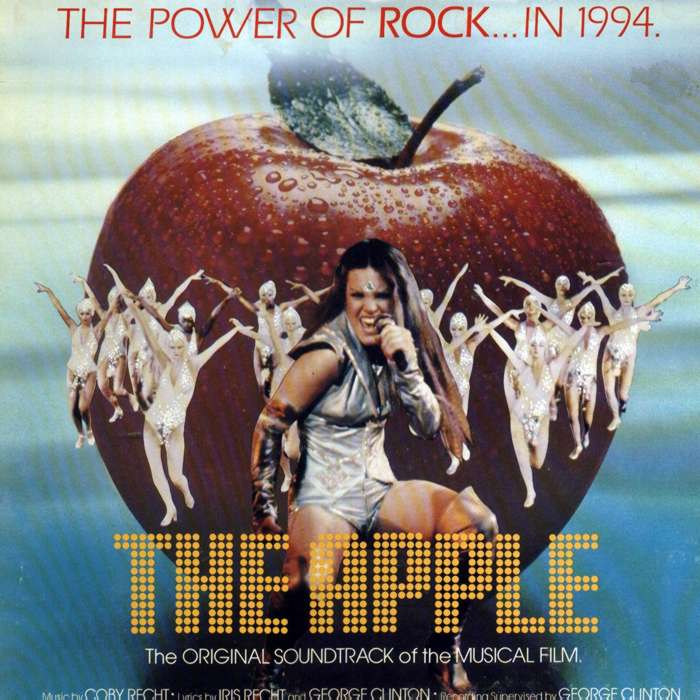
- From Cassavettes to Cobra: an interview with Menahem Golan, co-head (along with cousin Yoram Globus) of '80s mini-empire Cannon Films (via GreenCine Daily). A great read, though I wish the interviewer had asked Golan about The Apple.
- I'm officially a Paul Proulx fan. Paul's new blog, Bennett Media, promises to bring us many more director tributes (check out the new David Fincher compilation), episodes of the hilarious WOWMANWOW, and other projects from one of the sharpest, most original editors around.
- The latest installment of Steve Hyden's "Song and Vision" series focuses on the "Tiny Dancer" scene in Almost Famous. TMI alert: the missus and I made out to that scene on our third date. Eight years and two kids later, and in addition to being one of the best Obvious Movie Music Moments (as Hyden terms it), it packs a hell of a nostalgic wallop.
- Lauren Wissot interviews Malcolm McDowell for The House Next Door.
- Speaking of THND, from founding editor Matt Zoller Seitz comes this endlessly amusing (and appropriately titled) compilation, The Explanation:
- I'm officially a Paul Proulx fan. Paul's new blog, Bennett Media, promises to bring us many more director tributes (check out the new David Fincher compilation), episodes of the hilarious WOWMANWOW, and other projects from one of the sharpest, most original editors around.
- The latest installment of Steve Hyden's "Song and Vision" series focuses on the "Tiny Dancer" scene in Almost Famous. TMI alert: the missus and I made out to that scene on our third date. Eight years and two kids later, and in addition to being one of the best Obvious Movie Music Moments (as Hyden terms it), it packs a hell of a nostalgic wallop.
- Lauren Wissot interviews Malcolm McDowell for The House Next Door.
- Speaking of THND, from founding editor Matt Zoller Seitz comes this endlessly amusing (and appropriately titled) compilation, The Explanation:
Subscribe to:
Posts (Atom)