Tuesday, November 25, 2008

This howling is the most exciting thing I've ever heard.

Is it inappropriate to refer to Salò, or the 120 Days of Sodom as funny? I've been putting off watching the film for years and had a pretty good idea of what I was getting into. But while Salò more than lives up to its reputation as a deliberately offensive gross-out, I'd read little that prepared me for how thought-provoking, skillfully crafted and - at points - blackly funny the film would be. During the infamous "Circle of Shit" sequence, just when I thought I couldn't take any more, one of the pervy middle-aged fascists reponsible for the film's horrors flashes an adoring smirk, his face flecked with feces, as he plants a kiss on one of his young prisoners; all at once, my nausea turned to uncontrollable laughter at the film's sheer insanity. Salò pushes bodily horror to such an extreme that it becomes completely absurd, translating political outrage into a sustained scatological outburst (the Mr. Creosote scene in Monty Python's The Meaning of Life is its direct descendant). While Pasolini may have intended Salò as an anti-entertainment, it's a shame to see the movie get lumped in with dreck like Cannibal Holocaust and I Spit On Your Grave on "Most Disturbing" lists. Though I can only recommend Salò to cinephiles who can stomach just about everything, it's an uncompromising work of art that is well worth the challenge of sitting through it.

Transplanting the Marquis de Sade's book The 120 Days of Sodom to fascist Italy, where four men - the Duke, the Bishop, the Magistrate and the President - kidnap 18 young men and women, capturing them in a palace and putting them through all forms of torture and degradation. The Republic of Salò was created near the end of WWII as a puppet state, and Pasolini's film is an aggressive dramatization of the unchecked decadence that signifies the end of an empire. Pasolini, like Bertolucci and Vischonti, dramatizes Wilhelm Reich's theory that fascism is a form of sexual repression; the exuberant depictions of budding sexuality shown in the director's Trilogy of Life appear only briefly, as a forced performance that is quickly interrupted. The frequent nudity of Pasolini's young, beautiful captives has a disorienting effect - if the desire towards beauty and vitality is natural, is the desire to corrupt and destroy also natural? Pasolini's deliberately distancing techniques only serve to further obscure the answer to that question, as does the captives' suprisingly passivity in the face of annihilation, the strange affection evident in the captors' faces, and the scenes where an aging maitresse entertains the captives with winsome stories of her humiliation and abuse. Whether or not these horrors are natural, Pasolini argues, we accept them without hesitation.

Pasolini's use of theatrical alienation also adds a kinky metatextual layer to the film. A performance between the older and younger maitresse late in the film calls attention to the sadomasochistic dynamic between the actors and their director. All have willingly taken on the roles of torturers and victim, with Pasolini frequently revealing to his actors the nature of a scene just before shooting. While this is an extremely manipulative approach, I haven't read any stories about actors quitting the film. Salò carries an perverse but undeniable charge as an experiment in how far its actors were willing to go, and if they might in some cases be enjoying their respective roles; I must admit that I found myself frequently observing whether the actors were visibly aroused as they assumed dominant or submissive roles. Like de Sade, Pasolini is exploring the darkest areas of sexuality, but while the Marquis was having a wank, Pasolini examines the lizard brain with a critical eye. The dark side of his Arabian Nights and the entire flood of '70s Europorn, Salò introduces a cinema born out of the sexual revolution and the liberation of content that is not an endless Bacchanalic orgy but also the release, Pandora-like, of the basest qualities of human nature.

About the shit-eating: 30+ years after after Salò and Pink Flamingos, after Jackass and the birth of "extreme" as a selling point, when corprophagia can be found in a studio-released comedy like American Wedding, once-transgressive content exists as nothing more than a dare between giggling teens (or, frighteningly, people my age) looking to prove how desensitized they've become. How is it, then, that Salò has lost none of its power? This can partly be attributed to the very convincing shit - a mixture of chocolate and orange marmalade - but what really sets Salò apart from its descendants in gross-out is that, to quote Videodrome, it has a philosophy. With the film newly available on DVD, it'd be great if it gained a reputation as a triple dog dare for the Goatse/"Two Girls One Cup" crowd, unexpectedly blindsiding its new audience with its lacerating indictment of their late-empire decadence. That is, if they can get past the weird gay stuff.

Friday, November 21, 2008

Cinevistaralphabet


Paul Clark has tagged me with The Alphabet Meme that orignated at Blog Cabins. The original concept - to pick a favorite movie to represent each letter of the alphabet - has been tweaked by various authors who've written about alternate favorites, guilty pleasures, underseen movies and movies they'd like to revisit (or see for the first time). But I'm going to be boring and stick with the "favorite movies" idea - the appeal of memes like this, to me, is to follow the formula and discover anomalies. I like the idea of this list as an alternate all-time top 26. It's not really Bizarro me, but a me-not-me who I basically agree with but has omitted a few favorites and (thanks to Q and X) has a special place in his heart for Marvel adaptations and Australian sci-fi.
Apocalypse Now
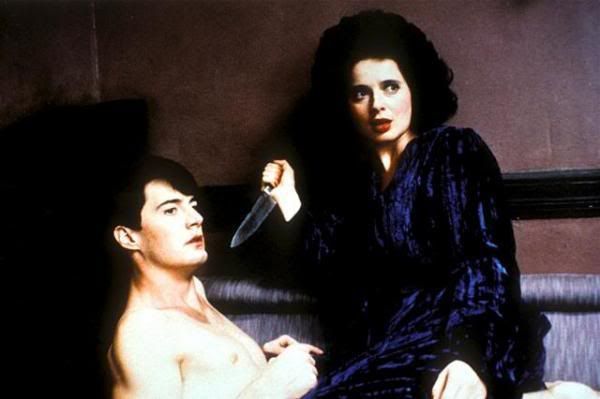
Blue Velvet
Carrie
Dawn of the Dead
E.T. the Extra-Terrestrial
The Fly
The Godfather Part II
Halloween
Inferno
Jaws
Kill Bill vol. 2
Lawrence of Arabia
The Man Who Fell to Earth
Nashville
One Flew Over the Cuckoo's Nest
Persona
The Quiet Earth
Raging Bull
The Shining
2001: A Space Odyssey
Un Chien Andalou
Vertigo
Wings of Desire
X2
Y tu mama Tambien
Zodiac

Edited to add: Oh yeah, I forgot to pass this on. Let's go with Neil, Greg, Allen, Jess and Jess.

Sunday, November 16, 2008

Tuesday, November 11, 2008

The curves of your lips rewrite history.

This is my contribution to Nathaniel's Musical of the Month at the Film Experience.

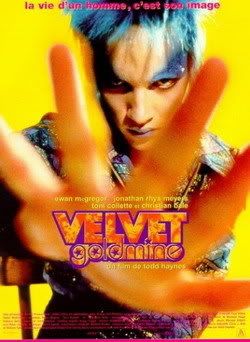
You can count on one hand the pop soundtrack cues that match the exhilarating high of Brian Eno's soaring "Needles in the Camel's Eye" played over images of throngs of young, tarted-up glitter kids in perpetual motion, serving as track 1, side 1 of Todd Haynes' glam rock fantasia Velvet Goldmine. The movie hits the ground running and never loses momentum - Haynes depicts the glam scene as no less than a teutonic shift in our cultural and sexual identity. Of course, the real heyday of artists like David Bowie, Roxy Music and T. Rex was nowhere near as huge as depicted here; Bowie was essentially a cult star who found his biggest success in the '80s with "Let's Dance," and much of the music from the period is largely dismissed as pretentious and silly today (at least by many of the passengers in my car). But the genius of Haynes' film is that it treats its subject as big, capturing the thrilling immediacy of being part of (or wanting to be a part of) a subculture, the feeling that your own revolution is - or can be - everyone's.

Named after Bowie's horniest song, Velvet Goldmine starts with the delivery of an infant Oscar Wilde to earth via spaceship before jumping to the staged assassination of Brian Slade (Jonathan Rhys-Meyers), a Bowie-inspired, androgynous pop idol who has his own Ziggy Stardust in alien persona Maxwell Demon. Ten years after the hoax and Slade's disappearance, rock journalist Arthur Stuart (Christian Bale) is assigned a "Where are they now?" piece about Slade; his investigation starts a Citizen Kane-like story where we learn pieces of the Slade story from those who knew him. At the heart of the film is Slade's doomed romance with American rocker Curt Wild (Ewan McGregor) - two parts Iggy Pop and one part Lou Reed, Wild gleefully wags his privates for his audience one moment before setting fire to the stage the next. The combustible affair between the openly bisexual Slade and the sexually malleable Wild, and the breakdown of Slade's relationship with wife Mandy (Toni Collette)* set the stage for Haynes' kaliedoscopic, visually stunning meditation on sex, performance, identity, drugs, celebrity, genderfuck and - above all - music. Haynes correctly identifies glam, wedged between the misogyny of the "free love" '60s and the defiantly aesexual rise of punk, as the moment when sex was a means of personal revolution. That this sexual revolution was rendered superficial through its contrived nature is arguable, but Haynes uses surfaces to argue for a deeper truth; when Wild and Slade, driving through a light show, serenade each other with a lip-sync of Lou Reed's "Satellite of Love," the moment becomes swooningly romantic precisely because of its obvious unreality.

Velvet Goldmine is filled with precisely such surface pleasures, from the wonderfully over-the-top costumes by Sandy Powell to the marvellously intricate sound design. Haynes is, above all, an aesthete; having studied semiotics at school, his films are like two-hour lessons in signs and signifiers, only they're actually fun to watch. When Haynes appropriates the out-of-time editing of Nicolas Roeg, the visual excesses of Ken Russell or the long-abandoned use of the zoom lens (Oh God, the zooms! Why did they ever go out of style?!), it's more than mere homage. Velvet Goldmine so thoroughly reenacts the sonic and visual textures of the period that each shot, each cut takes on an erotic charge. To the charge that the film is too cerebral, I can only respond that thinking can be very sexy - this is part of glam's appeal, descending not just from Wilde but from Rimbauld, the idea that the divide between introspection and experiential realities is a false one. What I mean to say is that this movie is really fucking hot.

To access the emotions of the film, one has to pay attention to Bale's journalist - the film is punctuated by Arthur's memories of the early '70s, as an awkward teen prone to hiding in his room listening to The Ballad of Maxwell Demon. When Arthur, watching Slade at a press conference on tv, imagines exclaiming "That's me!" to his parents right before Slade opines that we're all bisexual, it reminds all of us of our own adolescent identification with a particular rock star, and what it taught us about ourselves (if you claim you never obsessed over a rock star, you're probably lying). When the film arrives at a tryst between Wild and a young Arthur that may be real or imagined, Haynes doesn't shy away from the intensely personal attachment one can feel towards an artist who, in a sense, deflowers us (the scene is also bound - and Haynes couldn't have anticipated this - to take on special meaning to slash fiction fans as a visual record of Obi-Wan Kenobi buggering Batman). Velvet Goldmine is, more than anything, about what it feels like (to borrow from Almost Famous) to love some silly piece of music so much that it hurts. More than any movie I've seen, it captures the pure high of playing your favorite record (as the opening titles demand) at maximum volume.

* Sidenote: McGregor, Bale, Meyers, Collette - might this be the sexiest cast ever? I couldn't find a way to fit this into the review proper, but it's worth noting.

Monday, November 10, 2008

Title Card #84

The Trim Bin #73


- A must-read: Walter Chaw's interview with Charlie Kaufman, who articulates (better than I could hope to) about a dozen things I've been thinking/feeling/worrying about lately. I've talked to people who've loved everything Kaufman has done and hated Synecdoche, New York, so I really have no idea what to expect, which makes me more anxious to see it.

- I skipped reviewing The Happening because I'd just be hitting the same points most critics did in June. But when Shyamalan cut to Mark Wahlberg as a science teacher asking his students about disappearing bees, Jess and I laughed hard and didn't stop until the movie was over. Can anyone think of a more dramatic directorial flameout than M. Night Shyamalan? I hate to kick a guy when he's down, but Jesus...

- After I wrote about Mother of Tears, Paul Clark sent along a link to his recent review of Tenebre - fine reading, and I'm envious that Paul just had the pleasure of seeing Tenebre for the first time. Big agreement that Argento's best at his craziest.

- Phil Nugent shares a personal appreciation of Two-Lane Blacktop (via GreenCine Daily). His memories of late-night movies as "one of the things that settle and restore my soul" hit home particularly hard, as TV-38's Movie Loft had much the same role in my formative years. I'll write about it more sometime, perhaps - seems like kids raised on satellite, On Demand and a multitude of options are missing out.

- Between the movie shoot and Tommy's arrival, I didn't devote as much time to Halloween as I would have liked. Hopefully I'll be able to make up for this next year; in the meantime, here's a montage of gore courtesy of barringer82:


Thursday, November 06, 2008

The mind is kind.


In the winter of 1997, as audiences were making Titanic the highest-grossing movie of all time, a smaller but no less moving film about a tragedy was also playing. The Sweet Hereafter, the story of a small town in Canada reeling from the loss of its children in a schoolbus accident, uses its nonlinear narrative to circle around the accident without showing it for its first half. When the moment finally comes, in an extreme long shot, we only see the bus in the distance as it skids across the ice and rests on its surface for a terribly pregnant moment before silently falling through. The moment is restrained but not detached; when I saw The Sweet Hereafter shortly after going crazy for Titanic, it was an important lesson in my cinematic education - that a few moments of silence can have as much emotional impact as three hours of spectacle.

Based on the novel by Russell Banks, the film follows lawyer Mitchell Stevens (Ian Holm) as he travels to the town in order to convince the grieving parents to sue the bus company for damages. Through Stevens we learn about the lives of the parents and the survivors of the accident - bus driver Dolores Driscoll (Gabrielle Rose) and teenager Nicole Burnell (Sarah Polley), who has been confined to a wheelchair. In one of the movie's best scenes, Stevens delivers an impassioned speech to one couple about the need to search for justice; while it would have been easier to write the lawyer as a cynical opportunist, Banks and screenwriter/director Atom Egoyan choose to depict Stevens as an essentially good man who believes his work is just even as he is shaken by frequent phone calls from his own troubled, drug-addicted daughter. Though there is no clear cause for the accident, Stevens argues repeatedly that someone must be at fault and must pay; as we observe (again, at a distance) the parents and people of the town, their need to find answers in the face of incomprehensible loss is painfully identifiable.

Though the snowy landscape practically imposes a somber tone on most Canadian films, Egoyan uses the surroundings to particuarly strong effect here. The camera obsessively follows the image of the yellow bus against the blinding white snow, retracing its route over and over as if trying to unveil a clue it won't find. Coupled with Mychael Danna's icy score, the film - which juggles chronology, taking as its framing device the Pied Piper story - is remarkable for its sustaned austerity. Where other directors would fall victim to forced sentiment or false uplift with this material, Egoyan is attempt to let the story and performances unfold and trust in the strength of his source. This discipline occasionally works against the film, giving it a hermetic quality, particuarly when we learn that Nicole was sexually abused by her father (Tom McCamus). Egoyan reveals this fact in a shot of daughter and son embracing in a hayloft, by candlelight - the film hesitates at really dealing with the implications of this provocative image. Since Nicole's actions towards the end of the film are apparently motivated by her relationship with dad, Egoyan satisfies some insight into Nicole in the name of good taste. Thankfully, Sarah Polley's terrific performance, her piercing eyes serving as our own through the film, tells us all we need to know about Nicole.

I used to think The Sweet Hereafter was a masterpiece; watching it again, I found it to be merely an excellent one. What remains perfect is Ian Holm's performance. One of the most underrated actors, Holm is able to find as much truth in a simple gesture - standing before a mirror, peering at himself through his hands - as most actors can only begin to find in an extended monologue. At one point, we hear Stevens' story about having saved his daughter's life when she was still young; we can hear the bitterness and undying love for his child choking at Holm's throat. The question of whether any life is worth saving hangs, unanswered, in the air, and though Egoyan doesn't placate us with easy answers, his film finds dignity and even grace in our uncertainties.

Wednesday, November 05, 2008

Hell yes.


The other day, I was wondering whether it's still possible to bring people together and work towards a common goal. Tonight I got my answer. As incredible as it is to casually refer to "President Obama," it's the sight of thousands upon thousands of people - maybe a million! - flooding Grant Park that makes me go all misty-eyed. While I've been hoping for a Barack Obama victory since 2004, I realize that the real test lies ahead. I'm confident that Obama will meet the challenges ahead with intelligence, clarity and strength of character, but he's not Superman (though this is still kickass) and besides, not even Kal-El could fix all the horrifying mistakes of the past eight years. The true measure of an election is what it says about us, and tonight is, for me, resounding proof that in America, change is not only possible, it's happening.
Thanks, America, and don't let this be a fluke - let it be a beginning.

Selfishly, I'm happy for two reasons. One, the candidate I've liked all along actually won, which is surreal. Two, I can sleep more soundly knowing that the world Luna and Tommy are growing up in makes a little bit more sense tonight.

And whoever you voted for, the fact of a black man being elected President of the U.S. is a beautiful and long-overdue thing, and something we can all be proud of. Bush apparently congratulated Obama by saying "What an awesome night for you." Actually, George, it is pretty awesome.

Tuesday, November 04, 2008

Vote Camacho!!!


Because he knows shit's bad now, with all that starving bullshit, and the dust storms, and people running out of french fries and burrito coverings.

Monday, November 03, 2008

Title Card #83

Getting back to the garden.


I went to Woodstock and I left Woodstock, but I can't really say I took Woodstock. I auditioned for Taking Woodstock, the new Ang Lee movie, in July. The movie is based on the book by Elliot Tiber, whose job running his family's motel in upstate New York put him at the chaotic center of the titular festival. The filmmakers have chosen Columbia County - about 40 minutes from where I live - to stand in for Sullivan County. This means that the cast, which includes Dimitri Martin as Tiber, Emile Hirsch, Paul Dano and Eugene Levy as Yasgur, will be filled in with hundreds of locals. The prospect of playing a hippie for Ang Lee is a no-brainer, so I go the casting call, am advised not to cut my hair, and wait for the call.
Two months later, after sweating through August (my hair doesn't grow down, it grows out), I'm given a Monday morning call time. As it turns out, I could have gotten a haircut - I'm playing a "wannabe hippie," a geek who wants to be cool (how could they tell?). I'm costumed in a plaid shirt, regular-cut jeans and brown loafers before being sent to hair and makeup, where my hair is blow-dried and awkwardly side-parted. I look like the loneliest guy at an orgy.

We're taken from holding to location, a winding country road in Scotia that has been closed to traffic so the filmmakers can create their own traffic jam. Dozens of classic cars fill the road, the owners sitting nearby and comparing the scene to their own memories of the '60s (mostly variations of "We used to have the best weed, man"). As they place us in the scene, I realize crew and principals are a couple hundred yards away - we're here to fill in an extreme wide shot. We're instructed to walk away from the camera towards Happy Av. In the distance, I hear drums and see what looks like a group of hippies dancing naked around a fire. I keep almost making it to the party before "cut" is called and I have to go back to my first position. Story of my life, man.

Given little to do but walk, I'm given plenty of opportunity to enjoy the perfect mid-September weather and admire the period detail - the above picture from the festival could have been taken on-set. The shantytown of tents on Happy Av., populated by kissing couples, acidheads and nudists, coupled with the rural location's lack of contemporary details, makes it feel as though I've stepped into a time machine. If nothing else, Taking Woodstock will definitely look fantastic. As the crew moves closer, I'm instructed to walk down Happy Av. while Dimitri Martin exchanges dialogue with an actor playing a motorcycle cop. When I read about the movie, Martin seemed like an out-of-left-field choice, and still seems that way. Between takes, I find myself mistaking him for an extra before remembering to myself, "Oh yeah, it's that guy." Perhaps that anonymous quality is what Lee is after; either way, Martin seems like a generally nice guy. But if Paul Dano was here, I would have told him I was going to drink his milkshake. He probably never gets that.

During lunch, we're asked who would be willing to get muddy, and of course, I get in line. The best job on the set might be "mud wrangler," as the crew member given the task has a big grin on his face as he pelts us with mud. When we get back to set, the streets are also mud-splattered - I guess Woodstock's over. I shuffle, muddy and tired, down the street as Martin walks the other way. My first position is behind the camera, so I'm able to watch Ang Lee work with DP Eric Gautier and the crew. Watch, but not hear, as Lee is the most soft-spoken director I've ever seen. He's also the warmest and most unassuming, frequently chatting with extras between takes. When the scene is over and some of us are wrapped, Lee thanks each of us as we walk by. It's a sweet gesture, and I feel a little bad about my lukewarm review of Lust, Caution. I'm tempted as I pass to let him know how underrated Hulk is and ask why he thinks people didn't get it, but there's probably not enough time to get into that.

Everyone is just as nice all day. The costumes and location have caused everyone to act like it's 1969. I wonder to myself why people aren't this nice to each other out of costume. I wonder (as I did with Farlanders) why it's easier to get people my age to play protestors in a movie than to really stand up for something they care about. But it's fun to pretend for a day like people still believe that change is possible. And I heard about 800 "brown acid" jokes, and yes, there was a lot of dope-smoking, which the production seemed to be tacitly condoning. But there was one important way that the set was nothing like the real Woodstock - nobody was sharing.

Monday, October 27, 2008

Title Card #82

Who wants to eat the girl?

The recent work of Dario Argento reminds of Trainspotting's Sick Boy and his theory that all great artists decline with age. Watching Argento, a master stylist, reduced to making thrillers involving internet poker makes one approach each new film with trepidation. This is especially true of Mother of Tears, the long-awaited conclusion of Argento's "Three Mothers" trilogy. The first two chapters, Suspiria and Inferno, are perfectly realized cinematic nightmares made by a more inventive, audacious Argento, and there was hope that Mother of Tears would mark a bold return to form. Unfortunately, Mother of Tears is a missed opportunity, a sometimes entertaining splatterfest that never comes close to the earlier films' macabre elegance.

The film opens with the discovery of an ancient urn that, when opened by art student Sarah Mandy (Asia Argento), unleashes an evil force spreads chaos and sensless violence Rome and threatens the return of Mother Lachrymarum (Moran Atias) and a "second age of witches." An early scene that ends with a curator strangled with her own innards is impressively sick, and Sarah's subsequent escape from the museum promises some of the fairytale atmosphere that made Suspiria and Inferno so distinctive. Sadly, any sustained atmosphere is in short supply here - visually, Mother of Tears is flat and strangely generic. The baroque cinematography and bold color palettes of Argento's best work is replaced here with an perfunctory visual strategy straight out of a Sci-Fi Channel movie. The scenes of ordinary citizens committing random acts of violence were a perfect opportunity for Argento to recapture the hallucinatory mayhem that made Inferno so brilliant, but he eschews tension, even creative bloodletting, for matter-of-fact gore. Mother of Tears is a thuddingly literal-minded betrayal not only of the earlier films' marvelously sustained dream logic but of Argento's initial inspiration - shouldn't any work inspired by de Quincey at least aim for the uncanny?

The absence of any of Argento's strengths also makes his weaknesses more obvious. The setup could have been effective, but when the "age of witches" is represented by a bunch of sneering Goths led by a usually-topless Mother of Tears, it's more hokey than eerie. The cast, even the usually interesting Asia Argento, look bored as they go through the paces. And while Argento has done wonderful things with low-tech special effects in the past, CGI proves to be an uncomfortable fit - it's obvious and only draws further attention to Argento's distressingly anachronistic attempts to be hip and contemporary. Worst of all, Goblin's Claudio Simonetti trades the unnerving soundscapes of Deep Red and Suspiria for a loud, oppressive and completely forgettable score.

There are a few things to enjoy in Mother of Tears: there are a few impressively sickening moments, and the orgies Mother Lachrymarum hosts in an underground dungeon are impressively kinky. There's also some fun to be had in spotting Argento's recurring fetishes and obsessions - Asia has another questionable gratuitous nude scene shot by her dad, Argento's still working through tortured relationship with Daria Nicolodi (Asia's mother in the movie and real life), and monkeys are still threatening. And when Argento nods to his past successes - the recitation of the Three Mothers passage that opened Inferno, Asia wading through a pool of human decay exactly like the one in Phenomena, the self-consciously too-happy ending reminiscent of Opera - I got a slight buzz remembering those films. Unfortunately, those moments play less like a variation on familiar themes (as they often did to great effect in Inferno) and more like a slapped-together greatest hits collection for an underserved fan base. Mother of Tears is just good enough to hope that Argento has another classic up his sleeve, but bad enough to realize what an unlikely bit of alchemy that would be.

Thursday, October 23, 2008

Thomas Jerome Bemis


Born on Tuesday at 7:10 AM. Mom and baby are good, we're all exhausted but having a great time getting to know this delightful new member of our family.

Sunday, October 19, 2008

Saturday, October 18, 2008

Top 101 (2008 Edition)

Things that have changed in the past year: I've shot a feature and my second child is weeks (maybe days) from arriving. Things that have not changed: my near-fetishistic love of '70s cinema and my preference for movies that aren't afraid to go big, whether in scale, ambition or emotion. This list is a reflection of what I value most in the movies in 2008; that said every year making the list becomes less pleasurable and more difficult. While anything beyond 101 feels like cheating, I must note that any list that doesn't include Pulp Fiction, The Cabinet of Dr. Caligari, A.I. and Birth (to name a few) can't properly be called a list of my favorites (I always joke to people who comment on our large DVD collection that they're my 800 favorite movies). This is the VIP list, the movies that have become such a part of me that I wonder how I ever went without having seen them.


1. Blue Velvet (David Lynch, 1986)
2. The Shining (Stanley Kubrick, 1980)
3. Nashville (Robert Altman, 1975)
4. 2001: A Space Odyssey (Stanley Kubrick, 1968)
5. E.T. the Extra-Terrestrial (Steven Spielberg, 1982)
6. Vertigo (Alfred Hitchcock, 1958)
7. Raging Bull (Martin Scorsese, 1980)
8. There Will Be Blood (Paul Thomas Anderson, 2007)
9. Blade Runner (Ridley Scott, 1982)
10. Apocalypse Now (Francis Ford Coppola, 1979)


11. Carrie (Brian De Palma, 1976)
12. Boogie Nights (Paul Thomas Anderson, 1997)
13. Kill Bill vol. 2 (Quentin Tarantino, 2004)
14. Kill Bill vol. 1 (Quentin Tarantino, 2003)
15. Jaws (Steven Spielberg, 1975)
16. Taxi Driver (Martin Scorsese, 1976)
17. Alien (Ridley Scott, 1979)
18. The Man Who Fell to Earth (Nicolas Roeg, 1976)
19. Persona (Ingmar Bergman, 1966)
20. The Elephant Man (David Lynch, 1980)


21. Nosferatu: Phantom der Nacht (Werner Herzog, 1979)
22. Barry Lyndon (Stanley Kubrick, 1975)
23. My Own Private Idaho (Gus Van Sant, 1991)
24. Psycho (Alfred Hitchcock, 1960)
25. Badlands (Terrence Malick, 1973)
26. Halloween (John Carpenter, 1978)
27. A Clockwork Orange (Stanley Kubrick, 1971)
28. Children of Men (Alfonso Cuaron, 2006)
29. Lawrence of Arabia (David Lean, 1962
30. El Topo (Alexandro Jodorowsky, 1970)


31. The Empire Strikes Back (Irvin Kershner, 1980)
32. Jules and Jim (Francois Truffaut, 1962)
33. Dawn of the Dead (George A. Romero, 1978)
34. Chinatown (Roman Polanski, 1974)
35. Don't Look Now (Nicolas Roeg, 1973)
36. The Fly (David Cronenberg, 1986)
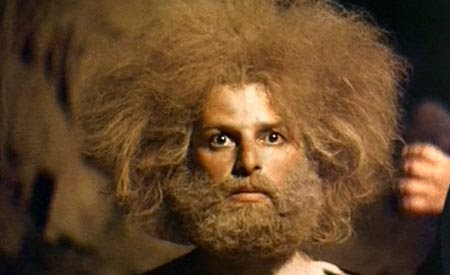
37. Aguirre the Wrath of God (Werner Herzog, 1972)
38. Fargo (Joel Coen, 1996)
39. The Godfather Part II (Francis Ford Coppola, 1974)
40. The Last Temptation of Christ (Martin Scorsese, 1988)


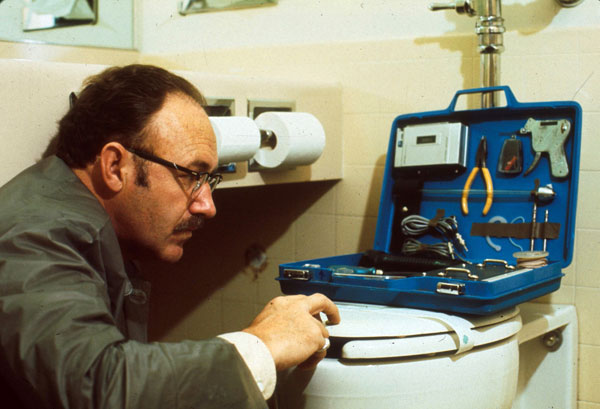
41. The Conversation (Francis Ford Coppola, 1974)
42. Eraserhead (David Lynch, 1977)
43. Dead Man (Jim Jarmusch, 1996)
44. 8 ½ (Federico Fellini, 1963)
45. The Thing (John Carpenter, 1982)
46. Touch of Evil (Orson Welles, 1958)
47. Ran (Akira Kurosawa, 1985)
48. Brazil (Terry Gilliam, 1985)
49. Schindler's List (Steven Spielberg, 1993)
50. GoodFellas (Martin Scorsese, 1990)


51. Mulholland Drive (David Lynch, 2001)
52. The Third Man (Carol Reed, 1949)
53. Inferno (Dario Argento, 1980)
54. All That Jazz (Bob Fosse, 1979)
55. Close Encounters of the Third Kind (Steven Spielberg, 1977)
56. Sid and Nancy (Alex Cox, 1986)
57. One Flew Over the Cuckoo's Nest (Milos Forman, 1975)
58. The Seventh Seal (Ingmar Bergman, 1957)
59. McCabe and Mrs. Miller (Robert Altman, 1971)
60. Cries and Whispers (Ingmar Bergman, 1972)


61. Blow Out (Brian De Palma, 1981)
62. Manhattan (Woody Allen, 1979)
63. Days of Heaven (Terrence Malick, 1978)
64. Dr. Strangelove or How I Learned to Stop Worrying and Love the Bomb(Stanley Kubrick, 1964)
65. Rashomon (Akira Kurosawa, 1950)
66. Citizen Kane (Orson Welles, 1941)
67. Once Upon a Time in America (Sergio Leone, 1984)
68. City Lights (Charles Chaplin, 1931)
69. Raiders of the Lost Ark (Steven Spielberg, 1981)
70. The Godfather (Francis Ford Coppola, 1972)


71. Last Tango in Paris (Bernardo Bertolucci, 1972)
72. The American Friend (Wim Wenders, 1977)
73. Betty Blue (Jean-Jacques Beneiex, 1986)
74. The Searchers (John Ford, 1956)
75. Harold and Maude (Hal Ashby, 1971)
76. Eyes Wide Shut (Stanley Kubrick, 1999)
77. Miller's Crossing (Joel Coen, 1990)
78. Magnolia (Paul Thomas Anderson, 1999)
79. Rushmore (Wes Anderson, 1998)
80. Orphee (Jean Cocteau, 1949)


81. Once Upon a Time in the West (Sergio Leone, 1968)
82. The Assassination of Jesse James by the Coward Robert Ford (Andrew Dominik, 2007)
83. Wings of Desire (Wim Wenders, 1987)
84. Y tu mama tambien (Alfonso Cuaron, 2001)
85. Heavenly Creatures (Peter Jackson, 1994)
86. No Country For Old Men (Joel and Ethan Coen, 2007)
87. Black Moon (Louis Malle, 1975)
88. Zodiac (David Fincher, 2007)
89. Stroszek (Werner Herzog, 1977)
90. Punch-Drunk Love (Paul Thomas Anderson, 2002)


91. Invasion of the Body Snatchers (Philip Kaufman, 1978)
92. Pat Garrett & Billy the Kid (Sam Peckinpah, 1973)
93. Belle de Jour (Luis Bunuel, 1967)
94. Ed Wood (Tim Burton, 1994)
95. Macbeth (Roman Polanski, 1971)
96. Phantom of the Paradise (Brian De Palma, 1974)
97. The Fountain (Darren Aronofsky, 2006)
98. Hedwig and the Angry Inch (John Cameron Mitchell, 2001)
99. The Big Lebowski (Joel Coen, 1998)
100. Eternal Sunshine of the Spotless Mind (Michel Gondry, 2004)
101. Popeye (Robert Altman, 1980)

Saturday, September 27, 2008

hiatus


The movie shoot starts today - I'll try to post on its progress at The Black Light Journals. Other than that, I'll be too busy to write until after Columbus Day. Expect a review of The Sweet Hereafter, notes on working as an extra on Taking Woodstock, and a proper appreciation of Paul Newman when I get back. The image-guessing game will resume in November.

Friday, September 26, 2008

I'm not set up to mold hard rubbers.

I've never talked about politics much in this blog except when relevant to the movie I'm discussing. While I enjoy the political rants Jeffrey Wells and Dave Poland mix in with their box-office rants, I don't really feel qualified to publish my opinions on the subject, and I don't want to end up stammering through a segment on The O'Reilly Factor. Plus, while I'm for one candidate, I've never found it constructive to focus one's energy on being against the other, so a poster in the sidebar has felt like enough. However, there's been something in the air for a while - let's say since, I don't know, August 29 - that has made it harder not to vent my suspicion our country actively becoming more ridiculous. For that reason, Burn After Reading, the Coens' latest comedy, is not only a pleasure as a return to form after the disappointment of Intolerable Cruelty and The Ladykillers, but as a series of cathartic belly laughs. The Coens take dead aim at a type of anti-intellectualism, self-absorption and willfull ignorance that is, sadly, uniquely American in character. It's cynical, even smug, but it couldn't have come at a better time.

Reminding of an absurdist version of Syriana, the movie revolves around dim-bulb gym employees Linda (Frances McDormand) and Chad (Brad Pitt) as they find a disc containing the memoirs of recently fired CIA analyst Osbourne Cox (John Malkovich). Mistaking Cox's memoirs and financial statements for top-secret information, Linda and Chad attempt to blackmail the pompous, alcoholic analyst. Cox's wife Katie (Tilda Swinton) and her lover, womanizing federal marshal Harry Pfarrer (George Clooney) are eventually drawn into a plot through a chain of events too nonsensical to describe, and I mean "nonsensical" as a compliment. Since Blood Simple, the Coens have returned again and again to the idea of plans gone awry, becoming masters of the convoluted plot. In Burn After Reading, it's the characters' superficial, self-centered natures that spirals the plot into levels of comic absurdity. The film's comic approach recalls Dr. Strangelove, starting as a straight-faced thriller before the plot is led astray by plastic surgery, sex toys and Dermut Mulroney. No less a comment on the state of our union than No Country For Old Men, the Coens' newest comes with the suggestion (like an R-rated version of the second half of Wall-E) that our self-destruction will be brought about by our desire to have things newer, faster, easier, cheaper and now.

Handsomely shot by DP Emmanuel Lubezki, Burn After Reading actually works pretty well as an example of the genre it's subverting. Exposing the essential arbitrariness of the topical thriller, the Coens succeed at deflating the self-importance of the "serious" thrillers that have become fashionable in recent years. Many of those star Clooney, of course, who gleefully sends up his macho appeal here - Pfarrer is like a comic flipside of Michael Clayton (the Coens would have correctly seen that film's protagonist as a schmuck), a barrel-chested masculine archetype who, at heart, wants his mommy. There are no heroes in the film, and no Lebowskis either; the only reasonable and decent character, gym manager Ted (Richard Jenkins, on a roll this year), is eventually punished for his decency. The audience's only surrogates are two CIA officers (David Rasche and J.K. Simmons, both brilliant) left to pick up the pieces. If we don't see ourselves in the buffoons, we're left, like Simmons, to lean back in our chairs and exclaim, "Jesus fucking Christ."

It'll be interesting to see if Burn After Reading improves after repeat viewings. The first time I saw The Big Lebowski I liked it, but it only revealed its brilliance around the third or fourth time. Right now, Burn After Reading seems like a top-notch comedy, its sharp dialogue worthy of Hawks and Wilder complete with the needless vulgarity their movies would certainly contain were they working today. It's a movie filled with acidic pleasures, among them Malkovich's upper-class twit, Swinton's low-key sadism, and Pitt, as much of a revelation playing a perpetually upbeat moron as he was playing Jesse James. Best of all is Frances McDormand as Linda, who, with her shallow, self-serving provincialism, tendency to act before thinking and lack of understanding about contemporary U.S. relations with Russia, reminded me exactly of - well, it was a much-needed laugh.

Monday, September 22, 2008