Tuesday, February 04, 2014

Top 10: 2013


It was clear that 2013 was going to be a strong year for movies early in the year. Usually, spring is a dumping ground for subpar studio fare and a time when we mostly have to wait for the good stuff. But Spring 2013 saw the release of Spring Breakers, The Lords of Salem, To the Wonder, Upstream ColorEvil Dead, Room 237, Mud - movies that, whether you loved or hated them, were certainly unique and worth discussing. During both Spring Breakers and The Lords of Salem, I was baffled by the fact that I was watching each in a multiplex. If the summer was a little heavier than usual on big-budget dreck, there were still plenty of treasures at the art house, and interesting genre fare like The Conjuring and Pacific Rim. The fall and winter were packed with strong movies from legendary filmmakers and those, like Steve McQueen, who are well on their way towards being counted among the greats. As divisive as many of these movies were, any cinephile would have had an easy time finding at least a handful of movies to be passionate about.

A lot has been written about the many movies in 2013 that were in some way about America's unchecked greed and excess and, perhaps, the gun-toting cuties of Spring Breakers or the cocaine-fueled orgies and dwarf-tossing of The Wolf of Wall Street as symptoms of an empire in decline. Personally, the movies that resonated for me were largely about characters existing within much larger systems beyond their control - capitalism, but also family, technology, time, the laws of physics and, especially, mysterious pig-farming identity thieves - who stumble towards finding meaning and happiness in their own lives. This identification probably has a lot to do with my family's searching for and, ultimately, buying and moving into a new house, the first I've lived in since I moved out of my parents' home. With everything that decision entails about committing to and building a life with another person, it makes sense that I was drawn to movies about relationships this year; it felt right to bookend my list with two movies about couples. It wasn't just relationship movies that resonated, though; shortly after we made a bid on the house - a farmhouse that was built in 1875 and has all of the character that suggests - I saw The Conjuring. Afterwards, I joked to my girlfriend that it was a perfect primer for the problems of home ownership. As I have a work schedule that enables me to be at home with our kids most of the week, I couldn't help feeling for Lili Taylor's character - if there are any ghosts in this house, I'm the one they're going to give a hard time.

That The Conjuring, a movie I liked very much, didn't make my top ten, along with the rest of the year's crop of interesting horror movies, gives an idea of what a strong year this was. There are years where I've had to round out my top ten with flawed but interesting films, but this was one of those years where my honorable mentions list would be about as worthy as the top ten. To be honest, my rankings this year (minus my top two, which were both released in the first half of the year and stayed firmly at the top of the list despite strong competition) are mostly irrelevant; I can't remember another year where deciding which movie was my third or fifth or seventh favorite of the year was as much a matter of splitting hairs. I've never included an honorable mentions list, but this year is a good time to start. Here are all of the movies not on my top ten that I'd rate 4 out of 5 stars or higher:

John Dies at the End, The Lords of Salem, Frances Ha, Berberian Sound Studio, This Is the End, World War Z, Fruitvale Station, Pacific Rim, The Act of Killing, The Conjuring, Blue Jasmine, The Spectacular Now, Captain Phillips, American Hustle

And, in the interest of full disclosure, movies on Metacritic's Top 30 that I haven't seen yet:

Stories We Tell, Short Term 12, The Great BeautyDallas Buyers Club, A Touch of Sin, Leviathan, The Past

And now, the top ten:

1. Before Midnight

Simply put, Before Midnight was the best moviegoing experience of the year for me. After my girlfriend and I saw this, we talked about where we are now and talked about the future. We talked and talked and ate good food and talked and made love and talked and talked and talked. If one of the reasons we love movies is because of how they reach us where we are and help us make sense of and find the poetry in our own lives, than no movie came close to Before Midnight for me this year. Of course, it also helps that's a perfect movie and the perfect end to one of the all-time great movie trilogies; I'm torn between the desire to revisit Jesse and Celine in ten years and the suspicion that this story may have already ended with a perfect balance of uncertainty and hope.

2. Upstream Color
It's been six months since I last watched Upstream Color, and in trying to describe what makes it special, it feels more like trying to recount a dream. While Shane Carruth's haunting, elliptical sci-fi romance about love, memory and finite beings controlled by infinite organisms welcomes multiple interpretations, I don't think anyone will be able to create a timeline that explains it all, as someone did for Carruth's first movie, Primer (it would look more like a very dense Venn diagram). While Upstream Color is as conceptually ambitious as Primer, it's also got a surprising amount of heart - take away all the sci-fi trappings, and what's left is a story about two survivors of a traumatic experience that has altered their concept of reality helping each other rebuild their lives by creating new, shared memories. Carruth (who not only wrote and directed the film but was also the cinematographer, editor (with David Lowery), composer and male lead) demonstrates remarkable control over his film's idiosyncratic tone; his work here has been compared to Terrence Malick and David Cronenberg, which is true in that all three directors possess an incredibly unique and self-assured vision. As the term "independent film" becomes increasingly muddled, here's a movie that is truly independent; it owes its existence to the democratization of film production and distribution, but it's ambitious in a way that few DIY filmmakers attempt. It's a great movie anyway, but as a no-budget filmmaker, it gives me hope.
3. 12 Years a Slave

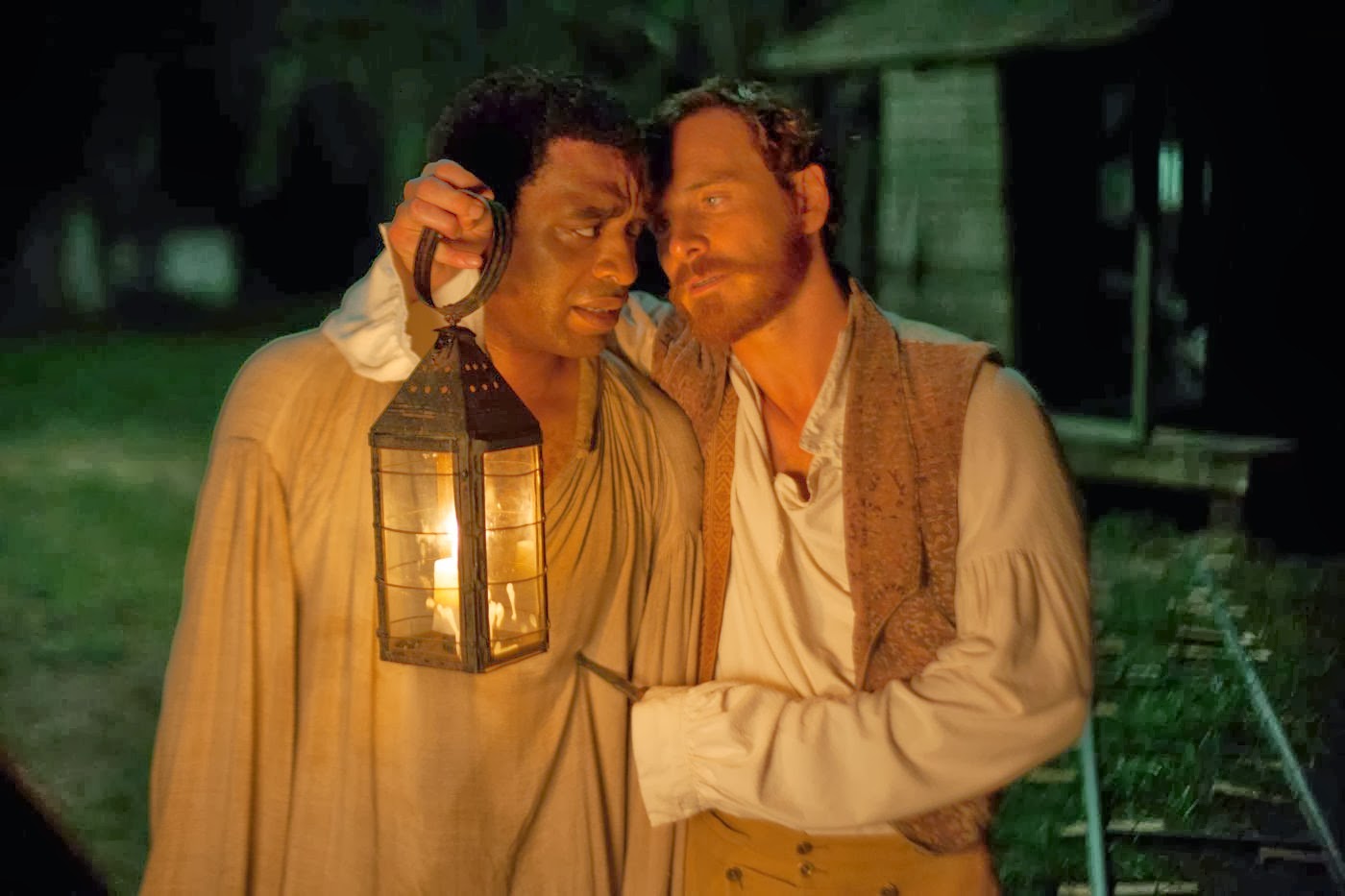
I honestly can't imagine what a relatively privileged white guy like me could say about 12 Years a Slave that could possibly be of interest. I don't mean for this to sound reductive, but I honestly feel like it's our job, as white audiences, to sit down, shut the hell up, watch the movie, allow the brutality - not just physical violence, but the way slavery breaks down Solomon Northup's sense of self - to wash over us and contemplate what the movie has to say about not only our terrible history but the legacy of privilege we continue to benefit from. I'm not trying to say the movie is perfect or beyond criticism, but when I read stuff like "Meh, I thought a few scenes were overdone" - no offense, but do you know how you sound? 12 Years a Slave is a punch to the gut, a descent into a hell that, it implies, we all have the potential to be complicit in creating. But it's not just the movie's intentions that make it great, as there are lots of well-intentioned but so-so movies on the subject of race. It's director Steve McQueen's ability (aided immeasurably by his remarkable cast) to be unflinching, to not just preach at us about the horrors of slavery but make them feel viscerally real and immediate, but also to find surprising moments of beauty and grace that serve to make the evils on display that much more tangible by contrast. McQueen is rigorous and precise, but never denies even the most loathsome of his characters an essential human frailty, which denies us the detachment of saying "That could never be me." I had a conversation with some friends, many of them black, who insisted that they had no interest in seeing 12 Years a Slave because the narrative is so ingrained in their culture and upbringing that they don't need a painful reminder. That makes perfect sense to me; conversely, if I had the power to do so, I'd show 12 Years a Slave in every predominantly white high school in America.

4. Gravity

Or, as my friend Kevin dubbed it, Panic Attack: The Movie. Kevin was being a smartass, but it's also true. While Gravity is remarkable as a believably immersive experience, Neil DeGrasse Tyson and Louis C.K. both missed the point when they criticized it for not being 100% scientifically accurate (though Louis C.K.'s point about Sandra Bullock's character as a "reluctant astronaut" is hilarious and duly noted). It's a great ride, but it's more than that. That I was moved by the emotional journey Bullock's character, Ryan Stone, takes in the film instead of being annoyed by her (admittedly somewhat awkwardly presented) backstory probably reveals my limitations as a critic (a friend asked a while back why I'm not writing about movies professionally, and as nice as the compliment was, I think I'm just too easily moved to hack it). Gravity plays like a more technically ambitious but also more intimate B-side to Alfonso Cuarón's previous film, Children of Men; both are about finding hope in the face of absolute darkness, made frighteningly literal in this film as Bullock is sent hurtling into the abyss. No movie engaged me on a primal, visceral level the way Gravity did this year, which is the kind of reaction that's easy for cinephiles to underestimate but is also essential to why we go to the movies.

5. The Wolf of Wall Street

As much as I loved this movie, I'm kind of sick of discussing it, at least the way the debate has been framed - between the controversy over Scorsese's film and the torture debate over Zero Dark Thrity last year, I'm ready to testify to Congress about the need to ban pundits from writing about movies. Once the dust has cleared, though, it'll be easier to place Jordan Belfort alongside other Scorsese protagonists who use money or violence or celebrity or something else to attempt to fill a spiritual void that, usually, they're not even aware is there. Two things set Belfort apart - with the exception of Rupert Pupkin, no Scorsese protagonist has been as unconflicted in his scuzziness, and unlike Pupkin and all the other gangsters and loners in the Scorsese filmography, Belfort's brand of amorality is almost completely legitimized and encouraged. I was so overwhelmed by the insane excess the first time that it took a second viewing to appreciate how great the movie is, particularly DiCaprio's performance, which is a remarkable feat of sustained insanity. It's wonderful that a great director in his seventies can still surprise us, and I'm not just talking about the sex and drugs - who knew that Scorsese had this kind of Felliniesque take on surreal excess in him? And though his movies are filled with great verbal humor, who knew he had such a knack for staging large-scale physical comedy? I always expect a lot of things from a new Scorsese movie, but I never expected to find him channeling his inner Jerry Lewis.

6. The World's End

On the Cinephiles podcast, Keith Uhlich marvelled at the contrast between the bleakness of The World's End's final message and the exuberance of the filmmaking. I mostly agree, but without going into spoilers, my reading of that ending is a little less bleak than Keith's. As bad as things get and as much as we're "fuck-ups" who are responsible for our own self-destruction, there's an odd sort of hopefulness in framing the story of humans in the 21st century as a tale of addiction and recovery; it's only after hitting bottom, after all, that we can grow, as the triumphant final shot implies. It's such a consistently hilarious movie that it's easy to miss how much it has to say about addiction, self-destruction and the perils of nostalgia, not to mention how tightly constructed it is. Simon Pegg's performance has been terribly underrated - it's not easy, as Pegg must in the early scenes, to find humor in being deliberately unfunny, to play the guy who used to be the life of the party but long ago passed a point where his attempts at clowning reveal the desperation underneath. The rest of the cast is great - this is Nick Frost's best performance, and I love the unspoken joke of Martin Freeman playing the Ian Holm role - and Edgar Wright has grown into one of the best visual storytellers in comedy or any genre. I can't wait for Ant Man, mostly because Wright might be the rare director that benefits from having a ridiculous amount of money at his disposal.

7. Mud

Allow me to explain a theory that I literally just thought of: Mud is a southern Gothic Peter Pan, with its young protagonist and his best friend drawn into an adventure with an eternal child who teaches them what they have to leave behind, even as it ends with him arriving in his own Never Never Land. Mud (the movie, not the character) isn't sexist or misogynist, as some have suggested; it's that it so completely takes the point of view of its young protagonist that it's largely about what boys know about women and adult relationships and, as the ending suggests, what Ellis will soon outgrow. Writer/director Jeff Nichols does a great job of evoking the kind of wide-eyed boys' adventure that is very hard to pull off convincingly, while at the same time giving us just enough information that we can understand the larger narrative happening around Ellis. He's a great actors' director, too: Matthew McConaughey continues his recent hot streak, but the adult cast all excels in their supporting roles, and the performances from Tye Sheridan and Jacob Lofland are believable and compelling in the way that can only happen when talented kids are paired with a patient, empathetic director. Beyond that, Mud is just a wonderful, entertaining yarn that left me feeling genuinely elated in a way that no other movie last year quite did.

8. Room 237

I don't like to accuse people who disliked a movie I liked of missing the point. However, I think that Room 237 is great for reasons that have little to do with whether you think its subjects' interpretations of The Shining are worthwhile or completely bonkers. Director Rodney Ascher does an excellent job of using film clips to evoke the effect the movies can have on our thought process, how we make associations between one movie and another and memories or other parts of our frames of reference. If some of the theories on The Shining are questionable, and their theorists frighteningly certain that theirs is the only correct interpretation, that's not a knock against the film. For one, they're a hoot, but they're also an extreme example of how all of us who love and obsess over the medium can get a little too deep into our own heads. There was a moment when I said to my girlfriend, "This is what the inside of my brain looks like." Not the moon landing nonsense, though. I think it was the map of Danny's path around the Overlook on his Big Wheel. Bonus points, obviously, if you've been obsessing over The Shining for 25 years.


9. Inside Llewyn Davis

Perhaps the smartest thing about Inside Llewyn Davis is that it never really tells us whether it thinks its struggling musician protagonist is any good or not. Without the validation of critical recognition or commercial success, anyone attempting to make music or art of any kind is left with the question of whether their work has value. Some find a way to work towards a different measure of success, while others, like Llewyn, indulge in self-pity and bitterness towards a culture they feel has rejected them. The easy thing for the Coens would have been to romanticize that self-pity, but they do something more complex here, finding the humanity in a character that isn't easy to like even as they don't shy away from his more assholish tendencies. That Oscar Isaac, as Llewyn, is able to project warmth even as his performance never begs us to like Llewyn helps a great deal. The Coens have long been preoccupied with our place in the universe, particularly how much of our suffering can be blamed on fate or chance or our own choices, and they've adapted subtly different positions in each film. Here, Llewyn has some bad luck, but the tragedy of the movie is seeing how a series of shortsighted choices, often forced by poverty, result in Llewyn sending himself to the purgatorial loop he seems to be caught in. You don't have to like Llewyn Davis to like Inside Llewyn Davis, but it's hard not to feel for the guy at least a little bit.

10. Her

I usually shy away from recommending movies to people, because tastes are unpredictable and people can be a little resentful when they feel like you talked them into seeing a dud. But the day after I saw Her, I wrote a Facebook page (fittingly enough) urging my friends to check it out. It's amazing how, from what seemed like a weak, gimmicky premise, Spike Jonze tells a story that says so much about love and loneliness; watching it, I thought not only about my own experiences, but several of my friends and how they would find something to relate to in it. Jonze's collaborator Charlie Kaufman has this same ability to start with a strange central conceit and take it someplace deeper; where Jonze differs as a screenwriter for Kaufman is his warmth and essential optimism. It's refreshing, after so many movies in the past few years that envision a scorched-earth future, to see a vision of where we're headed that holds out hope for our ability to grow. When I was younger, I asked an older friend what he thought of a movie that I found schmaltzy, and he said "I loved it! It had such warmth!" I snickered inside at his description at the time, but I'm ten years older now, and I'm starting to appreciate what a rare quality that is.

And the rest of my ballot for the 2013 Muriel Awards, the results of which are coming soon (you can follow them and check out previous years here):

Best Lead Performance, Male 

1. Leonardo DiCaprio, The Wolf of Wall Street
2. Chiwetel Ejiofor, 12 Years a Slave
3. Simon Pegg, The World’s End
4. Oscar Isaac, Inside Llewyn Davis
5. Tom Hanks, Captain Phillips

Best Lead Performance, Female

1. Julie Delpy, Before Midnight
2. Sandra Bullock, Gravity
3. Cate Blanchett, Blue Jasmine
4. Amy Adams, American Hustle
5. Greta Gerwig, Frances Ha

Best Supporting Performance, Male

1. Michael Fassbender, 12 Years a Slave
2. James Franco, Spring Breakers
3. Nick Frost, The World’s End
4. Matthew McConaughey, Mud
5. James Gandolfini, Enough Said

Best Supporting Performance, Female

1. Lupita Nyong’o, 12 Years a Slave
2. Octavia Spencer, Fruitvale Station
3. Jennifer Lawrence, American Hustle
4. Scarlett Johansson, Her
5. Shailene Woodley, The Spectacular Now

Best Direction

1. Richard Linklater, Before Midnight
2. Shane Carruth, Upstream Color
3. Steve McQueen, 12 Years a Slave
4. Alfonso Cuarón, Gravity
5. Martin Scorsese, The Wolf of Wall Street

Best Screenplay (original or adapted)

1. Richard Linklater, Julie Delpy and Ethan Hawke, Before Midnight
2. Simon Pegg and Edgar Wright, The World’s End
3. Joel Coen and Ethan Coen, Inside Llewyn Davis
4. Jeff Nichols, Mud
5. Spike Jonze, Her

Best Cinematography (film or video)

1. Emmanuel Lubezki, To the Wonder
2. Hoyte van Hoytema, Her
3. Bruno Delbonnel, Inside Llewyn Davis
4. Benoît Debie, Spring Breakers
5. Simon Duggan, The Great Gatsby

Best Editing

1. Alfonso Cuarón and Mark Sanger, Gravity
2. Paul Machliss, The World’s End
3. Shane Carruth and David Lowery, Upstream Color
4. Thelma Schoonmaker, The Wolf of Wall Street
5. Kirk M. Morri, The Conjuring

Best Music (original, adapted, or compiled)

1. T-Bone Burnett (music supervisor), Inside Llewyn Davis
2. Steven Price, Gravity
3. Griffin Boice and John 5, The Lords of Salem
4. William Butler and Owen Pallett, Her
5. Cliff Martinez and Skrillex, Spring Breakers

Best Documentary 

1. Room 237
2. The Act of Killing
3. At Berkeley

Best Cinematic Moment

1. Debris, Gravity
2. "Roll, Jordan, Roll," 12 Years a Slave
3. Lemmon 714, The Wolf of Wall Street
4. Basement/Hide and Clap, The Conjuring
5. Pub fight ("I hate this fucking town!"), The World's End
6. "Everytime," Spring Breakers
7. "Please Mr. Kennedy," Inside Llewyn Davis
8.  Mako's memory, Pacific Rim
9. "That's not my blood," Captain Phillips
10. Airplane attack, World War Z

Best Cinematic Breakthrough 

1. Shane Carruth, Upstream Color
2. Rodney Ascher, Room 237
3. Ryan Coogler, Fruitvale Station
4. Joshua Oppenheimer, The Act of Killing
5. Fede Alvarez, Evil Dead

 Best Body of Work 

1. Emmanuel Lubezki (To the Wonder, Gravity)
2. Leonardo DiCaprio (The Great Gatsby, The Wolf of Wall Street)
3. Sandra Bullock (The Heat, Gravity)
4. Steven Price (The World's End, Gravity)
5. Jonah Hill (This Is the End, The Wolf of Wall Street)

Best Ensemble Performance 
1. The World’s End 
2. 12 Years a Slave 
3. The Wolf of Wall Street 
4. American Hustle 
5. Inside Llewyn Davis

Tuesday, January 28, 2014

Top 10: 2003


1. Kill Bill vol. 1 (Tarantino)
2. Lost in Translation (Coppola)
3. Dogville (Von Trier)
4. Elephant (Van Sant)
5. The Lord of the Rings: The Return of the King (Jackson)
6. Big Fish (Burton)
7. Mystic River (Eastwood)
8. All the Real Girls (Green)
9. American Splendor (Pulcini, Berman)
10. The Company (Altman)

Sunday, January 26, 2014

The past is just a story we tell ourselves.

I'd put off seeing Her, even though I'm a big fan of Spike Jonze's first three features. The premise and trailers seemed ripe with the potential for a letdown, an arty Weird Science ripe with the potential for self-pity and/or the sort of narcissistic self-regard that happens too often when an indie auteur decides to tell the world that he, too, gets lonely sometimes. Luckily, Her avoids those pitfalls - it's a deeper, more heartfelt and all-around better movie than I expected. The story of a man who falls in love with his operating system, Her has a lot to say about how we relate to our technology and to each other at this particular moment in time. More than that, though, it's a universal story about falling in love and how the relationships that define our lives are the ones that challenge our notions of who we think we are (hopefully, though not always, for the better).

When we meet protagonist Theodore Twombly (Joaquin Phoenix), he's working at a job composing letters for other people, the first of many nifty aspects of the film's near-future setting that suggest how technology might continue to influence the ways we communicate with each other. Theodore has been separated from his wife, Catherine (Rooney Mara), for a year, and is living a solitary life that seems comfortable if not content. Jonze does a great job in these early scenes of expressing the kind of raw, awkward desire for connection that we've all experienced in some form - Theodore's idle sexual fantasies clash with the painful memories of his marriage's end, and an attempt at phone sex ends disastrously (and hilariously). Jonze's take on social networking is refreshing - rather than ranting about how our gadgets have made us less capable of intimacy, he suggests that at our core is a need to connect that, for all our insecurity and self-doubt, has and will continue to define (transcend?) our means of communicating that need.

I feel like I'm being disingenuous in talking around the ways that Her touched a nerve with me. I've been divorced for about a year, separated for much longer than that; this doesn't feel like a confession, exactly, as many of you already knew that. A lot of you have gone through the same thing and, unfortunately, a lot of you will eventually. Spike Jonze got divorced several years ago, and while I don't mean to speculate about how much he's drawing from his own experiences, this is clearly the work of a guy who gets it. And while I've healed from the experience and have grown up a bit as a result, there are moments in Her that capture that experience with frightening accuracy - there's a montage of brief memories accompanied by the scratching noise of a pen on the soundtrack that is devastating. What's so perfect about Samantha, the operating system that Theodore falls for, is that she's an ideal object of affection for someone who has gone through a divorce. She's sweet and flirtatious and empathizes with Theodore, but more importantly, she quickly learns to express her own needs, and she challenges Theodore to grow and be his best self. The beautiful irony of Jonze's screenplay is that he starts with a premise that lends itself to an easy dynamic - the manic pixie dream computer teaches the sad guy to love again - and quickly takes it in a drastically different and more interesting direction.

It says a lot about how well the movie works that there's so much to discuss about a character that only exists as a disembodied voice on the soundtrack. As with Jonze's two collaborations with Charlie Kaufman, Her begins with a goofy, high-concept idea that soon proves to be a means to explore bigger themes. However, while Jonze has always been a brilliant stylist who elicits great performances from his casts, Kaufman has such a strong voice that it was unclear how much authorship to attribute to the director. Her is the first movie solely written by Jonze (he co-wrote Where the Wild Things Are with Dave Eggers); maybe I shouldn't have been, but I was surprised by how mature and frank his writing is. If anything, Jonze is more emotionally direct than Kaufman. When Theodore and Samantha move beyond the early infatuation stage to the more complicated process of trying to sustain a relationship, it hardly matters that Samantha is a computer - it feels painfully true to life. It helps that, as Samantha, Scarlett Johansson creates a fully believable character using only her voice; Samantha grows, over the course of the movie, from an adolescent into a being with an endless capacity for growth, and it's largely thanks to Johansson's performance that this evolution works. And Phoenix does a great job of making us believe that Theodore's relationship with Samantha is not only real but transformative. There are, admittedly, a few moments where I found his performance distractingly mannered, but for the most part, that unguarded, even feminine, quality that Phoenix has onscreen works wonderfully here. The supporting cast is excellent as well, particularly Amy Adams as a sympathetic friend (the game she's designing, incidentally, is hilarious) and Olivia Wilde, who succeeds in creating a memorable, wounded character in just one scene.

The production design by K.K. Barrett imagines a future that is neither apocalyptic nor utopian, defined by shiny, colorful interiors that are at once utilitarian and warm. Cinematographer Hoyte van Hoytema favors a soft, tactile approach to lighting both the sets and the actors' faces, capturing some of the most strikingly intimate closeups in recent memory. The effect is that of a vision of the future that is hopeful in a real, earned way. Samantha makes a decision, near the end of the film, that speaks to the nature of artificial intelligence but also carries with it the notion that humans, too, are not only capable of growth and progress but are inevitably moving towards enlightenment. Her is a feel-good movie in the best way; this is probably a strange way to describe a critically acclaimed movie by a director I already like, but it's the most pleasant surprise of 2013.

Monday, January 20, 2014

Top 10: 1993


1. Schindler's List (Spielberg)
2. The Age of Innocence (Scorsese)
3. True Romance (Scott)
4. Philadelphia (Demme)
5. Dazed and Confused (Linklater)
6. Fearless (Weir)
7. Jurassic Park (Spielberg)
8. The Nightmare Before Christmas (Selick)
9. The Piano (Campion)
10. Blue (Kieslowski)

Monday, January 13, 2014

Top 10: 1983


1. The Dead Zone (Cronenberg)
2. The King of Comedy (Scorsese)
3. Scarface (De Palma)
4. The Meaning of Life (Jones, Gilliam)
5. Terms of Endearment (Brooks)
6. The Right Stuff (Kaufman)
7. Videodrome (Cronenberg)
8. Return of the Jedi (Marquand)
9. Risky Business (Brickman)
10. Trading Places (Landis)

Sunday, January 05, 2014

Top 10: 1973


1. Badlands (Terrence Malick)
2. Don't Look Now (Nicolas Roeg)
3. Pat Garrett and Billy the Kid (Sam Peckinpah)
4. O Lucky Man! (Lindsay Anderson)
5. The Long Goodbye (Robert Altman)
6. The Exorcist (William Friedkin)
7. Mean Streets (Martin Scorsese)
8. American Graffiti (George Lucas)
9. Day for Night (Francois Truffaut)
10. The Last Detail (Hal Ashby)

Monday, November 18, 2013

You think so, Bobby? You think they're, uh, they're evil sluts?

Twixt got me thinking about whether egocentrism is a necessary condition for a great artist. In the case of Francis Ford Coppola, his hubrise, grandiose ambitions and preoccupation with his own artistic persona have been evident throughout his body of work, and they largely motivate many of the best aspects of his films, as well as the worst. I can't help admiring Coppola's obvious, sincere desire to reinvent himself with almost every film rather than chasing his past success, even if it occasionally results in his disappearing up his own ass.* Twixt, the latest of Coppola's deliberate attempts at lower-budget, esoteric "student" filmmaking, frequently threatens to do just that - the movie always seems like it's just a moment away from becoming completely ridiculous, but that's also what makes it so compelling. It's a mess, but a fascinating mess, the kind of batshit experiment that perhaps only a great filmmaker with nothing to lose can make.

Coppola's surrogate protagonist is Hall Baltimore (Val Kilmer), a writer of trashy horror novels who is struggling with a strained marriage (Kilmer's ex-wife, Joanne Whalley, plays Baltimore's wife), money troubles, a drinking problem and unresolved grief over the accidental death of his teenage daughter. When visiting the small town of Swann Valley for a book signing, the sheriff (Bruce Dern), himself an aspiring horror writer, shares his suspicions that the town may have a vampire problem with Baltimore. This, coupled with a visit to a hotel where Edgar Allan Poe once stayed and a long night of drinking, causes Baltimore to have a dream (OR IS IT) about the mysterious hotel, a ghostly young girl (Elle Fanning) and a visit with Poe (Ben Chaplin) himself. The dream inspires Baltimore to start work on a new novel, and perhaps the best thing about Twixt is the way it captures the strange, internal journey of writing, constantly being in one's own head, eventually having to confront the most uncomfortable aspects of oneself in order to produce great work (or, as the hilarious final scene suggests, even pretty good work).

Coppola has always had these self-reflexive tendencies in his work - think of the scene where he inserts himself in Apocalypse Now with a film crew, announcing that it's a movie, or movies like One From the Heart or Dracula that are at once nakedly personal and preoccupied with the artifice of the creative process. One of the most revealing aspects of Twixt is that his artist surrogate is a hack who knows he's doing commercial hackwork, and the suggestion is that, as deep as he goes to write his latest book, it's no less schlocky than the rest of his work. Keep in mind that this is a movie by a director who has always seemed slightly embarrassed by the pulpy, crowd-pleasing origins of his most beloved movie, who made two sequels that deliberately subvert the things that made the first one popular (with varying degress of success, obviously), and who has always held onto (and is realizing, now more than ever) his dream of being a truly independent filmmaker. That Twixt is largely an homage to Coppola's mentor, Roger Corman, and a callback to Coppola's first movie, the Corman-produced Dementia 13, makes a lot of sense in this light. It's a case of a filmmaker no longer concerned with critical acclaim or distinctions between good and bad taste, throwing all these crazy ideas of his at the wall and seeing what sticks. And not all of it does, but it's exciting to watch it all splat against the wall.

This recklessness extends to the technical aspects of the film as well - the digital cinematography by Mihai Malaimare Jr. is sharp to the point of artificiality, and the use of greenscreen, surreal digital effects and weird, ambient sound design and music are so unabashedly kitschy that they transcend kitsch and become...I don't know what, but fascinating in ways that transcend our normal understanding of "good" and "bad" filmmaking. The performances are deliberately arch and theatrical, and Val Kilmer is given the opportunity to both play scenes of authentic grief and despair and do impressions of Marlon Brando and a gay basketball player from the '60s. Not all of it works, even in a metatextual way - a barely realized subplot about Satan-worshipping bikers that look like a Goth remake of The Outsiders is pretty painful, and there's a scene involving an Ouija board that provokes bad laughs. They're forgivable missteps, though, the byproduct of an artist truly pushing himself out of his comfort zone. A lot of the negative reviews of Twixt complained that it's an old fogey's idea of rebellious filmmaking, but to me that's precisely its charm. When I read about Coppola's aborted attempt to make this an interactive, Choose Your Own Adventure-style film, his disastrous attempt to pull this off at, of all places, Comic Con, and how he imagined and dictated the entire story on his iPhone when he was drunk in Istanbul, I'm filled with affection for the guy.

At the heart of Twixt is how Baltimore's creative process leads him to confront the memory of his daughter's death and incorporate it into his work. The details in the movie closely mirror the death of Coppola's eldest son, Gian Carlo, in a boating accident in 1986. This is the director's most naked expression of his grief and guilt over such an unimaginable loss; the dark joke is that it's that the catharsis the main character needs to experience to make the enormous creative leap of writing about vampires instead of witches. It's possible to read this all cynically, that Coppola is saying that artists mine our most personal, painful experiences for work that ultimately serves no greater purpose than fleeting entertainment for audiences who don't give a damn about the process. But Coppola's always been a romantic at heart, and I take the opposite reading out of it - all art, no matter how trashy, that comes from a personal place is valuable in a way that matters more than the reviews or sales. It's a great message, and while not every aspect of Twixt is successful, it's one of the most unpredictable and alive movies I've seen this year. It's funny, I began this review with the notion that Twixt was a flawed but fascinating experiment, but writing about it has already bumped it up half a star in my estimation; I suspect it's going to be a rewarding movie to revisit as time goes by.

*Then again, I feel more strongly than ever that we place way too much importance on an artist's consistency. Failure is an inevitable part of taking real risks, and the least successful parts of a movie like Twixt are still more interesting to me than predictable competence. At the very least, Coppola has become far more interesting than his protege, George Lucas, actually making the kinds of experimental movies Lucas claims he wants to make while he instead spends his time producing Red Tails and selling his legacy to Disney. But that's another topic for another day.


P.S.: Be sure to check out Bill Ryan and Keith Uhlich's four-part conversation about Twixt, which helped a great deal in clarifying my own response to the film.

Thursday, October 31, 2013

Top 100: '80s Horror! (#10-1)


Finally, we arrive at the top ten and the very best, in my humble opinion, of '80s horror. I have to admit to feeling a little relieved that this project is over. I feel like a kid on Halloween night, half-asleep in his Batman costume, surrounded by candy wrappers, his belly swollen and his breathing labored.

I'm actually eating a mini Butterfinger as I type this. When kids love Trick 'r Treating but don't particularly care for candy, dad wins.


10. Day of the Dead (George Romero, 1985)

Although Day of the Dead's reputation has improved a great deal since it was released to mixed-negative reviews and disappointing box office in 1985, it's still quite a divisive film - I've had two different friends describe their feelings about the movie in almost exactly the same language - "I try to like it but I just can't." And Romero's final entry in the original Dead trilogy (the director's own favorite) does seem to be daring you to like it in some ways - the EC-influenced color palette of Dawn of the Dead is replaced with the drab grays of the underground mine that is the movie's main location, the gore is more starkly realistic than either of the earlier films and, worst of all, there are very few likable characters. Much of the film's first half is devoted to the characters arguing with each other - the scientists who are struggling to find a solution and the soldiers, led by the brutish Captain Rhodes (Joe Pilato), who'd just as soon kill first and ask questions later. For a lot of viewers, this grows monotonous, and I can't blame them; I used to feel the same way, actually. But on repeat viewings, it becomes clearer that, though Romero's view of our ability to work together is hardly rose-tinted, there's more hope in the film than it seems. As with its predecessor, Day of the Dead has no faith in humanity's collective ability to live through catastrophe, but it does leave the door open for the individual to survive and make a new, perhaps better life. As with many cynics, at heart Romero is a die-hard humanist. Day of the Dead isn't the best of Romero's zombie films, but it might be the most thematically interesting. At the very least, it represent's Tom Savini's best work - three decades later, his remarkable, disgusting splatter effects still hold up.


9. A Nightmare on Elm Street (Wes Craven, 1984)

After the many sequels of varying quality, the atrocious remake and the merchandising, it's easy to forget that the first film in this long-running franchise is actually excellent. It's certainly Wes Craven's best film, with the former humanities professor drawing heavily on his background in literature and psychology for a movie that is rich with Jungian archetypes and fairy tale logic. Made on a shoestring budget by a fledgling independent distributor called New Line Cinema, A Nightmare on Elm Street touched a nerve thanks to its darkly surreal imagery and the aspect of the plot that continued through much of the series and is a key to the film's resonance with its young audience - the idea of teens being threatened by a monster their parents deny exists but, in fact, those parents actually created is perfect for an audience that largely believes their parents are hypocrites who can't understand what they're going through. I saw Robert Englund participate in a Q&A at a local horror convention a few weeks ago, and he talked about how the success of a movie that had almost no marketing budget had everything to do with the punk, Goth and alternative kids who first discovered the movie and embraced it. Englund, of course, is an indispensable part of the movie's success - it's easy to forget, again, because of the campier approach New Line eventually took with the character, but his performance as Freddy is as strong an example of physical, whole-body acting as any of the great silent movie villains.


8. Evil Dead 2 (Sam Raimi, 1987)

Evil Dead 2 is one of those movies that even people who aren't usually into horror seem to dig; the movie's comic bits, presumably, override their squeamishness. And perhaps no movie better illustrates the very close relationship between comedy and horror than this one. While Army of Darkness is a straight-up comedy with talking skeletons, Evil Dead 2 is still fundamentally a horror movie, filled with chainsaws, decapitations and demons that spew black goo from their mouths and cackle at the torment they'll inflict on their victims. But the funny bits and the scary bits both work as well as they do for the same reasons - Stooges-influenced knack for staging physical comedy also motivates his direction of the gorier bits, and both the comedy and the horror come down to finding creative new ways to make Bruce Campbell suffer. And in scenes like the one where the cabin's mounted animal heads and furniture start laughing on their own and poor Ash joins in, we can see how Raimi's comic and macabre sensibilities are united by a basic sense of absurdity. As for Campbell, if Robert Englund's performance ranks with the great silent movie monsters, than Campbell is as committed as any of the silent era's physical comedians. And none of them had to wield a chainsaw and a shotgun while they were doing their schtick.


7. Aliens (James Cameron, 1979)

If Alien was, as its director Ridley Scott put it, The Texas Chain Saw Massacre in space, then James Cameron's sequel is an ass-kicking crowd-pleaser in all the ways that the original isn't. By returning Ripley to LV-426 to finish off the outer gods she narrowly escaped in the earlier film, Aliens plays like a sci-fi version of Stallone's line "Do we get to win this time?" in Rambo: First Blood Part II, which Cameron co-wrote. That aside, Aliens is just as nerve-racking as its predecessor. In what might be my favorite review of his, Roger Ebert wrote, "I don't know how else to describe this: The movie made me feel bad. It filled me with feelings of unease and disquiet and anxiety. I walked outside and I didn't want to talk to anyone. I was drained. I'm not sure "Aliens" is what we mean by entertainment. Yet I have to be accurate about this movie: It is a superb example of filmmaking craft." Ebert's right - it's a brilliantly made film whose primary function is to terrify the audience to the point of exhaustion. But it also features one of the strongest female performances in any genre, a cast of very well-drawn supporting characters and performances, Stan Winston's amazing effects work and a filmmaker working at the top of his game. Is there any one of us who wouldn't trade three (or four, or five) Avatar sequels for one more Cameron-directed Alien? 


6. An American Werewolf in London (John Landis, 1981)

Like Evil Dead II, An American Werewolf in London is a hybrid of horror and comedy where each amplifies the effect of the other. But while Raimi's an everything-but-the-kitchen-sink showman, John Landis' approach to horror is as sharply crafted as his comedies. Landis has described the film's humor and horror as stemming from the idea of being a secular, skeptical person trapped in a supernatural scenario - I'm paraphrasing here, but it's about seeing the ghost of your best friend sitting across from you, and you know it's bullshit, but there he is. It's a very funny film in places, particularly the scenes involving Griffin Dunne as that dead, rapidly decaying best friend, but underneath it all is the fatalistic nature of the werewolf story, which can only end in a few ways, none of them happy. Besides that, it's an expertly made film, with a few sequences - the first wolf attack on the moors, the scene where David (David Naughton), in lycanthrope form, stalks a terrified man through an empty subway station - that could serve as textbook examples of how to build suspense, delaying a payoff until precisely the right moment. Rick Baker's work, particularly in the astonishing transformation sequence, has been endlessly praised and for good reason, but really, the entire movie is that brilliantly crafted. The final scene and cut to black, in particularly, is at once hilarious and devastating, one of the all-time great endings.


5. Inferno (Dario Argento, 1980)

A divisive film even among fans of Argento's previous movie, Suspiria. Inferno is meant as a sort of spiritual sequel to Suspiria, but where that movie's hallucinatory images paid off in bloody, vicious murder scenes, Inferno is quieter and more subtly menacing (save one scene, scored with Verdi's "Va, pensiero," that is as brutal as anything in the earlier film). It's also even more committed to abstract dream logic than Suspiria, drawing on the "three mothers" of De Quincey's Suspiria de Profundis to imagine that there are two other mothers, in addition to the one we met in Suspiria, that reside in other cities, spreading misery and darkness. There are scenes and shots that parallel and contrast with Suspiria in fascinating ways, as well as sequences, such as the one involving an underwater ballroom populated by the dead, that surpass the early film in visual impact and fright. It's Argento's most beautiful film, too, oddly romantic, and the influence of Mario Bava on the director has never been more apparent (Bava actually supervised the effects on Inferno, the last film he worked on). You'll notice I haven't talked much about characters or plot, and they honestly don't matter that much in Inferno - I can't argue with anyone who would prefer a coherent story. But for pure, sustained atmosphere, Inferno is one of the best cinematic nightmares ever.


4. Creepshow (George A. Romero, 1982)

I'd like to share a personal story. Creepshow was one of the first movies I really fell in love with - I rented it repeatedly from the local video store, rewound certain moments - the first appearance of the crate monster, E.G. Marshall's grisly death by thousands of cockroaches - countless times, and recounted each of the movie's lovingly crafted E.C.-inspired vignettes in great detail to my classmates. I even owned a copy of the graphic novel tie-in with gorgeous illustrations by Berni Wrightson. One night, when I was nine or ten years old, I had a terrifying, incredibly realistic dream where I was being pursued by a zombie that looked very much like the one in the first story, "Father's Day," through the woods behind my house. The dream ended with me jumping into the pond, thinking I was safe, then looking down and seeing the maggot-infested animated corpse grasping for my feet. I told my mom about it, and she told her friend Brenda, a conservative Christian who was somewhat less of a fundamentalist than Margaret White. Brenda announced that she was an expert at dream interpretation and proceeded to decipher my dream, telling me it was Jesus' way of letting me know I needed to cast aside my interest in horror movies and books because they were driving me away from Jesus and my spiritual growth. Terrified at the prospect of God sendingpersonalized horror movies to my brain to express his disappointment in me, I gave away all of my horror novels, issues of Fangoria, videos and comic book (including the Creepshow book) to friends and the town library.

Two things I learned from this. First, if you have a kid with a growing interest in scary stories, be an awesome parent and show them Creepshow. Second, even Jesus thinks that Brenda sucks.


3. The Thing (John Carpenter, 1982)

The first time I saw The Thing was on a grainy video, recorded from cable, that I borrowed from a friend (this was a while after I realized the whole "Jesus Creepshow dream" thing was baloney, and I was still quite bitter about it). Even on a muddy, pan-and-scan copy, The Thing was terrifying enough that I had to pause the movie several times and take a break. When I reached the movie's famously ambiguous ending, the copy abruptly stopped before the credits rolled, and I thought it must have cut off before the movie was over. When I saw it again on TV a while later, I was stunned - "That's it??" It took me a while to realize why the lack of closure is actually perfect for The Thing. This was before The Thing, which is second only to Halloween in Carpenter's filmography, was generally recognized as a horror classic, and it's been gratifying to see the movie gradually get the respect it deserves. Carpenter has made a lot of fascinating and very entertaining movies, but he was clearly never more invested in a movie than he was with The Thing, and it shows in every perfectly crafted frame.


2. The Fly (David Cronenberg, 1986)

I am not trying to be cute when I say that The Fly is one of the most moving cinematic love stories. I have to refer to Matt Zoller Seitz's recent piece on the film, which sums up my feelings about the film perfectly and with more eloquence than I'm capable of. He's right, it's a very sexy movie initially, and Geena Davis and Jeff Goldblum have terrific chemistry - you can see Seth Brundle and Veronica Quaife having a long and happy relationship, which makes Brundle's transformation all the more painful. It's a movie that illustrates how the entirety of someone's life can be forever altered by the simplest oversight, with tragic consequences. It's as good as any straight drama about a protagonist who has a terminal illness and the people who love them, but its genre allows Cronenberg to deal with the physical and emotional realities of dying with more bluntness and honesty than most mainstream movies would dare. I've put off seeing Amour, and I don't doubt it's as powerful as people have said, but I kind of feel like it's an experience I don't need, because I already have The Fly. Plus, I doubt Amour has a baboon being turned inside out or a woman giving birth to a giant larva.


1. The Shining (Stanley Kubrick, 1980)

Well, of course. But it feels kind of funny putting this on an '80s list, because Stanley Kubrick's masterpiece doesn't really feel representative of its decade. Or the decade before; even the garish '70s decor of the Overlook Hotel is slightly off, as it would be in a dream. Stanley Kubrick's movies have a tendency to feel out of time, and this was never more appropriate than in a film about a malevolent hotel that is, in a sense, unstuck in time. This out-of-time quality may have been why the movie, though commercially successful, was roundly rejected by horror fans in 1980 - there's an issue of Fangoria with the results of a poll of its readers that placed The Shining at the top of the "worst of 1980" list (Friday the 13th was voted best). So it's been amazing to watch it go from one of the first movies I truly loved, a movie that made me realize that movies are directed, but one that I could only find negative reviews of, to one that is constantly discussed and analyzed, that has inspired countless essays and art in other mediums and even a movie devoted entirely to some of the more offbeat theories about the film, one that consistently sits at or near the top of "Scariest movie ever" lists. Through it all, the movie has retained it's own unique, meticulously crafted, one-of-a-kind form of perfection. It reminds, more than any other movie, that while all art is in some sense a product of the time it was made, the greatest movies are truly timeless.


Wednesday, October 30, 2013

Top 100: '80s Horror! (#20-11)


Another eclectic list, this one featuring PG-rated family classics next to more disturbing fare of both the supernatural and real-life variety. I like that this part of the list runs the gamut from movies I've loved my entire life to movies I first saw as an adult. While a few stretch the definition of horror pretty far, they were a huge part of my early love for monster movies, as I'm sure they were for many of you.


20. Ghostbusters (Ivan Reitman, 1984)

As I wrote recently, Ghostbusters might be the defining movie of my generation. Just about everyone my age has seen it, loves it and can quote it at length. One of the keys to the movie's enduring appeal is that, in addition to being one of the funniest comedies, the horror movie moments are actually quite creepy. A lesser movie might have made the demon dogs haunting Dana Barrett's apartment building or the ghost in the library basement cartoonish and silly; instead, the movie's effects team, led by Richard Edlund (Star Wars, Poltergeist) make ghosts and ghouls as frighteningly believable as in any horror movie. This tension makes the laughs bigger, too - the "He slimed me" line, in particular, is a cathartic laugh the first time one sees the movie, as Slimer's attack plays like straight horror. Even the Stay Puft Marshmallow Man, as ridiculous as he is, is a legitimately nightmarish idea - run into Mr. Stay Puft in real life, and you, too would be terrified beyond the capacity for rational thought.


19. They Live (John Carpenter, 1988)

More sci-fi than horror, They Live still hinges on a horrifying concept - what if Republicans were literally alien conquerors in disguise who have brainwashed us into complacency? It's a premise worthy of a self-published conspiracy tract, and Carpenter doesn't mean for us to take it too seriously. At the same time, the movie is slyly intelligent about the systems that encourage us to be passive consumers. Carpenter has said that he made They Live at a point when he was fed up with Hollywood and opted to work with a low budget in exchange for creative control. The result is one of the purest expressions of Carpenter's cynical, anti-authoritarian worldview, and a movie that has more to say about the evils of capitalism than your average left-leaning documentary. Plus, it has bug-eyed aliens, "Rowdy" Roddy Piper and the greatest fight scene in the history of film.


18. Gremlins (Joe Dante, 1984)

The only movie on this list that can usually be found in the family section of video stores (see, kids, they used to have these things called video stores...). It's easy to forget that Gremlins caused quite a stir when it was released for its scarier moments, like the gremlin that is gruesomely killed in a microwave or the scene where the gremlins kill the town's resident mean old lady by hotwiring her stair chair, sending her flying through the evening sky. Gremlins was actually originally written as an R-rated horror movie, before producer Steven Spielberg decided it'd work better as a comedy. There's something hilariously self-lacerating about Spielberg's input, as the movie sees a character even more cute and cuddly than E.T. spawning those horrific green monsters. With its idyllic small-town setting, Gremlins basically starts as the quintessentially Spielbergian film before turning completely anarchic, with director Joe Dante giving his love of Chuck Jones and creature features full reign (and with Gremlins 2, Dante would really get to go nuts). There's a reason that Gremlins sparked enough outrage to lead to the creation of the PG-13 rating - it's a genuinely subversive take on both small-town values and blockbuster entertainment, as much of an act of punk rebellion against good, clean entertainment as any of the R-rated movies on this list.


17. Beetlejuice (Tim Burton, 1988)

Like Ghostbusters, Beetlejuice is a horror-comedy that works because it plays the horrific moments straight. The premise of a nice, recently deceased couple (Geena Davis and Alec Baldwin) trying to scare away the yuppies (Catherine O'Hara and Jeffrey Jones) that bought their house is a hilarious one, but when they try to scare the couple (who cannot yet see them) by ripping off their faces and poking out their eyes, it'd be pretty horrifying in any other context. Beetlejuice also has one of the greatest cinematic takes on the afterlife - it's neither beautiful nor terrifying, just more of the same, endless waiting rooms populated by bureaucrats and middlemen. And of course, an undead con artist who has seen The Exorcist 167 times (played brilliantly by Michael Keaton).


16. Dead Ringers (David Cronenberg, 1988)
One of David Cronenberg's most frightening movies, Dead Ringers is also unusual in that it's almost completely free of genre tropes and plot devices. Cronenberg's movies are almost never about the supernatural, but Dead Ringers also features no bodily transformation or mutant children or sex zombies. It's just a movie, loosely based on a true story, about twin gynecologists Eliot and Beverly Mantle (Jeremy Irons), their destructive relationship with an actress (Genevive Bujold) and their subsequent spiral into drug addiction, insanity and self-destruction. The movie's as tragic as it is disturbing - its scares are derived entirely from witnessing how even the most rational mind can turn against its owner. Irons is amazing in both roles, and though the movie is less violent than most of Cronenberg's films, the sense of psychic violence in the movie is devastating. And Beverly's experiments with new surgical tools for "mutant women" - well, perhaps it's best that this is the rare Cronenberg movie that doesn't go all the way.


15. The Fog (John Carpenter, 1980)
John Carpenter's follow-up to The Fog is a subtler but no less creepy experience than its predecessor. An old-fashioned ghost story about a sea captain and his crew who return from beyond the grave, shrowded in fog and vowing revenge on the descendants of those responsible for their deaths 100 years earlier. Carpenter creates incredible atmosphere out of the ever-present fog, the barely-seen ghosts and the beautiful, haunting northern California locations. I've seen The Fog countless times, and it's still a great pleasure to watch the terrific ensemble case - including Hal Holbrook, Adrienne Barbeau and Jamie Lee Curtis - react to the fog's encroaching menace, with most of the cast ending up together in a climax that plays like a ghostly version of Assault on Precinct 13 set in a church. Carpenter chose to reshoot parts of The Fog, adding more gruesome bits and overt scares, after his original rough cut of the film seemed too mild. Those moments are fun, but though The Fog isn't as intense as Halloween, it's just as enjoyable in its own way - it's scariest in the in-between moments, in the drawn-out anticipation of something terrible, and in Carpenter's gorgeous widescreen compositions.


14. The Evil Dead (Sam Raimi, 1981)

While I was always a fan of The Evil Dead - the first time my best friend and I watched it with kids, we nearly passed out from hysterical laughter when the movie abruptly cut to this song accompanying the end credits - I always considered a lesser movie than its two more polished sequels. The "a-ha" moment came when I saw a late-night 35mm screening with an enthusiastic crowd a few years ago, and found myself actually getting freaked out for the first time by a movie I'd already seen several times before. All of the things that signs of a low-budget, handmade production - the sometimes amateurish acting, artlessness of the production design and DIY special effects - actually contribute the movie's unnerving atmosphere. It feels reckless and unpredictable, like you're in the hands of a natural born showman who also might be a bit of a nut. All low-budget horror filmmakers today aspire to make The Evil Dead, but while that magic of all the elements coming together in just the right way might be a once-in-a-lifetime occurrence, it also doesn't hurt to have the kind of insane commitment the filmmakers gave to make The Evil Dead work. The Evil Dead is always what I'll point to when people say that Raimi sucks now, as its DNA can still be found in his big-budget tentpole movies (Rachel Weisz literally turns into a deadite at the end of Oz: The Great and Powerful). His movies don't always work, but he's never stopped being the kid from Michigan who will use every trick at his disposal to entertain us.


13. Near Dark (Kathryn Bigelow, 1987)

While I'm a fan of The Hurt Locker and Zero Dark Thirty was my favorite movie of 2012, I also hope that Kathryn Bigelow might return to the kind of sharp-witted genre deconstruction she did so brilliantly in Point Break and, especially, Near Dark. Like The Lost Boys, Near Dark (which was released soon after Schumacher's film) is about a young man (Adrian Pasdar) who falls for a girl (Jenny Wright) and is drawn into her surrogate family of vampires. But while The Lost Boys is a very fun crowd-pleaser, Near Dark is a more ambitious and thematically complex film, using the southwestern locations to position its vampire family as a modern incarnation of Old West outlaws (Lance Henriksen, Jeanette Goldstein, Bill Paxton and Joshua Miller, all terrific). The mixture of western and Gothic archetypes finds each casting surprising light on the other. It's also a thousand times sexier than Twilight and features an extended scene of the vampires preying on townies at a bar that is one of the best sustained horror setpieces I've ever seen, not to mention Paxton's perfect delivery of the line " It's finger-lickin' good."


12. The Dead Zone (David Cronenberg, 1983)

While David Cronenberg's adaptation of Stephen King's book about a man who wakes from a years-long coma is generally well-regarded, it's overshadowed a bit by the same year's Videodrome and some of the director's other, higher-profile movies. It's a shame, because while The Dead Zone may seem one more conventional on the surface, it's one of the director's very best films and thematically of a piece with the rest of his work. Christopher Walken is great as Johnny Smith, the mild-mannered schoolteacher who discovers he can see into peoples' futures by touching them, which proves to be much more of a curse than a gift. As Johnny discovers his gift's ultimate purpose, the movie builds to an ending that has echoes in several Cronenberg films, from The Fly to Cosmopolis. It's heartbreaking in a way that few horror movies, with a chilly New England atmosphere (though the movie was actually shot in Canada) and at least one gruesome, Cronenbergian death scene involving a pair of scissors. And Martin Sheen's performance as Greg Stillson, a Senatorial candidate whose "aw shucks" persona conceals his very dangerous aspirations, still resonates today - I won't mention any of the seemingly populist but possibly dangerously extreme modern-day politicians who invite comparisons to Stillson, but I'm sure you can think of a few.


11. Fright Night (Tom Holland, 1985)

Fright Night is neither the first nor the last horror movie to feature a protagonist that is basically a surrogate for the horror fans in the audience, but it's probably the best. The movie is a riff on Rear Window, its Jimmy Stuart a horror-loving teen named Charley Brewster (William Ragsdale) who suspects that his new neighbor (Chris Sarandon) might be a vampire; he's right, of course, and he tries to enlist the help of local creature features hosts and faded horror star Peter Vincent (Roddy McDowall). It's the Vincent character, who laments that the kind of movie that made him a star went out in favor of "demented madmen running around in ski masks, hacking up young virgins," that makes Fright Night really special. It's a movie that goes out of its way to celebrate a style of horror that was anachronistic even in 1985. The movie features state-of-the-art effects (supervised, like Ghostbusters, by Richard Edlund) and plenty of gruesome moments, but at heart it's a valentine to Peter Cushing, Christopher Lee and the Hammer and Amicus classics the filmmakers likely grew up on. And as Jerry Dandrige, the vampire next door, Sarandon is one of my favorite movie vampires. He's everything a good movie vampire should be - charming, seductive, sexually ambiguous, a good dancer, and clearly having a lot of fun being a vampire.