Thursday, August 23, 2007
I had quite a normal childhood.

Friday, August 17, 2007
Thursday, August 16, 2007
Top 10: Voice-over

"IN A WORLD WHERE..."
Voice-over is often used to gloss over narrative problems or water a challenging film down in the name of accessibility (Blade Runner being the most notable example of the latter). But like any cinematic device, when placed in the hands of talented filmmakers, voice-over can be transformed from something familiar into something we've never quite seen (or heard before).
1. Days of Heaven Terrence Malick's four films have all employed voice-over to great effect, the disconnected thoughts of characters in The Thin Red Line and The New World enhancing those films' meditative tones, and Sissy Spacek's rambling, disconnected thoughts in Badlands achieve a sort of banal poetry. In Days of Heaven, Malick presents the tragic turn-of-the-century love story from the point of view of the protagonist's preteen sister. First-time film actress Linda Manz narrates in a flat, unaffected manner that perfectly compliments her character, who is inarticulate but perceptive about the lives of those far older than her. Malick has been criticized for emotionally distancing his audience from the story; in fact, the narrator's guileless, wide-eyed memories draw us directly into the film's devastatingly ephemeral heart.
2. A Clockwork Orange Stanley Kubrick once called this a "Who do you root for?" movie, and the director frequently used voice-over to confound his audience's expectations. The matter-of-fact, dryly statistical narrator in The Killing reduces the film's heist down to a shopping list of times, amounts, and other quantities, while the cruel storyteller of Barry Lyndon undercuts the characters' actions and dreams with savage irony (a device used in recent films like Dogville and Little Children). In both Lolita and A Clockwork Orange, the protagonists relate their stories with eloquence and wit, confusing our loyalties by causing us to sympathize with characters who do reprehensible things. A Clockwork Orange is particularly brilliant in this respect - Malcolm McDowell is charasmatic and strangely sexy as the young hooligan Alex, who recounts his evenings spent raping and pillaging with great gusto and his subsequent arrest and reconditioning with terrible sorrow. Kubrick asks us to sympathize with the devil in order to convey the film's philosophical message; the technique is no doubt manipulative, but it's also sickly hilarious and frequently imitated (see also: Trainspotting and American Psycho).
3. Taxi Driver Like A Clockwork Orange, the voice-over in Taxi Driver is meant to align us with a difficult character. But where Kubrick's aim was satire, Martin Scorsese and screenwriter Paul Schrader want us to understand Travis Bickle. As he prowls the city streets, seething with contempt for the decaying world around him, Robert DeNiro's narrative gives voice to fears, obsessions, and compulsions that, while extreme, are also all too recognizable. As Travis' inexpressive rage transforms into brutal violence, the scariest implication is that his madness is, somehow, our own.
4. Sunset Boulevard Has there ever been a filmmaker more joyously clever than Billy Wilder? Sunset Boulevard contains his wittiest device, the story of a murder recounted by the corpse. It's a concet that would prove popular - American Beauty, in particular, used it to wonderful effect - but in Sunset Boulevard, it's more than a plot device. Wilder's vision of Hollywood as a cemetary, a place where the long-forgotten dwell, is complimented by poor Joe Gillis' narration from beyond the grave. It's a perfectly acidic vision of the dark side of a city devoted to attaining cinematic immortality.
5. To Kill a Mockingbird The voice-over in Robert Mulligan's adaptation of Harper Lee's book has been frequently imitated over the years to lesser effect. The imitators attempt to mimic the unpretentious Southern charm of an adult Scout's memories of her youth, but they miss the eerier moments, the ghostly intimations of doom, and the bitter nature of an adult's memories of the moment she stepped into a world of absurd intolerance. There's nothing saccharine about the narrative - like the rest of the film, it's possessed with a hauntingly delicate soul that is ultimately heartbreaking.
6. Cries and Whispers One of Ingmar Bergman's best films, Cries and Whispers is bathed in red, a color that Bergman said he imagined the inside of the soul to be. And Cries and Whispers is a film composed of interiors, both literally and through the diary entries of the dying Agnes (Harriet Andersson). Agnes' memories of her life and her emotionally remote sisters are almost impossibly sad, laced with regret, confusion, and fear. All the more stunning that Cries and Whispers ends with Agnes' happiest memory, and Bergman, for once, grants his storyteller a moment of peace (for more on the ending, go here).

7. The Postman Always Rings Twice Film noir is littered with hapless schmoes who become putty in the hands of a smarter, more calculating woman. Never was this more perfectly realized than in the 1946 version of James M. Cain's novel. John Garfield's Frank recounts his torrid, deadly affair with Cora (Lana Turner) in a voice-over filled with uncertainty (Frank's most-used phrase is "I guess"), jealously and insecurity. It's not only good pulp, it's a sharp examination of the tortured male psyche.
8. The Royal Tenenbaums The narration in the story of a family of geniuses has the mannered, matter-of-fact style of a novel one might find in the young-adult section of the library (it's particularly reminiscent of Salinger, whose Franny and Zooey Wes Anderson owes a great debt to). Alec Baldwin's solemn, matter-of-fact delivery is a hilarious compliment to the film's deadpan tone and the eternal adolescence of the Tenenbaums.
9. The Big Lebowski The Coens often have a great deal of fun with voice-over, from Nicolas Cage's hayseed philosopher in Raising Arizona (Ebert panned the film for the narration, but I adore it) to Billy Bob Thorton's apology for his long-windedness ("They're paying me by the word") at the end of The Man Who Wasn't There. Best of all is The Big Lebowski, the story of a burnt-out bowling aficionado-turned-amateur detective as told by a folksy, sarsaparilla-swilling cowboy who may also be God. But there I go, ramblin' again...
10. Adaptation Like many of the films on this list, Adaptation does a fine job of using voice-over to illustrate its characters' unspoken fears and desires. But the moment that really sets Adaptation apart occurs when Charlie Kaufman (Nicolas Cage) is attending one of Robert McKee's famous screenwriting seminars; as Kaufman excoriates himself in voiceover for looking for easy answers, his thoughts are interrupted by McKee (Brian Cox), who warns, "God help you if you ever use voice-over in your work, my friends. God help you! That's flaccid, sloppy writing!" From that point on in the film, Kaufman's inner voice is silent.
Monday, August 13, 2007
Sunday, August 12, 2007
The Trim Bin #60

"I would never want to bully anybody into liking E.T. (nor would I ever say that someone is devoid of humanity or has “ice” in their veins because they feel nothing when watching it) but neither do I care for the implication that just because I am one of the millions of people who happen to be very moved by the film, that I am somehow a mindless sheep, a deluded fool not sophisticated enough to realize when he’s been “played like a piano” or whatever. To the people that might make this elitist claim, I tend to want to respond in kind with my own personal brand of elitism that asserts I would rather be a "foolish" believer, a sensitive soul, romantic at heart able to see the good in something than a hardened cynic blinded to the immense riches and rewards right in front of them if they would only have the humility and willingness to “open themselves up” to it. I do hope that for such individuals there is something (perhaps even a film) that brings them a comparable degree of joy, sadness and just general affirmation of what they hold dear. I hope there’s something in their lives that they cherish as much as I cherish E.T. because if so, they’re very lucky people."
- Rob Zombie's Halloween is almost upon us, and the newest trailer is wonderfully creepy. On the other hand, Zombie damns himself with some old quotes discovered by Stacie Ponder. Usually I have a pretty good sense of what I'll love or hate, but I have no idea how idea how I'll feel about Halloween, and I can't wait to find out.
- Siskel and Ebert's old reviews have found their way to the internet. For insight, watch their argument over Blue Velvet; for laughs, check out Siskel's faith in cinema shaken by She's Out of Control.
- Dual tributes to Bergman and Antonioni written by Woody Allen and Martin Scorsese, respectively, remind that a great director is first and foremost a great fan (they also serve as a welcome antidote to Jonathan Rosenbaum's contrarian wankery).
- Finally, a grand piece of film writing: Walter Chaw's epic journey through the films of Patrick Swayze.
Friday, August 10, 2007
Thursday, August 09, 2007
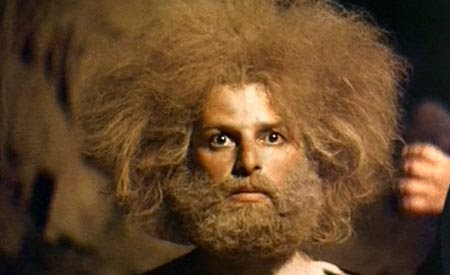
Scary German Guy is bitchin'!

Friday, August 03, 2007
Thursday, August 02, 2007
Mightn't I be allowed to keep my horse?

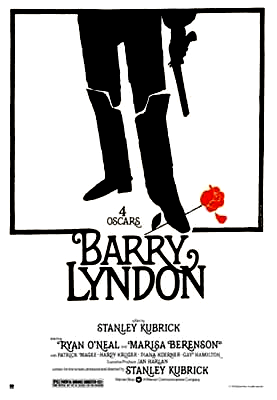
Barry Lyndon opens in wide shot - this is not uncommon with Kubrick, but it is used for a drastically different effect. Consider the opening image of 2001, designed to overwhelm our senses; or The Shining, with its labyrinthine helicopter shots teasing our anticipatory sense of dread. But from its first image, which depicts the death of the protagonist's father in a duel, Barry Lyndon keeps us at a distance. Kubrick and cinematographer John Alcott (with the help of a Zeiss lens originally used by NASA) create a period piece with an astounding sense of immediacy, the image of the opening duel composed with such astonishing depth and clarity that we feel present in the action. But rather than using the images to pull us in, Kubrick remains remote, a time traveller observing the alien behaviors and practices of 18th-century Europe. This gives each shot an oppressive weight, as though each moment were a slide examined through the microscope lens; this deterministic approach is perfect for a protagonist who remains almost totally passive in his own fate. We meet Redmond Barry (Ryan O'Neal) as a sullen, lovestruck youth and follow him across the continent as he wins and then loses everything through no fault or effort of his own.
Kubrick uses O'Neal's vacant screen presence brilliantly - Barry is a cipher who is able to deceive his way into wealth and status not through any particular talents of his own but out of sheer luck (indeed, the Thackeray novel upon which the film is based was originally titled The Luck of Barry Lyndon). The scene when Barry romances the wealthy, widowed Lady Lyndon (Marisa Berenson) is a masterpiece of surfaces, both actors photographed like perfectly-made porcelain dolls similarly incapable of demonstrating actual emotion. The narrator (Michael Hordern) assures us they have fallen in love, a fact we might have otherwise missed; throughout, the narration dryly mocks these characters' half-realized aspirations and lays bare their actual motivations (in original editions of the book, occasional notes from the editor served the same purpose). These characters have no apparent inner selves, substituting manners for morals and objects for ideas. The meticulously recreated props and costumes, along with the striking period locations, supply not just the film's style but its meaning - Kubrick simultaneously fetishizes the art and culture of the period while attacking the shallow materialism of his characters. Kubrick's films are frequently about the struggle of the individual; here, the individual has receded into the background, upstaged by the tapestries. It's as sharp a comment about the present as it is the past.
The film builds deliberately, almost to the point of boredom - what would constitute a good 40 minutes' worth of action in other films stretches past the intermission here. We begin to wonder why Kubrick has forced us to endure this endless parade of images that make us feel nothing. It's actually a setup, and Kubrick snares us with the introduction of the adult Lord Bullingdon (Leon Vitali), Barry's stepson, who returns after a childhood of petty torments from his ineffectual stepdad to assert his rightful claim to his family's wealth. The moment when Bullingdon uses his smirking half-brother to interrupt a concert with a clomping pair of boots is a genuine shock; by destroying the sustained audiovisual symmetry, its as if violence has been done to the film itself. Kubrick presents our children as the only beings we must ultimately answer to - this is paralleled, devastatingly, with the death of Barry's own son after his fall from the horse that was the boy's birthday present. We do not see the fall happen at first; then, as the boy recounts it, Kubrick cuts suddenly, jarringly, to an image that represents everything we reach for and fail to attain. Dissonant noise replaces Schubert on the soundtrack for one moment, exposing the underlying chaos that we attempt to overrule by creating our own meaning. In this sense, Barry Lyndon is also a comment on the cinematic apparatus, which cannot help but recreate a reality that it was designed to reproduce.
Barry Lyndon, more than any of Kubrick's other films, invites the oft-repeated criticism of the director as a cold, calculating misanthrope, and it's certainly his chilliest film. However, while Kubrick's evaluation of humanity is unsparing, the film is almost religious in its search for meaning in the meaningless. Late in the film, Barry finally commits a selfless act, for which he is mercilessly punished. Kubrick has no sympathy for overdue introspection; his films attest to his understanding of existence as an ongoing practice that may eventually be perfected, and as the ending of 2001 demonstrated, he was capable of great hope. So while Barry Lyndon is far from Kubrick's cuddliest picture, it is nevertheless a perfect, dazzling example of the search for truth even in the most untruthful of worlds.
Tuesday, July 31, 2007
So anyway...

Monday, July 30, 2007
You with your visions and dreams.

Friday, July 27, 2007
Wednesday, July 25, 2007
You know, I really hate children.

Saturday, July 21, 2007
Thursday, July 19, 2007
The Game Plan = the next Departed???

Tuesday, July 17, 2007
He calls it his "tiny chef."

Ratatouille takes place in the restaurant of a famous, deceased chef known for both his culinary innovations and his emphasis on accessiblity, with his motto "Anyone can cook!" In the chef's absence, small-minded vulture capitalists have co-opted his likeness and ideology for maximum profit, churning out cheap, microwavable bastardizations of his work. I found myself thinking about Walt Disney's legacy during Ratatouille, similarly commodified and cheapened over recent years (not that the guy was a saint, but that's beside the point). Disney's saving grace has been their relationship with Pixar, a company with a deep, prodigious grasp of both animation and storytelling that seems dedicated to preserving everything that fodder like Brother Bear Goes Bananas aims to destroy. This is a company that can understand the story of an ambitious little rat who surreptitiously assumes the role of an interspecies cultural attache; Ratatouille's makers know what it's like to be the little guy, armed only with impeccable taste.
Friday, July 13, 2007
Thursday, July 12, 2007
He was...well, he wasn't a good swimmer.

It's often forgotten that Jason Voorhees is developmentally disabled; indeed, the above quote is the only direct reference to this fact in the ten-film series. This partly owes to the ways that the character changed over the course of a franchise that has little use for narrative coherence, but it's also indicative of the time that the original Friday the 13th was released. That film, and its immediate sequels, literalize the mindless man-child archetype (Boris Karloff's Frankenstein monster and Gunnar Hansen's Leatherface are two predecessors) by confronting us with a villian whose monstrousness is largely defined by his disability. The original Friday the 13th is about our society's fear of the mentally retarded; this is just as evident in the films that don't reference this fact.
ies' Sloth was an attempt to counter negative stereotypes by presenting a physically deformed, brain-damaged man as a lovable E.T.-like figure; later in the decade, Rain Man and Life Goes On were influential in their positive portrayals of mentally challenged characters. But in 1980, there was still nothing unusual about a studio horror release that had as its villain the vengeful mother of a stereotypical mongoloid who appears at the film's end for one last scare. The killer in Friday the 13th is a woman whose disabled son drowned tragically because of the neglect of horny camp counselors (a character for whom the film extends no empathy). If one chooses to read the film as a morality piece - the dead teens punished for their preoccupation with sex, pot and the band Rush (probably) - then Jason is the dark side of the eternal child, pulling Adrienne King into the depths of Crystal Lake, away from adulthood and back to the womb.The most potent incarnation of Jason is the John Merrick-esque sack-hooded woodsm
an we meet in Friday the 13th Part 2, his disguise reminding of the exploitation of the disabled and deformed in carnival freak shows. If Jason is out for revenge after the death of his mother (a scenario that doesn't really make any sense, but we'll ignore that for now), he's also assuming the monstrous role assigned to him. Jason's makeshift shack in the woods is a terrific touch, literalizing the theme of rural horror previously seen in The Texas Chain Saw Massacre and The Hills Have Eyes. But unlike those films, Jason wasn't born a villain - he was created, like Caliban, shoved to the fringes of society until he becomes the monster he's always been viewed as. It's a great, rich concept that Friday the 13th Part 2 doesn't do nearly enough with. Unfortunately, it's also the last time that the series even pays lip service to the idea of Jason as a flesh-and-blood character.The dehumanization of Jason begins with the hockey mask, and reaches fruition with Friday the 13th: A New Beginning. After Jason was killed (suppsedly for good) in the previous film, the producers atte
mpted to revive the franchise by replacing Jason with another mask-wearing killer that is revealed in the final minutes to be a completely different character. It was a cynical move (see also: Halloween III), and the filmmakers wisely chose to reinvent Jason as an undead golem for future films. Over the course of the series, Jason has been a demon's host, a genetically enhanced superbeing, and a worthy adversary for Freddy Kreuger - Jason is pure simulacrum, completely detached from his origins as a "frightened retard."While this happens with most horror franchises - Freddy's wisecracks watering down his child-molesting backstory, for instance - Jason's evolution is particularly drastic. This has everything to do with the advent of political correctness - when Kelly Rowland calls Freddy a "faggot" in Freddy vs. Jason, the joke is her strange use of the word rather than a comment on Freddy's sexuality. Similarly, it's impossible to imagine a sympathetic protagonist calling Jason a "retard" today. An evil ubermensch Jason allows us to laugh and scream without feeling guilty, and I won't argue that it's a good thing that most people understand that, at the very least, there are some things you just don't say. But part of me misses "special" Jason, who could have only existed at a time when our scares were much thornier.
Monday, July 09, 2007
Sunday, July 08, 2007
too much information
3. I tag eight unsuspecting bloggers, who must then share eight facts about themselves (I believe this is legally binding).
3. I was fired from my first writing gig - the film critic for my seventh-grade newspaper. It was a Christian school, and I offended the faculty by writing about an R-rated movie (Romy and Michelle's High School Reunion).
4. Yes, I was once a born-again Christian. In the years since I've been a near-atheist, a not-really-Taoist, and a sort-of-agnostic. These days, while I'd comfortably call myself spiritual, the closest thing I have to a religious leader is
5. David Bowie. I'm a bleedin' poof for David Bowie. I celebrate his entire catalog.
6. I once performed a puppet show of the Gom Jabbar scene from Dune.
7. I'm deathly, irrationally afraid of snakes - garter snakes, to be precise. I know they won't hurt me; it's a purely Pavlovian thing.
8. My favorite color is brown.
I tag: Doug, Jack, John, Dr. Insermini, Milena, Steve, Michael and Jess.
Friday, July 06, 2007
Monday, July 02, 2007
Man, I'm Big Dick Blaque.

These ideas would have resonated more deeply had Schrader pushed his character further; many of the film's problems would immediately be solved if Jake had sex with Niki. But the character remains firmly one-dimensional, a stranger in a strange land immune to temptation, and Schrader cannot seem to take his own protagonist seriously, let alone fully humanize him. And the provocative suggestion that Jake's daughter was seriously kinky to begin with (a porn actor tells Jake, "I don't know what kind of shit she was into, but my dick was red and swollen and chewed up for a week") is quickly brushed aside in favor of a slam-bang ending and a forced resolution. One can feel in Hardcore Schrader's desire to make a movie that would genuinely offend his fundamentalist family; unfortunately, the themes he touches upon but never really explores are far more incendiary than gratuitous T&A (he would return to the central concerns of Hardcore with much greater success in films like American Gigolo, Cat People and Auto Focus).
Friday, June 29, 2007
Thursday, June 28, 2007
The Trim Bin #59

- The updated AFI list is no better or worse than the last one - it's nice to see Blade Runner and Nashville in there, and it's laughable that The Sixth Sense is apparently the greatest film of 1999 (the best moviegoing year in my lifetime thus far). There's nothing really wrong with the list itself - about a third of the films listed appear on my own top 100 - but it paints an extremely narrow picture of film history and culture. The AFI list is inherently less interesting than the Sight and Sound Top 10 or other lists, mostly because voters must choose from a preliminary list of 400 films that are at least partly chosen for their popularity. Where other lists are meant to provoke discussion, this one is meant to generate nostalgia and boost DVD sales. Add to this the AFI's stupid insistence on an American-only list because the word "American" appears in their name, and you have a list that is purposefully anti-eclectic. It sucked in 1998, it sucks now, and it will suck ten years from now (or nine, as the AFI apparently cannot count to ten). Case closed.
- A while back I was speculating about casting Peter Jackson's adaptation of The Lovely Bones. The parents have been cast, and I'm split. On the one hand, Rachel Weisz is a great choice for Abigail - her ability to be emotionally open without sacrificing subtlety perfectly fits the story's delicate tone. On the other hand, the casting of Ryan Gosling as the patriarch doesn't work for me, and not just because he's far too young to play a father of three. A confession: I just don't get Ryan Gosling. Where others see precocious brilliance, I see a joyless, mannered assembly of self-conscious method tics in search of a performance with soul. I find his tendency towards "important" material contrived. I didn't buy him for a second as a crackhead in Half Nelson. And his pretentiously unpretentious normal guy routine is infuriating, because any normal guy wouldn't be able to say things like "I've always hated the complacency which comes from good looks" with a straight face. I'll give Peter Jackson the benefit of the doubt - I didn't think much of Viggo before The Fellowship of the Ring - but seriously, am I missing something?
- CHUD has an interesting article about the evolution of the 4th of July as a blockbuster weekend/crap depository. I can't wait to see Transformers, even though I'm pretty sure it's going to unleash a plague of snakes and flesh-eating bugs that will kill all of America's children, unleashing an army of Druid cyborgs that not even Tom Atkins can stop from conquering the world. Either way, the robots look cool.
Friday, June 22, 2007
Wednesday, June 20, 2007
Top 100: Pop Music in Film

There are some original songs here, but the emphasis is on source music. Straight musicals and performance aren't on this list (with the borderline exception of, ironically, Performance), as they belong on another list completely. Also, I've limited myself to one cue per film - otherwise, half the list would be Goodfellas. Links to the corresponding scenes are provided when available. I hope you enjoy this more than another recent 100 list.
1. “Sister Christian,” Night Ranger – Boogie Nights
2. “The End,” The Doors – Apocalypse Now
3. “Jumpin’ Jack Flash,” The Rolling Stones – Mean Streets
4. “In Dreams,” Roy Orbison – Blue Velvet
5. “Singin’ In the Rain,” Gene Kelly – A Clockwork Orange
6. “Memo From Turner,” Mick Jagger – Performance
7. “Stuck In The Middle With You,” Stealer’s Wheel – Reservoir Dogs
8. “I Think I See The Light,” Cat Stevens – Harold and Maude
9. “Knockin’ On Heaven’s Door,” Bob Dylan – Pat Garrett & Billy the Kid
10. “In Your Eyes,” Peter Gabriel – Say Anything
11. “These Days,” Nico – The Royal Tenenbaums
12. “Layla,” Derek and the Dominos - Goodfellas
13. “I Put a Spell On You,” Screamin’ Jay Hawkins – Stranger Than Paradise
14. “The Stranger Song,” Leonard Cohen – McCabe and Mrs. Miller
15. “Didn’t I Blow Your Mind This Time,” The Delfonics – Jackie Brown
16. “Just Dropped In (To See What Condition My Condition Was In)”, Kenny Rogers and the First Edition – The Big Lebowski
17. “Mrs. Robinson,” Simon and Garfunkel – The Graduate
18. “Tiny Dancer,” Elton John – Almost Famous
19. “Hurdy Gurdy Man,” Donovan – Zodiac
20. “Fight the Power,” Public Enemy – Do the Right Thing
21. “Late for the Sky,” Jackson Browne – Taxi Driver
22. “Relax,” Frankie Goes to Hollywood – Body Double
23. “Theme From Shaft,” Issac Hayes – Shaft
24. “Wise Up,” Aimee Mann - Magnolia
25. “A Quick One While He’s Away,” The Who - Rushmore
26. “Nobody But Me," Human Beinz – Kill Bill vol. 1
27. “Baby Did a Bad Bad Thing,” Chris Issak – Eyes Wide Shut
28. "Everybody's Talkin'," Harry Nilsson - Midnight Cowboy
29. “Moving In Stereo,” The Cars – Fast Times at Ridgemont High
30. “Sussudio,” Phil Collins – American Psycho
31. “An Invitation to the Blues,” Tom Waits – Bad Timing
32. “Amoreena,” Elton John – Dog Day Afternoon
33. "I'm Shipping Up To Boston," Dropkick Murphys - The Departed
34. “A Change is Gonna Come,” Sam Cooke – Malcolm X
35. “The Court of the Crimson King,” King Crimson – Children of Men
36. "Like a Rolling Stone," Bob Dylan and The Band - New York Stories
37. “Staggolee,” Pacific Gas & Electric - Grindhouse
38. “Everybody’s Got To Learn Sometime,” Beck – Eternal Sunshine of the Spotless Mind
39. "Careful With That Axe Eugene," Pink Floyd - Zabriskie Point
40. "Goldfinger," Shirley Bassey - Goldfinger
41. “Staying Alive,” The Bee Gees – Saturday Night Fever
42. “Life on Mars,” David Bowie – The Life Aquatic with Steve Zissou
43. “The Killing Moon,” Echo and the Bunnymen – Donnie Darko
44. “Natural’s Not In It,” Gang of Four – Marie Antoinette
45. “This Magic Moment,” Lou Reed – Lost Highway
46. “Girl, You’ll Be A Woman Soon,” Urge Overkill – Pulp Fiction
47. "Raindrops Keep Fallin' On My Head," B.J. Thomas - Butch Cassidy and the Sundance Kid
48. “Blue Moon,” Sam Cooke – An American Werewolf in London
49. “Don’t You (Forget About Me),” Simple Minds – The Breakfast Club
50. “Hurricane,” Bob Dylan – Dazed and Confused
51. "We'll Meet Again," Vera Lynn - Dr. Strangelove
52. “Janie Jones,” The Clash – Bringing Out the Dead
53. “The Old Main Drag,” The Pogues – My Own Private Idaho
54. “If You Wanna Be a Bird,” The Holy Modal Rounders – Easy Rider
55. "Surfin' Bird," The Trashmen – Full Metal Jacket
56. "Sinnerman," Nina Simone – Inland Empire
57. "From Her To Eternity," Nick Cave and the Bad Seeds - Wings of Desire
58. "Old Time Rock and Roll," Bob Seger - Risky Business
59. “Banana Boat Song,” Harry Belafonte - Beetlejuice
60. “Louie Louie,” The Kingsmen – Animal House
61. "Can We Still Be Friends," Todd Rundgren - Vanilla Sky
62. "Twist and Shout," The Beatles - Ferris Bueller's Day Off
63. “Freebird,” Lynyrd Skynyrd – The Devil’s Rejects
64. “Tequila,” The Champs – Pee-Wee’s Big Adventure
65. "No One Lives Forever," Oingo Boingo - The Texas Chainsaw Massacre 2
66. “Waterloo,” Abba – Muriel’s Wedding
67. "Let's Misbehave," Irving Aaronson and His Commanders - Pennies From Heaven
68. “I Want You Around,” The Ramones – Rock ‘n’ Roll High School
69. “Numb/Encore” Jay-Z and Linkin Park, Miami Vice
70. “Daniel,” Elton John – Alice Doesn’t Live Here Anymore
71. "Magic Man," Heart - The Virgin Suicides
72. “Bela Lugosi’s Dead,” Bauhaus – The Hunger
73. “All Out of Love,” Air Supply - Happiness
74. “Girls,” Death in Vegas – Lost in Translation
75. "The Seeker," The Who - American Beauty
76. “Goodbye Horses,” Q. Lazzarus – The Silence of the Lambs
77. “I’m Your Man,” Leonard Cohen - Secretary
78. “The Blower’s Daughter,” Damien Rice - Closer
79. “There Is An End,” The Greenhornes with Holly Golightly – Broken Flowers
80. “Who Made Who,” AC/DC – Maximum Overdrive
81. "Philadelphia," Neil Young – Philadelphia
82. "Hey You," Pink Floyd - The Squid and the Whale
83. "Venus in Furs," Velvet Underground - Last Days
84. "Just in Time," Nina Simone - Before Sunset
85. "Bad To The Bone," George Thorogood and The Destroyers – Christine
86. "Without You," Harry Nilsson - The Rules of Attraction
87. "Devil Got My Woman," Skip James - Ghost World
88. "Suzanne," Leonard Cohen - Breaking the Waves
89. "Everybody Wants Some," Van Halen - Better Off Dead
90. "Partyman,” Prince – Batman
91. "Midnight, the Stars and You," Roy Noble Orchestra - The Shining
92. "Young Americans," David Bowie – Dogville
93. "2000 Man," The Rolling Stones - Bottle Rocket
94. "Anthem," Leonard Cohen - Natural Born Killers
95. "Sax and Violins," Talking Heads - Until the End of the World
96. "Rock Around the Clock," Bill Haley and the Comets - Blackboard Jungle
97. "Tonight (We'll Make Love Until We Die)" - The Return of the Living Dead
98. "Stardust," Louis Armstrong - Stardust Memories
99. "Que Sera Sera," Doris Day - The Man Who Knew Too Much
100. "Eye of the Tiger," Survivor - Rocky III
Monday, June 18, 2007
always a day away

Nana Baa used to read to me all the time; in recent years she would joke about sitting at the kitchen table at six in the morning, drinking coffee, and suddenly hearing small footsteps as I descended the stairs carrying a stack of books. And I must have made the poor woman watch Annie a hundred times. But she was always totally enthusiastic - she was a great listener, and she cared about the things that mattered to me. Nana Baa was a pretty perfect great-grandmother.
Sunday, June 17, 2007
Friday, June 15, 2007
Thursday, June 14, 2007
She took a midnight train going anywhere

No further proof is needed of David Chase's genius than his ability to turn eight seconds of a silent, black screen into the most talked-about scene of the year. One cannot Google "Sopranos final scene" without being inundated with angry, profane message board posts condemning series creator David Chase with a level of vitriol usually reserved for kiddie rapers and George Lucas. Nobody predicted those final moments, but if someone had, I'd have dismissed the notion as pretentious nonsense. Now, I can't imagine The Sopranos ending any other way. What began as a scabrous black comedy sold on its high concept ("If one family doesn't kill him, the other will" - yuk yuk!) expanded in scale and ambition over the years, becoming an uncompromising lesson in darkness worthy of mention alongside its oft-referenced progenitors. Now that the series is over, we've just begun to fully absorb and process its brilliance, up to and including a final cut that quietly redefines what television is capable of.
When AJ lashes out at a table of mourners for their superficial chatter about "jack-off fantasies on television," it's hard not to feel like Chase is chastising us. But the truth is more complicated; as ambivalent as he may be about The Sopranos' popularity among those who get off on the violence and complain about the artsy-fartsy stuff, he isn't out to punish his audience. Agent Harris' exclamation - "We're going to win this one!" - and his investment in Tony's continued survival is meant to mirror our own relationship to the big guy. We care about Tony, his crew and his family for the same reason we care about Tom Powers, Tony Montana and Henry Hill; no matter how many sins they commit, it's encouraging to see the little guy succeed, his problems so managable compared to our world's. Chase goes out of his way to avoid glorifying his characters' actions, but he's not sanctimonious either, allowing each character a fond farewell (Paulie and the cat - perfect). While Dr. Melfi may be able to close the door on Tony, it's hard for us to do the same (this is largely due to James Gandolfini's performance, one for the ages). We may find ourselves wishing, as Steve Perry once did, that the movie will never end.
Which brings us to that final scene. If I had to choose, I think that final cut to black signifies Tony's sudden death at the hands of an unnamed hitman in a Members Only jacket, if for no other reason than last week's flashback to Bobby's line "You never hear it coming." At the same time, there's just as strong an argument to be made that Chase is merely playing with our expectations. I mean, it's not like Bobby Baccalieri is John the Baptist. And Members Only's visit to the bathroom does echo The Godfather, except that there's no reason for him to be hiding his weapon in the john. But this is what the scene is about - Chase gives us a grab bag of signifiers relying not only on our knowledge of The Sopranos but on our collective cultural knowledge (this has always been a big part of the show). Knowing that we're watching the last minutes of the last episode gives every moment mythic significance, with "Don't Stop Believin" elevated to the level of an all-too-ironic Greek chorus. We're conditioned to expect the worst; it's impossible to watch a family, numb but still alive, munch onion rings without anticipating a dramatic twist of fate. And it is here that Chase succeeds in truly putting us inside the mind of his protagonist, who will always be looking over his shoulder.
The question that final cut leaves us to ask is whether things are as bad as we perceive them to be. Are we reaching? It's perhaps the most important question of our age, one that we'll do anything to avoid. So the final scene is radical not just in form but in the questions it leaves us; the rabid discussion isn't just about The Sopranos, it's a confession of our need, more than ever, for resolution. I felt that way too, as every last detail - Carmela's vacant, icy stare (Edie Falco deserves a better award than a frigging Emmy), the small flick of Tony's wrist as he dispatches another onion ring - was invested with unbelievable poignance. The Sopranos is one of the great American stories. I hate to see it end. And then
Monday, June 11, 2007
Doing it Spacey-style

1. If, and only if, you get tagged, write a post with links to 5 blogs that make you think.
2. Link to this post so that people can easily find the exact origin of the meme.
3. Optional: Proudly display the ‘Thinking Blogger Award’ with a link to the post that you wrote.
Please note that any of the blogs linked to the right fully deserve this award, but the rules say five, so there it is.
Film Experience Blog - I've always been dismissive of celeb-obsessed film writing, but Nathaniel at The Film Experience changed that for me. Nathaniel's blog is a witty marriage of serious film discussion and star commentary that reminds of Entertainment Weekly back when it was actually fun to read. Plus, he's made me see Michelle Pfeiffer in a whole new light.
Friday, June 08, 2007
Thursday, June 07, 2007
I shoot to disappear.