Friday, May 11, 2007


Wednesday, May 09, 2007
Monday, May 07, 2007
I loved your father, as I love you.

I wish I could have seen Spider-Man 3 when I was eight. The packed audience I saw the movie with was filled with wide-eyed little boys and girls oohing and aahing at the webslinger's exploits. Spider-Man 3 is easily the youngest-skewing entry in the series, and I'm certain that, if I'd seen it in the third grade, it would have been on my all-time top ten. But the best popcorn movies (Spider-Man 2 among them) unlock that guileless sense of wonder that we thought we'd lost. And while Spider-Man 3 - the most baffling summer tentpole in recent memory - is the loudest, busiest and hardest-working Spider-Man movie, it's only intermittently fun, and by its end, it's more tiresome than wondrous. Spider-Man 3 is to Spider-Man 2 as The Godfather Part III is to The Godfather Part II, okay on its own terms but terribly disappointing by comparison.
The unwiedly plot pits webslinging grad student Peter Parker (Tobey Maguire) against four villains - Sandman (Thomas Haden Church) an escaped convict mutated by a nasty case of plot contrivance; Venom (Topher Grace) whose alter ego Eddie Brock is Peter's Salieri; his childhood friend Harry (James Franco), now clad in his dad's Green Goblin costume; and his girlfriend, Mary Jane (Kirsten Dunst), who has morphed into a petty, narcissistic shrew. The film is as much about their relationship and the emergence of Peter's id - manifested in a gooey, alien deus ex machina called symbiote - as it is about Spidey fighting the bad guys. Spider-Man 3 becomes one of those dreaded comic book closet dramas that are kryptonite for action-hungry fanboys. But while I've passionately argued in favor of derided examples of superhero mumblecore like Hulk and Superman Returns, large stretches of Spider-Man 3 are just tedious. In the first two Spider-Man movies, the computer-generated spectacle was at the service of character and story - when Spider-Man battled Dr. Octopus, our emotional investment in the characters raised the stakes action-wise. I realize this sounds obvious, but it's something that director Sam Raimi appears to have forgotten (or perhaps he just doesn't care). So while Spider-Man 3 contains strong moments - Flint Marko's rebirth as Sandman, for instance - the story remains earthbound, the characters rendered inert by the lumbering, incoherent script. It's fun, sort of, but also impossible to care about.
The unwiedly plot pits webslinging grad student Peter Parker (Tobey Maguire) against four villains - Sandman (Thomas Haden Church) an escaped convict mutated by a nasty case of plot contrivance; Venom (Topher Grace) whose alter ego Eddie Brock is Peter's Salieri; his childhood friend Harry (James Franco), now clad in his dad's Green Goblin costume; and his girlfriend, Mary Jane (Kirsten Dunst), who has morphed into a petty, narcissistic shrew. The film is as much about their relationship and the emergence of Peter's id - manifested in a gooey, alien deus ex machina called symbiote - as it is about Spidey fighting the bad guys. Spider-Man 3 becomes one of those dreaded comic book closet dramas that are kryptonite for action-hungry fanboys. But while I've passionately argued in favor of derided examples of superhero mumblecore like Hulk and Superman Returns, large stretches of Spider-Man 3 are just tedious. In the first two Spider-Man movies, the computer-generated spectacle was at the service of character and story - when Spider-Man battled Dr. Octopus, our emotional investment in the characters raised the stakes action-wise. I realize this sounds obvious, but it's something that director Sam Raimi appears to have forgotten (or perhaps he just doesn't care). So while Spider-Man 3 contains strong moments - Flint Marko's rebirth as Sandman, for instance - the story remains earthbound, the characters rendered inert by the lumbering, incoherent script. It's fun, sort of, but also impossible to care about.
Because the movie is so completely plot-driven, it's impossible to avoid the glaring plot holes and cheap shortcuts throughout the narrative. I won't make a list, because I don't want to sound like Comic Book Guy, so I'll just say that even though Raimi tries to play the sudden revelations delivered in the third act by a character we've only seen peripherally for most of three films - information that this character could have passed along at any time and only decides to share exactly when the plot requires it - as tongue-in-cheek, it's still lazy, shoddy storytelling. Spider-Man 3 is filled with moments that demonstrate it is a film that doesn't know what it is about. By its climax, it tries to pretend that it was always about Harry Osborne's internal conflict; this is unfortunate, because James Franco is a terrible actor and he looks ridiculous in the Goblin costume. Almost as poor is Kirsten Dunst, who has done terrific work elsewhere but is saddled with a Mary Jane that has been reduced to a simpering, pathetic victim who finds a reason to whine and complain about her relationship with freaking SPIDER-MAN. Dunst doesn't even try, and while I can't really blame her, it didn't make me hate every moment of her screen time any less. I was praying that Peter would kick this sad sack to the curb and shack up with Gwen Stacy (Bryce Dallas Howard makes a charming character out of a glorified cameo). Or Betty Brandt. Even the landlord's daughter would be fine. Mary Jane is a beast.
The rest of the cast does well under the circumstances. The entire movie hinges on the underdeveloped notion that Peter is getting too cocky, but Tobey Maguire's performance elevates the material; he smartly plays Peter as well-intentioned as he's always been, but blindsided by his sudden popularity. And Church succeeds in creating a brooding, inarticulate yet sympathetic heavy in the Boris Karloff mold. But all of the actors are failed by the script - Church gets a hackneyed backstory involving a daughter who has apparently been on her deathbed for five years, and Topher Grace stumbles into the Venom role literally by accident (also, Venom looks completely stupid). Great actors like Dylan Baker, Theresa Russell and James Cromwell (as Captain Stacy) are given little to do except stand around and occasionally deliver some exposition. Rarely has such a strong cast been assembled to do so little.
From a technical standpoint, Spider-Man 3 is the best-made entry in the series. A scene involving a runaway crane inspires genuine vertigo. The action throughout is admittedly entertaining. The effects are state-of-the-art. Bruce Campbell is a pleasure as always. And when Peter, spurned by Mary Jane and tripped up on symbiate, enjoys a brief "jerk" phase that builds to an out-of-nowhere dance number, the movie at least breathes a little, evoking the sheer fun of making movies that has made so many of Raimi's earlier films so special. But that feeling is missing from the rest of Spider-Man 3; frankly, it feels like it could have been directed by anyone. You can feel the effort that went into the film, but it lacks any sort of personal touch - it's slick but cold. Spider-Man 3 ends with a funeral in the rain, which is fitting, because it's a bummer of a way to end a trilogy.
Friday, May 04, 2007

Thursday, May 03, 2007
I do not know what price I will have to pay for breaking what we alchemists call Silentium.

I often go to the movies in my dreams. There are a few different cinemas that exist only in my imagination which I return to from time to time, often to attend repertory screenings of films I've seen in reality. But when I watch a film in my dreams, details such as plot, dialogue, casting and even the film's images may be drastically different. This is not a failure of my memory - I've seen The Shining too many times to count, and yet in my head, the rotting corpse lives in the bedroom of Room 237 rather than the bathroom (analyze this however you like). Rather, it seems as though my mind rearranges the details of a film to communicate its own meaning; the result is sort of a "dream director's cut." I thought about this during a scene early in Inferno, Dario Argento's thematic sequel to Suspiria, during a scene set in a cab that almost replicates a scene in the earlier film - the lighting and composition are almost identical, and the same actor plays the cab driver in both films. But Argento also plays with our memory of Suspiria, altering the visual and narrative perspective enough so that this allusion becomes disorienting rather than reassuring. Inferno is a Through the Looking Glass to the earlier film's Alice in Wonderland, both deepening and contorting our understanding of Argento's cinematic universe. It's also a masterpiece in its own right, serving as a Rosetta Stone for Argento's work and, more broadly, the power of scary stories.
The second chapter in Argento's "Three Mothers" trilogy (the third, starring his daughter Asia, will be released later this year), Inferno opens with an excerpt from the book The Three Mothers (Argento's fabricated reworking of Thomas de Quincey's Suspiria de Profundis), by the architect and alchemist E. Varelli. The three mothers are the source of all pain and sorrow in the world; the first, Mater Suspiriorum (the mother of sighs), resided at the dance academy from Suspiria, while the second, Mother Lacrimarum (the mother of tears) resides in Rome (and makes an almost sublimal appearance here). Mater Tenebrarum, "the youngest and cruelest," is said to reside in New York; when Rose (Irene Miracle), a poet living in New York, reads Varelli's book, she becomes convinced that she lives in the building occupied by Mater Tenebrarum. As she begins to investigate the building and becomes afraid for her life, she writes her brother Mark (Leigh McCloskey), a student in Rome, to come home. This begins a chain of events that draws an assortment of characters to the house, where they invariably meet with terrible fates. The characters are intentionally blank, used as symbols; Argento's aim is to tell a story not through a linear progression of events, but rather to depict evil as something that spreads like ripples atop his ever-present bodies of water. While those who demand interior logic and meaningful characterization are likely to hate Inferno (and the late-70's haircuts and 'staches don't help), the meaning of the film can be found in what Argento denies us; these characters are pawns manipulated by forces beyond their control, unable to protest the nastiness waiting for them around the corner.
In the absence of a dense plot, Argento directs our attention towards specific symbols - keys, doors, mirrors - that are loaded with connotative significance. But Argento also denies us a logical (or at least linear) narrative progression, severing the connection between the signified and the signifier. Like the film's characters, we become adrift, disoriented, out of control, as though we were dreaming. But where lesser directors employ dream logic to gloss over narrative shortcomings, Argento is very deliberately acting in a diaboloical manner not unlike the alchemists, giving us a sort of cinematic cryptogram that confounds our methods of deduction. Inferno is a self-contained work of art, filled with allusions to other works but, like Varelli's book, possessed by its own singular vision. One does not watch Inferno so much as dream it.
Inferno is largely faithful to Suspiria's surreal color pallette in its lighting and design - both films look like 1950s MGM musicals as directed by Francis Bacon. But the effect is drastically different; the scares in Suspiria revolve around shock, the mysterious machnations of the witches ultimately manifested in Argento's trademark gloved slasher. The horror in Inferno is disembodied - its roots can be found in those remarkable moments in Suspiria (Jessica Harper passing through a set of sliding doors, for instance) where nothing overtly scary is happening and yet we're fild with an overwhelming sense of dread. Argento sustains this unease throughout Inferno - an early scene where Sarah descends into a hidden pool beneath her building (Mario Bava contributed to this and several sequences in the film) creates a mounting sense of anticipatory anxiety, so that the scene is not about the inevitable "boo!" moment so much as our own expectation of that moment. The entire film unfolds with the same precise understanding of the uncanny, aided in large part by Keith Emerson's often melancholy score. When we meet Mater Tenebrarum, Argento finds in a single image a definitive statement about horror - why we are at once repelled by and drawn to that which frightens us, and what is at the center of this obsession.
In the opening narration, Varelli writes that "the life experiences of our colleagues should warn us not to upset laymen by imposing our knowledge upon them." Argento's film, too, infects its audience by exposing them to the roots of their fears and desires. In this, Inferno becomes a work where cinema and dreams intersect; there's a purity to this film, as though Argento is projecting his unconscious directly onto the movie screen. As a meditation on the horror genre, Inferno is perfect, a work of pure film; as an example of the genre, it's scary as fuck.
Wednesday, May 02, 2007
The Trim Bin #57

- Alejandro Jodorowsky is one of the most underrated filmmakers, largely because his films are so little-seen. So the arrival of the new Jodorowsky box set, distributed by the good people at Anchor Bay, felt unreal after decades of grainy tenth-generation dubs. But then, it's unreal that these films even exist at all - the three features contained in this set, Fando y Lis, El Topo (one of my all-time favorite movies) and The Holy Mountain, feel as if they were not filmed but conjured out of thin air. I'll review the films once I've adequately processed them, but I can easily say that this set is a must-own. The transfers are stunning, the extras are copious, and the set includes Jodorowsky's haunting scores for El Topo and The Holy Mountain. Anchor Bay has even discovered a long-lost short, La Cravate, filmed in 1957. I can't wait to revisit Jodorowsky's films, and I'm especially happy that they have a chance to receive the sort of widespread appreciation they deserve. Now we just need a good R1 release of Santa Sangre.
- Alex Jackson's epic, provocative review of Grindhouse, which argues that "If you prefer Planet Terror you don’t understand movies and if you prefer Death Proof you don’t really like them. And either way, you aren’t fully experiencing them."
- Jackson also pointed me in the direction of Criticker, a website that allows you to rate movies on a scale of 0-100 and compare your tastes with other users and critics. It's very addictive, yet it also touches upon an insecurity I've long had, namely that I'm too positive. Take that C+ for Vampires, for instance; it's probably much worse than that would suggest, but I always have a big grin on my face when I'm watching it. I've given about twenty percent of the films I've rated 100s, and while I can partly attribute this imbalance to the absence of many Troll IIs, I must ask my readers - am I too easy?
- Greg at Dreamscape has some interesting thoughts on the connections between The Kinks, Hot Fuzz and Kant (contains some spoilers).
- I received the sad news today that Images Cinemas' Focus Arts Monthly is no more. Published by the cinema where I work as a projectionist, Focus provided not only a schedule of upcoming films but also film reviews, opinion pieces and articles on local arts happenings by a diverse slate of writers. The back issues here will give you an idea of how special Focus was; I know that I was given an extraordinary amount of freedom to write about whatever I wanted. While my editors must have often regretted this fact, as I often abused such power to dwell on dork minutia; nevertheless, Focus was a fine little newsletter, and I'm proud to have been a part of it.
- Finally, the extremely mixed reviews for Spider-Man 3 have me very excited to see the film - I love it when the reviews for a movie I've been anticipating are all over the place, as it makes it easier to clear my head and make up my own mind. Part threes are always tricky - for every Return of the King or Alien 3, there are ten Batman Forevers. So it's interesting that both the positive and negative reviews have frequently referenced another second superhero sequel, Superman III. If the comparison is meant to refer to the excellent scene where Superman fights himself, this is a good thing. If it is a comparison to the rest of the film, things look grim. Check out the desparate-feeling and arguably racist (Look! Richard Pryor wants to sell you booze! Ha ha ha!) trailer for Superman III to get an idea of how quickly things can go downhill with any successful series' third chapter. Let's hope Spidey manages to sidestep the proverbial shark.
- Alex Jackson's epic, provocative review of Grindhouse, which argues that "If you prefer Planet Terror you don’t understand movies and if you prefer Death Proof you don’t really like them. And either way, you aren’t fully experiencing them."
- Jackson also pointed me in the direction of Criticker, a website that allows you to rate movies on a scale of 0-100 and compare your tastes with other users and critics. It's very addictive, yet it also touches upon an insecurity I've long had, namely that I'm too positive. Take that C+ for Vampires, for instance; it's probably much worse than that would suggest, but I always have a big grin on my face when I'm watching it. I've given about twenty percent of the films I've rated 100s, and while I can partly attribute this imbalance to the absence of many Troll IIs, I must ask my readers - am I too easy?
- Greg at Dreamscape has some interesting thoughts on the connections between The Kinks, Hot Fuzz and Kant (contains some spoilers).
- I received the sad news today that Images Cinemas' Focus Arts Monthly is no more. Published by the cinema where I work as a projectionist, Focus provided not only a schedule of upcoming films but also film reviews, opinion pieces and articles on local arts happenings by a diverse slate of writers. The back issues here will give you an idea of how special Focus was; I know that I was given an extraordinary amount of freedom to write about whatever I wanted. While my editors must have often regretted this fact, as I often abused such power to dwell on dork minutia; nevertheless, Focus was a fine little newsletter, and I'm proud to have been a part of it.
- Finally, the extremely mixed reviews for Spider-Man 3 have me very excited to see the film - I love it when the reviews for a movie I've been anticipating are all over the place, as it makes it easier to clear my head and make up my own mind. Part threes are always tricky - for every Return of the King or Alien 3, there are ten Batman Forevers. So it's interesting that both the positive and negative reviews have frequently referenced another second superhero sequel, Superman III. If the comparison is meant to refer to the excellent scene where Superman fights himself, this is a good thing. If it is a comparison to the rest of the film, things look grim. Check out the desparate-feeling and arguably racist (Look! Richard Pryor wants to sell you booze! Ha ha ha!) trailer for Superman III to get an idea of how quickly things can go downhill with any successful series' third chapter. Let's hope Spidey manages to sidestep the proverbial shark.
Friday, April 27, 2007

Thursday, April 26, 2007
Aguirre, der Zorn Myspace

Paul Clark's thoughts after attending an Ernie Gehr screening and Q&A got me thinking about the two times I've seen Werner Herzog at such an event (he was invited by Williams College to appear as part of a documentary forum in 2006, accidentally arrived a year early, hung around for a few days, then returned the next year). During that first visit, on a Friday afternoon, Herzog screened a documentary about the scoring of Grizzly Man at the cinema where I work as a projectionist (we were treated to an advanced screening of the film the night before, and on Friday night we saw a rough cut of The Wild Blue Yonder before his investors). With most people at work, only a handful showed up for the making-of screening, so the Q&A was more conversational. I decided to ask Herzog about the final shot of Stroszek, one of the greatest and most elusive endings ever - why a chicken? Herzog explained, simply, that he never makes a cut before he loses interest in an image, and the shot runs as long as it does because he just found that dancing chicken so damned interesting. It was an unpretentious, insightful answer, and now that I've started to make my own films, it's guided me through many a tough directorial decision.
The next year, when Herzog appeared at the "Extreme Documentary" forum, one audience member asked him what he thought about YouTube.
Let that sink in for a moment - he asked the director of Aguirre the Wrath of God about a site where people post videos of their babies farting.
I agree wholeheartedly with Clark's assertion that films are best experienced viscerally and psychologically - I want to see the world through the filmmaker's eyes (as Clark eloquently describes the moviegoing experience). While an intellectual understanding of the filmmaking process greatly helps one articulate one's response to a film, knowledge should never supercede understanding. Especially if you end up standing in front of a living legend, with one chance to ask him about anything at all, and you ask about a frigging website (although Herzog gave a hilarious answer about Bavarian teens recording their sexual exploits with cell phone cameras, which he called "beautiful"). I far prefer canonical to topical analysis, which could explain why I reacted so strongly to my peer's question. Or maybe he was just a schmo. Could be both.
What are your best/worst Q&A experiences? And if you could ask your favorite filmmaker one thing, what would it be?
Wednesday, April 25, 2007

Monday, April 23, 2007
By the power of Greyskull!

Each of the directors who contributed a fake trailer to Grindhouse demonstrate very different reasons for their affection for schlock; for Eli Roth it's boobs and gore, and for Rob Zombie it's tasteless kitch. But Edgar Wright's Don't is a tribute not in content but in style, lovingly recreating the disjointed, nightmarish shocks of Fulci and Argento. He also demonstrates meticulous attention to detail in referencing the look of Eurohorror, understanding that the soul of any film rests not in its plot but in its very composition (in this way, he's far closer to Quentin Tarantino than either of his co-contributors). This is key to understanding what makes Shaun of the Dead and Wright's new movie, Hot Fuzz (both films starring and co-written by Simon Pegg), so unique - neither satire or farce, they're homages that are also superior examples of their respective genres. If I prefer Shaun of the Dead to Hot Fuzz, it's because I prefer zombies to hyperbolic action, but this is just another way of saying that Hot Fuzz is not only hilarious, it's also out-Michael Bays Michael Bay.
The film's opening, which is oddly reminiscent of The Departed, introduces us to Sergeant Nick Angel (Pegg), the best cop in London. He's so good, in fact, that he makes his co-workers look bad, and so he's promptly relocated to Sandford, a bucolic village where the biggest crime is loitering and the Inspector (Jim Broadbent) regularly treats the station to cake and ice cream. Angel is partnered with the Inspector's well-meaning but inept son, Danny (Nick Frost), who dreams of being Patrick Swayze in Point Break. As Angel begins to investigate a series of "accidents" that seem less than accidental, the film manages to pay tribute to Chinatown, Bad Boys II and everything in between, with sudden detours to accomodate nods to The Wicker Man and gialli (complete with surprisingly strong gore). But while it mines jokes from the inherent toxicity of the Simpson/Bruckheimer mold, it also avoids condescension, instead acknowledging the righteous cop as the modern, agnostic arbiter of justice. This extends to Wright's filmmaking strategy, which never misses an opportunity for a whip-pan or an extreme close-up when a fixed medium shot would do - while this approach is sometimes headache-inducing, there's no denying its fidelity to its sources.
Wright also smartly packs his cast with a who's-who of great British actors (Belloq!). The best would be Broadbent, who gave me the biggest laugh in the movie with the line "A great big bushy beard," and (oddly enough) Timothy Dalton, who reeks with smarm as a local market owner who repeatedly lets us know that he's a serial killer. And at the heart of the film is the relationship between Nick and Danny; as with Shaun of the Dead, Wright and Pegg have written relatable, sympathetic characters into an over-the-top story. There's a sweetness to the way that Danny idolizes Nick and in turn gets him to open his heart in a way that no woman ever could. Of course, this touches upon the inherent homoeroticism of the buddy cop genre, but it's to the filmmakers' credit that there are no "Ewww! Boys kissing!" jokes. If Danny and Nick had made love, Hot Fuzz would be a masterpiece; even so, it's a pleasure to see a comedy aimed at young males that embraces real affection between men.
Hot Fuzz misses a few opportunities, mainly contemporary action movies' celebration of dead-eyed nihilism. The film's final half hour - a symphony of carnage captured in slo-mo, dutch-angled glory - would give Tony Scott a hard-on, but by keeping his heroes from getting their hands too dirty, Wright sidesteps the casual disdain for human life that typifies the genre (Robert Rodriguez's Machete trailer nails this). But I'm happy to admit that this is essentially nitpicking from a fan; Hot Fuzz is unabashed fun from beginning to end. Wright has succeded admirably at a dubious goal, making a film that perfectly captures the undeniable pleasure of turning one's brain off from time to time.
Friday, April 20, 2007

Thursday, April 19, 2007
By the pricking of my thumbs, something wicked this way comes!
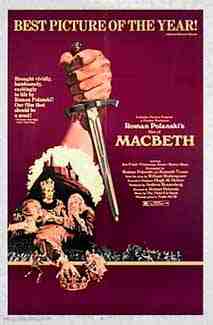 This post is part of the William Shakespeare Blog-a-Thon.
"Macbeth", as Jan Kott has noted, "begins and ends with slaughter. There is more and more blood, everyone walks in it; it floods the stage." Kott's reinterpretation of Shakespeare through a modern lens no doubt influenced both Peter Brook's King Lear and Roman Polanski's Macbeth, both released in 1971. But while both films are among the best Shakespeare adaptations, Brook's film is deliberately inert, while Polanski's film is wonderfully, terribly alive. From the opening scene, where the play's three witches congregate on an empty shore before departing into the gray, oppressive horizon, Polanski influses his Macbeth with a palpable sense of menace. This is fitting given his faithful but distinctly personal take on the material; if Shakespeare's play is ultimately intended as an affirmation of the inevitable restoration of order over chaos (and, by extension, the triumph of good over evil), Polanski presents evil as an endless, impenetrable cycle.
The film's visual canvas is at once beautiful and repellent - every frame is filled not only with blood but also drizzle, mud, shit and grime against images of the Scottish highlands (actually Wales) that are chilling in their blank impassivity. This is mirrored in a Macbeth (Jon Finch) who seldom reveals his emotions and instead remains chillingly inscrutable as he is transformed from a noble thane into a murderous, corrupt king. The decision to underact the character creates a protagonist for whom evil is not the result of madness but rationalization - from a pragmatic standpoint, Macbeth's decision to murder Duncan (Nicholas Selby) makes a perverse kind of sense, which makes the senseless violence it spawns all the more incomprehensible. And with Lady Macbeth (Francesca Annis) portrayed not as a calculating femme fatale but as a blithe impetuous young woman who lacks a moral barometer (her famous delivery of the "out damn spot" speech in the nude underlines the childlike vulnerability beneath her cunning). When she manipulates her husband to kill the king, she's like the worst result of centuries of "daddy's little princess" paternalization, craving power without even beginning to understand its significance.
Polanski is unflinching with Macbeth's extensive violence and brutality - the film is at points a catalog of the things that steel can do to human flesh. This could have easily veered into grand guignol territory, but Polanski isn't after shock so much as matter-of-fact observation of our tendency towards carnage. The film's extensive use of handheld cameras and natural lighting give it an immediacy that extends to its supernatural scenes. This is most notable in the scene when Macbeth is confronted by Banquo's ghost; by at once presenting the ghost as tangibly present and subtly creating a feeling of temporal dislocation, Polanski touches the uncanny (Kubrick was likely influenced by the scene, which is echoed in The Shining's Room 237 sequence). If the horrors of the film seem more psychological than supernatural, it is because Polanski refuses to let Macbeth (or us) off the hook that easily; when Macbeth arrives at the famous "tomorrow and tomorrow" soliliquy, detached from his people and his own fate, it becomes clear that, to Polanski, the world is only as good or evil as we each perceive it to be.
By replacing Malcolm's final speech in favor of a coda that bookends the film with the witches (those purveyors of senseless mayhem), Polanski denies us any sense of real resolution - the film doesn't end so much as stop. While Polanski's films are characteristically bleak, it's not much of a leap to assume that, as the film was made so soon after the senseless murder of Sharon Tate, the director couldn't find a way to justify a final note of hope. The strength of Polanski's films (unavoidably echoed in his often tortured personal life) is his ability to stare directly into the abyss with open eyes. While his more recent films suggest that, like Shakespeare when he wrote The Tempest, Polanski has made some sort of tentative peace with the world around him. Whatever the case may be, his films from Knife in the Water to The Tenant represent an unparalleled examination of dread, and if Macbeth is his darkest moment as a filmmaker, it's also a thing of shivery beauty.
Friday, April 13, 2007

Tuesday, April 10, 2007
The Trim Bin #56

- The trailer for Rob Zombie's Halloween remake can be found here. At this point, I feel like it could go either way. I like that Zombie has apparently taken his own brutal approach to the opening murders, and I'm at least confident that it won't be a generic retread. If I'm afraid of anything at this point, it's that it will be too much a Rob Zombie movie to be recognizably Halloween. If he achieves the right balance of honoring the original and making it his own, it could end up deserving mention alongside Phillip Kaufman's Invasion of the Body Snatchers and John Carpenter's The Thing. But if not, than Zombie had better watch out, because you do not want to piss off Donald Pleasance's ghost.
- Several fine eulogies have been written about the passing of Bob Clark (you can find two here and here), one of the most eclectic filmmakers of all time - few men could have made both Children Shouldn't Play With Dead Things and Baby Geniuses. But while his filmography is spotty, he's also reponsible for creating one cultural institution (A Christmas Story) and the original Black Christmas. I revisited the film last holiday season with the intention of writing about it here, then found I had little to say except "eek!" So thank you, Mr. Clark, for creeping the hell out of me.
- Walter Chaw calls Robert Rodriguez "the Salieri to Tarantino's Mozart." As for reports that Harvey Weinstein may chop Grindhouse, I hope he comes to his senses. This will only tarnish the movie's image: it's an underperformer, but this sort of action makes it seem like a bomb on the level of Heaven's Gate, which it's not. I'd love to see Death Proof with the missing reel intact - I think it's one of Tarantino's best movies, and in its complete form, it might be the best. But wait for DVD or a limited late-summer/fall release. Give it some breathing room. To put it simply, DON'T. DON'T. DON'T. DON'T.
DON'T.
- Finally, here are David Lynch's thoughts on product placement:
- Walter Chaw calls Robert Rodriguez "the Salieri to Tarantino's Mozart." As for reports that Harvey Weinstein may chop Grindhouse, I hope he comes to his senses. This will only tarnish the movie's image: it's an underperformer, but this sort of action makes it seem like a bomb on the level of Heaven's Gate, which it's not. I'd love to see Death Proof with the missing reel intact - I think it's one of Tarantino's best movies, and in its complete form, it might be the best. But wait for DVD or a limited late-summer/fall release. Give it some breathing room. To put it simply, DON'T. DON'T. DON'T. DON'T.
DON'T.
- Finally, here are David Lynch's thoughts on product placement:
Sunday, April 08, 2007
Saturday, April 07, 2007
THIS IS MY MECCA!

There's a moment in Death Proof, Quentin Tarantino's half of the exploitation double-header Grindhouse, when one of his leads mentions a guy who made her a mix tape. Not a CD, she clarifies, but a tape, and the other women riding with her swoon as one of them exclaims, "That's so romantic!" Grindhouse is a celebration of the romance of analog - namely, the kind of schlocky B-movie double-feature experience that died with the dawn of video. And while Tarantino and Robert Rodriguez have both responded to this meta-moviemaking experiment in drastically different ways that will leave most audience members strongly preferring one over the other, they both deserve a great deal of credit for recreating the terrifically cheap thrills of a bygone era.
After a fake trailer for a Danny Trejo-starring action vehicle called Machete (think Shooter, but awesome), a go-go-dancing Rose McGowan introduces us to the world of Rodriguez's Planet Terror, a zombies-gone-amok picture set in a rural Texas town. A descendant of George A. Romero and John Carpenter's early low-budget efforts, Planet Terror pits a small gang of survivors, led by McGowan's Cherry Darling and her mysterious truck-driving ex, Wray (Freddy Rodriguez). The schlock aesthetic frees Rodriguez to make his most entertaining movie since From Dusk Till Dawn, his hyperactive imagination serving up a smorgasbord of explosions, severed limbs and burst pustules without the burden of logic or character development (it's like a more honest Once Upon a Time in Mexico).
Rodriguez even succeeds in recalling the best grindhouse movies' goofy but sincere attempts at social commentary, supplying us with a sneering, inarticulate Lieutenant played by Bruce Willis (another sometime actor does a surprisingly effective job as a rapist) and positioning Osama bin Laden as the 21st-century replacement for Hitler as the go-to real-life boogeyman to lend one's monster movie some gravitas. While Planet Terror's take on grindhouse is mostly superficial (and the obvious digital effects are a slight compromise), it's a great deal of gross-out fun, using genre staples like Tom Savini, Michael Biehn and Jeff Fahey to wonderful effect. And when the film arrives at the awesome, already famous sight of McGowan toting a machine gun leg, Rodriguez succeeds in giving us an iconic movie image that perfectly summarizes the transgressive appeal of chicks with guns. Planet Terror is the sort of movie that Avco Embassy might have released in 1981, and I mean that as a tremendous compliment.
While the pleasures of Planet Terror are overt, Death Proof is a subtler and at points confounding take on slasher, car and rape-revenge pictures. This is evident in the way each director approaches the digital touchups designed to make their prints appear old and degraded - Rodriguez fills every frame with scratches and dirt, while Tarantino employs them less, allowing the film to speak for itself. Death Proof's credits play out through a haze of pot smoke, and Tarantino has indeed finally made a stoner movie, languorously paced and amiably unfocused. Basically two extended action sequences bookended by a great deal of chitchat between its mostly female cast, Death Proof follows Stuntman Mike (Kurt Russell), an ex-stand-in with a few crayons short of a box, as he stalks one group and is then pursued by another group of young women. Tarantino takes a lot of time letting his story unfold, observing a local celebrity (Sydney Poitier - how mean were her parents?) and her friends as they get drunk, flirt with guys and dance to T-Rex. This is mirrored in the film's second half, where stuntwoman Zoe (Zoe Bell, essentially playing herself) and her posse spend their day off from a movie shoot tracking down a 1970 Dodge Challenger (the Vanishing Point car, as Zoe excitedly informs us) to perform an extremely dangerous stunt for kicks. Tarantino is not so much deconstructing as distilling the essence of 70's exploitation, which counted among its charms a tendency towards rambling plots (see Dennis Cozzalio's take on the unexpected sweetness of Revenge of the Cheerleaders); we learn about the characters not through extensive exposition but in asides and brief exchanges, and it's a weirdly subversive surprise to see Tarantino celebrating grindhouse cinema's understated qualities as well as the sex and violence.
This approach is destined to be off-putting to a lot of audience members (a friend I saw the film with eloquently summarized Death Proof as "fucking shit" and "Duel meets Spice World"). But while both films are a great deal of fun, Death Proof is just a great film, period. It's odd and unwieldly, but deliberately so. The hangout scenes not only establish an unusual amount of investment in the characters for a slasher movie, they also serve to create a Hitchcockian air of menace - when Arlene (Vanessa Ferlito) notices Mike's ominous muscle car has followed them, she represents every pursued woman with an instinctive awareness of nastiness around the corner since Janet Leigh. A self-described wolf, Mike might have emerged right out of the female protagonists' collective unconscious - virile but unknowable, he's a living representation of the collision of sex and death, and Russell's incomparable talent for dead-eyed nihilism makes Mike an unforgettable villain. When Bell, Rosario Dawson and Tracy Thoms take over in the second half, the film becomes a potent celebration of female strength. But where Planet Terror relies on a machine-gun leg for its impact, Death Proof's leading ladies possess a truly death-proof inner strength - it's a hokey conceit, but Tarantino is smart enough to play it sincerely, remembering that there is an underlying truth in even our trashiest celluloid fantasies. Stick with Death Proof and you'll be rewarded with some jaw-dropping chase sequences, an orgasm of an ending, and a wealth of ideas about the power of genre that will stick with you long after the credits roll.
But while, yes, I definitely prefer Tarantino's film to Rodriguez's, they both honor their ancestors in different ways. And they were nice enough to invite their peers to contribute some memorable trailers that play between the features - Rob Zombie's Werewolf Women of the SS (featuring Nicolas Cage in the part he was born to play), Edgar Wright's drily hilarious Eurohorror Don't, and Eli Roth's grisly holiday slasher Thanksgiving (which makes awesome use of the Creepshow score). Add to this a grab bag of appropriately period headers, ads for the taco shack next door, and a few missing reels bound to piss off many an oversexed audience member, and it's clear that this is a labor of love for everyone involved. I'm too young to have experienced the real thing - when I was visiting New York City, a billboard featuring a Times Square marquee advertising a double bill of Night of the Creeps and The Texas Chainsaw Massacre 2 with the tagline "THINGS HAVE CHANGED" pissed me off something fierce. Now I can say that I too have been to the Grindhouse, and for that I am most thankful.
Friday, April 06, 2007

Thursday, April 05, 2007
Let's start building some hurtin' bombs.

Rocky Balboa is unprecedented, a Sylvester Stallone-directed film that's actually pretty good. Stallone, who also reprises his most popular character here, could have easily thrown together a by-the-numbers retread and made a few bucks off the nostalgia craze - easier still, he could have just sold the remake rights. Instead, he's made a surprisingly low-key and personal character study that honors the qualities that made the first Rocky such a rousing moviegoing experience. The result is far from perfect, but it is likeable, entertaining and oddly moving.
Sixteen years after the execrable Rocky V, the film finds the Italian Stallion living a modest but comfortable life, spending his nights entertaining guests at his restaurant with stories of his famous fights against Apollo Creed and Clubber Lang (no mention of having defeated Communism). The biggest change in Rocky's life is the loss of his beloved wife Adrian, who died of "lady cancer" (as Rocky puts it) several years earlier. The opening scenes follow Rocky on the anniversary of her death as he visits spots (such as the lot where an ice rink once stood) that remind him of Adrian, her brother Paulie (Burt Young) reluctantly tagging along. These scenes set a surprisingly melancholic tone for the film, which eschews the overblown theatrics (and talking robots) of previous sequels in favor of a muted color palette and a quiet, observational style. And while earlier entries in the franchise have taken a by-the-numbers approach, Rocky Balboa has a structure that hearkens back to the first film, following the characters as not much happens - Rocky befriends a younger woman and her son, Rocky gets a dog, Paulie is still a prick - and allowing the interchanges between the characters to propel the story. The main villain in the film isn't any fighter but Rocky's own advancing age; while this isn't the most original of premises, Stallone invests it with a level of insight and wit that reminds us of how the star of Stop! Or My Mom Will Shoot was once a promising voice for our populist myths.
Stallone also takes the piss out of any jokes at the near-60 fighter, not to mention his own checkered filmography - imagine what it must be like to live with the fact that you starred in Tango and Cash, and you'll get an idea of the pathos behind Rocky's indirect admission that, yes, you can call him Punchy. When Rocky agrees to fight heavyweight champ Mason "The Line" Dixon (Vodka Drunkenski was unavailable), his goal isn't to knock out the younger fighter but to leave the ring with his dignity intact (and to teach the young whippersnapper a thing or two). There's something charming about Stallone's modesty, making a movie that not only appeals to serious fans but demonstrates that he's trying new things as a filmmaker. This is nowhere more evident than during the fight, which is filled with sudden cuts to moments from Rocky's (and our) memories. It's not entirely successful - a purple-tinted closeup of Burgess Meredith is sort of terrifying - but it does reveal Stallone as an auteur in his own way, preoccupied with the persistence of memory.
Rocky Balboa has a lot of problems - the scenes between Rocky and his son don't work, the narrative is weirdly compressed (probably due to the small budget), and there's far too much A.J. Benza. But watching Rocky, calcified joints and all, training with Paulie and Duke (the eternally awesome Tony Burton) to Bill Conti's classic theme, it's impossible not to smile, not just out of nostalgia but geniune fondness. This is Stallone's The Straight Story, and whether this is a good or bad thing is for you to decide. All I know is, I'm now illogically excited to see John Rambo.
Saturday, March 31, 2007
Top 10: Final Girls

I recently read Carol J. Clover's Men, Women, and Chain Saws: Gender in the Modern Horror Film, an excellent critical analysis of slasher, possession and rape-revenge movies. Clover's book challenges the conventional wisdom that horror movies are inherently misogynistic, arguing instead that they instead do a great deal to challenge traditional gender roles - it's insightful and unpretentious, the rare tome that both Slavoj Zizek and Joe Bob Briggs could appreciate. In a neat coincidence, the same day I finished the book, I read Quentin Tarantino praising the book in Fangoria as hands-down the best of its kind.
Clover's book has a great deal to say about the Final Girl - the female character who confronts the monster and lives to fight another day. The Final Girl is often but not always chaste; she survives because she is resourceful, quick-witted and perceptive. Since Tarantino's Death Proof looks to be a tribute to the Final Girl, here are some of the best examples of the archetype:

1. T. Ellen Ripley (Sigourney Weaver), Alien While most horror films telegraph their survivors early on, Ripley emerges as the Final Girl gradually - she's stoic and remote, and not as immediately likeable as fellow crew member Lambert (Veronica Cartwright). But as her shipmates are picked off one by one, Ripley remains strong and decisive when Lambert can only sob helplessly. The final twenty minutes of Alien contain almost no dialogue, but our fear is sustained largely by Weaver's sweaty, wide-eyed, unforgettable performance as she outwits the tituar xenomorph before literally blowing it away. Ripley would live to fight, die, be reborn and fight again in the subsequent films, emerging as one of the greatest characters not only in horror but in all cinema.

2. Laurie Strode (Jamie Lee Curtis), Halloween A self-described Girl Scout who spends Halloween babysitting while her friends are busy drinking and screwing, Laurie is perhaps the beginning of the "good girls don't die" cliché. But, as Carpenter himself has pointed out, Laurie survives not because she's chaste but because she's full of repressed sexual energy, which ties her to Michael Myers and makes her a formidable foe. Whatever the Lacanian reading may be, she's deadly with a wire hanger. Curtis, of course, reprised the Final Girl role to great effect in several films, including The Fog, Road Games and Halloween II.

3. Suzy Bannion (Jessica Harper), Suspiria Suzy is the archetypal fairy-tale heroine, an innocent lost in the haunted woods (Germany's Black Forest) and trapped at a dance school run by witches (what an awesome premise!) who have mysterious but no doubt horrible plans for her. Harper is one of the great underusedd actresses of the 70's, and the sight of her delicate, almost alabaster features shrinking at the unknown horrors surrounding her enhances our own terrifying feeling of vulnerability. The final shots of Suzy's smiling escape are wonderfully triumphant, her relief mirroring ours.

4. Fran (Gaylen Ross), Dawn of the Dead As if trying to survive the start of a worldwide zombie epidemic weren't enough, Fran is also in the early stages of pregnancy. But rather than allowing her boyfriend and their virile companions to rescue her, Fran insists on learning to fly their helicopter, fire a gun and take care of herself. When her self-reliance pays off at the film's end, it's impossible not to applaud her.

5. Sally Hardesty (Marilyn Burns), The Texas Chain Saw Massacre Sally survives through pure endurance - for nearly half the film, she does not stop running as she flees Leatherface and his demented family. Managing to escape a particularly unpleasant dinner party, Sally escapes, though sadly, she's gone completely bananas. Burns' hysterical laughter at the film's end is one of the most unsettling (and imitated) moments in horror cinema.

6. Sue Snell (Amy Irving), Carrie Sue is unique in that her survival is particuarly grim - her well-intentioned attempt to do a good deed for poor Carrie White leaves her the only surviving member of her class. Like Sally, Sue isn't in great shape at the end, and Irving's screams punctuate cinema's definitive "Boo!" scare.

7. Nancy Thompson (Heather Langenkamp), A Nightmare on Elm Street A uniquely 80's heroine, Nancy reacts to the threat of a spectral child molester who threatens to kill her in her dreams by studying booby traps and makeshift weapons - many Final Girls have confronted their monsters, but few have whacked them in the groin with a sledgehammer. It is Nancy's ability to turn her back on Freddy that ultimately defeats him, though not for good - Langenkamp would return to give oddly stitled performances in two sequels.

8. Betty (Cristina Marsillach), Opera The young diva that finds herself caught in an endless, gooey mindfuck in Argento's best giallo is memorable for her kinks. Just minutes after witnessing her boyfriend's brutal murder, she's calmly chatting about her sexual hangups; as the film proceeds, we learn more about Betty's strange family history and how it connects her with the killer. Argento literalizes the repression theme that Carpenter implied in Halloween, and the result is a marvelously twisted slasher with a Final Girl who proclaims her love of all things warm in fuzzy in a final scene that would make David Lynch proud.

9. Alice Hardy (Adrienne King), Friday the 13th The virginal (though not drug-free) Alice isn't the most distinctive of characters, but she deserves inclusion here for three reasons. First, she kills Mrs. Voorhees and is therefore responsible for motivating her mentally challenged son - thought to be dead but apparently just wandering around the woods of Crystal Lake for two decades for no particular reason - to slaughter ten films' worth of horny teens in revenge. The second reason is her involvement in the first film's goofily perfect final scare, but less celebrated is her subsequent demise at the start of Friday the 13th Part 2, which began a tradition of slasher films' cheerfully cynical disregard for their protagonists.

10. Stretch (Caroline Williams), The Texas Chainsaw Massacre 2 The Texas DJ who runs afoul of Leatherface and his kin is referenced a great deal in Clover's book, and for good reason. While Hooper's spoofy take on his own masterpiece is uneven (and that's putting it very generously), I have an enormous amount of affection for it, largely due to the scene where Stretch neutralizes Leatherface by almost literally making love with his saw (the scene plays like the revenge of Cixous). Williams also gleefully recreates the final shot of the the first film with her own chainsaw dance - it's not the subtlest filmic representation of contemporary gender theory, but it is the grooviest.
Sidenote: while researching this Top 10, I stumbled across this completely awesome blog. I highly recommend that you check it out.
Clover's book has a great deal to say about the Final Girl - the female character who confronts the monster and lives to fight another day. The Final Girl is often but not always chaste; she survives because she is resourceful, quick-witted and perceptive. Since Tarantino's Death Proof looks to be a tribute to the Final Girl, here are some of the best examples of the archetype:

1. T. Ellen Ripley (Sigourney Weaver), Alien While most horror films telegraph their survivors early on, Ripley emerges as the Final Girl gradually - she's stoic and remote, and not as immediately likeable as fellow crew member Lambert (Veronica Cartwright). But as her shipmates are picked off one by one, Ripley remains strong and decisive when Lambert can only sob helplessly. The final twenty minutes of Alien contain almost no dialogue, but our fear is sustained largely by Weaver's sweaty, wide-eyed, unforgettable performance as she outwits the tituar xenomorph before literally blowing it away. Ripley would live to fight, die, be reborn and fight again in the subsequent films, emerging as one of the greatest characters not only in horror but in all cinema.
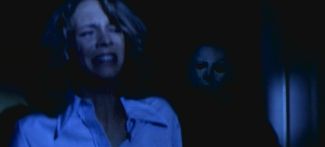
2. Laurie Strode (Jamie Lee Curtis), Halloween A self-described Girl Scout who spends Halloween babysitting while her friends are busy drinking and screwing, Laurie is perhaps the beginning of the "good girls don't die" cliché. But, as Carpenter himself has pointed out, Laurie survives not because she's chaste but because she's full of repressed sexual energy, which ties her to Michael Myers and makes her a formidable foe. Whatever the Lacanian reading may be, she's deadly with a wire hanger. Curtis, of course, reprised the Final Girl role to great effect in several films, including The Fog, Road Games and Halloween II.

3. Suzy Bannion (Jessica Harper), Suspiria Suzy is the archetypal fairy-tale heroine, an innocent lost in the haunted woods (Germany's Black Forest) and trapped at a dance school run by witches (what an awesome premise!) who have mysterious but no doubt horrible plans for her. Harper is one of the great underusedd actresses of the 70's, and the sight of her delicate, almost alabaster features shrinking at the unknown horrors surrounding her enhances our own terrifying feeling of vulnerability. The final shots of Suzy's smiling escape are wonderfully triumphant, her relief mirroring ours.

4. Fran (Gaylen Ross), Dawn of the Dead As if trying to survive the start of a worldwide zombie epidemic weren't enough, Fran is also in the early stages of pregnancy. But rather than allowing her boyfriend and their virile companions to rescue her, Fran insists on learning to fly their helicopter, fire a gun and take care of herself. When her self-reliance pays off at the film's end, it's impossible not to applaud her.

5. Sally Hardesty (Marilyn Burns), The Texas Chain Saw Massacre Sally survives through pure endurance - for nearly half the film, she does not stop running as she flees Leatherface and his demented family. Managing to escape a particularly unpleasant dinner party, Sally escapes, though sadly, she's gone completely bananas. Burns' hysterical laughter at the film's end is one of the most unsettling (and imitated) moments in horror cinema.

6. Sue Snell (Amy Irving), Carrie Sue is unique in that her survival is particuarly grim - her well-intentioned attempt to do a good deed for poor Carrie White leaves her the only surviving member of her class. Like Sally, Sue isn't in great shape at the end, and Irving's screams punctuate cinema's definitive "Boo!" scare.

7. Nancy Thompson (Heather Langenkamp), A Nightmare on Elm Street A uniquely 80's heroine, Nancy reacts to the threat of a spectral child molester who threatens to kill her in her dreams by studying booby traps and makeshift weapons - many Final Girls have confronted their monsters, but few have whacked them in the groin with a sledgehammer. It is Nancy's ability to turn her back on Freddy that ultimately defeats him, though not for good - Langenkamp would return to give oddly stitled performances in two sequels.

8. Betty (Cristina Marsillach), Opera The young diva that finds herself caught in an endless, gooey mindfuck in Argento's best giallo is memorable for her kinks. Just minutes after witnessing her boyfriend's brutal murder, she's calmly chatting about her sexual hangups; as the film proceeds, we learn more about Betty's strange family history and how it connects her with the killer. Argento literalizes the repression theme that Carpenter implied in Halloween, and the result is a marvelously twisted slasher with a Final Girl who proclaims her love of all things warm in fuzzy in a final scene that would make David Lynch proud.

9. Alice Hardy (Adrienne King), Friday the 13th The virginal (though not drug-free) Alice isn't the most distinctive of characters, but she deserves inclusion here for three reasons. First, she kills Mrs. Voorhees and is therefore responsible for motivating her mentally challenged son - thought to be dead but apparently just wandering around the woods of Crystal Lake for two decades for no particular reason - to slaughter ten films' worth of horny teens in revenge. The second reason is her involvement in the first film's goofily perfect final scare, but less celebrated is her subsequent demise at the start of Friday the 13th Part 2, which began a tradition of slasher films' cheerfully cynical disregard for their protagonists.

10. Stretch (Caroline Williams), The Texas Chainsaw Massacre 2 The Texas DJ who runs afoul of Leatherface and his kin is referenced a great deal in Clover's book, and for good reason. While Hooper's spoofy take on his own masterpiece is uneven (and that's putting it very generously), I have an enormous amount of affection for it, largely due to the scene where Stretch neutralizes Leatherface by almost literally making love with his saw (the scene plays like the revenge of Cixous). Williams also gleefully recreates the final shot of the the first film with her own chainsaw dance - it's not the subtlest filmic representation of contemporary gender theory, but it is the grooviest.
Sidenote: while researching this Top 10, I stumbled across this completely awesome blog. I highly recommend that you check it out.

Sunday, March 25, 2007

Friday, March 23, 2007
Freedom isn't free.

300 is a rare thing: an utter failure of both form and content. The film, an adaptation of the graphic novel by Frank Miller and Lynn Varley, is a constant visual assault - a mishmash of iconic hero tableaux punctuated by lovingly rendered moments of decapitation and dismemberment and accompanied by a deafening cock-rock soundtrack. All of this is apparently designed to repeatedly hammer home two points: the Spartans were awesome and the Persians were homos. This is very faithful to the novel, and to Miller's xenophobic, phallocentric and frankly ridiculous worldview. But the comic form serves as a perfect frame for Miller's one-dimensional brand of storytelling, which finds a proper context in a broadly representational medium. Robert Rodriguez was smart to adapt Sin City with a healthy dose of irony - as 300 repeatedly proves, this hogwash can't be played straight. Where Rodriguez' film worked as an amoral thrill ride, director Zach Snyder (who showed promise with 2004's Dawn of the Dead) makes the grave mistake of telling this story with a straight face. The result is a film that Leni Riefenstahl would have made if she had an iMac.
The film, like the graphic novel, recounts the Battle of Thermopylae in the simplest possible terms: 300 Spartans, led by King Leonidas (Gerard Butler), manage to stand against the massive Persian army for three days. That's more or less the plot, but this should not suggest that 300 tells a story, although an omnipresent narrator spells out practically every single moment should you get confused. The bulk of the film is an extended battle sequence in which the Spartans stand up against increasingly daunting opposition from their enemies (the film is in many ways reminiscent of Mike Tyson's Punch-Out). This non-narrative is matched by Snyder's monotonous visual strategy, which mimics Rodriguez' techniques but not the director's style or wit. Glance at 300's IMDb trivia page and you'll find a wealth of information about all the cutting-edge effects programs used on the film; unfortunately, these tools are not put to use in an imaginative way. The film's images lack a proper sense of scale - every shot is big and loud (and usually slo-mo), and the result is dramatically inert and aesthetically boring.
The film, like the graphic novel, recounts the Battle of Thermopylae in the simplest possible terms: 300 Spartans, led by King Leonidas (Gerard Butler), manage to stand against the massive Persian army for three days. That's more or less the plot, but this should not suggest that 300 tells a story, although an omnipresent narrator spells out practically every single moment should you get confused. The bulk of the film is an extended battle sequence in which the Spartans stand up against increasingly daunting opposition from their enemies (the film is in many ways reminiscent of Mike Tyson's Punch-Out). This non-narrative is matched by Snyder's monotonous visual strategy, which mimics Rodriguez' techniques but not the director's style or wit. Glance at 300's IMDb trivia page and you'll find a wealth of information about all the cutting-edge effects programs used on the film; unfortunately, these tools are not put to use in an imaginative way. The film's images lack a proper sense of scale - every shot is big and loud (and usually slo-mo), and the result is dramatically inert and aesthetically boring.
The film also rests uneasily in a gray area between fantasy and historical fiction, making it unclear whether we are to take its thornier messages at face value. It feels almost too obvious to dwell on 300's hatred of non-whites, women and the disabled, especially since Snyder has repeatedly protested that those who dare to analyze his film as a text have "missed the point" (an interesting statement, as it implies that 300 has a point). If the film's incendiary messages were the result of a singular vision, as with The Passion of the Christ, the result would at least be perversely fascinating. But Snyder's defiant anti-intellectualism is actually far more disturbing - if the film lacks a real authorial perspective, then it becomes a sort of Rorshach test upon which the audience can project its worst instincts. The Persian army, which is inferior to the Aryan superheroes, may not be intended as a comment on its modern-day descendants, but for Snyder to ignore the ways that his film might resonate with towelhead-fearing patriots is not only irresponsible, it's pretty frigging stupid.
If there's one theme in 300 that cannot be written off as unintentional, it's the film's fear of sexual deviance. The Persians are depicted as a bunch of faggots, dykes and perverts engaging in all forms of decadence (menage a trois - shock horror!), and Xerxes is a slender, deep-throated pretty boy with a perfect manicure. When one considers how much of the film's action hinges on who will or will not kneel before Xerxes, it becomes clear that the Spartans are not fighting for freedom so much as trying to escape submission in any form. 300 is ultimately a movie about every red-blooded American male's deep-seated, unshakable fear of getting fucked in the ass. As the foundation for a narrative, it's completely retarded. But had the filmmakers followed in the example of Walter Sobchak, they could have at least had a hell of a tagline.

Tuesday, March 20, 2007
The Trim Bin #55
- It's time for another quiz over at Sergio Leone and the Infield Fly Rule, administered this time by Professor Irwin Corey (if you just said "who?", then Dennis can fill you in). For the uninitiated, these quizzes are a lot of fun, very thought-provoking, and have plenty of room for both Wim Wenders and Short Round.
- In my Zodiac review I described Jake Gyllenhaal as "not a great actor." After Nathaniel at the Film Experience Blog reminded me of this moment, I must admit that I may soon be forced to change my tune.
- Boston-area readers: the Harvard Film Archive is screening Roman Polanski's version of Macbeth on April 9. It's a great, unheralded movie, and I can't imagine it screens on 35mm all that often, so I highly recommend checking it out.
- While the writing at Ain't It Cool News is notoriously indefensible, I can't help but appreciate their enthusiasm. They just started a retrospective series about the summer of 1982 (a high point for geeks), and the piece on E.T. does a fine job of capturing what makes that film so perfect.
- Finally, this video from the set of I Heart Huckabees has been all over the web today, and I couldn't resist passing it along. How very zen:
Friday, March 16, 2007

Wednesday, March 14, 2007
Nonlinear Equations with Verbal Kint
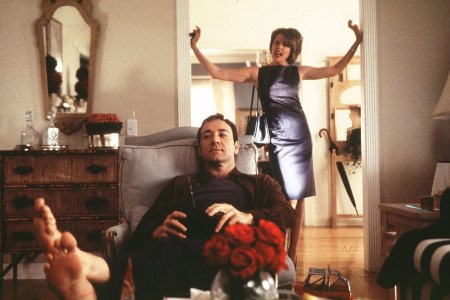
Kevin Spacey rules.
Last week, I got a call from Billy Dowd, the casting director and Massachusetts native who previously cast me as an extra in War of the Worlds and The Departed. Billy asked if I wanted to work for two days on an untitled movie (which I'll refer to by its working title, 21) starring Mr. Spacey, Lawrence Fishburne and Kate Bosworth. That Saturday, I woke at 2:45 and left soon after to begin the three-hour ride to Boston. By 8:30, I was sitting in a classroom at Boston University about five feet away from Lex Luthor. What follows are some memories from the next two days - they may be a bit scattered, as I'm still catching up on my sleep, and because I just worked with Kevin Fucking Spacey.
After arriving at BU and signing in, I caught up a bit with Billy and then chatted with other extras in holding. The group was a mix of experienced actors and relative newcomers like myself - I even ran into a former high school classmate who is finishing up her las
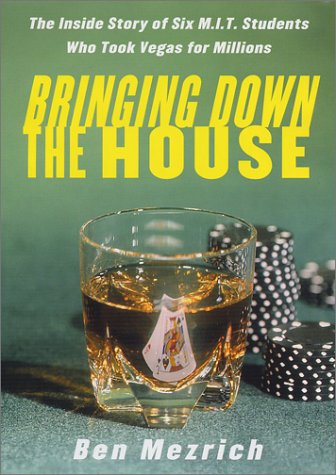 t semester at Emerson. We were then brought to set and given a description of the scene. The film is a somewhat fictionalized adaptation of the book Bringing Down the House, the story of a group of MIT students (BU is standing in as a location) who used their talents to make boatloads of money counting cards in Las Vegas and soon found themselves fleeing the city's heavies. The scene being filmed comes early in the film, as Spacey's character, a professor, is subtly testing his students to find the perfect recruits for his blackjack team. We were assigned seats in the classroom, the master shot was lit using stand-ins, and the actors were brought to set.
A bit of personal context: I saw American Beauty when I was fifteen, which is pretty much the perfect age to see American Beauty. And while I can objectively admit the film has dated a bit, I'm almost embarrassed to admit that it will always be one of my favorite movies - I think there's real magic in the film and particularly in Spacey's pitch-perfect performance. Add in Glengarry Glen Ross, The Usual Suspects, L.A. Confidential and Seven, and it's clear the guy was on a roll in the nineties. Of course, his recent work has been decidedly mixed, so while I was excited to work on the film, my enthusiasm was a bit muted until I began to watch Kevin Spacey work. I then spent the following two days trying not to act like a giggling thirteen-year-old girl.
The coolest thing about Kevin Spacey is that he carries not one whiff of egotistical-movie-star bullshit. While an AD gave us the standard "Do not talk to the actors" spiel, he spent a good deal of time between takes chatting with the extras, asking us where we went to school, whether we were pursuing acting professionally and whatnot. And when I said that I worked with Spacey, that wasn't hyperbole; he offered us suggestions on how to react to the scene and cracked awful jokes (the worst was a pun involving Newton the scientist and the cookie) to loosen us up. He, along with the entire crew, made us feel like an integral part of the production - after all, it would be odd if Spacey's character was lecturing to an empty classroom. I appreciate it when the extras aren't ignored (on The Game Plan, we were left to our own devices), not only because it puts us at ease, but because it's good for the movie as well, suggesting a great deal of attention to even the littlest details.
Because my job was basically to sit, stare and laugh at a few jokes, I was able to just observe Spacey develop the scene with the director and crew. His first few takes were tentative, and he fumbled a good deal of his lines ("So Kantorovich's theory of quadratic convergence states that...I don't know what the fuck I'm doing"). But as the day progressed, he began to try out slight variations on the dialogue with each take and sponatenously punctuating one line with a tossed piece of chalk. It appeared that his goal was to eliminate any actorly artifice and play the scene intuitively, to allow us to watch the character's thought process without a lot of external business. His improvisations were well chosen, too; a brief scene shot on Monday where the lead character (played by Jim Stafford, who in a nice coincidence was also the lead in Across the Universe, which my friend Kate worked on) confronts his professor wasn't very well-written, but around the third take, he ended the scene with a throwaway line ("You should get that eye checked out") that got to the heart of the scene better than any of the scripted dialogue.
Spacey can be scary when he wants to be, though. On the second day, he responded to an unsolicited line reading, telling the director, "If you're going to do that, you can't mumble." He was quiet and polite, but he might as well have said "I'm going to cut off your head and FedEx it to Brad Pitt."

Other than that moment, however, I must admit that I was pleasantly surprised by the director, Robert Luketic. I wasn't expecting much from the director of Legally Blonde and Monster-in-Law, but he possesses many of the qualities every director should have - patience, enthusiasm, imagination and almost manic energy. A young, dimunutive Australian, Luketic has a very craftsmanlike style on the set, building a scene shot-by-shot and encouraging ideas from all parties. This is in contrast to, say Michael Bay - one of the PAs had worked on Transformers and described working with Bay as a constant barrage of profanity, hubris and verbal abuse. I think that Luketic has it in him to make a good movie, and (selfishly, of course) I hope it's this one.
The most educat
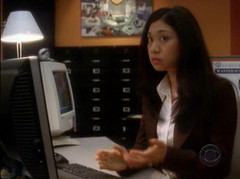 ional moment came on the second day, when I was seated next to the very kind, friendly actress Liza Lapira and found myself in the midst of the entire crew as they lit her closeup. The director of photography, Russell Carpenter, shot both Titanic and The Wizard of Speed and Time, so I paid close attention to his lighting strategy (which seemed to rely mostly on Kino Flos, diffusion and muted colors to create a soft, understated palate). I slipped in an occasional "Hey, what's that for?" when I felt I could do so without being annoying. After lunch, I spent most of the afternoon walking down a hallway past Kate Bosworth (she's pretty and sociable, but needs to eat a few cheeseburgers). And during the down time, I got a chance to talk with the former president of the Screen Actors Guild in Boston. I earned two SAG vouchers on 21, one away from being eligible to join the union. This opens up a lot of opportunities and makes acting as a career seem much more possible, but it also prevents you from doing a lot of lower-paying but potentially rewarding work. So it was valuable to have the chance to talk with someone experienced about finding your confidence as an actor and choosing the right moment to make that leap.
The oddest moment: emerging from a stall and washing my hands in an otherwise empty men's room, I glance in the mirror and notice Mr. Spacey, back towards me, relieving himself. It took all of my willpower not to say "You know, you were really good in K-Pax."
If you're wondering why the stars didn't have private bathrooms, that's what made this set so unique. There were no divisions between the stars, crew and extras, or between union and non-union - everyone ate the same meals, got the same breaks and was afforded the same level of respect. Spacey, who is also producing 21, has made a lot of noise about wanting to support new talent, and it's nice to see him put his (or Sony's, anyway) money where his mouth is. It seems that he hasn't forgotten what it was like to be just starting out and hungry for the opportunity to work even for a day. I can't say whether the movie will be any good (though I think it has a chance), but it was the most generous, positive moviemaking experience I've had in my miniscule career. And both times we broke for lunch, it took all of my willpower not to quote this scene:
Sunday, March 11, 2007
Dave, I want a gun.

Zodiac begins with a familiar scenario: a young couple parked in a secluded spot get the heebie-jeebies when they recognize a car that has been following them (the car takes the role usually occupied by a strange noise). The outcome of the scene is unsurprising, but our anticipation of violence creates immediate tension, which director David Fincher sustains with subtletly, reducing the scene to its barest visual and narrative elements, creating a moment of stark horror. Donovan's haunting "The Hurdy-Gurdy Man" joins the deafening noise of gunfire on the soundtrack as we are introduced to the titular killer ("the roly-poly man"), a villain without a face, permanently cloaked in shadow; the scene at once appeals to and subverts our expectations for the film, a meticulously crafted variation on the police procedural subgenre. Zodiac is deeply, persistently creepy in a way that few films are, obsessed as it is with our primal, deep-seated fear of unsolved mysteries and, by extension, the unknown - it's a film that deserves mention next to such masterpieces of paranoia as The Conversation and Blow Out.
The film follows the search for the Zodiac killer from the perspective of three men - San Fransisco Chronicle columnist Paul Avery (Robert Downey Jr.), detective Dave Toschi (Mark Ruffalo) and Robert Graysmith (Jake Gyllenhaal), a cartoonist for the Chronicle who ultimately wrote a book about the Zodiac that is the basis for the film's screenplay. The film's narrative spans years, then decades, chronicling all the clues, dead ends and unanswered questions accompanying the case. The first half of the film recreates the Zodiac's crimes in unflinching detail, captured in razor-sharp HD by cinematographer Harris Savides (who also shot Gus Van Sant's Elephant, a spiritual cousin to Fincher's film), and documents his years-long correspondence to the Chronicle and the SFPD, taunting their inability to uncover his identity. But as the years pass and film progresses, the Zodiac's crimes stop and his contact with his pursuers trails off - the killer is a disembodied spectre hanging over the film, and the true villain is not any of the suspects we meet but rather the aimless, dislocated feeling of dread stemming from the lack of a pat resolution. A terrifying scene set in a possible culprit's home (Who Framed Roger Rabbit will never be the same) is undercut by the failure of the evidence to incriminate said suspect. The film teases our desire for an answer, fetishistically recreating in minute detail a newsroom straight out of All the President's Men and using its intrepid protagonists as archetypal figures in the search for truth. But Fincher is ultimately concerned with how this search consumes and destroys each man. A scene where Toschi criticizes Dirty Harry (loosely based on the case) for its fascistic wish fulfillment forces us to confront our own need for retribution, which, as Fincher subtly reminds us, is rarely the same as resolution.
Zodiac's ambiguities are mirrored in the film's narrative techniques, particularly the conflict between the film's digital medium and its rigidly analog narrative structure. Zodiac is a long film, but never a bloated one - the story unfolds at a quick pace, a barrage of facts loaded into every scene. Yet Fincher raises more questions than answers - for instance, he employs titles indicating the passage of time as Kubrick did in The Shining, using repetition to underline time as an abstract concept that we collectively employ to assign continuity to our lives. When we meet the prime suspect (John Caroll Lynch) during an interrogation, the camera remains at a distance, allowing us to read whatever we choose into his guarded mannerisms and halting, defensive speech. At one point, Graysmith tells his wife (Chloe Sevigny, underused in a standard worried wife role that is the film's only weak point) that he needs to look the Zodiac in the eye and know that it's him, yet the film uses images to challenge the idea that seeing is believing. Taking place at a moment in time when modes of information were rapidly expanding, Zodiac shows us everything but explains nothing; in a sense, is the perfect horror movie for empiricists.
The performances are stellar all around - Downey is characteristically brilliant as a hipster reporter whose seeming ironic detachment is a defensive measure against his very real fears, and Ruffalo is sympathetic as a good cop beaten by the weight of time. Gyllenhaal, who has publicly bitched about Fincher's demanding methods, is like the director's Shelley Duvall; he uses the actor's earnestness to create a progagonist with ambiguous motives. Graysmith devotes decades to the pursuit of the Zodiac, putting his family's safety at risk - while other characters frequently comment on his guilelessness, his goodness (and, consequently, his identity) is defined in relation to his elusive subject. Graysmith needs to know Zodiac in order to know himself; while Gyllenhaal isn't a great actor, he works brilliantly as a character who isn't quite there.
But the real star of the film is Fincher, for whom this film marks a major step forward. This is not a dismissal of his earlier films - Seven and Fight Club are brilliant and endlessly rewatchable, but they're didactic and relatively accessible, their strength residing in the sheer visceral impact of the images. With Zodiac, Fincher takes a more subtle, disciplined approach and reveals that, in addition to his technical gifts, he's also a great storyteller. When he allows for a visual flourish such as a time-lapse shot of the Transamerica Pyramid being built brick by brick, the images have a meditative, poetic quality that enhance the film in surprising ways. Zodiac may be the film that ends up defining Fincher - it's a masterpiece, sometimes terrifying, sometimes maddening, and competely spellbinding. In an interview, Downey compared Fincher to Kubrick; he's begun to live up to the comparison, so let's just hope that he's a bit more prolific - the world needs more films as insistently alive as Zodiac.
The film follows the search for the Zodiac killer from the perspective of three men - San Fransisco Chronicle columnist Paul Avery (Robert Downey Jr.), detective Dave Toschi (Mark Ruffalo) and Robert Graysmith (Jake Gyllenhaal), a cartoonist for the Chronicle who ultimately wrote a book about the Zodiac that is the basis for the film's screenplay. The film's narrative spans years, then decades, chronicling all the clues, dead ends and unanswered questions accompanying the case. The first half of the film recreates the Zodiac's crimes in unflinching detail, captured in razor-sharp HD by cinematographer Harris Savides (who also shot Gus Van Sant's Elephant, a spiritual cousin to Fincher's film), and documents his years-long correspondence to the Chronicle and the SFPD, taunting their inability to uncover his identity. But as the years pass and film progresses, the Zodiac's crimes stop and his contact with his pursuers trails off - the killer is a disembodied spectre hanging over the film, and the true villain is not any of the suspects we meet but rather the aimless, dislocated feeling of dread stemming from the lack of a pat resolution. A terrifying scene set in a possible culprit's home (Who Framed Roger Rabbit will never be the same) is undercut by the failure of the evidence to incriminate said suspect. The film teases our desire for an answer, fetishistically recreating in minute detail a newsroom straight out of All the President's Men and using its intrepid protagonists as archetypal figures in the search for truth. But Fincher is ultimately concerned with how this search consumes and destroys each man. A scene where Toschi criticizes Dirty Harry (loosely based on the case) for its fascistic wish fulfillment forces us to confront our own need for retribution, which, as Fincher subtly reminds us, is rarely the same as resolution.
Zodiac's ambiguities are mirrored in the film's narrative techniques, particularly the conflict between the film's digital medium and its rigidly analog narrative structure. Zodiac is a long film, but never a bloated one - the story unfolds at a quick pace, a barrage of facts loaded into every scene. Yet Fincher raises more questions than answers - for instance, he employs titles indicating the passage of time as Kubrick did in The Shining, using repetition to underline time as an abstract concept that we collectively employ to assign continuity to our lives. When we meet the prime suspect (John Caroll Lynch) during an interrogation, the camera remains at a distance, allowing us to read whatever we choose into his guarded mannerisms and halting, defensive speech. At one point, Graysmith tells his wife (Chloe Sevigny, underused in a standard worried wife role that is the film's only weak point) that he needs to look the Zodiac in the eye and know that it's him, yet the film uses images to challenge the idea that seeing is believing. Taking place at a moment in time when modes of information were rapidly expanding, Zodiac shows us everything but explains nothing; in a sense, is the perfect horror movie for empiricists.
The performances are stellar all around - Downey is characteristically brilliant as a hipster reporter whose seeming ironic detachment is a defensive measure against his very real fears, and Ruffalo is sympathetic as a good cop beaten by the weight of time. Gyllenhaal, who has publicly bitched about Fincher's demanding methods, is like the director's Shelley Duvall; he uses the actor's earnestness to create a progagonist with ambiguous motives. Graysmith devotes decades to the pursuit of the Zodiac, putting his family's safety at risk - while other characters frequently comment on his guilelessness, his goodness (and, consequently, his identity) is defined in relation to his elusive subject. Graysmith needs to know Zodiac in order to know himself; while Gyllenhaal isn't a great actor, he works brilliantly as a character who isn't quite there.
But the real star of the film is Fincher, for whom this film marks a major step forward. This is not a dismissal of his earlier films - Seven and Fight Club are brilliant and endlessly rewatchable, but they're didactic and relatively accessible, their strength residing in the sheer visceral impact of the images. With Zodiac, Fincher takes a more subtle, disciplined approach and reveals that, in addition to his technical gifts, he's also a great storyteller. When he allows for a visual flourish such as a time-lapse shot of the Transamerica Pyramid being built brick by brick, the images have a meditative, poetic quality that enhance the film in surprising ways. Zodiac may be the film that ends up defining Fincher - it's a masterpiece, sometimes terrifying, sometimes maddening, and competely spellbinding. In an interview, Downey compared Fincher to Kubrick; he's begun to live up to the comparison, so let's just hope that he's a bit more prolific - the world needs more films as insistently alive as Zodiac.
Friday, March 09, 2007


Saturday, March 03, 2007
The padrone is dead! He told me to tell you!

The films of Bernardo Bertolucci follow protagonists who find their individual desires in conflict with the changing world around them. In Last Tango in Paris, this theme is played out in microcosm, as a middle-aged man and a young woman demolish standards of sex, love and propriety within the confines of a cramped apartment; his next film, Novecento (1900), occupies a far more sprawling canvas. The film follows its characters over the first half of the 2oth century, set against the backdrop of the struggle between Communism and Fascism in a newly unified and rapidly changing Italy. It's easy to see why this story would be appealing to the director, and intriguing to consider the ways that the film itself is a struggle between Bertolucci the classicist and Bertolucci the revolutionary. While the result is not always successful, it is endlessly fascinating.
1900 begins at the end of WWII before moving to its titular year, on the day of Verdi's death, as two children are born to two different families. The aging padrone (Burt Lancaster) of a wealthy land-owning family invites one of his laborers (Sterling Hayden) to drink with him to celebrate the birth of their grandsons on the same day. The film follows these two boys as they grow into men, the wealthy Alfredo (Robert de Niro) reminiscent of Henry V as he leads a naively hedonistic life before inheriting his role as the new padrone, and his childhood friend Olmo (Gerard Depardieu) becomes a leader in the Communist movement. Olmo and Alfredo's story, which follows them from their childhood friendship through old age, would be enough for one film, but Bertolucci's vision is staggering in scale. 1900 unfolds deliberately, allowing plenty of time for supporting characters like Lancaster and Hayden's patriarchs and stopping to observe moments like the killing and butchering of a pig. There's no doubt that Bertolucci, fresh off the international success of Last Tango in Paris and equipped with a cinematic "Get Out of Jail Free" card, is being wildly self-indulgent. But I must confess that for me, self-indulgent is not always a dirty word; a film should be to some extent a catalog of a filmmaker's preoccupations, desires and turn-ons. So while 1900 often sacrifices narrative clarity in favor of spectacle, the result is a uniquely immersive cinematic experience that is as emotionally rich as it is intellectually rewarding.
The images in 1900 are painterly yet unsentimental, evoking a kind of clear-eyed nostalgia for the then-recent past. Bertolucci and cinematographer Vittorio Storaro linger on sweeping landscapes and bucolic scenes from life in rural Italy - the frame is filled with soft greens, yellows and browns that recall the early modernists (the opening credits play over Pellizza da Volpedo's "The Fourth Estate"). At the same time, the camera often stops to linger on the grungy details of everyday life - a horse defectating, frogs twitching on the end of a string, the juice of a smashed watermelon dripping down the lens. Bertolucci uses these details to portray the Communists as more vital, connected as they are by their livelihoods to "milk and shit" (Lancaster's summary of the earth's fruits), while the bourgeois live a relatively cloistered existence, their refinements disconnecting them in some elemental way from their humanity. And yet it's clear that the director is in love with the beautiful surfaces of the aristocracy, going so far as to eroticize wealth in the form of Alfredo's petulant but mesmerizing wife Ada (Dominique Sanda) while allowing Olmo's wife (Stefania Sandrelli) to disappear without warning during the intermission. At the center of the film is the conflict between Olmo and Alfredo as the former becomes driven by his cause while the latter grows apathetic, doing nothing to help his friend; while Bertolucci's political allegiance is with the former, it's clear that he has sympathy for the latter, and 1900 is perhaps best viewed as a filmmaker's battle between his moral convictions and his aesthetic fetishes.
1900 begins at the end of WWII before moving to its titular year, on the day of Verdi's death, as two children are born to two different families. The aging padrone (Burt Lancaster) of a wealthy land-owning family invites one of his laborers (Sterling Hayden) to drink with him to celebrate the birth of their grandsons on the same day. The film follows these two boys as they grow into men, the wealthy Alfredo (Robert de Niro) reminiscent of Henry V as he leads a naively hedonistic life before inheriting his role as the new padrone, and his childhood friend Olmo (Gerard Depardieu) becomes a leader in the Communist movement. Olmo and Alfredo's story, which follows them from their childhood friendship through old age, would be enough for one film, but Bertolucci's vision is staggering in scale. 1900 unfolds deliberately, allowing plenty of time for supporting characters like Lancaster and Hayden's patriarchs and stopping to observe moments like the killing and butchering of a pig. There's no doubt that Bertolucci, fresh off the international success of Last Tango in Paris and equipped with a cinematic "Get Out of Jail Free" card, is being wildly self-indulgent. But I must confess that for me, self-indulgent is not always a dirty word; a film should be to some extent a catalog of a filmmaker's preoccupations, desires and turn-ons. So while 1900 often sacrifices narrative clarity in favor of spectacle, the result is a uniquely immersive cinematic experience that is as emotionally rich as it is intellectually rewarding.
The images in 1900 are painterly yet unsentimental, evoking a kind of clear-eyed nostalgia for the then-recent past. Bertolucci and cinematographer Vittorio Storaro linger on sweeping landscapes and bucolic scenes from life in rural Italy - the frame is filled with soft greens, yellows and browns that recall the early modernists (the opening credits play over Pellizza da Volpedo's "The Fourth Estate"). At the same time, the camera often stops to linger on the grungy details of everyday life - a horse defectating, frogs twitching on the end of a string, the juice of a smashed watermelon dripping down the lens. Bertolucci uses these details to portray the Communists as more vital, connected as they are by their livelihoods to "milk and shit" (Lancaster's summary of the earth's fruits), while the bourgeois live a relatively cloistered existence, their refinements disconnecting them in some elemental way from their humanity. And yet it's clear that the director is in love with the beautiful surfaces of the aristocracy, going so far as to eroticize wealth in the form of Alfredo's petulant but mesmerizing wife Ada (Dominique Sanda) while allowing Olmo's wife (Stefania Sandrelli) to disappear without warning during the intermission. At the center of the film is the conflict between Olmo and Alfredo as the former becomes driven by his cause while the latter grows apathetic, doing nothing to help his friend; while Bertolucci's political allegiance is with the former, it's clear that he has sympathy for the latter, and 1900 is perhaps best viewed as a filmmaker's battle between his moral convictions and his aesthetic fetishes.
And this being a Bertolucci film, sex is used as a means to lay bare the characters' motivations and unspoken desires. This is most apparent when Olmo and Alfredo end up in bed together with a prostitute (Stefania Casini) - the scene leaves nothing to the imagination, yet it is not at all exploitative. It makes clear Alfredo's unspoken attraction to Olmo, and in particular Olmo's life, and Olmo's provincial morality, which prevents him from becoming a total radical. Both actors are winningly vulnerable (De Niro in particular is surprisingly earnest), and Bertolucci's lens renders them not only physically but also spiritually naked - the rest of the film hinges, in a sense, on this scene. In particular, it establishes the separation of both men from Attila (Donald Sutherland), the leading fascist in the town. Sutherland is incredible in the role, an embodiment of the Reichian notion of sexual repression as the root of fascism (an idea that also drives Pasolini's Salo). When Attila traps and does perverse things to a young boy in response to a slight from his employer, Alfredo, the gory climax of the scene is an orgasm of sorts, demonstrating in stark terms how sex has been transformed into violence. Few filmmakers have taken "Make Love Not War" to heart as Bertolucci has, and while one can question his methods, it's impossible to doubt their visceral impact.
There has been much debate about 1900's ambiguous, seemingly out-of-left-field ending. While such a whimsical note seems at first ill-fitting, the moment of levity actually serves to reframe the film in a fascinating way. Bertolucci allows the clash of ideologies to extend beyond the frame - this is, after all, a story that has not yet reached its end. Ultimately, 1900 is a celebration of the moment in time when it became possible for ideas to rule the world. Perhaps it is inevitable that such subject matter can only lead to a staggering, often unwieldly work of cinema. But if that is the case, than perhaps it is also true that this is merely a reflection of the world live in, when empires rest on ideals like elephants balancing on the head of a pin.
Friday, March 02, 2007

Subscribe to:
Posts (Atom)