"IN A WORLD WHERE..."
Voice-over is often used to gloss over narrative problems or water a challenging film down in the name of accessibility (
Blade Runner being the most notable example of the latter). But like any cinematic device, when placed in the hands of talented filmmakers, voice-over can be transformed from something familiar into something we've never quite seen (or heard before).
1. Days of Heaven Terrence Malick's four films have all employed voice-over to great effect, the disconnected thoughts of characters in
The Thin Red Line and
The New World enhancing those films' meditative tones, and Sissy Spacek's rambling, disconnected thoughts in
Badlands achieve a sort of banal poetry. In
Days of Heaven, Malick presents the tragic turn-of-the-century love story from the point of view of the protagonist's preteen sister. First-time film actress Linda Manz narrates in a flat, unaffected manner that perfectly compliments her character, who is inarticulate but perceptive about the lives of those far older than her. Malick has been criticized for emotionally distancing his audience from the story; in fact, the narrator's guileless, wide-eyed memories draw us directly into the film's devastatingly ephemeral heart.
2. A Clockwork Orange Stanley Kubrick once called this a "Who do you root for?" movie, and the director frequently used voice-over to confound his audience's expectations. The matter-of-fact, dryly statistical narrator in
The Killing reduces the film's heist down to a shopping list of times, amounts, and other quantities, while the cruel storyteller of
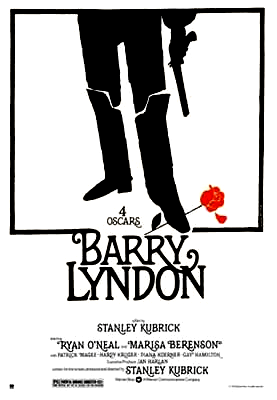
Barry Lyndon undercuts the characters' actions and dreams with savage irony (a device used in recent films like
Dogville and
Little Children). In both
Lolita and
A Clockwork Orange, the protagonists relate their stories with eloquence and wit, confusing our loyalties by causing us to sympathize with characters who do reprehensible things.
A Clockwork Orange is particularly brilliant in this respect - Malcolm McDowell is charasmatic and strangely sexy as the young hooligan Alex, who recounts his evenings spent raping and pillaging with great gusto and his subsequent arrest and reconditioning with terrible sorrow. Kubrick asks us to sympathize with the devil in order to convey the film's philosophical message; the technique is no doubt manipulative, but it's also sickly hilarious and frequently imitated (see also:
Trainspotting and
American Psycho).
3. Taxi Driver Like
A Clockwork Orange, the voice-over in
Taxi Driver is meant to align us with a difficult character. But where Kubrick's aim was satire, Martin Scorsese and screenwriter Paul Schrader want us to understand Travis Bickle. As he prowls the city streets, seething with contempt for the decaying world around him, Robert DeNiro's narrative gives voice to fears, obsessions, and compulsions that, while extreme, are also all too recognizable. As Travis' inexpressive rage transforms into brutal violence, the scariest implication is that his madness is, somehow, our own.
4. Sunset Boulevard Has there ever been a filmmaker more joyously clever than Billy Wilder?
Sunset Boulevard contains his wittiest device, the story of a murder recounted by the corpse. It's a concet that would prove popular -
American Beauty, in particular, used it to wonderful effect - but in
Sunset Boulevard, it's more than a plot device. Wilder's vision of Hollywood as a cemetary, a place where the long-forgotten dwell, is complimented by poor Joe Gillis' narration from beyond the grave. It's a perfectly acidic vision of the dark side of a city devoted to attaining cinematic immortality.
5. To Kill a Mockingbird The voice-over in Robert Mulligan's adaptation of Harper Lee's book has been frequently imitated over the years to lesser effect. The imitators attempt to mimic the unpretentious Southern charm of an adult Scout's memories of her youth, but they miss the eerier moments, the ghostly intimations of doom, and the bitter nature of an adult's memories of the moment she stepped into a world of absurd intolerance. There's nothing saccharine about the narrative - like the rest of the film, it's possessed with a hauntingly delicate soul that is ultimately heartbreaking.
6. Cries and Whispers One of Ingmar Bergman's best films,
Cries and Whispers is bathed in red, a color that Bergman said he imagined the inside of the soul to be. And
Cries and Whispers is a film composed of interiors, both literally and through the diary entries of the dying Agnes (Harriet Andersson). Agnes' memories of her life and her emotionally remote sisters are almost impossibly sad, laced with regret, confusion, and fear. All the more stunning that
Cries and Whispers ends with Agnes' happiest memory, and Bergman, for once, grants his storyteller a moment of peace (for more on the ending, go
here).
 7. The Postman Always Rings Twice
 Film noir is littered with hapless schmoes who become putty in the hands of a smarter, more calculating woman. Never was this more perfectly realized than in the 1946 version of James M. Cain's novel. John Garfield's Frank recounts his torrid, deadly affair with Cora (Lana Turner) in a voice-over filled with uncertainty (Frank's most-used phrase is "I guess"), jealously and insecurity. It's not only good pulp, it's a sharp examination of the tortured male psyche.
8. The Royal Tenenbaums The narration in the story of a family of geniuses has the mannered, matter-of-fact style of a novel one might find in the young-adult section of the library (it's particularly reminiscent of Salinger, whose
Franny and Zooey Wes Anderson owes a great debt to). Alec Baldwin's solemn, matter-of-fact delivery is a hilarious compliment to the film's deadpan tone and the eternal adolescence of the Tenenbaums.
9. The Big Lebowski The Coens often have a great deal of fun with voice-over, from Nicolas Cage's hayseed philosopher in
Raising Arizona (Ebert panned the film for the narration, but I adore it) to Billy Bob Thorton's apology for his long-windedness ("They're paying me by the word") at the end of
The Man Who Wasn't There. Best of all is
The Big Lebowski, the story of a burnt-out bowling aficionado-turned-amateur detective as told by a folksy, sarsaparilla-swilling cowboy who may also be God. But there I go, ramblin' again...
10. Adaptation Like many of the films on this list,
Adaptation does a fine job of using voice-over to illustrate its characters' unspoken fears and desires. But the moment that really sets
Adaptation apart occurs when Charlie Kaufman (Nicolas Cage) is attending one of Robert McKee's famous screenwriting seminars; as Kaufman excoriates himself in voiceover for looking for easy answers, his thoughts are interrupted by McKee (Brian Cox), who warns, "God help you if you ever use voice-over in your work, my friends. God help you! That's flaccid, sloppy writing!" From that point on in the film, Kaufman's inner voice is silent.