Sunday, August 31, 2008

Lumet, Lazarescu, Ringwald


Another season, another movie quiz at Sergio Leone and the Infield Fly Rule. This one comes courtesy of interstellar explorer and fop Dr. Zachary Smith. Read on, and take the quiz over at SLIFR if you dare, you bubbleheaded booby.

1) Your favorite musical moment in a movie

Awesome Mix Tape #6 serving as a perfect Greek chorus to a drug deal gone terribly wrong at the end of Boogie Nights.

2) Ray Milland or Dana Andrews

The Man with X-Ray Eyes.

3) Favorite Sidney Lumet movie
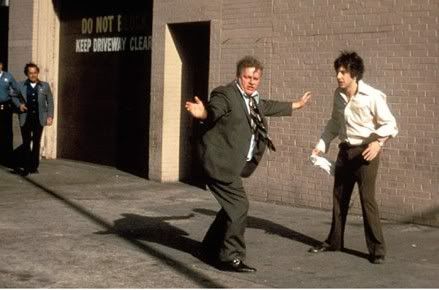
Dog Day Afternoon, easily. Lumet's always great at directing actors, but the heavyhandedness that occasionally creeps into otherwise great movies like 12 Angry Men and Network is totally absent in Dog Day Afternoon. It's a pitch-perfect character study, one of the most entertaining movies ever made, with an ending that breaks my heart.

4) Biggest surprise of the just-past summer movie season

I can't honestly say there were any surprises. While I enjoyed all of the big movies I'd been highly anticipating to varying degrees, this summer really lacked an out-of-nowhere sleeper for me to get excited about. And, as an art house projectionist, I can't remember a summer in at least five years with such a dearth of interesting indie counterprogramming. I did love Encounters at the End of the World, but that's Herzog, so hardly a surprise.

5) Gene Tierney or Rita Hayworth

Rita Hayworth

6) What’s the last movie you saw on DVD? In theaters?

On DVD, Amelie - I've been testing out different movies with my one-year-old daughter (she loved the Amelie-as-little-girl opening, but lost interest with Audrey Tautou). In theaters, Encounters at the End of the World (still thinking about that poor, crazy penguin).

7) Irwin Allen’s finest hour?

Gene Hackman cursing God as he does a parallel bars routine in the upturned bowels of the Poseidon.

8) What were the films where you would rather see the movie promised by the poster than the one that was actually made?

The teaser poster for Jaws 2, with the sun setting over a blood-red sea, is far creepier and more atmospheric than anything in the movie.

9) Chow Yun-Fat or Tony Leung

Tony Leung

10) Most pretentious movie ever

Pretentious is one of the most horribly misused terms in talking about movies. I might not like all the movies of Michael Haneke or Oliver Assayas, but they're still intelligent and coherent enough to be worthy of argument. A truly pretentious movie is Aria - a murderer's row of directors making shorts scored to famous arias for NO APPARENT REASON.

11) Favorite Russ Meyer movie

Beyond the Valley of the Dolls, but I really need to see more.

12) Name the movie that you feel best reflects yourself, a movie you would recommend to an acquaintance that most accurately says, “This is me.”

You're asking someone who personalizes the movies he watches to an unhealthy degree. I think of of the reasons that Blue Velvet is my favorite movies is because it's like watching my psyche projected onto the screen. Make of that what you will.

13) Marlene Dietrich or Greta Garbo

Marlene Dietrich

14) Best movie snack? Most vile movie snack?

Best - Reese's Pieces. Most vile - any form of malted milk balls.

15) Current movie star who would be most comfortable in the classic Hollywood studio system

When Vanity Fair did that Hitchcock gallery earlier this year, Naomi Watts made an absolutely perfect Tippi Hedren.

16) Fitzcarraldo—yes or no?

Absolutely!

17) Your assignment is to book the ultimate triple bill to inaugurate your own revival theater. What three movies will we see on opening night?

Pretension alert: lately I've been realizing that most of my favorite movies - and, by extension, my cinematic ideal - are movies that render the divide between high art and pop meaningless. So, three movies that do just that: Psycho, Chinatown and Altman's Popeye.

18) What’s the name of your theater? (The all-time greatest answer to this question was once provided by Larry Aydlette, whose repertory cinema, the Demarest, is, I hope, still packing them in…)

Well, I already used the Vista. I'd love to be the one in charge of programming the Mohawk, an old movie house that my town is gradually raising funds to renovate. I think I'd keep the name.

19) Favorite Leo McCarey movie

Duck Soup

20) Most impressive debut performance by an actor/actress.

Malcolm McDowell in if...

21) Biggest disappointment of the just-past summer movie season

Well, Mamma Mia! was terrible, but I can't say I was disappointed, exactly...

22) Michelle Yeoh or Maggie Cheung

Maggie Cheung

23) 2008 inductee into the Academy of the Overrated

The Death of Mr. Lazarescu

24) 2008 inductee into the Academy of the Underrated

Smiley Face
25) Fritz the Cat —yes or no?

Not really.

26) Trevor Howard or Richard Todd

Trevor Howard

27) Antonioni once said, “I began taking liberties a long time ago; now it is standard practice for most directors to ignore the rules.” What filmmaker working today most fruitfully ignores the rules? What does ignoring the rules of cinema mean in 2008?

I think the most meaningful examples of this today don't happen in alternative cinema, but in mainstream films that deviate from the rules in meaningful ways. Three of the best films of the past few years - There Will Be Blood, Zodiac, No Country For Old Men, The Dark Knight - were partly defined by their defiance of expectations. And the response to their left turns, particularly in the case of No Country For Old Men, continue to reverberate not only in the cinephile community but among everyday moviegoers who were genuinely shaken.

28) Favorite William Castle movie

The Tingler

29) Favorite ethnographically oriented movie

One of my favorite things about the work of Jim Jarmusch is its unspoken study and celebration of cultural diversity in microcosm. Down By Law is probably the best example of this.

30) What’s the movie coming up in 2008 you’re most looking forward to? Why?

The Curious Case of Benjamin Button. Fincher's coming off Zodiac, and the trailer's a beauty.

31) What deceased director would you want to resurrect in order that she/he might make one more film?

That's sort of a sad question, isn't it? Reminds me of the ending of A.I. Hey, let's go with zombie Kubrick's Napoleon.

32) What director would you like to see, if not literally entombed, then at least go silent creatively?

It's reassuring to see so many people citing Brett Ratner before I did. Just rewatched Red Dragon - only Ratner could take that cast and source material and make something so hacky.

33) Your first movie star crush
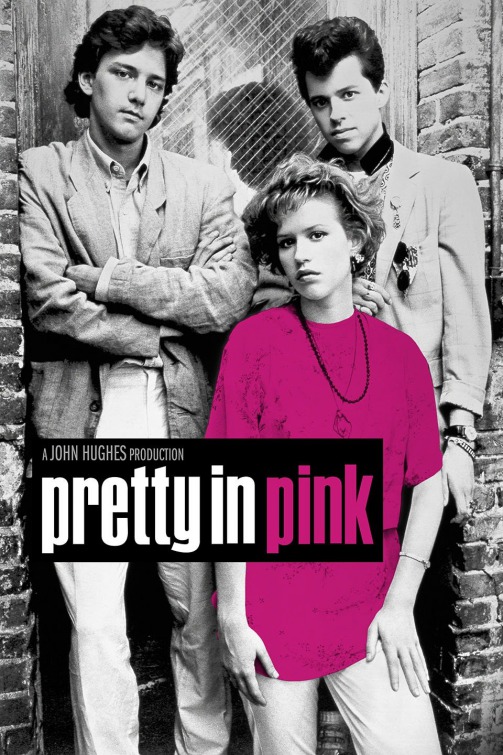
I wish I had something cool to say, like I was really into Anna Karina at five. But really, Molly Ringwald.

Friday, August 29, 2008

Now which would you rather be, an anal bead or a dragon?

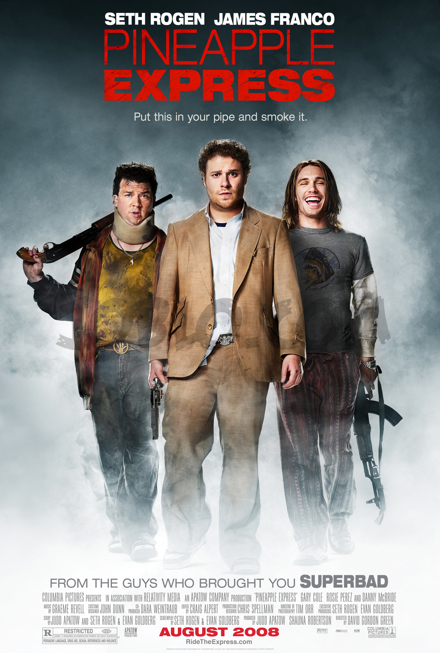
My first laugh at Pineapple Express came as I entered the theatre and was overwhelmed by the musky odor of patchouli. It was as if every member of the movie's target audience had thought to themselves, "Man, if I don't do something, everyone's gonna know I'm high!" At a movie where just about everyone was high. And sure enough, the movie's black-and-white, '30s-set prologue - an unapologetic tribute to the pleasures of pot and a condemnation of anyone who disagrees as a joyless narc - had the audience roaring with approval. That said, it's not exactly a big accomplishment to make a pothead laugh; I'm happy to report that, even if you're sober, Pineapple Express is hilarious.

A mash-up of '80s-inspired action and stoner comedy that treats both genres not with hipster derision but with genuine affection, Pineapple Express follows process server Dale Denton (Seth Rogen) and his dealer Saul (James Franco) as they find themselves on the run after Dale witnesses a corrupt cop (Rosie Perez) and Saul's supplier Ted Jones (Gary Cole) commit a murder. Saul is mistakenly placed at the scene by Pineapple Express, a rare strain of marijuana left behind by the panicked Dale; the Express is the proverbial "good shit," so rare that, according to Saul, smoking it is "like killing a unicorn." Dale and Saul's attempts to save themselves are frequently interrupted by the Pineapple Express, making the film a charming hybrid - a high-octane chase that reminds its target audience how helpless they'd be in the same situation. The choice of All the Real Girls director David Gordon Green proves to be an inspired one; Green (who recently outed himself as an avowed Seagalologist) clearly had a blast directing against type, and his car chases and shootouts would make George P. Cosmatos proud. Green's improvisational method of filmmaking proves well-suited to the Judd Apatow repertory company, while finding room for moments, like a leisurely scene of Saul and Dale frolicking in the woods, that give the movie a goofy poetry absent from other Apatow productions (though one can see Apatow striving for it in his own films). If it's less identifiably personal than his earlier work, it presents the exciting possibility that Green may become the new Hal Ashby, comfortably shifting between genres while adding his own gentle authorial touch.

Green also meshes nicely with his two leads, whose adorable "bromosexual" chemistry drives the movie (the unspoken, awkward affection between male friends is perhaps the central theme in the Apatow ouevre). Rogen is effective in a role he rarely plays, the straight man - spending most of the movie confused, terrified or exasperated at Franco, he makes an excellent Abbott. It's Franco who gets to run with the stoner antics, and he's surprisingly hilarious; I've talked some shit about the guy in the past, and I'm officially prepared to take it back. He's a good actor, but his pretty-boy looks have gotten him repeatedly miscast in square-jawed roles, but between Freaks and Geeks and Pineapple Express, it's pretty clear that he should play fuckups more often. The first time we see Saul, he's watching 227 and Krull at the same time; five minutes later, he repeats a line from 227 to himself, and whether the moment was improvised or written, Franco's delivery is so perfectly offhanded that we feel like we've known this guy for years. Franco deserves a lot of credit for making Saul not just a stoner caricature but a sweet, slightly sad dude with a comendable sense of loyalty - I must admit, he reminded me of a friend of mine (who is not a dealer), and his performance made me appreciate my friend in a new light. You don't usually get that kind of insight from pot movies.

The rest of the ensemble is as strong - Danny McBride (memorable as Bust Ass from All The Real Girls) as Lando Calrissian surrogate Red has been signaled out by most of the reviews, and he is pretty hilarious. But I also appreciated Ed Begley Jr. (who gets the best line in the movie) as the father of Dale's teenage girlfriend and especially Craig Robinson as an effete hitman. That teen girlfriend (played by Amber Heard) is one of several threads that falls victim to the meandering plotting that is perhaps inevitable in a pot movie, but that's also one of the film's charms. When Dale announces that maybe he and Saul should quit smoking and grow up, I feared the film would fall victim to the clumsly moralism that shows up a lot in Apatow productions; thankfully, the characters soon forget this, as well as the fact that they've killed several people (the climax's unapologetic bloodletting going further than Hot Fuzz would allow itself). Pineapple Express plays out like the high that the titular weed promises; you don't quite remember, when the ending arrives, how you've gotten there, and the pieces don't quite make sense, if it even happened at all. But it sure makes for a hell of a laugh with your best friends. I know there's a pun to be made, but I'm letting it go.

Monday, August 25, 2008

Title Card #75


The Trim Bin #72


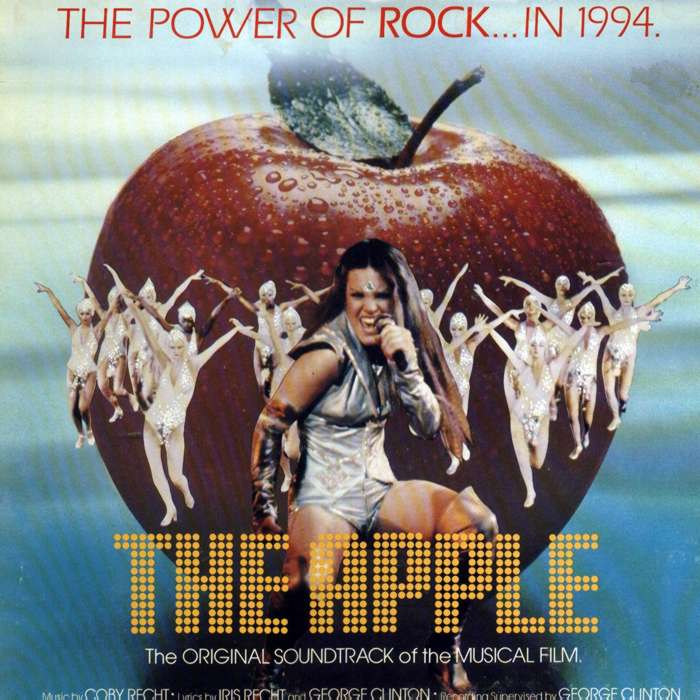
- From Cassavettes to Cobra: an interview with Menahem Golan, co-head (along with cousin Yoram Globus) of '80s mini-empire Cannon Films (via GreenCine Daily). A great read, though I wish the interviewer had asked Golan about The Apple.

- I'm officially a Paul Proulx fan. Paul's new blog, Bennett Media, promises to bring us many more director tributes (check out the new David Fincher compilation), episodes of the hilarious WOWMANWOW, and other projects from one of the sharpest, most original editors around.

- The latest installment of Steve Hyden's "Song and Vision" series focuses on the "Tiny Dancer" scene in Almost Famous. TMI alert: the missus and I made out to that scene on our third date. Eight years and two kids later, and in addition to being one of the best Obvious Movie Music Moments (as Hyden terms it), it packs a hell of a nostalgic wallop.

- Lauren Wissot interviews Malcolm McDowell for The House Next Door.

- Speaking of THND, from founding editor Matt Zoller Seitz comes this endlessly amusing (and appropriately titled) compilation, The Explanation:


Friday, August 22, 2008

Tonight the Super Trooper lights are gonna find me

Is it possible for self-parody to be unintentionally funny? Mamma Mia!, the movie adaptation of the billion-dollar-grossing ABBA stage musical, revels in the kitschy appeal of the Swedish supergroup. Yet the movie blurs the line between tongue-in-cheek and actual ineptness that it enters a sequin-studded vortex of triple irony. I and everyone I saw the movie with laughed constantly, and I'm not sure if any of us could say if we were laughing with or at Mamma Mia! (or both) at any given moment. As a movie it's indefensible, but as a moviegoing experience it's a blast - it's the best bad musical since Sgt. Pepper's Lonely Hearts Club Band.

Set on a small Mediterranean island where matriarch Donna (Meryl Streep) runs a rustic inn, Mamma Mia! announces itself as an opiate for the masses early on. Donna explains a crack in the courtyard floor as a sign of the island's erosion, then adds, "Don't think about it." Mamma Mia! is designed as a diversion from entropy and the anxiety it inspires (particularly in priveledged, middle-aged housewives). The cure, according to Mamma Mia!, is nostalgia, as Donna's memories of a summer of love that never was (at least not in the late '80s) - a summer when three strapping Europeans (Pierce Brosnan, Colin Firth and Stellan Skarsgard) mounted her (not all at once, alas) - are renewed when her daughter (Amanda Seyfried) invites all three men to her wedding in the hopes of discovering which is her father. The movie not only plays into its target audience's wistful rememberances of things past, but also the rampant materialism (Streep, who employs the entire island, daydreams of having more money and a boat), middle-class notions of culture and unresolved daddy issues typical of the Me Generation. While Streep and the cast try gamely to keep things light, the frivolity is forced and suffocating. When Streep plays air guitar while friends Julie Walters and Christine Baranski frolic on a dock, we're supposed to be delighted by the sight of serious actresses letting loose. All I could think about was how terrible menopause must be.


The show's creators - producer Judy Craymer, writer Catherine Johnson and director Phyllida Lloyd - have elected to write and direct the movie themselves, despite having never made or perhaps even seen a movie. Sometimes the result is inept, as when Brosnan was apparently instructed during one of Streep's ballads to stand completely still and do nothing. Other times, like when Firth morphs into a younger, mutton-chopped version of himself, it's trippier than The Wall. It's a movie that feels like it was directed by Chauncey Gardiner, a constant stream of subtextually frought images helmed by a filmmaker completely oblivious to their presence or meaning. I'm sure that the filmmakers would claim it's only meant as a fun romp, which would be fine, except it's also horribly shot and staged, and doesn't contain a single memorable dance number. For a musical that has its origins in the West End, it feels about as polished as a high school lip-sync (which will surely be its lasting cultural legacy).


But none of this should suggest I didn't have a lot of fun at Mamma Mia! I can completely understand why every actor signed on, and they find the right knowing approach to the material. Streep even manages to find authentic emotion in the hoariest of mother-daughter cliches. But my favorite performance, by far, is Stellan Skarsgard's. Playing a sea captain who writes award-winning travel books, Skarsgard cooks in the buff, flirts with Julie Walters and says lines like "I'll take a third" with straight-faced detachment. Which is exactly how I'd act if I found myself trapped in the troubling alternate universe that is Mamma Mia!

Monday, August 18, 2008

Monday, August 11, 2008

Title Card #73


I think maybe Mr. Newton has had enough, don't you?


The Man Who Fell to Earth is the rare example of a perfect marriage of director, star and source material. Adapted by Paul Mayersberg from Walter Tevis' novel, the story of an alien who visits our planet to save our own and his gradual failure is ideally suited to the strengths and preoccupations of director Nicolas Roeg and star David Bowie; at once cerebral and kinky, Roeg's films sharing with Bowie's music a fascination with shifting identity (Roeg's Performance uncannily paralleling Bowie's The Rise and Fall of Ziggy Stardust and the Spiders From Mars), polymorphous sexuality and, of course, alienation. One can also find a correlation between Bowie's Burroughs-inspired free-associative songwriting process and Roeg's radical, nonlinear approach to editing. So it's no surprise that The Man Who Fell to Earth is a mind-blowing sensory experience; dense, elusive and deeply sad, its uncanny sense of otherworldliness and introspective approach to science fiction set it apart as one of the very best films in the genre.

Like Brueghel's Icarus (referenced early in the film), the arrival of Thomas Jerome Newton (Bowie) on our planet goes mostly unnoticed. Newton's mission is to find a way to bring water back to his dying planet; to do this requires great wealth, so he sets about using his advanced knowledge of technology to make a fortune as an inventor. Whether Newton is literally an alien or, as Buck Henry (who plays Newton's befuddled business associate Oliver Farnsworth) suggests, a human genius who lives in a dissociative state, he is what Chuck Klosterman calls "Advanced" - a few steps ahead of the rest of us, destined to be co-opted and misunderstood. One of the rare movies of its kind to adapt the perspective of the visitor rather than the humans who encounter him, The Man Who Fell to Earth sees the world through Newton's eyes: Roeg and DP Anthony Richmond find ways to make buildings, automobiles, televisions and everything manmade look completely alien in their sheer arbitrariness. Newton's mission (with water the source of life and, by extension, meaning) is thwarted by a world that prefers gratification and distraction - tv, booze, sex and religion - to something more sustainable (a world, as Newton observes of tv, that shows us everything but doesn't tell us everything). His flight is cut short not by the heat of the sun but by our banality and contempt for anyone who seems different, even if they have something to teach us.

All of this is present in Tevis' book, which is also more overtly political. But while Roeg's film is critical of humanity's foibles, it's never didactic - Newton never lectures us or orders us to change our ways like Klaatu did (though I love The Day the Earth Stood Still for different reasons). As Newton admits to college professor Nathan Bryce (Rip Torn), "We'd have probably treated you the same if you'd come over to our place." Roeg admits that there is something seductive about apathy; as Tommy sits, wasted, watching fifteen TVs at once and screaming "Get out of my mind!" it's impossible to avoid our own addiction to distraction. Roeg is sharp but never unsympathetic; the film's love/hate affair with humanity is embodied in the character of Mary-Lou (Candy Clark), a motel cleaning lady who becomes Tommy's lover. As played by Candy Clark, Mary-Lou is sweetly innocent, and their sex scenes (as with all such scenes in Roeg's work, explicit but never dirty) suggest a real connection. But Mary-Lou is also naive and needy; in one of my favorite images from the film, as Mary-Lou asks Tommy if he doesn't think there must be a God up there somewhere, Roeg gives equal value in the frame to Tommy's bemused expression and Mary-Lou's wide-eyed Spielbergian wonder. When Tommy reveals himself to Mary-Lou, her idealism is confounded by the (literally) sticky reality of her lover; Roeg, who emphasizes the distance between people, suggests that it's our repulsion at the slimy, primal truth of difference and attraction, that keeps us from truly connecting.

In Roeg's hands, sci-fi tropes like "space" and "time" take on a radical new context. Time becomes meaningless in the narrative, its passage marked only by the aging of the human characters as the world stays permanently 1976. Roeg's images only seem random until you see them as a form of dialogue within the film; when he juxtaposes Bryce's rough sex games with a student with a Kabuki swordfight, the collision of dissonant images and sounds is at once sexy, disturbing, and theatrical, saying more about sex, violence and performance than either scene would on its own. Roeg's free-associative approach, a collage of allusions, symbols and double meanings accompanied by the ambient soundscapes of John Phillips and Stomu Yamash'ta, is a risky one - when it fails, as it would later with 1983's Eureka, the result is nearly impossible to decipher (though still very entertaining). But when it succeeds, as it does here and through the rest of his remarkable filmmaking streak from Performance to Bad Timing, his films substitute traditional continuity for what Dennis Cozzalio terms "graphic continuity," a highly subjective approach that, at its best, strikes at the heart of how we are knowing what we are seeing.

And at the heart of the film is Bowie, playing the part he'd been rehearsing for all of his life. One can sense the loneliness of "Space Odyssey," the glam contrivances of Ziggy Stardust and the ambisexual hedonism of Diamond Dogs in the odd, detached Mr. Newton. Bowie's performance is internal, understated, but there isn't a moment we don't believe him in the role. Part of this is the baggage Bowie brings to the film, but Roeg is doing more than exploiting Bowie's public persona; as he did with Mick Jagger's sexual ambiguity and would do with Art Garfunkel's quiet egghead image, he locates the complex nature of Bowie's appeal. When Tommy, stirring a glass of champagne with a gun, declares "I see women and men," it's a brilliant fusion of character, actor and celebrity, our identification with the alien forcing us to consider our own feelings of otherness (it's also kind of hot). This creative symbiosis would continue with Bowie's Low, which began as a soundtrack to The Man Who Fell to Earth and is Bowie's best and most innovative album. Neither Low nor The Man Who Fell to Earth It's not for everyone, but nothing truly great can please everyone; as Tommy tells Bryce, who admits he doesn't like the alien's foray into music, "I didn't make it for you."

Thursday, August 07, 2008

Play the game (8/7/08)


I used to smoke weed with Johnny Hopkins.


The Russian/Mongolian/German/Kazakh epic Mongol is the latest in a trend of films that reflect a current fascination with the origins of our heroes and villains. After Batman, Leatherface, Michael Myers and many others comes the origin story of a real-life figure, Genghis Khan, but the hushed, reverent tones typical of historical biopics are absent here. Loosely translated from already-patchy sources, Mongol renders the Khagan's life in bold, bloody strokes that have more in common with Marvel Comics than David Lean. Which is not meant as a putdown - Mongol is a movie dedicated to the thesis that Genghis Khan was bitchin'. And, for the most part, it succeeds admirably.

The film is focused on young Temudjim (Odnyam Odsuren as a child, Tadanobu Asano as an adult) as he is captured and forced into slavery, undergoes a Conan-like adolescence and emerges a great warrior determined to unite his people and attack Mr. Kim's City Wok. Except for that last part. One thing that is notable about Mongol is it's disdain for exposition - it occurs to Temudjin that he should unite the Mongolians, and then he does it. Director Sergei Bodrov seemingly has little interest in exploring the psychology of Genghis Khan, preferring to let the film's stunning landscapes and its harrowing battle scenes speak for the character. Khan's wife Borte (Kulan Chuulun) observes that "All Mongols do is kill and steal," and while this isn't true of acutal Mongolian culture, but Bodrov's film is less about the rise of an empire than smashing, chasing, stabbing and bleeding. Luckily, the battle scenes are genuinely impressive - immersive, visceral, perhaps a little too clean (visually, not literally, as there's plenty of blood and mud) but demonstrating a strong understanding of the manipulation of space and scale. The battles work both as a nod to old-school epic filmmaking and as a superior example of a digital-era action movie matched by an equally anachronistic score I can only describe as Tuvan hardcore.

Bodrov is interested in humanizing Khan in one way - we learn that he was a superior lover who penetrated his wife with the same skill that he impaled his enemies. And while the scenes of Temudjin and Borte sharing butterfly kisses or frolicking in a meadow with their offspring are jarring, there's something almost cute about the idea of the Khan as truly being motivated by the love of a woman. My friend Michael informs me that Mongol is the first in a planned trilogy, and it will be interesting to see if Bodrov's Khan is ultimately more lover than fighter. Of course, this Temudjin represents an ideal, if not for Bodrov, than for its audience, which could explain its massive appeal. According to the movie's Wikipedia page, Bodrov admitted to fabricating much of his story to "fill in the holes," but insists his version is accurate because he knows Khan so well. I'm sure there are a lot of Asian culture-worshipping twentysomething males out there who know exactly how what Bodrov means.


I'm also pretty sure that Dale Doback (John C. Reilly) and Brennan Huff (Will Ferrell), the titual protagonists of Step Brothers, would agree that Mongol is the best movie ever. While the basic concept of Step Brothers - two forty-year-old guys are forced to move in together when their parents marry - is as simple as Mongol's, I've yet to read a review that talks about what a strange, fascinating experiment it is. Casting a top comic actor with a clearly defined persona (blogger Dr. Criddle once described Ferrell, as "an arrogant sack of meat," which pretty much sums up his appeal to me) with one of our best character actors (fresh off his leading-man triumph in the underrated Walk Hard) results in a darker movie than the previews suggest. If all Mongolians do is kill and steal, all Dale and Brennan do is hit each other and the head and curse, and for a while Step Brothers runs the risk of becoming completely one-note. But Ferrell and Reilly actually make their characters believable, and the film is unafraid to follow them into strange territory - you expect them to beat each other up, but you don't necessarily expect to see them hi-fiving as they compare their penises.

Supported by Mary Steenburgen and Richard Jenkins (honestly, as good here as in The Visitor) as the parents and Adam McKay's direction - his skills with capturing and assembling largely improvised comedy puts Adam Sandler's repertory of hacks to shame - Step Brothers is surprisingly credible for a movie with fart jokes. In retrospect, the Ferrell/McKay trilogy are all about dim-witted protagonists who learn an obvious but important lesson; in a genre dominated by fratboy misanthropy, they seem downright progressive. It's more uneven than the previous McKay/Ferrell collaborations, but between the weird asides and supporting performances (Kathryn Hahn as Ferrell's sad, horny sister-in-law nearly steals the movie) and the committedly asinine work by the leads (even Reilly's reaction shots crack me up), it's hilarious and strangely moving. By the film's end, you're rooting for Dale and Brennan to find their own version of success; perhaps this is the beginning of a trilogy?

Sunday, August 03, 2008

Saturday, August 02, 2008

You can suck my ectoplasmic Schwanzstücke!

I started to really get into Hellboy II: The Golden Army about fifteen minutes in, when I started thinking of it less as the follow-up to Pan's Labyrinth than a sequel to Hellboy. All three films stem from Guillermo del Toro's fascination with monsters, but after the revalation of Pan's Labyrinth, Hellboy II's relative thematic brevity was a bit disappointing at first. But once the Hellboy (Ron Perlman) and his fellow monster hunters arrive at the Troll Market - a teeming village of strange creatures that plays like an off-kilter version of Star Wars' Cantina scene - I had tuned into the film's modest but likeable tone. Hellboy II is a treat for anyone who grew up reading Famous Monsters of Filmland or Fangoria, carefully painting models of Frankenstein's monster or staying up late to catch a horror double feature back when local channels barely censored a thing (long live TV38's Movie Watch). Looser and more inventive than its predecessor, Hellboy II is a gleeful bestiary grounded by its sharp understanding of why we can sympathize and even relate to cinematic monsters.

Opening with a nifty stop-motion sequence depicting the triumph of humanity over the mythical world and the banishment of its inhabitants, Hellboy II pits the Bureau for Paranormal Research and Defense against the elfin Prince Nuada (Luke Goss), who is after a mythical MacGuffin that will allow him to resurrect the golden army - a legion of hulking mechanical soldiers - and revolt against the humans. One of the improvements over the first Hellboy is that the plot here is secondary to the characters; the distinctively eccentric world created in the comics by Mike Mignola isn't suited to the typical superhero movie structure, and del Toro smartly allows his characters more breathing room this time around. Boring audience surrogate Agent Myers is dropped in favor of a Hellboy-centric movie focusing on Red's stormy relationship with firestarter Liz (Selma Blair), their uneasy attempt at "normal" life made difficult by the freakish reception from the humans they protect once Hellboy blows their cover. The standard good vs. evil arc of superhero movies is subverted here by Del Toro's preference for his monstrous characters; this time around, Del Toro explores the idea of a monster fighting his own kind in greater depth. A scene involving an enormous plant elemental that threatens to destroy a city works because Del Toro is less interested in working to an explosive payoff than in having his audience consider the creature's strange beauty; there are plenty of effects wizards helming comic book movies, but few that could find such a moment of grace amidst the explosive spectacle.

Hellboy II is a visual marvel as well, relying more than the average contemporary monster movie on makeup and practical effects. The comparison to the Star Wars Cantina scene also underlines something Del Toro has in common with young George Lucas, his ability to balance the astounding with the mundane. It's relatively easy at this point to make towering fantastic landscapes, but it takes real imagination to make them feel lived-in. Perhaps this is why the CGI sequences are less successful - the climactic battle with the golden army, for instance, was a little too familiar to be totally engaging (perhaps seeing it after The Dark Knight was a mistake, as it couldn't help but feel a little square by comparison). For me, the emotional climax is Liz's visit with a wonderfully realized angel of death (again with the eyes, Guillermo), a scene that, for all the true geeks in the audience, speaks poignantly to our need to connect and gang up against the normals - if the monster is, as Bruno Bettelheim and others have suggested, a manifestation of our inescurities, than Hellboy II is a call to let one's freak flag fly.

However, the best moments of Hellboy II are the in-between ones - the scene where effete ectoplasmic BPRD agent Johann Krauss (voiced by Family Guy's Seth MacFarlane) calmly tells Hellboy "I think I can take you," or the brilliant scene where Hellboy and Abe Sapien (Doug Jones, also the angel of death) get drunk on Tecate and bond over Barry Manilow. In loosening up, Del Toro has made a film that feels less like we're on an epic mission with Hellboy and more like we're just hanging out with him, which is much more fun and interesting. I love the world Del Toro has established here, and I hope we get to see everything he's set up pay off in a Hellboy III, even if that means a smaller budget. Even without the large scale Del Toro was afforded here, it's the characters that make this world worth returning to. And I'm particularly dying to see the payoff on that final freeze-frame - let's just say I know exactly how Hellboy feels.

Sunday, July 27, 2008

Nothing to Do with Anything


There's a strange new trend emerging of remakes that aren't really remakes. Two trailers that ran before The Dark Knight, The Day the Earth Stood Still and Death Race, each share titles and basic premises with genre classics. I'm not automatically anti-remake - there have been a number of remakes worth mentioning alongside the earlier films, and some of the best remakes (The Fly, The Thing) deviate wildly from the originals in fascinating ways. But not only do these two movies have almost nothing in common with their respective sources, they also demonstrate contempt for everything that makes the originals worth remaking in the first place.

Paul Bartel's Death Race 2000 is one of the best example of B-movies' ability to fly under the radar - its pitch-black humor and sharp social commentary were (and remain) practically nonexistant in mainstream American movies. Set in a near future where a totalitarian government pacifies the proles with a deadly cross-country race, Death Race 2000 is brilliantly self-reflexive exploitation, slyly indicting its audience for our passivity and appetite for violent, shallow entertainment. A big-budget studio remake that retains the orignal's distrust for authority could be a lot of fun in the hands of Robert Rodriguez, fellow Corman protege Joe Dante, or a few hundred directors more qualified to balance action and satire than Paul W.S. Anderson, the director of Soldier and Aliens vs. Predator. Judging by the trailer, Anderson's Death Race is completely toothless, with the original's villianous president replaced by an unamused-looking Joan Allen (redundant, I know) as a prison warden, with criminals forced to compete replacing the original's celebrity drivers, who earn bonus points by running down pedestrians. With very little at stake story-wise, Anderson seems more focused on screeching tires and things that blow up good. Iconic antihero David Carradine is replaced by Jason Statham, a boring doofus that medium-budget action movies keep trying to sell as cool. The trailer is filled with fetishistic close-ups of pimped-out death cars interspersed with leering T&A shots that completely betray the original's deadpan, free-spirited attitude towards sex and nudity. In other words, it looks like exactly the kind of mindless spectacle Bartel was making fun of.

There are also plenty of explosions (or, at least, the suggestion of shit blowing up good) in the trailer for The Day the Earth Stood Still. Which is funny, because the original has barely any action - it's sci-fi driven by ideas, with alien visitor Klaatu's encounters with and message to humans meant as a comment on the political climate in '50s America. Here, Klaatu - a member of an intellectually advanced race - is played by Keanu Reeves. And while Keanu lets us know in his most ominous attitude that we should listen to him, the trailer cuts to hamhanded 9/11 imagery as some sort of vague CGI blur (nanobots? locusts?) prepare to do...something. Maybe the lights go out and the rest was a dream sequence; either way, it's hard to imagine with Keanu in the lead that The Exorcism of Emily Rose director Scott Derrickson's movie will be anywhere near as talky as Robert Wise's.

The really weird thing is, it'd be easy in either of these cases to make a movie that both respects the orignal and has wide commercial appeal. These remakes appear so dumbed down that one wonders why they even bothered buying the rights to the originals. Neither Death Race 2000 or The Day the Earth Stood Still has much relevance to the young male audience their remakes are targeting, so why not alter the plots just a little more, keep the money and not insult the fans? If the trailers are accurate, these pseudo-remakes are too stupid for fans of the original to possibly enjoy, and anyone who will enjoy these probably hasn't heard of the original; they are, essentially, movies for nobody.

That said, I'd like to offer a few of my pitches for any studio execs that happen to read this:

Knightriders George A. Romero's movie about a troupe of motorcycle-riding Medieval Faire performers is ripe for a remake in the age of geek chic. Except you shouldn't cast real geeks, like in the original. And lose all of the anti-corporate stuff, because we all know how well that worked out for Speed Racer. Replace Ed Harris with Vin Diesel, get Rob Cohen to direct and change "Medieval Faire" to "Vegas Stunt Spectacular," and you're looking at a 30 million opening weekend (35 if you can get Evanescence to do the soundtrack).

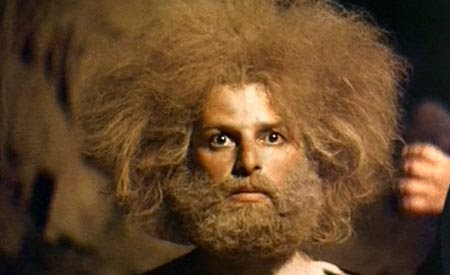
Zardoz John Boorman's trippy sci-fi movie is perfect for a remake because it has lots of boobies and shooting. But all the religion stuff would probably be annoying for an audience today, so instead, have Zardoz control the brutals with extreme sports. The Rock can play Sean Connery and still have a lot of sex with the Immortals, but instead of freckly European ladies, they should be Jessica Alba and a bunch of other hotties. The stone Zardoz head can stay, but the Rock should blow it up at the end. Neil Marshall directs.

The Red Shoes Replace ballet with crunk. Fifty million in the bank.

Friday, July 25, 2008

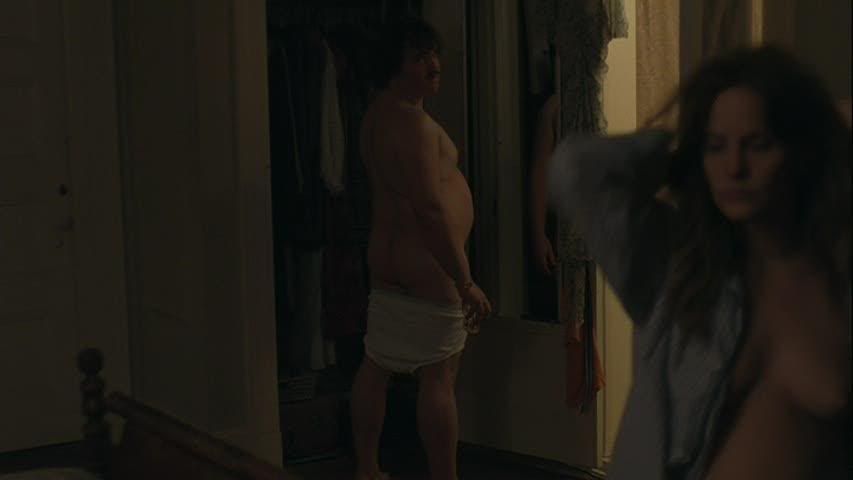
Gratuitious Nudity #8


Jack Black and Jennifer Jason Leigh, Margot at the Wedding (2007)

Monday, July 21, 2008

You remind me of my father.

Warning - geeked-out hyperbole ahead. There's just no other way.

I keep hearing that noise - the low, atonal hum that opens The Dark Knight as if were an emergency broadcast signal for the end of days, creating an immediate, palpable tension that never lets up for the next two-and-a-half hours. With Batman at the center of a sprawling crime story focused on what Cormac McCarthy calls "the dismal tide" and Stephen King refers to as "slippage," The Dark Knight is a stunning, deeply unsettling portrait of entropy. The title isn't lying - this is dark stuff, not the Hammer-influenced, relatively safe darkness of Tim Burton's Batman movies, but a darkness born straight out of our uncertain present. It's ambitious, heady stuff for a movie that also needs to sell fast food and action figures, but Christopher Nolan's film is the rare summer blockbuster that lives up to impossible expectations - it's not just a great comic book or action movie but great cinema, one of a small group of films like The Godfather Part II and The Empire Strikes Back that elevates popular art to something thematically rich, thought-provoking, and wildly exciting.

Using Batman Begins' epilogue as a jumping-off point, The Dark Knight finds Lieutenant Gordon's (Gary Oldman) warning to Batman/Bruce Wayne (Christian Bale) about the threat of escalation manifested in the Joker (Heath Ledger), who emerges without a past or explanation with a single-minded, anarchic purpose. Let me tell you what you already know: Ledger is mesmerizing as the Joker, a Nietzschian force of nature worthy of mention alongside all-time great movie villains from Hans Becker to Anton Chigurh. An early scene where the Joker makes a pencil disappear elicited spontaneous applause from the audience, and deservedly so - it's impossible to take your eyes off Ledger whenever he's onscreen, and to attribute this to his untimely death is both crass and inaccurate. The hissing tongue, the Jimmy Stewart from Mars voice, the ugly-duckling way he walks in the nurse's uniform (probably my favorite moment) and every other detail he gives the Joker are more than a bag of self-conscious actorly quirks. Ledger's performance is a triumph of extremes that succeeds in making us believe in a villain who is both completely mad and frighteningly logical about his identity and purpose - when the Joker tells Batman "You complete me," we're left with the disturbing implication that in this round of good vs. evil, the bad guy has the upper hand.

This Joker provides more than enough conflict for one movie, but he's just the prime mover of Nolan and his brother Jonathan's marvelous, intricately plotted script. A bank manager (William Fichtner) complains that criminals used to believe in something; this Gotham is a city of dying ideals, and its good guys are measured by how they protect these ideals while still effectively doing their jobs. At the heart The Dark Knight is the contrast between idealistic D.A. Harvey Dent (Aaron Eckhart, less showy than Ledger but just as effective) and Wayne (Bale, underrated for his subtle work here), who accepts his own corruption as a means to an end. The choices these two men, as well as Lieutenant Jim Gordon (Gary Oldman, endearingly square), Dent's girlfriend/Wayne's former squeeze Rachel Dawes (Maggie Gyllenhaal - upgrade!) make are never simple, and Nolan doesn't provide us with easy answers. In a time when big-budget movies are designed to be as reassuring to an audience's assumptions as possible, it's sort of amazing that Nolan was able to make a superhero movie this complex. Gotham (as played, stunningly, by Chicago) is a labyrinth of moral ambiguity, and Nolan challenges us to question our own assumptions about heroism and decency in a way that couldn't be more relevant (I'm only beginning to process the film's many layers of meaning).

But while mine is one in a sea of raves for The Dark Knight, I was confused by the number of reviews that claim the movie is no fun. It's wildly fun, almost dangerously so since most of the film's most entertaining moments arise from the shock of how far Nolan lets his Joker go. Balancing dazzlingly executed action sequences with carefully composed emotional beats (Gyllenhaal's delivery of the word "Listen" kills me). It's exhausting in the end, to be sure, but only because it's such a complete moviegoing experience - immersive, visceral, technically perfect (DP Wally Pfister, editor Lee Smith and composers Hans Zimmer and James Newton Howard all deliver their best work) and flat-out astounding. Nolan reveals an ambition unseen not only in most comic book adaptations but in most movies, period. It feels like his entire career has been building to this, as he reveals himself to be one of the great cinematic storytellers, and The Dark Knight an unqualified masterpiece.

Sunday, July 20, 2008

Thursday, July 17, 2008

I wanted to explode, light the sky for an instant and disappear.


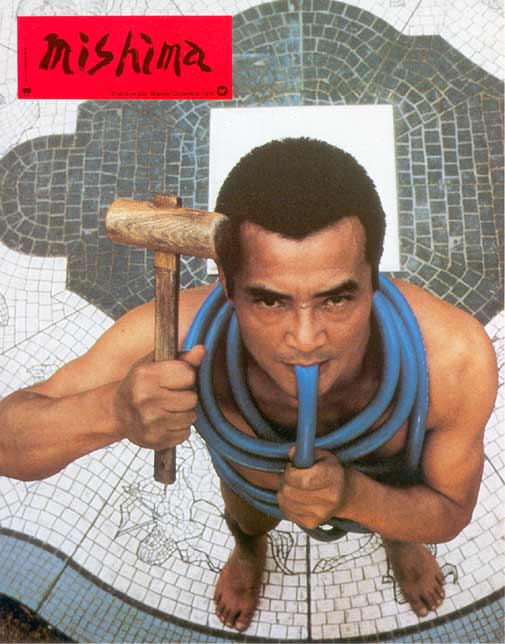
The Wikipedia page for Yukio Mishima links to the category "Writers who committed suicide," underlining our fasciation with artists who kill themselves and the seeming validity it gives their work. This macabre interest is amplified with Mishima, whose ritualistic suicide was not the result of depression or mental illness but a calculated and, in retrospect, inevitable extension of his art. But while Paul Schrader's Mishima: A Life in Four Chapters is structured around Mishima's last day, it avoids the mistake of films like Sylvia and The Hours that depict their subjects' entire lives as a mere foreshadowing of their deaths. Interweaving Mishima's life and work until the two become inseparable, Mishima is a study of one man's obsessive nature that, miraculously, resonates as an exhilarating affirmation of life.


Dividing his film into four chapters, director Paul Schrader (who co-wrote with his brother Leonard) employs a remarkable, ahead-of-its-time structure. Using November 25, 1970 - the day Mishima (Ken Ogata) and five young men from his private army held a Japanese general hostage while the writer addressed the gathered troops before committing seppuku - as its jumping-off point, Mishima cuts between that day, moments from Mishima's past, and scenes from three of his stories. It's an innovative approach, but the most important thing about structure in film isn't innovation but whether the film is organized in a way that allows its characters and ideas room to breathe. In its rigid formal approach, Mishima mirrors the tension between the author's internal and external life, and as the narrative progresses towards the author's ultimate attempt to fuse art and action in death, the film's seemingly separate elements achieve a stunning harmony. By first making us feel the divisions in the author's life - between poetry and physicality, female and male, pen and sword - Schrader's boldly internal approach to Mishima's life illuminates the connections between seemingly disparate elements of the author's sexual ambiguity, radical conservative politics and sadomasochistic impulses. Through Mishima's eyes, we come to see how all of these things spring from the same creative well - Mishima is a tribute to the power of ideas and their various forms.


Schraders also juggles contrasting visual strategies for each section, giving the film an out-of-time feeling that serves its anachronistic subject well. Schrader's worship of Ozu can be felt in the rigid classical compositions of Mishima's stifling childhood; the 1970 scenes have a hand-held immediacy evoke a '60s radicalism that already felt like ancient history in 1985; and the scenes from The Temple of the Golden Pavilion, Kyoko's House and Runaway Horses couldn't be more contemporary. While Ogata is great as Mishima, the star of the film is production designer Eiko Ishioka, whose bold, expressive use of color and space (remastered and gorgeous on the new Criterion release) makes for a thrilling cinematic realization of Mishima's fantasies. The overt theatricality of these scenes frames the biographical sections as another form of performance, Mishima's obsession with perfecting his body and his life's final act as a transformation of his own life into a work of art (and suggests why, for some smart, socially alienated young males, samurai iconography has the same power as trenchcoats and death metal do for some of their angrier peers). For Schrader, whose filmography is filled with protagonists prone to violent acts as a statement and whose own life has been largely devoting to contriving his own persona, this venture into extremely personal territory results in his best work as a director.


But while Mishima is undoubtedly the work of an auteur, it's also a remarkable collaboration between its creative leads. Ishioka's sets, John Bailey's sharp cinematography, the precise editing by Michael Chandler and Philip Glass' exhilarating score (perhaps his best) result in a cinematic experience that is both intellectually provocative and a sensory delight. To say it's the kind of film they don't make any more would ignore the fact that films like Mishima have always been rare; one of exective producers George Lucas and Francis Ford Coppola's acts of atonement for their lavish success, it's the rare American film driven entirely by the strength of its ideas. Mishima is the kind of movie you let wash over you, its stunning images proving that, though rare, it is possible for cinema to serve as a marriage of art and action.


Sunday, July 13, 2008

Title Card #68

It doesn't hurt to fall off the moon.

Céline and Julie Go Boating is a film you don't watch so much as get lost in. Watching it for the first time, I was quickly overwhelmed - while 3-D and IMAX promise an immersive experience, director Jacques Rivette's three-hour meditation on role-playing, fantasy and storytelling reminds of what truly intereactive cinema feels like. It's a movie that invites you to become its third protagonist, not in a gimmicky sense but through a meaningful and engaging exploration of film's boundless possibilities. Yet for all this, and despite its length and complicated structure, Céline and Julie Go Boating is a breeze - rarely has such a philosophically and formally ambitious film felt so much like playtime.

With its virtuosic opening sequence introducing us to Céline (Juliet Berto) and Julie (Dominique Labourier) through a very long game of tag, the film announces itself as an elaborate tease. As the bookish Julie and the waifish Céline meet, form a quick bond and are drawn into a completely different movie - a melodrama about a wealthy, mysterious family - Rivette and his actors (who wrote most of the film, with their director as an editor) create a series of puzzles with no definitive solutions. Rivette repeatedly blurs the line between reality and fiction, favoring a loose, informal visual strategy and natural sound. The film is less concerned with either of its narratives than with the act of storytelling - here, a state of hypnosis for a voluntary audience. I wasn't surprised to read that Rivette is a Twin Peaks fan; both directors are preoccupied with the power of imagination, but if the creative process is often dark and unsettling in Lynch's work, for Rivette it is a funhouse of endless possibilities.

The film also repeatedly references Lewis Carroll and other fairy tale tropes, but without the overt symbols of the following year's Black Moon. The magic candy that Céline and Julie ingest to jump between worlds hints at the sexual subtext of children's fantasies, but Rivette sidesteps psychoanalysis in favor of a playful approach that compliments his wide-eyed heroines, who ultiumately stand in for any writer, performer or director (after all, it takes a certain kind of person to play make believe for a living). The film's success hinges on the leads' fearlessly silly performances. Berto, who reminds of a Gallic Shelley Duvall, projects both innocence and an offbeat sex appeal - when Céline takes a shower, Berto's breasts are upstaged by her childlike unselfconsciousness. And Labourier's Julie is a marvelous comic performance, a tightly wound collection of nervous habits and compulsions undone by her new (old?) friend. The bond that the two women form is a return to innocence that, ultimately, arrives at an understated moment of epiphany before doubling back to start a new game.

In both its style and its meaning, Céline and Julie Go Boating is a liberating experience, the kind of movie that expands one's concept of cinema's possibilities. As Céline and Julie return to the movie's central mystery, hoping that maybe this time will be different, Rivette locates the source of cinema's intoxicating power - the promise of seeing through different eyes. When Céline and Julie finally go boating, it becomes clear that Rivette wants to remind us that life is indeed a dream. Maybe so; either way, dreams are rarely as sweet as this.

Thursday, July 10, 2008

The Trim Bin #71


- One of the great mysteries of my life is how so many people I know who have otherwise proven their intelligence and good taste count themselves as a fan of The Boondock Saints. Alex Jackson's comprehensive takedown of the Saints pretty well explains my confusion over its hopefully waning popularity - now that we have The Departed, can we retire this piece of crapola as a symbol of Beantown pride?

- I finally saw Iron Man a few weeks ago, about $300 million past the point where a full review seems relevant. To summarize: big thumbs up to Robert Downey Jr., an even bigger thumbs up to Jeff Bridges, awesome robot suit business that puts Transformers to shame, funny, unpretentious, politically muddled and a bit choppy. A good time, and hopefully the sequel will be to the first as Spider-Man 2 is to Spider-Man.

- I'm usually bad at self-promotion, but with the Self-Involvement Blog-a-thon currently underway, it feels like an appropriate time to point out that I was recently the subject of Adam Ross' Friday Screen Test. Thanks, Adam, for your generous introduction - a "wanderer," eh? Interesting...

- Tom Sutpen at If Charlie Parker Was a Gunslinger... has shared an invaluable resource - the original recordings of the famous Hitchcock/Truffaut interview tapes.

- I don't write about music much because I'm just not good at it, but I have to mention an album I'm currently in love with, M83's Saturdays = Youth. It's must-listening stuff for children of the eighties, using the unmistakable sound of movies and music of the decade not as an homage or parody but to evoke the way that our lives, the songs we hear and the films we see become one in the rear view of memory. It's brainy, catchy and oddly moving - check out the video for "Graveyard Girl."

Sunday, July 06, 2008

Define hoedown.


Last year, an exhibit on marine life at a local museum featured placards informing kids that many of the featured species are nearly extinct; a co-worker's nine-year-old daughter has panic attacks over global warming. It's growing difficult to educate our children about the importance of caring for our enviroment without terrifying them into apathy; one of the many triumphs of WALL-E is how it speaks directly to a child's anxieties about the future, neither patronizing nor indoctrinating its young viewers. A cartoon of surprising sadness and thematic heft, WALL-E is remarkable in the way it gently suggests that the solution to our problems lies in our capacity to love one another. Effortlessly connecting its sweet love story with universal human concerns, WALL-E is, along with movies like AI, Solaris and Eternal Sunshine of the Spotless Mind, another of this decade's sci-fi masterpieces concerned with finding love in a world transforming before our eyes.

Another of WALL-E's astonishments is the way that it makes Hello Dolly! not only palatable but moving; a jolly number from the musical introduces us to an Earth 700 years in the future that has become an abandoned, trash-strewn wasteland. As humans have abandoned the planet to reside, fat and compacent, in an enormous shopping center, a small robot named WALL-E remains alone, his days spent compacting trash while his nights are devoted to showtunes, bubble wrap and other prized artifacts. It's impossible not to be moved as the little guy makes his way across vast expanses of scorched earth littered with towering trash heaps and plagued by dust storms, all the while whistling a tune. The animators have created a frighteningly believable future that would be the stuff of horror movies were it not for the geniuine, guileless optimism that seems to be an intrinsic part of Pixar's philosophy. When WALL-E's centuries-long isolation is broken by the sudden arrival of search robot EVE - her egg-shape signaling the return of femininity and, more specifically, fertility - his attempts at romance, which remind of Chaplin's Little Tramp in both their hilarity and poignant persistance, suggest that the key to our future lies in holding hands. It's a cute idea, but as WALL-E's thematic implications sink in, it's also surprisingly powerful.

Structured like the Kubrick movies it pays homage to, WALL-E also expands to include sly satire as the robots travel to the spaceship. Writer/director Andrew Staunton gets a lot of laughs in at our complacency and rabid consumerism, as humanity has become a flock of portly, immobile proles. It's unsparing stuff for a kid's movie, stopping short of misanthropy by arguing that most people simply need a little wake-up call. And WALL-E is just that - as Pauline Kael once said about Nashville, it loves us too much to patronize us. In the moral awakening of the ship's captain (Jeff Garlin) lies a powerful reminder of the obvious - Earth is awesome, and worth taking care of. And while I shudder to think of all the Humvee-driving parents who dismissed any questions their kids might have had after the movie, I still love the idea that the seeds of change have been planted in their heads.

But even if you're not a tree-hugging hippy, WALL-E is still worth your time. Staunton and his team of animators balance near-wordless physical comedy worthy of Keaton with a breathtaking vision of the future worthy of Kubrick or early Ridley Scott. WALL-E astounds in moments both grand (WALL-E reaching out to touch phosphorescent blue space debris) and mundane (the robots' shared fascination with the flame from a cigarette lighter). And at the film's heart is a man-made protagonist that, through his selflessness, compassion and bravery, personifies all that is great in us. Sound designer Ben Burtt, who gives WALL-E his voice, did the same for E.T. - like Spielberg's masterpiece, WALL-E finds just the right note of hope at a time when it is most needed. Were it simply funny and brilliantly animated, WALL-E would be another in a string of great Pixar movies; add in its rich ideas and its giant heart, and you have a movie that deserves to be a perennial classic.

Thursday, July 03, 2008

Play the Game (7/3/08)

A review of Celine and Julie Go Boating is coming soon - thanks, Paul, for the excuse to visit Pleasant Street Video.

Saturday, June 28, 2008

Because she's got a GREAT ASS!


While volumes have been written about the look of Michael Mann's films, his dialogue is less frequently talked about: compact and economical, Mann's writing is perfectly matched to his images. When Detective Vincent Hanna (Al Pacino) tells his his estranged wife Justine (Diane Venora) that "You were right - all I am is what I'm after," the character's essence is captured in ten words. In Mann's world, identity and function are the same - the director defines his characters, as they define themselves, by what they do. This was never truer than with Heat, an epic cops-and-robbers story that has been permanently enshrined as a Maxim-endorsed all-time-classic Guy Movie, a label that doesn't begin to capture its narrative and aesthetic pleasures. Heat is slick, stylish and loaded with guns and fast cars, to be sure, but what's truly remarkable is its fusion of character and action - it's an "action movie" in a way that louder, dumber, less skillfully crafted movies only claim to be.

With its sprawling narrative revolving around Hanna's pursuit of master thief Neil McCauley (Robert De Niro) and his crew, Heat takes the well-worn notion of cops and criminals representing two sides of the same coin and makes it feel new. Stripped of the iconic (often fetishistic) trappings of the genre, permanently clad in charcoal suits chosen to avoid drawing attention to themselves, opposed in what they're after but the same in their single-minded pursuit of their goals, even as their work makes normal human relationships an impossibility. Together they reside in the shades of dark that make up Mann's palette - the director doesn't turn their relationship into a baroque showdown as Scorsese does in The Departed, his interests focused more on the details of their process. Mann's visual approach is a lesson in how to fuse style and substance, with each camera setup, no matter how bold, is dictated by the performances; there isn't a single false move or a moment that exists solely for the sake of being cool. The scenes following Hanna have a constant motion that mirror his (and Pacino's) restlessness, but De Niro's carefully composed scenes have the actor's focused stillness - rarely have medium shots carried such a kinetic charge. And in the famous diner scene between the two actors, Mann smartly gets out of the way - the coiled intensity that both actors bring to the table as they quietly discuss their mutually assured destruction gives the scene all the fireworks it needs.

The relationship between the leads, however, is just the focus of a story that widens its scope to their intersecting worlds. Mann's structural approach owes more to Robert Altman than John Woo, as characters that would typically exist solely as plot devices are given depth and shape. A supporting character like ex-con Donald Breenan (Dennis Haysbert) is given scenes that allow us to understand him before his role in the plot is defined; this approach used to frustrate me, but now I admire its formal audacity. It's the sort of film that, every time you watch it, you find yourself focusing on different characters; this time, I was mesmerized by Diane Venora as Justine, at once sympathetic and alienated from her husband, and Val Kilmer and Ashley Judd, excellent as a fucked-up, destructive and completely in love couple. Where most cops' wives in these films exist only to worry and complain that the protagonist is never home, Diane Venora is given the space to create a woman who both understands her husband and has needs beyond the restrictions of the plot. Eady, McCauley's girlfriend and the cause of his character's biggest mistake, is the only character in Heat that I don't believe, though this isn't due to the writing as much as it is to Amy Brenneman's bland performance - every time I watch it, I think of how much more interesting the role might have been were it played by Julianne Moore or Gwyneth Paltrow, for instance. But this is a quibble in a film full of great performances, where even peripheral characters like Bud Cort's racist restaurant manager, Tom Noonan's cryptic techie and Natalie Portman as Hanna's emotionally unstable stepdaughter (a role crucial to the film's meaning) are given room to breathe and become something fascinating. The incredible tension that Heat has been praised for goes beyond its louder scenes; it's as palpable in the film's quietest moments, in the distances between people who maintain such a distance because, as Hanna explains, "It keeps my edge."

When that tension does explode, Mann's gifts as an action director have never been more fully realized. The climactic shootout between cops and robbers has a stunning immediacy where other directors would have too many setups and too many cuts in the interest of seeming cool to 13-year-olds. Heat is awesome, but it's also remarkably mature and disciplined; the film's violence is in total service to the story, making us realize just how gratuitious most onscreen bloodletting can be. The centerpiece of the film is clearly its final confrontation, which I will not spell out at in case you haven't seen it, because it's the sort of moment that deserves to be discovered. In this scene, Mann demonstrates an understanding of spatial relations that reminds of Kurosawa - it is the realization of the preceding three hours, sharpened to a fine point and ending in a moment, set to Moby's stirring "God Moving Over the Face of the Waters," that is pure catharsis. When we go to an action movie, we expect to be blown out of our skull, and too often we settle for cheap shots. So it's refreshing to revisit a film committed to illuminating meaning in chaos; Mann's films challenge me to raise my expectations, and the older I get, the stronger and more rewarding they are.

Monday, June 23, 2008

The web of destiny carries your blood and soul back to the genesis of my lifeform.


The following is my contribution to this month's Film Club at Final Girl.

A friend of mine summed up the basic appearance of Lifeforce when he fondly recalled Mathilda May's performance as a naked space vampire as the source of one of his first erections. The first time I saw Lifeforce, around six or seven years old, I was too young to be anything but confused by the camera's constant focus on May's breasts. I knew what sex was, and had a vague idea that adults enjoyed it, but its appeal as anything except a reproductive act was beyond me. Watching Lifeforce at two in the morning on cable (I was an elementary school insomniac), I was vaguely aware that I was seeing something I shouldn't, but I couldn't understand why the movie was more about doing it than space or vampires. The tension between my friend's and my own reactions suggests that Lifeforce, with its uneasy combination of kid-friendly special effects and monsters and near-constant nudity, as a horror movie for adolescent boys faced with the growing suspicion that their penises are about to get them into trouble. As a horror movie, Lifeforce can't compete with the wealth of genre classics (including Day of the Dead, Re-Animator, Return of the Living Dead and Fright Night) that opened in 1985. But as porn for Fangoria-reading 13-year-olds, it's pretty great.


Adapted from Colin Wilson's novel Space Vampires, the film opens with a space shuttle mission investigating Halley's comet and discovering an alien spacecraft in the comet's cone. Members of the shuttle's crew, including Col. Tom Carlson (Steve Railsback), are sent in to investigate the craft; its interiors are unmistakably vaginal, so, naturally, the astronauts discover ominous caverns, giant bats and, most curiously, three human-looking aliens in a state of hibernation. By the time the shuttle returns to earth, everyone onboard has died except for Carlson and the humanoids, who use their physical perfection and powers of mind control to seduce humans and drain them of their life force. The aliens turn everyone in their wake into zombies who must either consume the energy of others or suffer a sudden, explosive death. On a pure entertainment level, it's a great concept, allowing for lots of exploding bodies, fantastic optical effects and random kinkiness. But screenwriters Dan O'Bannon and Don Jakoby also cannily exploit the story's subtext; it's fun to watch May use her sex appeal to destroy astronauts, scientists, soldiers and other boyish archetypes, and I'd be surprised if they weren't intentionally playing to their young male audience's anxieities (O'Bannon, after all, wrote for Heavy Metal). One of the funniest moments in Lifeforce is when Col. Crane (Peter Firth) is asked if his encounter with the space girl was sexual in nature and he responds, fearfully, "Yes - overwhelmingly so."


Unfortunately, Lifeforce never finds the right tongue-in-cheek tone that O'Bannon or his Dark Star collaborator John Carpenter might have brought to the film. Tobe Hooper's direction is aimless and, by the film's apocalyptic end, chaotic - the movie's style is far too heavyhanded to work on the B-movie level that a movie originally titled Space Vampires demands to be taken at. If Hooper is to be believed, the pressure of his producers at Cannon Films is to be blamed, as they saw Lifeforce as a chance to break out with an effects-packed summer tentpole. And while the film looks marvellous (courtesy of Star Wars' John Dykstra), the scale of it is oppressive; it's bloated and overlong, and too preoccupied with its fireworks to remember why its funny. As kitsch Lifeforce is a blast, but it could have been a classic had everyone involved remembered to breathe. In Hooper's defense, he did achieve a darkly comic sensibility the next year with Invaders From Mars and The Texas Chainsaw Massacre 2 that would have worked perfectly here; sadly, after all three films flopped, he was prematurely sent to direct-to-video hell.


It's a shame, because even though Lifeforce doesn't really work, it's stranger and more interesting than 90% of the big-budget attempts at riding the coattails of Star Wars and Alien. Where else are you going to see Patrick Stewart kiss Steve Railsback, or Mr. Deltoid from A Clockwork Orange explode? Lifeforce is what friend and Samurai Dreams contributor James fondly refers to as a "buds 'n' suds movie," one best enjoyed with a few beers and friends sharp enough to laugh at the movie's fear of teen horniness. When Lifeforce reaches its totally 80's (i.e., coked-out), seizure-inducing wet dream of an ending, it triumphs as an affirmation of the cosmic-scale creative and destructive force of the boner. I don't really have a way to wrap this up; I just hope that last sentence ends up on a DVD case.

Sunday, June 22, 2008

Saturday, June 21, 2008

I put a bird in my hair.

I was having a drink with my friends Kate and Chris before going to see Sex and the City. When Chris referred to Kristin Davis' character Charlotte as "the hottest," I went into a tired, frustrated rant about why Charlotte and "bagging the virgin" fantasies are boring. Kate interrupted me, asking, "Is Miranda your favorite?" And she was right - I think Miranda's swell, and I'm not quite sure how she guessed this or what it says about me. Sex and the City's primary appeal is as a Rorschach test and a conversation starter; most of the time when people are talking about the show, they end up relating it to their own relationship issues. Though the show was often clunky, its four characters validated the concerns of many women (and a few men secure enough to admit it), and as a believer in the therapuic potential of pop culture, I admired it. So it's a shame that the Sex and the City movie completely misses what makes the show so popular; on the subjects of sex, marriage, parenthood and single life, it's remarkably tone-deaf. And this is not just the biased response of a dude for whom the movie wasn't intended; Kate, who couldn't wait to see it, left disappointed and slightly angry.

The movie reunites us to the show's protagonists in the midst of their thematically complimentary dramas, with Carrie (Sarah Jessica Parker) engaged and then jilted by corpulent ass Mr. Big (Chris Noth); Miranda (Cynthia Nixon) and Steve's (David Eigenberg) marriage threatened by infidelity; Charlotte finally pregnant; and Samantha (Kim Cattrall) in L.A. and torn between her relationship and her horniness (not a crime). Enough fodder for a few 30-minute episodes of the show, yet at two and a half hours, Sex and the City feels both bloated and rushed, so busy to get from one dick gag or fashion montage to the next that it completely forgets what made these characters relatable in the first place. Charlotte's fear of losing her baby, for instance, would have been the subject of an entire episode, but instead it's quickly dismissed. No time for character development, after all, when you have to make room for poo jokes, humping dogs and a calculated, patronizing supporting turn by Jennifer Hudson as Carrie's new assistant Louise, who announces that the main thing in life is love, a point writer/director Michael Patrick King drives home with a close-up of Louise's ghetto-fabulous "LOVE" key chain. The whole thing is so bland and ill-conceived that it almost seems to be making fun of its own audience, pelting us with ridiculous costumes and a fleeting shot of a large penis while taunting, "Are you not entertained?"

Maybe King missed what made the show work, or maybe it just doesn't play on the big screen; either way, it's obvious how uninvolved the leads are. The women just don't have the same chemistry anymore; I don't want to guess at off-screen reasons for this, but it gives the movie an unintended sad subtext, like these ladies should have parted ways a while ago but nobody wants to be the one to say it. Davis has turned Charlotte into a crazy lady and a cautionary tale for young women who think they can cruise on cuteness forever, but then, I always hated Charlotte. This pains me as someone who has repeatedly defended Sarah Jessica Parker's looks and talent, but her performance is bound to be almost as big a camp classic as Joan Crawford's in Mommy Dearest. Acutely, self-consciously aware she's the lead in a movie a lot of people are going to see, Parker plays Carrie's generic post-breakup plotline like she's in an Ingmar Bergman film, weeping and staring tragically into the distance for most of the movie; I kept waiting for one of her friends to slap her, but it never happened. The movie's hostility is reserved for Samantha - judging by her treatment here, shipped off to L.A. and given little to do except tolerate repeated jabs at her age and weight, I think it's safe to say that everyone involved hates Kim Cattrall. Samantha's as watered-down as the rest of the movie; how much closer to the show's edginess would the movie be if the gang sparked a joint, or engaged in serious discussion about some very specific sexual practice? Take those moments out, and any semblance of wit or insight, and you're left with ladies in silly dresses. With this in mind, I fail to see why it's the movie's critics, and not the movie itself, being labelled as sexist.

However, yes, I do love Miranda, or more accurately, Cynthia Nixon. I love that in every one of her scenes, you can tell that she knows just how bad this movie is and she wants it to end as badly as you do. I love that, when her costars are all self-important about doing sex scenes in a movie called Sex and the City, she has a surprisingly graphic love scene with Eigenberg; her confidence in the face of ageism is admirable, and - sorry, Chris - she really is the hottest. And I love that she takes her stupid subplot and, next to Parker's overemoting, finds real emotion underneath the surface. There's a moment between Steve and Miranda towards the end that moved me a little bit and managed, on the strength of the performances, to evoke the bittersweet romantic appeal of New York. Sadly, the rest is poo poo, boner and stupid shoes.

Monday, June 16, 2008

Stan Winston (1942-2008)

I feel like a part of my childhood died today. For anyone whose early infatuation with the movies was stoked by his fantastic creations, the death of Stan Winston represents the passing of a giant in special effects. Winston's makeup and visual effects work over the course of more than 30 years, in both practical and CGI, gave us some of the most iconic creatures and moments in cinema. Below are just a few of his most memorable achievements, each an example of Winston's seemingly magical ability to transform a filmmaker's wildest flights of imagination into a breathtaking reality.

Sunday, June 15, 2008

Saturday, June 14, 2008

Hear me, believe me and fear me!

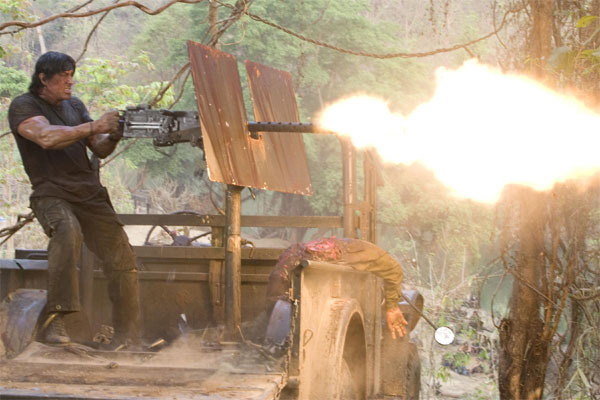
My first and only act of theft, at the age of four, was shoplifting the novelization of Rambo III from the local Osco Drug (I was caught immediately and cried many guilty tears). I'm not sure why I so urgently needed the book, or why exactly I idoloized John Rambo at such a young age. I was never much into G.I. Joe or other war toys; I think I valued Rambo as a mythic, larger-than-life figure like other preschool heroes Conan, He-Man and Lion-O. It'd be easy to write off the Rambo series as strictly for kids who are oblivious to the films' politics - at once fascist and extreme libertarian - and how the Teutonic awesomeness of Stallone's monosyllabic god of war serves to silence all debate about Vietnam and its aftermath more nuanced than "They wouldn't let us win!" But while Rambo, the roughest, goriest and loudest entry in the series, is as politically nuanced as a Toby Keith anthem, it shares with its predecessors an earnestness that keeps it from being truly offensive. Whether it's reasonable to describe a movie featuring several dozen exploding heads as "earnest," I'll leave up to you.

Concerned (like Indiana Jones and the Kingdom of the Crystal Skull) with the fate of a distinctly '80s icon who has outlived his time, Rambo finds the titular character (Sylvester Stallone) living a solitary existence as a snake wrangler in Thailand. In the two decades since Rambo III, Rambo has become even more pissed-off and withdrawn (his first line is "fuck off"), but after a group of missionaries asks him to take them upriver to Myanmar, he's naturally forced back into action. Stallone has said while promoting Rambo that he hopes the movie will bring attention to the atrocities in Burma, and the graphic documentary footage that opens Rambo makes for a surprisingly sobering reintroduction to the character. At the same time, Myanmar is one of the few morally black-and-white conflicts Stallone could have deposited the character into; he doesn't completely exploit this fact, but Rambo is certainly driven by a nostalgia for the righteous kill. In simplifying a real-life war zone, Stallone's script feels like it was scrawled in red marker by a hyperactive, antisocial thirteen-year-old; bad guys threaten not just to violate an attractive female missionary (Julie Benz) but to "rape her fifty times," and the head baddie warns that "I will feed you your own intestines!" Pop icons can carry powerful political subtext, of course, but when treated this literally it's as effective as Spider-Man crying at ground zero.

Luckily, Stallone's newfound social awareness has also motivated him to reach new levels of absurd, gratuitous blood and guts. In one interview, Stallone explained that Rambo's over-the-top violence was necessary to match the realism of Saving Private Ryan and Black Hawk Down; I don't know if he believes his film is as serious-minded as those (Jonathan Rosenbaum might prefer it to the others), but it's interesting to see how his aim of realism has actually pushed Rambo closer to the grindhouse than its predecessors. With its rough, shaky-cam images of exploding bodies, severed limbs and disfigured corpses, Rambo is less like any war movie I've seen than a straightforward splatter movie. And the increasingly hulking, monolithic Stallone reminds more of an '80s slasher icon than the greased, permed model of Regan-endorsed homoeroticism we've seen before. He's a product, like the rest of Rambo, of an aging action star's id, and the unapologetic bloodlust on display has seemingly liberated Stallone; this is the crudest Rambo movie, but while First Blood is the only one I could call "good" with a straight face, Rambo is by far the most fun.

Another hint at Rambo's appeal to kids can be found in Son of Rambow, Garth Jennings' ode to his own VHS-era youth. In Rambow, set in early-'80s England, a pirated copy of First Blood inspires young Will (Bill Milner) and Lee (Will Poulter) to create their own action epic. Jennings nails the kids' apolitical attraction to the character; for Lee, the movie is simply one he can imitate to win a filmmaking contest, while Will, a small, awkward kid raised in a sheltered religious community, finds in Rambo a figure through which he can vicariously express his repressed pre-adolescent rage. Jennings lovingly recreates this early era of DIY filmmaking, and his nostalgia is infectious. Rambow's story is a bit thin, perhaps, but the heartfelt depiction of the central friendship, and its urging of its young audience to tell (or retell) the stories that matter to them, won me over. So if you have a kid who becomes fascinated with the Rambo cover art in the same way I was with that awesome EMI video box for First Blood Part II, rent them this instead - it's just as fun, with none of the nightmares.

Thursday, June 12, 2008

The Trim Bin #70

- Cartoonist, landlord and friend Howard Cruse reports in his blog on the social event of 2008: Luna's first birthday party.

- An unnamed writer at Master of Sopranos (via The House Next Door) presents a comprehensive, very persuasive argument for why, as the author writes, "Tony's death is the only ending that makes sense."

- J.J.'s appreciation of Liza Minelli at As Little As Possible makes me feel a bit better about that disappointed look Jess gave me once when she walked in on me watching Liza with a Z.

- Lauren Wissot writes about the sadomasochistic scene between Lula and Bobby Peru at Wild at Heart. I'd always read the scene as a rape, but Wissot's made me reconsider it as an even darker and thornier version of the "baby wants to fuck" scene in Blue Velvet.

- Last night I stumbled upon a clip from Trent Harris' The Beaver Trilogy, one of the last great underground movies that, due to rights issues, has remained truly underground (though, according to the comments here, you can buy a copy from Harris through his website). If you don't know what The Beaver Trilogy is, I'm not going to say any more, except that you should watch this scene - tell me this isn't a movie you need to see: