Tuesday, May 15, 2007

London's mine!


28 Weeks Later is the most pleasant surprise so far this year. What could have easily been a cheap rush job with a vague resemblance to its predecessor is instead a zombie (movie that both honors and expands upon the first film. It's the rare horror sequel that can stand on its own, returning to the undead-ravaged London of 28 Days Later to tell a story that, while not flawless, is remarkably ambitious and literate. It's also incredibly dark, particularly for a studio sequel - while the first film ends on an optimistic note, 28 Weeks Later is concerned with the collapse of civilization on a microcosmic level (the breakdown of the family), and from its stunning opening sequence through the last shot, it's as uncompromisingly cynical as George A. Romero's landmark Dead movies.

The film opens on a seemingly familiar note, with married couple Alice (Catherine McCormack) and Don (Robert Carlyle) hiding out in the English countryside with a group of fellow survivors. But as soon as we start to settle into the story, it takes a violent left turn. The screenplay (co-written by director Juan Carlos Fresnadillo) is remarkable for the surprises it contains; the twists in 28 Weeks Later are character-driven, as the protagonists are capable of fear, weakness and deception while still invoking our sympathies. The tension in the film comes not just from the threat of the rage-infected masses, but from our shifting loyalties with the characters. After a series of title cards covering the passage of time, the film cuts ahead - well, you know - as an England occupied by the US Army begins the process of rebuilding and refugees, including Don and Alice's kids, Tammy (Imogen Poots) and Andy (the awesomely-named Mackintosh Muggleton). As things inevitably turn to shit, the film becomes a disturbingly effective argument against occupation as a means of fighting terrorism because, moral and political considerations aside, it just doesn't work. A Film Freak Central reader asked critic Walter Chaw if everything has to be about Iraq; the answer is no, but nearly everything is. And 28 Weeks Later is a condemnation of America's post-9/11 hysterical idiocy that is as sharp and potent as only a genre film can be.

The film admittedly loses a bit of steam when its focus shifts to two Americans, a sniper named Doyle (Jeremy Renner) and Major Scarlet (Rose Byrne), a medical officer determined to get the kids to safety for reasons that echo Children of Men. Both actors are fine, but their characters are vehicles of the plot and lack the same depth that the other characters share (Aliens, which this film has been frequently compared to, is superior because it creates real relationships between its Marines that amplify our emotional investment). That said, the second half of 28 Weeks Later is as tense and unrelenting as any film in recent memory. While the first film was shot digitally, Fresnadillo chooses to shift ably between 35mm, super 16 and DV - even the very texture of the film is unreliable. He also proves to be one of the handful of filmmakers who knows how to employ rapid cuts and shaky, fragmented images in order to evoke a sense of disorientation rather than simply being disorienting. The empty streets of London, which are briefly employed for their adventurous quality early on, become dark and oppressive, culminating in an underground sequence that is as effectively claustrophobic as the scene in The Silence of the Lambs that it references. There's a recurring image in the film of a rifle's telescope serving as a means of voyeurism; the same unstable relationship between seeing and destroying motivates the film's scares.

A friend from work complained that the film's near-nihilism is a betrayal of 28 Days Later's final note of hope. Usually, I'd be inclined to agree - Children of Men, for instance, wouldn't be nearly as powerful without its final images. But horror movies are another story; the best horror filmmakers are the ones who are willing to unflinchingly follow through with an enactment of our worst fears, and Fresnadillo puts himself near the head of the class on that count. There are problems with 28 Weeks Later - a line about the virus not crossing species blithely overlooks the start of the first film, and there's a recurring role for a rage-infected character that makes as little sense as the shark's trip to the Bahamas in Jaws: The Revenge. But as a longtime horror fan who has to wade through so much disposable, middle-of-the-road fodder destined to collect dust on Blockbuster shelves, it's a delight to see the makers of 28 Weeks Later try to actually say something with their zombie sequel. And it's good to have a reminder that there are filmmakers with genuine vision, even in the places one least expects to find them.

Wednesday, May 09, 2007

Monday, May 07, 2007

I loved your father, as I love you.


I wish I could have seen Spider-Man 3 when I was eight. The packed audience I saw the movie with was filled with wide-eyed little boys and girls oohing and aahing at the webslinger's exploits. Spider-Man 3 is easily the youngest-skewing entry in the series, and I'm certain that, if I'd seen it in the third grade, it would have been on my all-time top ten. But the best popcorn movies (Spider-Man 2 among them) unlock that guileless sense of wonder that we thought we'd lost. And while Spider-Man 3 - the most baffling summer tentpole in recent memory - is the loudest, busiest and hardest-working Spider-Man movie, it's only intermittently fun, and by its end, it's more tiresome than wondrous. Spider-Man 3 is to Spider-Man 2 as The Godfather Part III is to The Godfather Part II, okay on its own terms but terribly disappointing by comparison.

The unwiedly plot pits webslinging grad student Peter Parker (Tobey Maguire) against four villains - Sandman (Thomas Haden Church) an escaped convict mutated by a nasty case of plot contrivance; Venom (Topher Grace) whose alter ego Eddie Brock is Peter's Salieri; his childhood friend Harry (James Franco), now clad in his dad's Green Goblin costume; and his girlfriend, Mary Jane (Kirsten Dunst), who has morphed into a petty, narcissistic shrew. The film is as much about their relationship and the emergence of Peter's id - manifested in a gooey, alien deus ex machina called symbiote - as it is about Spidey fighting the bad guys. Spider-Man 3 becomes one of those dreaded comic book closet dramas that are kryptonite for action-hungry fanboys. But while I've passionately argued in favor of derided examples of superhero mumblecore like Hulk and Superman Returns, large stretches of Spider-Man 3 are just tedious. In the first two Spider-Man movies, the computer-generated spectacle was at the service of character and story - when Spider-Man battled Dr. Octopus, our emotional investment in the characters raised the stakes action-wise. I realize this sounds obvious, but it's something that director Sam Raimi appears to have forgotten (or perhaps he just doesn't care). So while Spider-Man 3 contains strong moments - Flint Marko's rebirth as Sandman, for instance - the story remains earthbound, the characters rendered inert by the lumbering, incoherent script. It's fun, sort of, but also impossible to care about.


Because the movie is so completely plot-driven, it's impossible to avoid the glaring plot holes and cheap shortcuts throughout the narrative. I won't make a list, because I don't want to sound like Comic Book Guy, so I'll just say that even though Raimi tries to play the sudden revelations delivered in the third act by a character we've only seen peripherally for most of three films - information that this character could have passed along at any time and only decides to share exactly when the plot requires it - as tongue-in-cheek, it's still lazy, shoddy storytelling. Spider-Man 3 is filled with moments that demonstrate it is a film that doesn't know what it is about. By its climax, it tries to pretend that it was always about Harry Osborne's internal conflict; this is unfortunate, because James Franco is a terrible actor and he looks ridiculous in the Goblin costume. Almost as poor is Kirsten Dunst, who has done terrific work elsewhere but is saddled with a Mary Jane that has been reduced to a simpering, pathetic victim who finds a reason to whine and complain about her relationship with freaking SPIDER-MAN. Dunst doesn't even try, and while I can't really blame her, it didn't make me hate every moment of her screen time any less. I was praying that Peter would kick this sad sack to the curb and shack up with Gwen Stacy (Bryce Dallas Howard makes a charming character out of a glorified cameo). Or Betty Brandt. Even the landlord's daughter would be fine. Mary Jane is a beast.


The rest of the cast does well under the circumstances. The entire movie hinges on the underdeveloped notion that Peter is getting too cocky, but Tobey Maguire's performance elevates the material; he smartly plays Peter as well-intentioned as he's always been, but blindsided by his sudden popularity. And Church succeeds in creating a brooding, inarticulate yet sympathetic heavy in the Boris Karloff mold. But all of the actors are failed by the script - Church gets a hackneyed backstory involving a daughter who has apparently been on her deathbed for five years, and Topher Grace stumbles into the Venom role literally by accident (also, Venom looks completely stupid). Great actors like Dylan Baker, Theresa Russell and James Cromwell (as Captain Stacy) are given little to do except stand around and occasionally deliver some exposition. Rarely has such a strong cast been assembled to do so little.


From a technical standpoint, Spider-Man 3 is the best-made entry in the series. A scene involving a runaway crane inspires genuine vertigo. The action throughout is admittedly entertaining. The effects are state-of-the-art. Bruce Campbell is a pleasure as always. And when Peter, spurned by Mary Jane and tripped up on symbiate, enjoys a brief "jerk" phase that builds to an out-of-nowhere dance number, the movie at least breathes a little, evoking the sheer fun of making movies that has made so many of Raimi's earlier films so special. But that feeling is missing from the rest of Spider-Man 3; frankly, it feels like it could have been directed by anyone. You can feel the effort that went into the film, but it lacks any sort of personal touch - it's slick but cold. Spider-Man 3 ends with a funeral in the rain, which is fitting, because it's a bummer of a way to end a trilogy.

Thursday, May 03, 2007

I do not know what price I will have to pay for breaking what we alchemists call Silentium.


I often go to the movies in my dreams. There are a few different cinemas that exist only in my imagination which I return to from time to time, often to attend repertory screenings of films I've seen in reality. But when I watch a film in my dreams, details such as plot, dialogue, casting and even the film's images may be drastically different. This is not a failure of my memory - I've seen The Shining too many times to count, and yet in my head, the rotting corpse lives in the bedroom of Room 237 rather than the bathroom (analyze this however you like). Rather, it seems as though my mind rearranges the details of a film to communicate its own meaning; the result is sort of a "dream director's cut." I thought about this during a scene early in Inferno, Dario Argento's thematic sequel to Suspiria, during a scene set in a cab that almost replicates a scene in the earlier film - the lighting and composition are almost identical, and the same actor plays the cab driver in both films. But Argento also plays with our memory of Suspiria, altering the visual and narrative perspective enough so that this allusion becomes disorienting rather than reassuring. Inferno is a Through the Looking Glass to the earlier film's Alice in Wonderland, both deepening and contorting our understanding of Argento's cinematic universe. It's also a masterpiece in its own right, serving as a Rosetta Stone for Argento's work and, more broadly, the power of scary stories.

The second chapter in Argento's "Three Mothers" trilogy (the third, starring his daughter Asia, will be released later this year), Inferno opens with an excerpt from the book The Three Mothers (Argento's fabricated reworking of Thomas de Quincey's Suspiria de Profundis), by the architect and alchemist E. Varelli. The three mothers are the source of all pain and sorrow in the world; the first, Mater Suspiriorum (the mother of sighs), resided at the dance academy from Suspiria, while the second, Mother Lacrimarum (the mother of tears) resides in Rome (and makes an almost sublimal appearance here). Mater Tenebrarum, "the youngest and cruelest," is said to reside in New York; when Rose (Irene Miracle), a poet living in New York, reads Varelli's book, she becomes convinced that she lives in the building occupied by Mater Tenebrarum. As she begins to investigate the building and becomes afraid for her life, she writes her brother Mark (Leigh McCloskey), a student in Rome, to come home. This begins a chain of events that draws an assortment of characters to the house, where they invariably meet with terrible fates. The characters are intentionally blank, used as symbols; Argento's aim is to tell a story not through a linear progression of events, but rather to depict evil as something that spreads like ripples atop his ever-present bodies of water. While those who demand interior logic and meaningful characterization are likely to hate Inferno (and the late-70's haircuts and 'staches don't help), the meaning of the film can be found in what Argento denies us; these characters are pawns manipulated by forces beyond their control, unable to protest the nastiness waiting for them around the corner.

In the absence of a dense plot, Argento directs our attention towards specific symbols - keys, doors, mirrors - that are loaded with connotative significance. But Argento also denies us a logical (or at least linear) narrative progression, severing the connection between the signified and the signifier. Like the film's characters, we become adrift, disoriented, out of control, as though we were dreaming. But where lesser directors employ dream logic to gloss over narrative shortcomings, Argento is very deliberately acting in a diaboloical manner not unlike the alchemists, giving us a sort of cinematic cryptogram that confounds our methods of deduction. Inferno is a self-contained work of art, filled with allusions to other works but, like Varelli's book, possessed by its own singular vision. One does not watch Inferno so much as dream it.

Inferno is largely faithful to Suspiria's surreal color pallette in its lighting and design - both films look like 1950s MGM musicals as directed by Francis Bacon. But the effect is drastically different; the scares in Suspiria revolve around shock, the mysterious machnations of the witches ultimately manifested in Argento's trademark gloved slasher. The horror in Inferno is disembodied - its roots can be found in those remarkable moments in Suspiria (Jessica Harper passing through a set of sliding doors, for instance) where nothing overtly scary is happening and yet we're fild with an overwhelming sense of dread. Argento sustains this unease throughout Inferno - an early scene where Sarah descends into a hidden pool beneath her building (Mario Bava contributed to this and several sequences in the film) creates a mounting sense of anticipatory anxiety, so that the scene is not about the inevitable "boo!" moment so much as our own expectation of that moment. The entire film unfolds with the same precise understanding of the uncanny, aided in large part by Keith Emerson's often melancholy score. When we meet Mater Tenebrarum, Argento finds in a single image a definitive statement about horror - why we are at once repelled by and drawn to that which frightens us, and what is at the center of this obsession.

In the opening narration, Varelli writes that "the life experiences of our colleagues should warn us not to upset laymen by imposing our knowledge upon them." Argento's film, too, infects its audience by exposing them to the roots of their fears and desires. In this, Inferno becomes a work where cinema and dreams intersect; there's a purity to this film, as though Argento is projecting his unconscious directly onto the movie screen. As a meditation on the horror genre, Inferno is perfect, a work of pure film; as an example of the genre, it's scary as fuck.

Wednesday, May 02, 2007

The Trim Bin #57


- Alejandro Jodorowsky is one of the most underrated filmmakers, largely because his films are so little-seen. So the arrival of the new Jodorowsky box set, distributed by the good people at Anchor Bay, felt unreal after decades of grainy tenth-generation dubs. But then, it's unreal that these films even exist at all - the three features contained in this set, Fando y Lis, El Topo (one of my all-time favorite movies) and The Holy Mountain, feel as if they were not filmed but conjured out of thin air. I'll review the films once I've adequately processed them, but I can easily say that this set is a must-own. The transfers are stunning, the extras are copious, and the set includes Jodorowsky's haunting scores for El Topo and The Holy Mountain. Anchor Bay has even discovered a long-lost short, La Cravate, filmed in 1957. I can't wait to revisit Jodorowsky's films, and I'm especially happy that they have a chance to receive the sort of widespread appreciation they deserve. Now we just need a good R1 release of Santa Sangre.

- Alex Jackson's epic, provocative review of Grindhouse, which argues that "If you prefer Planet Terror you don’t understand movies and if you prefer Death Proof you don’t really like them. And either way, you aren’t fully experiencing them."

- Jackson also pointed me in the direction of Criticker, a website that allows you to rate movies on a scale of 0-100 and compare your tastes with other users and critics. It's very addictive, yet it also touches upon an insecurity I've long had, namely that I'm too positive. Take that C+ for Vampires, for instance; it's probably much worse than that would suggest, but I always have a big grin on my face when I'm watching it. I've given about twenty percent of the films I've rated 100s, and while I can partly attribute this imbalance to the absence of many Troll IIs, I must ask my readers - am I too easy?

- Greg at Dreamscape has some interesting thoughts on the connections between The Kinks, Hot Fuzz and Kant (contains some spoilers).

- I received the sad news today that Images Cinemas' Focus Arts Monthly is no more. Published by the cinema where I work as a projectionist, Focus provided not only a schedule of upcoming films but also film reviews, opinion pieces and articles on local arts happenings by a diverse slate of writers. The back issues here will give you an idea of how special Focus was; I know that I was given an extraordinary amount of freedom to write about whatever I wanted. While my editors must have often regretted this fact, as I often abused such power to dwell on dork minutia; nevertheless, Focus was a fine little newsletter, and I'm proud to have been a part of it.

- Finally, the extremely mixed reviews for Spider-Man 3 have me very excited to see the film - I love it when the reviews for a movie I've been anticipating are all over the place, as it makes it easier to clear my head and make up my own mind. Part threes are always tricky - for every Return of the King or Alien 3, there are ten Batman Forevers. So it's interesting that both the positive and negative reviews have frequently referenced another second superhero sequel, Superman III. If the comparison is meant to refer to the excellent scene where Superman fights himself, this is a good thing. If it is a comparison to the rest of the film, things look grim. Check out the desparate-feeling and arguably racist (Look! Richard Pryor wants to sell you booze! Ha ha ha!) trailer for Superman III to get an idea of how quickly things can go downhill with any successful series' third chapter. Let's hope Spidey manages to sidestep the proverbial shark.


Thursday, April 26, 2007

Aguirre, der Zorn Myspace


Paul Clark's thoughts after attending an Ernie Gehr screening and Q&A got me thinking about the two times I've seen Werner Herzog at such an event (he was invited by Williams College to appear as part of a documentary forum in 2006, accidentally arrived a year early, hung around for a few days, then returned the next year). During that first visit, on a Friday afternoon, Herzog screened a documentary about the scoring of Grizzly Man at the cinema where I work as a projectionist (we were treated to an advanced screening of the film the night before, and on Friday night we saw a rough cut of The Wild Blue Yonder before his investors). With most people at work, only a handful showed up for the making-of screening, so the Q&A was more conversational. I decided to ask Herzog about the final shot of Stroszek, one of the greatest and most elusive endings ever - why a chicken? Herzog explained, simply, that he never makes a cut before he loses interest in an image, and the shot runs as long as it does because he just found that dancing chicken so damned interesting. It was an unpretentious, insightful answer, and now that I've started to make my own films, it's guided me through many a tough directorial decision.
The next year, when Herzog appeared at the "Extreme Documentary" forum, one audience member asked him what he thought about YouTube.

Let that sink in for a moment - he asked the director of Aguirre the Wrath of God about a site where people post videos of their babies farting.

I agree wholeheartedly with Clark's assertion that films are best experienced viscerally and psychologically - I want to see the world through the filmmaker's eyes (as Clark eloquently describes the moviegoing experience). While an intellectual understanding of the filmmaking process greatly helps one articulate one's response to a film, knowledge should never supercede understanding. Especially if you end up standing in front of a living legend, with one chance to ask him about anything at all, and you ask about a frigging website (although Herzog gave a hilarious answer about Bavarian teens recording their sexual exploits with cell phone cameras, which he called "beautiful"). I far prefer canonical to topical analysis, which could explain why I reacted so strongly to my peer's question. Or maybe he was just a schmo. Could be both.

What are your best/worst Q&A experiences? And if you could ask your favorite filmmaker one thing, what would it be?

Wednesday, April 25, 2007

Gratuitous Nudity #1


Gilda Texter, Vanishing Point (1971)

Monday, April 23, 2007

By the power of Greyskull!


Each of the directors who contributed a fake trailer to Grindhouse demonstrate very different reasons for their affection for schlock; for Eli Roth it's boobs and gore, and for Rob Zombie it's tasteless kitch. But Edgar Wright's Don't is a tribute not in content but in style, lovingly recreating the disjointed, nightmarish shocks of Fulci and Argento. He also demonstrates meticulous attention to detail in referencing the look of Eurohorror, understanding that the soul of any film rests not in its plot but in its very composition (in this way, he's far closer to Quentin Tarantino than either of his co-contributors). This is key to understanding what makes Shaun of the Dead and Wright's new movie, Hot Fuzz (both films starring and co-written by Simon Pegg), so unique - neither satire or farce, they're homages that are also superior examples of their respective genres. If I prefer Shaun of the Dead to Hot Fuzz, it's because I prefer zombies to hyperbolic action, but this is just another way of saying that Hot Fuzz is not only hilarious, it's also out-Michael Bays Michael Bay.

The film's opening, which is oddly reminiscent of The Departed, introduces us to Sergeant Nick Angel (Pegg), the best cop in London. He's so good, in fact, that he makes his co-workers look bad, and so he's promptly relocated to Sandford, a bucolic village where the biggest crime is loitering and the Inspector (Jim Broadbent) regularly treats the station to cake and ice cream. Angel is partnered with the Inspector's well-meaning but inept son, Danny (Nick Frost), who dreams of being Patrick Swayze in Point Break. As Angel begins to investigate a series of "accidents" that seem less than accidental, the film manages to pay tribute to Chinatown, Bad Boys II and everything in between, with sudden detours to accomodate nods to The Wicker Man and gialli (complete with surprisingly strong gore). But while it mines jokes from the inherent toxicity of the Simpson/Bruckheimer mold, it also avoids condescension, instead acknowledging the righteous cop as the modern, agnostic arbiter of justice. This extends to Wright's filmmaking strategy, which never misses an opportunity for a whip-pan or an extreme close-up when a fixed medium shot would do - while this approach is sometimes headache-inducing, there's no denying its fidelity to its sources.

Wright also smartly packs his cast with a who's-who of great British actors (Belloq!). The best would be Broadbent, who gave me the biggest laugh in the movie with the line "A great big bushy beard," and (oddly enough) Timothy Dalton, who reeks with smarm as a local market owner who repeatedly lets us know that he's a serial killer. And at the heart of the film is the relationship between Nick and Danny; as with Shaun of the Dead, Wright and Pegg have written relatable, sympathetic characters into an over-the-top story. There's a sweetness to the way that Danny idolizes Nick and in turn gets him to open his heart in a way that no woman ever could. Of course, this touches upon the inherent homoeroticism of the buddy cop genre, but it's to the filmmakers' credit that there are no "Ewww! Boys kissing!" jokes. If Danny and Nick had made love, Hot Fuzz would be a masterpiece; even so, it's a pleasure to see a comedy aimed at young males that embraces real affection between men.

Hot Fuzz misses a few opportunities, mainly contemporary action movies' celebration of dead-eyed nihilism. The film's final half hour - a symphony of carnage captured in slo-mo, dutch-angled glory - would give Tony Scott a hard-on, but by keeping his heroes from getting their hands too dirty, Wright sidesteps the casual disdain for human life that typifies the genre (Robert Rodriguez's Machete trailer nails this). But I'm happy to admit that this is essentially nitpicking from a fan; Hot Fuzz is unabashed fun from beginning to end. Wright has succeded admirably at a dubious goal, making a film that perfectly captures the undeniable pleasure of turning one's brain off from time to time.

Thursday, April 19, 2007

By the pricking of my thumbs, something wicked this way comes!

This post is part of the William Shakespeare Blog-a-Thon.

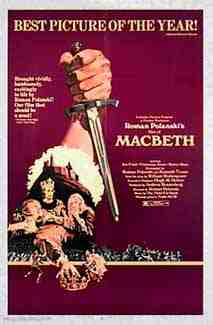
"Macbeth", as Jan Kott has noted, "begins and ends with slaughter. There is more and more blood, everyone walks in it; it floods the stage." Kott's reinterpretation of Shakespeare through a modern lens no doubt influenced both Peter Brook's King Lear and Roman Polanski's Macbeth, both released in 1971. But while both films are among the best Shakespeare adaptations, Brook's film is deliberately inert, while Polanski's film is wonderfully, terribly alive. From the opening scene, where the play's three witches congregate on an empty shore before departing into the gray, oppressive horizon, Polanski influses his Macbeth with a palpable sense of menace. This is fitting given his faithful but distinctly personal take on the material; if Shakespeare's play is ultimately intended as an affirmation of the inevitable restoration of order over chaos (and, by extension, the triumph of good over evil), Polanski presents evil as an endless, impenetrable cycle.


The film's visual canvas is at once beautiful and repellent - every frame is filled not only with blood but also drizzle, mud, shit and grime against images of the Scottish highlands (actually Wales) that are chilling in their blank impassivity. This is mirrored in a Macbeth (Jon Finch) who seldom reveals his emotions and instead remains chillingly inscrutable as he is transformed from a noble thane into a murderous, corrupt king. The decision to underact the character creates a protagonist for whom evil is not the result of madness but rationalization - from a pragmatic standpoint, Macbeth's decision to murder Duncan (Nicholas Selby) makes a perverse kind of sense, which makes the senseless violence it spawns all the more incomprehensible. And with Lady Macbeth (Francesca Annis) portrayed not as a calculating femme fatale but as a blithe impetuous young woman who lacks a moral barometer (her famous delivery of the "out damn spot" speech in the nude underlines the childlike vulnerability beneath her cunning). When she manipulates her husband to kill the king, she's like the worst result of centuries of "daddy's little princess" paternalization, craving power without even beginning to understand its significance.


Polanski is unflinching with Macbeth's extensive violence and brutality - the film is at points a catalog of the things that steel can do to human flesh. This could have easily veered into grand guignol territory, but Polanski isn't after shock so much as matter-of-fact observation of our tendency towards carnage. The film's extensive use of handheld cameras and natural lighting give it an immediacy that extends to its supernatural scenes. This is most notable in the scene when Macbeth is confronted by Banquo's ghost; by at once presenting the ghost as tangibly present and subtly creating a feeling of temporal dislocation, Polanski touches the uncanny (Kubrick was likely influenced by the scene, which is echoed in The Shining's Room 237 sequence). If the horrors of the film seem more psychological than supernatural, it is because Polanski refuses to let Macbeth (or us) off the hook that easily; when Macbeth arrives at the famous "tomorrow and tomorrow" soliliquy, detached from his people and his own fate, it becomes clear that, to Polanski, the world is only as good or evil as we each perceive it to be.


By replacing Malcolm's final speech in favor of a coda that bookends the film with the witches (those purveyors of senseless mayhem), Polanski denies us any sense of real resolution - the film doesn't end so much as stop. While Polanski's films are characteristically bleak, it's not much of a leap to assume that, as the film was made so soon after the senseless murder of Sharon Tate, the director couldn't find a way to justify a final note of hope. The strength of Polanski's films (unavoidably echoed in his often tortured personal life) is his ability to stare directly into the abyss with open eyes. While his more recent films suggest that, like Shakespeare when he wrote The Tempest, Polanski has made some sort of tentative peace with the world around him. Whatever the case may be, his films from Knife in the Water to The Tenant represent an unparalleled examination of dread, and if Macbeth is his darkest moment as a filmmaker, it's also a thing of shivery beauty.

Tuesday, April 10, 2007

The Trim Bin #56


- The trailer for Rob Zombie's Halloween remake can be found here. At this point, I feel like it could go either way. I like that Zombie has apparently taken his own brutal approach to the opening murders, and I'm at least confident that it won't be a generic retread. If I'm afraid of anything at this point, it's that it will be too much a Rob Zombie movie to be recognizably Halloween. If he achieves the right balance of honoring the original and making it his own, it could end up deserving mention alongside Phillip Kaufman's Invasion of the Body Snatchers and John Carpenter's The Thing. But if not, than Zombie had better watch out, because you do not want to piss off Donald Pleasance's ghost.

- Several fine eulogies have been written about the passing of Bob Clark (you can find two here and here), one of the most eclectic filmmakers of all time - few men could have made both Children Shouldn't Play With Dead Things and Baby Geniuses. But while his filmography is spotty, he's also reponsible for creating one cultural institution (A Christmas Story) and the original Black Christmas. I revisited the film last holiday season with the intention of writing about it here, then found I had little to say except "eek!" So thank you, Mr. Clark, for creeping the hell out of me.

- Walter Chaw calls Robert Rodriguez "the Salieri to Tarantino's Mozart." As for reports that Harvey Weinstein may chop Grindhouse, I hope he comes to his senses. This will only tarnish the movie's image: it's an underperformer, but this sort of action makes it seem like a bomb on the level of Heaven's Gate, which it's not. I'd love to see Death Proof with the missing reel intact - I think it's one of Tarantino's best movies, and in its complete form, it might be the best. But wait for DVD or a limited late-summer/fall release. Give it some breathing room. To put it simply, DON'T. DON'T. DON'T. DON'T.

DON'T.

- Finally, here are David Lynch's thoughts on product placement:


Sunday, April 08, 2007

Saturday, April 07, 2007

THIS IS MY MECCA!


There's a moment in Death Proof, Quentin Tarantino's half of the exploitation double-header Grindhouse, when one of his leads mentions a guy who made her a mix tape. Not a CD, she clarifies, but a tape, and the other women riding with her swoon as one of them exclaims, "That's so romantic!" Grindhouse is a celebration of the romance of analog - namely, the kind of schlocky B-movie double-feature experience that died with the dawn of video. And while Tarantino and Robert Rodriguez have both responded to this meta-moviemaking experiment in drastically different ways that will leave most audience members strongly preferring one over the other, they both deserve a great deal of credit for recreating the terrifically cheap thrills of a bygone era.


After a fake trailer for a Danny Trejo-starring action vehicle called Machete (think Shooter, but awesome), a go-go-dancing Rose McGowan introduces us to the world of Rodriguez's Planet Terror, a zombies-gone-amok picture set in a rural Texas town. A descendant of George A. Romero and John Carpenter's early low-budget efforts, Planet Terror pits a small gang of survivors, led by McGowan's Cherry Darling and her mysterious truck-driving ex, Wray (Freddy Rodriguez). The schlock aesthetic frees Rodriguez to make his most entertaining movie since From Dusk Till Dawn, his hyperactive imagination serving up a smorgasbord of explosions, severed limbs and burst pustules without the burden of logic or character development (it's like a more honest Once Upon a Time in Mexico).


Rodriguez even succeeds in recalling the best grindhouse movies' goofy but sincere attempts at social commentary, supplying us with a sneering, inarticulate Lieutenant played by Bruce Willis (another sometime actor does a surprisingly effective job as a rapist) and positioning Osama bin Laden as the 21st-century replacement for Hitler as the go-to real-life boogeyman to lend one's monster movie some gravitas. While Planet Terror's take on grindhouse is mostly superficial (and the obvious digital effects are a slight compromise), it's a great deal of gross-out fun, using genre staples like Tom Savini, Michael Biehn and Jeff Fahey to wonderful effect. And when the film arrives at the awesome, already famous sight of McGowan toting a machine gun leg, Rodriguez succeeds in giving us an iconic movie image that perfectly summarizes the transgressive appeal of chicks with guns. Planet Terror is the sort of movie that Avco Embassy might have released in 1981, and I mean that as a tremendous compliment.


While the pleasures of Planet Terror are overt, Death Proof is a subtler and at points confounding take on slasher, car and rape-revenge pictures. This is evident in the way each director approaches the digital touchups designed to make their prints appear old and degraded - Rodriguez fills every frame with scratches and dirt, while Tarantino employs them less, allowing the film to speak for itself. Death Proof's credits play out through a haze of pot smoke, and Tarantino has indeed finally made a stoner movie, languorously paced and amiably unfocused. Basically two extended action sequences bookended by a great deal of chitchat between its mostly female cast, Death Proof follows Stuntman Mike (Kurt Russell), an ex-stand-in with a few crayons short of a box, as he stalks one group and is then pursued by another group of young women. Tarantino takes a lot of time letting his story unfold, observing a local celebrity (Sydney Poitier - how mean were her parents?) and her friends as they get drunk, flirt with guys and dance to T-Rex. This is mirrored in the film's second half, where stuntwoman Zoe (Zoe Bell, essentially playing herself) and her posse spend their day off from a movie shoot tracking down a 1970 Dodge Challenger (the Vanishing Point car, as Zoe excitedly informs us) to perform an extremely dangerous stunt for kicks. Tarantino is not so much deconstructing as distilling the essence of 70's exploitation, which counted among its charms a tendency towards rambling plots (see Dennis Cozzalio's take on the unexpected sweetness of Revenge of the Cheerleaders); we learn about the characters not through extensive exposition but in asides and brief exchanges, and it's a weirdly subversive surprise to see Tarantino celebrating grindhouse cinema's understated qualities as well as the sex and violence.


This approach is destined to be off-putting to a lot of audience members (a friend I saw the film with eloquently summarized Death Proof as "fucking shit" and "Duel meets Spice World"). But while both films are a great deal of fun, Death Proof is just a great film, period. It's odd and unwieldly, but deliberately so. The hangout scenes not only establish an unusual amount of investment in the characters for a slasher movie, they also serve to create a Hitchcockian air of menace - when Arlene (Vanessa Ferlito) notices Mike's ominous muscle car has followed them, she represents every pursued woman with an instinctive awareness of nastiness around the corner since Janet Leigh. A self-described wolf, Mike might have emerged right out of the female protagonists' collective unconscious - virile but unknowable, he's a living representation of the collision of sex and death, and Russell's incomparable talent for dead-eyed nihilism makes Mike an unforgettable villain. When Bell, Rosario Dawson and Tracy Thoms take over in the second half, the film becomes a potent celebration of female strength. But where Planet Terror relies on a machine-gun leg for its impact, Death Proof's leading ladies possess a truly death-proof inner strength - it's a hokey conceit, but Tarantino is smart enough to play it sincerely, remembering that there is an underlying truth in even our trashiest celluloid fantasies. Stick with Death Proof and you'll be rewarded with some jaw-dropping chase sequences, an orgasm of an ending, and a wealth of ideas about the power of genre that will stick with you long after the credits roll.


But while, yes, I definitely prefer Tarantino's film to Rodriguez's, they both honor their ancestors in different ways. And they were nice enough to invite their peers to contribute some memorable trailers that play between the features - Rob Zombie's Werewolf Women of the SS (featuring Nicolas Cage in the part he was born to play), Edgar Wright's drily hilarious Eurohorror Don't, and Eli Roth's grisly holiday slasher Thanksgiving (which makes awesome use of the Creepshow score). Add to this a grab bag of appropriately period headers, ads for the taco shack next door, and a few missing reels bound to piss off many an oversexed audience member, and it's clear that this is a labor of love for everyone involved. I'm too young to have experienced the real thing - when I was visiting New York City, a billboard featuring a Times Square marquee advertising a double bill of Night of the Creeps and The Texas Chainsaw Massacre 2 with the tagline "THINGS HAVE CHANGED" pissed me off something fierce. Now I can say that I too have been to the Grindhouse, and for that I am most thankful.

Thursday, April 05, 2007

Let's start building some hurtin' bombs.


Rocky Balboa is unprecedented, a Sylvester Stallone-directed film that's actually pretty good. Stallone, who also reprises his most popular character here, could have easily thrown together a by-the-numbers retread and made a few bucks off the nostalgia craze - easier still, he could have just sold the remake rights. Instead, he's made a surprisingly low-key and personal character study that honors the qualities that made the first Rocky such a rousing moviegoing experience. The result is far from perfect, but it is likeable, entertaining and oddly moving.

Sixteen years after the execrable Rocky V, the film finds the Italian Stallion living a modest but comfortable life, spending his nights entertaining guests at his restaurant with stories of his famous fights against Apollo Creed and Clubber Lang (no mention of having defeated Communism). The biggest change in Rocky's life is the loss of his beloved wife Adrian, who died of "lady cancer" (as Rocky puts it) several years earlier. The opening scenes follow Rocky on the anniversary of her death as he visits spots (such as the lot where an ice rink once stood) that remind him of Adrian, her brother Paulie (Burt Young) reluctantly tagging along. These scenes set a surprisingly melancholic tone for the film, which eschews the overblown theatrics (and talking robots) of previous sequels in favor of a muted color palette and a quiet, observational style. And while earlier entries in the franchise have taken a by-the-numbers approach, Rocky Balboa has a structure that hearkens back to the first film, following the characters as not much happens - Rocky befriends a younger woman and her son, Rocky gets a dog, Paulie is still a prick - and allowing the interchanges between the characters to propel the story. The main villain in the film isn't any fighter but Rocky's own advancing age; while this isn't the most original of premises, Stallone invests it with a level of insight and wit that reminds us of how the star of Stop! Or My Mom Will Shoot was once a promising voice for our populist myths.

Stallone also takes the piss out of any jokes at the near-60 fighter, not to mention his own checkered filmography - imagine what it must be like to live with the fact that you starred in Tango and Cash, and you'll get an idea of the pathos behind Rocky's indirect admission that, yes, you can call him Punchy. When Rocky agrees to fight heavyweight champ Mason "The Line" Dixon (Vodka Drunkenski was unavailable), his goal isn't to knock out the younger fighter but to leave the ring with his dignity intact (and to teach the young whippersnapper a thing or two). There's something charming about Stallone's modesty, making a movie that not only appeals to serious fans but demonstrates that he's trying new things as a filmmaker. This is nowhere more evident than during the fight, which is filled with sudden cuts to moments from Rocky's (and our) memories. It's not entirely successful - a purple-tinted closeup of Burgess Meredith is sort of terrifying - but it does reveal Stallone as an auteur in his own way, preoccupied with the persistence of memory.

Rocky Balboa has a lot of problems - the scenes between Rocky and his son don't work, the narrative is weirdly compressed (probably due to the small budget), and there's far too much A.J. Benza. But watching Rocky, calcified joints and all, training with Paulie and Duke (the eternally awesome Tony Burton) to Bill Conti's classic theme, it's impossible not to smile, not just out of nostalgia but geniune fondness. This is Stallone's The Straight Story, and whether this is a good or bad thing is for you to decide. All I know is, I'm now illogically excited to see John Rambo.