Wednesday, January 31, 2007

Top 10: 1996


1. Dead Man (Jarmusch)
2. Fargo (Coen)
3. Breaking the Waves (Von Trier)
4. Scream (Craven)
5. Welcome the the Dollhouse (Solondz)
6. Trainspotting (Boyle)
7. From Dusk Till Dawn (Rodriguez)
8. Jude (Winterbottom)
9. The People Vs. Larry Flynt (Forman)
10. Mars Attacks! (Burton)

Saturday, January 27, 2007

Hi! Are you a fairy?


I fear that the Pale Man will be haunting my dreams for a long time to come. If you've seen the trailers for Pan's Labyrinth, you've seen the Pale Man, a faceless, contorted figure whose eyes rest in his hands like an extra from Beetlejuice. In Pan's Labyrinth, the Pale Man plays the role of the sleeping monster that Ofelia (Ivana Banquero), the film's preteen heroine, accidentally awakens. In his brief appearance, the Pale Man is both an effective summation of the film's real-life horrors (mindless violence triumphing over creativity, perception buried in the hands rather than the mind, and by extension, the heart) and a terrifying, visceral beast destined to burrow its way into our collective nightmares. And director Guillermo del Toro achieves a tricky balancing act throughout the film, creating a visually sumptuous fairy tale rooted in our very real need to escape into worlds of our own creation; the result is intellectually and emotionally exhilarating.

The labyrinth of the film is of the Borgesian sort, weaving between the objective world and an intricate fantasy world; while this conceit has been used in films from The Wizard of Oz to Brazil, here it is not only used to demonstrate the contrast between dreams and waking life but also something knottier. Set in 1944 Spain, the film joins Ofelia as she arrives with her pregnant mother Carmen (Ariadna Gil) at the secluded estate of her new stepfather, Captain Vidal (Sergi López), a cruel megalomaniac capable of unflinching violence. With her mother dangerously ill and violence between Vidal's men and republican guerillas erupting in the woods aroud her, Ofelia's unremittingly bleak existence is the perfect backstory for a fairy-tale heroine. So it makes a certain amount of sense when she is led by an insectlike fairy to a hedge maze on the periphery of the estate and introduced to a six-foot-tall faun (Doug Jones) who has a very specific purpose for her. This leads Ofelia into a series of journeys into another world, where she must solve an increasingly complicated puzzle even as reality becomes more and more unbearable. The brilliance of Pan's Labyrinth rests in the way that it subtly demonstrates how each world is altered by the other, with Ofelia acting as a literal door (Jungian alert!) between them. The horrors of the fantasy world are amplified by their connection to Ofelia's very real fear of annihilation; at the same time, Ofelia is empowered by her magical quest in a way that makes her stronger, more resourceful and better equipped to outwit her real-life wicked stepfather. Del Toro makes a very powerful argument for the importance of faith and imagination (dismissed as childish by Ofelia's mother) in confronting our everyday monsters. It's not only a convincing defense of the geeky Mexican's monster-filled body of work, it also announces del Toro as a fantasist of unshakable maturity and depth.

The art direction, makeup and visual effects departments do a breathtaking job of bringing various otherwordly haunts to life, adding details (such as the discarded shoes of the Pale Man's previous victims) that make each moment creepily believable. But while the real-life story usually suffers in films like these, here it's just as strong. Ofelia befriends Mercedes (Maribel Verdu), Vidal's maid, who admits that she once believed in the same stories but no longer can. Their scenes together are sweet and subtly sad, underscored by a longing for the return of innocence. Pan's Labyrinth is also the second recent film (after Children of Men) to suggest that a more feminine approach to life might not be a bad idea; while Vidal asserts his dominance through unspeakable cruelty and the guerillas, justified as they may be, ravage the countryside with destruction, it is the women who achieve something resembling peace. Banquero is amazing here, creating the most nuanced, sensitive performance by a child since Anna Paquin in The Piano. López is deeply disturbing as the methodical military man who becomes the face of a very modern form of evil - power in the absence of true vision. And Doug Jones deserves a great deal of credit both for the Pale Man and the faun, whose motives are uncertain as he guides Ofelia through the labyrinth.


For the first hour of Pan's Labyrinth, I was entranced but uncertain as to how del Toro would work the seemingly disparate elements of wide-eyed fantasy and brutal violence together. But as the narrative progresses, it reveals a fearful symmetry that builds to a stunning conclusion. The less said about Pan's Labyrinth and the secrets it contains, the better; suffice to say that if you choose to take its journey, it will likely shake you to your core. Del Toro has always been great for his infectious sense of unpretentious fun - hell, he even made a Blade movie that I actually liked. Pan's Labyrinth is an enormous sense forward in this sense; it's incredible, the way the film completely disarms you, leaving you totally immersed in its world. The result is something like wonder, and that's one thing of which we could always use more.

Monday, January 22, 2007

Top 10: 1986


1. Blue Velvet (Lynch)
2. The Fly (Cronenberg)
3. Sid and Nancy (Cox)
4. Betty Blue (Beineix)
5. Aliens (Cameron)
6. Stand by Me (Reiner)
7. Platoon (Stone)
8. Jean de Florette (Berri)
9. Ferris Bueller's Day Off (Hughes)
10. Big Trouble in Little China (Carpenter)

Sunday, January 21, 2007

Madame Bovary is not a slut.

Little Children references Flaubert's Madame Bovary at great length during a book group discussion attended by the film's protagonist, and it's easy to see how Flaubert's conflicted heroine is mirrored in Winslet's character. But it's also a clue about the fragile, often paradoxical tone of the film; Flaubert's work is characterized by the conflict between romanticism and realism, and that conflict is at the heart of Little Children. Suburban tragicomedies have become their own subgenre, and director Todd Field acknowledges recent films like American Beauty and Happiness in sly ways. But Little Children is a far tricker work its predecessors, blurring the line between bucolic humanism and ironic detachment. The result is perhaps the most challenging film of 2006: it's flawed yet indelible.

Sarah Pierce (Kate Winslet) is a liberal-minded bookworm who dropped out of grad school to marry Richard (Gregg Edelman), an older, successful businessman who is also (as Sarah discovers) a porn aficionado and a bit of a pantysniffer. Sarah is befuddled by her upper-middle-class existence and ambivalent about her relationship with her daughter Lucy (Sadie Goldstein), who is as sweet and needy as toddlers tend to be. Sarah spends her days at the playground with Lucy, trying to ignore the banal chatter of fellow moms; the mononoty is broken one day by the arrival of Brad Adamson (Patrick Wilson), a stay-at-home dad known to the moms as the "Prom King." Sarah strikes up a conversation with Brad in order to shock her peers, but what begins as a joke quickly turns serious as Sarah and Brad find themselves urgently attracted to each other. Before long, they're engaging in sessions of enthusiastic sex while the kids nap. Brad's wife Kathy (Jennifer Connelly), a documentary filmmaker increasingly frustrated by her husband's repeated failures at the bar exam, begins to suspect that something is afoot. It's a familiar premise, but Field and co-writer Tom Perrotta (adapting his book) approach it with understated insight. While it'd be easy to judge Sarah and Brad for their infidelity and questionable parenting, Field also gives Winslet and Wilson the room to create a palpable, almost spiritual connection. The sex scenes are sweaty and vital, and they bring the film's understated visual strategy (lonely houses, treetops against a gray sky) and dry observation of playground routines (narrated in brilliant deadpan by Frontline's Will Lyman) into focus. We exist outside of the narrative until Brad and Sarah's affair allows us in, and even then our ability to engage in the story is determined by our capacity for empathy.

It's a complex challenge that Field presents, and Little Children complicates matters further by juxtaposing Brad and Sarah's story with the arrival of Ronnie McGorvey (Jackie Earl Haley), a "sex pervert" who has just been returned from prison to live with his long-suffering mother, May (Phyllis Somerville, great in a brief role). From the scene where Ronnie decides to take a dip and promptly clears out the town pool, Field masterfully plays upon our conflicted sympathies - Ronnie is capable of horrible things, but he's no less recognizably human than Larry (Noah Emmerich), an ex-cop who harasses the McGorveys out of an inflated sense of self-righteousness (not to mention guilt over his own sins). All of this could have played as a painfully simplistic work of moral equivalency, but again, Field gives us room to measure the divide between the characters' intentions and their actions on our own terms. Haley does excellent work here; living in a Rockwellian nightmare of ticking clocks and passive, smirking Hummels, Ronnie is a man slowly unravelling and threatening to break at any moment. When he finally does, it seems that Field is asking (in no uncertain terms) what parts of ourselves we must discard in order to put away childish things.

I realize that I've made Little Children sound more like a Sociology 101 midterm than a fun night out. Indeed, it is a difficult film to embrace, and its ambitions make its flaws (Mary B. McCann's stilted, obvious performance as the leader of the soccer moms, for instance) more glaring. At the same time, it's refreshing to see a film that places an enormous amount of faith in the audience's intelligence. Perrotta's screenplay is sharply funny, and Field demonstrates a flair for satire unseen in his good but delibrately somber first feature, In the Bedroom. Wilson does hilarious work as a "primary caregiver" pretty enough to dismiss the importance of beauty and goofily enamored with contact sports and skaters. Connelly's icy presence is perfect for Kathy. And Winslet is the heart of the film, giving another in a series bold, uncompromising and insightful performance; when Sarah begins to cry outside Brad's house, you can see the tragicomic soul of Little Children on her trembling face, which reveals both the child she was (and still is) and the grownup she might someday become.

Saturday, January 13, 2007

Top 10: 1976


1. Carrie (De Palma)
2. The Man Who Fell to Earth (Roeg)
3. Taxi Driver (Scorsese)
4. Face to Face (Bergman)
5. 1900 (Bertolucci)
6. The Bad News Bears (Ritchie)
7. Network (Lumet)
8. Marathon Man (Schlesinger)
9. Rocky (Avildsen)
10. Bound for Glory (Ashby)

Monday, January 08, 2007

Shantih, Shantih, Shantih.


There's an almost inaudible ring on the soundtrack of Children of Men after each of the film's sudden bursts of violence. It is, as one character explains, the last hurrah of ear cells about to die. The sound is at the heart of Children of Men, a film set in a near-future where humanity is on the verge of ending not with a bang but a whimper. It's an unflinching vision of our darkest fears about the direction our world is headed in, yet the film never feels oppressive or nihilistic. Instead, director Alfonso Cuaron has made a film that inspires genuine faith in the potential of the human spirit in the face of its own self-destruction.

Based on a novel by PD James, Children of Men takes place in 2027, when war and environmental destruction have left most of the world in chaos (the screenplay wisely avoids much exposition, as the characters mention catastrophic events around the world with the same familiarity that we reference 9/11). The only city left standing is a London overrun by violence; the city has become a place where refugees are imprisoned in internment camps and suicide pills are available over the counter. The film opens with news of the death of the youngest person on the planet - "Baby Diego," age 18. For unknown reasons, women are no longer able to conceive, and the end of humankind appears to be just around the corner. Theo (Clive Owen), a former activist who now works as a low-level government drone, has responded naturally, living in a state of depressed indifference. He spends his days getting drunk and occasionally visiting his friend Jasper (Michael Caine), a dope-smoking peacenik who lives in a secluded house with his catatonic wife. Theo's routine is interrupted when he is suddenly contacted by Julian (Julianne Moore), his ex-wife, who now works for a subversive pro-immigration group called the Fishes. Julian wants Theo to help her secretly transport a young refugee across the country. Theo eventually learns that the young woman, Kee (Claire-Hope Ashitey), is pregnant, and it becomes clear how much is at stake.

The film is structured like a classical Hollywood thriller, as Theo and Kee race across England, pursued by revolutionaries who want the child to help advance their own cause. But in many ways, Children of Men is an incredible step forward in the art of cinema, both technically and emotionally. Cuaron and cinematographer Emmanuel Lubezki employ a remarkable strategy of desaturated colors, handheld camerawork, and natural light to create a future that feels remarkably immediate, underscoring the connection between this possible future and our own uncertain present. And the much-talked-about, seemingly unbroken shots that last as long as ten minutes aren't a gimmick as they were in Russian Ark, for instance. They strengthen our identification with Theo as he ends up in increasingly nightmarish situations. What Cuaron has achieved here cannot be underestimated; it's not that he invented the techniques on display here, but rather, as Welles did with Citizen Kane or Kubrick with 2001, he gives them newfound conceptual depth. He has made the camera an invisible, ground-level presence; we barely have time to stop and marvel at the cinematic trickery, immersed as we are in the world of the film. Cuaron, director of the wonderfully horny Y Tu Mama Tambien and the best Harry Potter film, reveals himself here as a pioneer, and Children of Men is a milestone in the evolution of cinematic language.

That said, the emotional weight of the film rests solely on the shoulders of Clive Owen, who rises to the occasion admirably. Theo is a man whose sould has been deadened by personal and global tragedy, and Owen wisely underplays every moment. The performance recalls Bogart in Casablanca (a film that shares a great deal of DNA with this one); it's exhilarating to watch Theo, who once tried to change the world before giving in to grief and apathy, rediscover his soul. Julianne Moore is heartbreaking as Julian - with a minimum of exposition, you can see the entire history of their relationship in her eyes. Chiwetel Ejiofor, Pam Ferris and Peter Mullan do strong work in complex supporting roles. Michael Caine appears to be having a blast as Jasper, and lends the film considerable warmth and poignance. And Claire-Hope Ashitey is funny and sweet as a refreshingly unsentimental savior (her one-line dismissal of any Christ allegory is perfect). Ashitey is also the subject of the film's most indelible image - standing nude and swollen with child in a barn, surrounded by cows, Ashitey becomes a painterly summation of the conflict that drives Children of Men - between the animal and the divine, the profane and the sacred, chaos and symmetry.

It's true that Children of Men is incredibly prescient, but if the film will live beyond its topical relevance (and I believe it will), it's because it is more fundamentally about our constant fear of the future (irrespective of what war we're currently fighting). The violence in Children of Men is as jarring as that in Psycho - it forces us to confront the overwhelming weight of our own anxiety about what comes next. But the film also offers a great deal of real hope, arriving at a moment of grace that serves to remind us of the faith we place in our children to make the most of this broken world they've inherited. Children of Men has a vital, pulsing spirit, infused with an eclectic mix of ideas, a concordance's worth of references to art both high and low (love the flying pig), and the subtle, witty suggestion that a world repopulated by the children of women might not be a bad idea. The subject matter of Children of Men may be bleak, but it is nevertheless the most joyous cinematic experience I've had in a long time.

Friday, December 29, 2006

The Trim Bin #53 (Joyeux Anniversaire!)


You don't often hear the phrase "Opens December 25 in New York, LA and North Adams." So my top ten for 2006 will be completed in several weeks, after the most talked-about films have made their way to Images or the Spectrum 8. Until then, I thought I'd share my favorite film-related experiences in 2006.

- When asked by coworkers what I did last weekend, I sometimes notice a flicker of concern in their expressions when I explain that I drove three hours to see a scratchy print of a twenty-year-old movie that I could have simply popped into my DVD player in the comfort of my own home. Repertory screenings are an integral part of my love of film; the reasons are partly philosophical, but mostly it's just pure geek joy. There's something about it that just transports me, and I don't quite know how to describe it except to say that it's magic. The most memorable classic screenings this year include Jaws and Ed Wood at Pothole Pictures; Pee-Wee's Big Adventure, Terminator 2 and The Lost Boys at Cinemark's Friday Night Rewind; Nosferatu and Rosemary's Baby at the Brattle; 2001 and Jurassic Park at the Mahaiwe; and The Shining at Images.

But more than any one screening, one of the most amazing film experiences in 2006 was my ten-day, eight-film adventure in May with the missus. In a journey that spanned Northampton, Cambridge and Shelburne Falls, we attended screenings of Blue Velvet, Pink Flamingos, The Piano, My Own Private Idaho, Badlands, Days of Heaven, King Kong and Full Metal Jacket. Between the aftermath of my college graduation and our impending marriage, our sensory deprivation-like immersion in a nonstop celluloid orgy not only kept us sane, it also reminded us why we fell for each other in the first place.

- The single most surreal moment of 2006: sitting in the '62 Center, waiting for a panel discussion of female documentarians (part of the Extreme Documentary weekend) to begin and lost in my own thoughts, I absentmindedly look to my right, and see Werner Herzog sitting two seats away and staring back at me. I find myself unable to form anything resembling a coherent thought, so I offer a polite head nod, which Herzog returns. I turn my gaze forward, and spend the next two hours resisting the urge to look to my right.

- This was also a year of some small but important steps towards eliminating that pesky qualifier "aspiring" from "filmmaker." I heart Jonathan Caouette, who was kind enough to accept copies of our work (it almost doesn't matter if he watched it - it was just nice to have the encouragement). As for the extra work, The Departed is one of the best movies of 2006 and The Game Plan is almost certainly going to be one of the worst movies of 2007, but it doesn't matter either way, because I now understand how a movie is made in a way that simply can't be taught in a classroom. And I'm proudest of Chrissie, and of the work yet to come.

- As for the movies released this year: as always, there was a lot of filler and overhyped studio product. But I've seen five new classics this year, and a dozen other memorable gems that I'm sure I'll revisit in the years to come. And as I've said, I've haven't seen everything yet! So it's been a good year, and 2007 promises to be a better one. I'm going to make movies, and I'm going to be a dad. Not bad at all.

Thanks for reading. See you next year.


Films watched this week:

World Trade Center 4
Gremlins 10
Badlands 10
Scrooge (1970) 8
Pirates of the Caribbean: Dead Man's Chest 6
The Ice Harvest 8
Dune (1984) 9
12 Monkeys 10
Mulholland Drive 10

Thursday, December 28, 2006

Sarge, I just saw Jesus.


The opening moments of World Trade Center, silent images of Manhattan in the moments before dawn, have an understated grace. They suggest a subtler, more meditative film than the one we are about to see. The spell is broken with the title card, over an image of the New York skyline, that informs us of the following: "September 11, 2001." Because, apparently, we are complete fucking dimwits.

It's not that Oliver Stone has made a deliberately cynical movie with World Trade Center; the movie radiates with the obvious good intentions of its cast and crew. But therein lies the problem. Stone has worked hard to make an accessible, apolitical film designed primarily to honor those whose lives were lost on 9/11 and deify the city's cops and rescue workers. And while this is a worthy subject for a film, Stone's singlemindedly inoffensive approach serves to give one of the most significant days in human history as much emotional resonance as any generic disaster movie (Nicolas Cage actually says "RUUUNNN!!!" as the first tower collapses in slow motion). World Trade Center is a noble effort, but it's also a huge missed opportunity.

The film tells the true story of John McLoughlin (Cage, in one of his bad performances) and William J. Jimeno (Michael Peña), two average cops whose lives became inextricably linked with September 11. The moments leading up to the first collision are effectively tense, if only because we in the audience supply the anticipatory dread. But as McLoughlin and Jimeno join the rescue efforts, World Trade Center becomes flat and formulaic. The actors do not respond to the sight of bodies falling from the towers, or news that the crash was deliberate, with the spontaneous horror palpable that day; they feel like actors playing cops and firemen, reading their lines, afraid to make any risky choices. And that caution is at the heart of the film, which becomes evident as the towers collapse, leaving our protagonists trapped under twenty feet of rubble. This will not be a film that stares into the abyss, but an attempt to inspire and reassure. The last thing we need right now is to be cuddled.

Stone sidesteps potentially subversive moments, such as the subplot involving a batshit insane marine, Dave Karnes (Michael Shannon), who is "called by God" to ground zero (imagine the movie Herzog could make out of this guy), in favor of easy platitudes and greeting card sentiments - apparently, 9/11 happened because they didn't love their wives better (Maria Bello and Maggie Gyllenhal, two of the best actresses working today, are wasted in underwritten "crying wife" roles). I haven't written about United 93 because the task seems so overwhelming, but I'll have to soon - I'll refrain from listing the multiple reasons it's a better movie, but chief among them is the scenes of wives and husbands tearfully calling their spouses for the last time. That film posesses genuine pathos, because it understood the meaning of family in the face of absolute despair. Here, it's just an easy shortcut to audience identification. Weak.

The cinematography and editing are well done, but they serve no purpose other than to placate the middle-American audience the film is so transparently courting. The ending narration suggests that we've forgotten the spirit of patriotism and unity that brought us together on that day. Actually, we've never moved beyond it, and that's the problem. The thirty percent of Americans who still desperately cling onto the belief that our current war is worth fighting cannot let go of five years of American flag bumper stickers, "Whack the Osama" banner ads, and Toby Keith songs. They live for that shit; without it, they'd lose their minds. It's painful to see Stone, historically one of our most audacious cinematic muckrakers, shrug his shoulders and spoon-feed this claptrap to the masses. And worse, by leaving Karnes' jingoistic Rambospeak in the film but refusing to question it, Stone has made a film that could easily read by less media-savvy folk as a call to arms; that's not only bad filmmaking, it's irresponsible. I can't see any reason why he would make this World Trade Center other than his need to stay commercially viable, and that hurts. I'm still of the opinion that there's nothing inappropriate about making films about 9/11 (the subject has already given us one new classic). I just hope that we eventually get a World Trade Center movie that actually has something to say.

Also, I know that Jimeno really saw Jesus with a water bottle. It still looks totally goddamn ridiculous.

Monday, December 25, 2006

Thursday, December 21, 2006

The Trim Bin #52


This will be a condensed entry, as I find myself too tired and stupid to write complete paragraphs right now (gotta love the holidays). I'll be back next week, and hopefully my brain will have returned as well. In the meantime:

- The teaser for Grindhouse. Boner.

- This one's for the missus: a Woody Allen spectacular. Yes, my wife finds Woody Allen attractive, which does wonders for my self-image. But she also digs Reds-era Warren Beatty, which gives me hope.

- Here's my latest article for the Transcript, a suggestion of what movies to watch this Christmas season; here's a clip from one such timeless Yuletide classic. Have you been naughty or nice this year?


Films watched this week:

Superman Returns 10
Blue Velvet 10
Inland Empire 10
Silent Night Deadly Night 3
Silent Night Deadly Night Part 2 0
Star Trek: The Motion Picture 8
Brazil 10
The Fountain 10
For Your Consideration 6

Tuesday, December 19, 2006

You dyin', lady.


Inland Empire is David Lynch's most dreamlike film. Having seen it four days ago at the Brattle, I find that my memories of it are very fuzzy. This is not to say that the film is forgettable - as with all of Lynch's best work, it contains countless moments that burrow their way deep into the mind's eye. Rather, the sequence of narrative events is blurry; as with a dream, time and space are malleable and unpredictable, shifting between continents, decades and stories without warning (and that's to say nothing of the talking rabbits). Lynch, who has long toyed with the breakdown of classical narrative in ways both overt (Lost Highway, Mulholland Drive) and subtle (The Straight Story), has finally succeeded in shattering the Hollywood model of storytelling into a million pieces, and the result is nothing less than a creative rebirth.

The film presents itself as a "long-lost radio play," and is apparently being viewed by a weeping Polish prostitute; it begins as a sitcom starring the aforementioned rabbits before eventually settling into the story of Nikki Grace (Laura Dern), an actress whose fame has slightly dimmed. Nikki is visited by a new neighbor (Grace Zabriskie) who talks like Bela Lugosi and surely comes from the same place ("hard to see from the road") as The Man From Another Place, the Lady in the Radiator, the Mystery Man and all of the other messengers from other realities that populate Lynch's world. The neighbor tells Nikki two versions of a fable that seem to foreshadow the film's story (though they explain nothing); suddenly, it is the next day, and Nikki has been cast in a Southern melodrama called On High in Blue Tomorrows. In a scene reminiscent of The Shining (allusions to Kubrick's film are all over the place), director Kingsley Stewart (Jeremy Irons) warns his leads that the film is supposedly cursed; an earlier version of the film, made in Poland, was left unfinished when its two stars were brutally murdered. Nikki flirts with the idea of an extramarital romance with her costar, Devon Berk (Justin Theroux) which, they are warned, will indirectly threaten the fabric of their reality. Before long, the film makes an almost imperceptable shift into the uncanny, casting Nikki adrift on a fragmented journey through various realities, cinematic and otherwise. If Mulholland Drive concluded with a trip down the rabbit hole, Inland Empire is a freefall; it makes the previous film look downright accessible.

Lynch filmed Inland Empire on standard-definition digital video, which both allowed for an atypical shooting process (the film was assembled one scene at a time over the course of several years) and opened the director up to a new realm of visual possibilities. At first it seems that Lynch's painterly compositions are rendered inert by DV's static nature. But as the film progresses, it takes on a disjointed beauty; the fragmented images contribute to the hallucinatory atmosphere, and they also liberate Lynch to do his most experimental work since Eraserhead. While Inland Empire is filled with nods to Lynch's earlier films, it feels less self-referential than reflective, placing his recurrent themes and images in a startling new context. In many ways, Inland Empire brings closure to the cycle of psychic violence at the center of Lost Highway and Mulholland Drive while also announcing the start of a new chapter in Lynch's ongoing narrative. It's a reflection on the very act of storytelling embodied by an actress whose ability to live others' lives is the source of both her nightmares and her strength. And so Inland Empire's success is largely thanks to Dern, who disappears completely into the role. Her fearlessness, and the thrill of a new medium, have an invigorating effect on Lynch; when a languid gang of prostitutes suddenly launches into a full-blown musical number set to "The Locomotion," it's a perfectly bizarre moment that crystallizes the film's themes as profoundly as Dean Stockwell's lip-synch in Blue Velvet and the Club Silencio sequence in Mulholland Drive. There's genuine audacity on display here, and while Inland Empire at points requires phenomenal patience, it's worth it to see Lynch push the boundaries of cinema and his own imagination into uncharted territory.

There's so much that remains to be discovered about Inland Empire; Lynch makes films that demand to be revisited and reexamined, and this is no exception. In a few years, when we've finally begun to absorb the meaning of this long-lost radio play, the real discussion can begin. I can't claim to understand all of Inland Empire, but the great thing about Lynch is that understanding seems beside the point; he wants us to experience his films. And Inland Empire is an astounding experience; it's the kind of film you can get lost in, wandering through its many rooms and disappearing into its ever-present shadows. You will either love Inland Empire or hate it. You won't forget it.

Wednesday, December 13, 2006

The Trim Bin #51


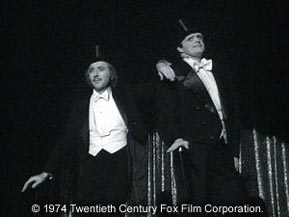
- Hearing about the death of Peter Boyle, my mind immediately jumped to two scenes. The first is Boyle as the cabbie guru Wizard waxing philosophical to Travis Bickle in Taxi Driver (a scene largely improvised by Boyle). The second is the "Puttin On the Ritz" scene in Young Frankenstein; the monster's indecipherable yelps are one of the film's highlights. It's hard to imagine anyone but Boyle playing either role so memorably, and for that he will be missed.

- I'm planning on beginning the next gauntlet (suggestions for a new name are welcome) starting on January 1st. This time, we'll be determining which film is the worst of all time. Feel free to leave a comment here with your bottom ten anytime between now and January; I look forward to judging the worst of the worst.

- The awards season has begun, with most major critics' groups having announced their choices (you can find a handy guide to the NY, Boston, LA and Washington picks here). The biggest winners this year appear to be Letters From Iwo Jima, United 93, The Departed and The Queen. Two of those films are among my favorites this year, and Letters could join that list (I'm indifferent to The Queen despite Helen Mirren's pitch-perfect performance). All in all, not a bad year for the critics, as it was probably too much to hope for a sudden surge of enthusiasm for The Fountain. I'm neither qualified nor interested in doing much awards speculation, so this is probably it until the Oscar nominations. I just figured I'd mention that yes, I do think about these things.

- More on The Departed: this piece from Film Comment (page 1 page 2 page 3 page 4) is the strongest written on the film so far, and offers some provocative ideas about the film (I took Queenan at face value, but perhaps he is shadier than he seems).

- Finally, in honor of the new David Lynch/Laura Dern collaboration Inland Empire (I'm seeing it at the Brattle this weekend, and I can't wait), here's a scene featuring Dern's brilliant work as Lula in Wild at Heart. "Holy shit, it's night of the living fuckin' dead!"

Alien 10
The Queen
6
The Royal Tenenbaums
10
Casino Royale
7
Casualties of War
9
Hairspray
8

Monday, December 11, 2006

I'm deaf, not blind!


Every frame of Babel announces Alejandro González Iñárritu as a filmmaker with the noblest of intentions. Iñárritu's previous features, Amores Perros and 21 Grams, each told interlocking stories linked by a single incident. In Babel, that incident is a gunshot, and the stories connected here are played out on a global canvas. Iñárritu's film is concerned with such weighty subjects as terrorism, globalization, illegal immigration, and social alienation. So why does it say so little?

The gunshot is fired by Yussef (Boubker Ait El Caid), a Moroccan boy testing his father's new rifle; through a contrivance that is only plausible if one accepts that Yussef is an idiot, he critically wounds Susan (Cate Blanchett), an American woman grieving the loss of her infant son while on a Middle Eastern holiday with her husband Richard (Brad Pitt). Back in the U.S., their Mexican housekeeper and nanny, Amelia (Adriana Barazza) is left to watch their older son and daughter; her decision to bring the kids to her son's wedding in Mexico turns out badly. And connected more tenuously is the story of Chieko (Rinko Kikuchi), a deaf Japanese teen who resists any emotional connection with her father (Kôji Yakusho) and is plagued by sexual insecurity that compels her towards risky behavior. As with 21 Grams, the film cuts between different narratives, often fracturing continuity; unlike that earlier and better film, Babel's juxtaposition of different stories feels arbitrary, the characters connected by little except their geographic diversity. For all its scope, Babel's ideas feel obvious and superficial - for all the mentions of terrorism, it has nothing to say on the subject, and its take on the geopolitical climate is about as nuanced and insightful as the song "We Are The World." The film's self-consciously bleak tone labors to imply important statements that just aren't there; unfortunately, this is the very definition of pretentious.

Surprisingly, Iñárritu and screenwriter Guillermo Arriaga, who have never failed to create well-crafted, believable characters, stumble badly here. Babel's multiethnic cast is reduced to a series of underwritten cliches - Gael Garcia Bernal is wasted as a hot-tempered Latino - and, worse, most of the characters are totally unsympathetic. We learn little about the Moroccan farmer and his family, his sons depicted only as foolish and creepy (Yussef masturbates to thoughts of his own sister). And the nanny's actions are so irresponsible and implausible that we end up rooting for Border Patrol - odd, considering that the writer and director are Mexican! Only Pitt and Blanchett are given the opportunity to create relatable, fleshed-out characters (though even their characters are crudely robbed of any real narrative resulution). They do fine work together (a scene where they finally address their loss works better than it has any right to), but the unsettling (hopefully unintentional) subtext is that only the pretty white people can overcome adversity and emerge unscathed. While Babel ostensibly pleads for peace, love and understanding, with a little tweaking in the editing room it could just as easily be positioned as a stirring tale of the white man's burden.

But the worst part of Babel is the Japan segment, which strains all credibility in the service of a ridiculous plotline with ugly racial and sexual undertones. I am willing to accept that Chieko would probably have issues with self-image that would lead to promiscuous and destructive behavior. I am not willing to accept that, in the course of one day, a seemingly intelligent and assertive 17-year-old girl would blatanty proposition four different men (including a dentist and a police detective) in one day. Kikuchi deserves a great deal of credit for her fearlessness, but it feels exploitative - Chieko, pantyless under her school uniform, plays into the prurient, vaguely racist Japanese schoolgirl fetish (plus, she's submissive and a virgin). Iñárritu asks Kikuchi to bare all both physically and emotionally, but he demonstrates no real desire to explore the motivation behind Chieko's actions in any detail. The filmmaker feels entitled to teach us, to urge us to understand each other, yet he doesn't even understand his own character; the whole thing feels unbearably hypocritical. The film closes with Iñárritu's dedication to his children, who he describes as his sole source of hope. Unfortunately, that hope is nowhere to be found in Babel; for all its ambition, it is ultimately hollow.

Sunday, December 10, 2006

Kindergarten Auteur


The following are my answers to Professor Dave Jennings' Milton-Free, Universe-Expanding Holiday Midterm, from Sergio Leone and the Infield Fly Rule. These are always a blast, and I encourage you to head over to SLIFR and share your own answers.

]1) What was the last movie you saw, either in a theater or on DVD, and why?
Casino Royale, because I love the idea of Daniel Craig as Bond. The film had some problems, but Craig did not disappoint.

2) Name the cinematographer whose work you most look forward to seeing, and an example of one of his/her finest achievements.
Robert Richardson, whose work with Scorsese, Stone and Tarantino demonstrates audacious use of light and color and a pitch-perfect sense of composition. His work on Natural Born Killers is particularly impressive, juggling 35mm, 16mm, super 8 and video to create a kaleidoscopic, hallucinatory experience.

3) Joe Don Baker or Bo Svenson?
Baker. It's all about the baby oil.

4) Name a moment from a movie that made you gasp (in horror, surprise, revelation…) The reveal at the end of Brazil.

5) Your favorite movie about the movies.
Boogie Nights.

6) Your Favorite Fritz Lang movie.
M, one of the most genuinely unsettling movies ever made.

7) Describe the first time you ever recognized yourself in a movie. When I first saw Blue Velvet at 13, I immediately identified with Jeffrey Beaumont (though it took a long time to admit as much to myself).

8) Carole Bouquet or Angela Molina?
I need to see more Bunuel.

9) Name a movie that redeems the notion of nostalgia as something more than a bankable commodity.
"Rosebud..."

10) Favorite appearance by an athlete in an acting role.
Fred Williamson as Spearchucker (!) in M*A*S*H*.

11) Favorite Hal Ashby movie.
If ever a movie could be described as having a good soul, it's Harold and Maude.

12) Name the first double feature you’d program for opening night of your own revival theater.
Ah, a question I've pondered for years...Alien and E.T.

13) What’s the name of your revival theater?
My first instinct is Cinevistaramascope, but that's probably too cumbersome for newspaper listings. So let's call it The Vista.

14) Humphrey Bogart or Elliot Gould?
Gould and his cat.

15) Favorite Robert Stevenson movie.
Mary Poppins.

16) Describe your favorite moment in a movie that is memorable because of its use of sound.
The barely audible helicopters that open Apocalypse Now.

17) Pink Flamingoes-- yes or no? I love me some dogshit.

18) Your favorite movie soundtrack score. Vertigo.

19) Fay Wray or Naomi Watts?
I'm going to avoid nostalgia, commodified or otherwise, and go with Naomi Watts.

20) Is there a movie that would make you question the judgment and/or taste of a film critic, blogger or friend if you found out they were an advocate of it? No. It's all about the quality of the argument.

21) Pick a new category for the Oscars and its first deserving winner. Best cameo (this year: Pamela Anderson in Borat).

22) Favorite Paul Verhoeven movie. Robocop, case closed.

23) What is it that you think movies do better than any other art form? Captivate one’s senses.

24) Peter Ustinov or Albert Finney? Albert Finney. His Scrooge is the only one I can stomach, let alone revisit annually.

25) Favorite movie studio logo, as it appears before a theatrical feature. I love the late 70’s/early 80’s tri-color Avco Embassy logo that appears before movies like The Fog and The Howling.

26) Name the single most important book about the movies for you personally. In the Blink of an Eye by Walter Murch.

27) Name the movie that features the best twist ending. (Please note the use of any “spoilers” in your answer.) Can’t argue with Psycho.

28) Favorite Francois Truffaut movie. Jules and Jim.

29) Olivia Hussey or Claire Danes? Danes by default, but they’re both sort of generic.

30) Your most memorable celebrity encounter. Watching Martin Scorsese direct for an afternoon taught me more than four years of film studies courses.

31) When did you first realize that films were directed? When I first saw Jaws at the age of five and noticed that the director also made E.T. (my then-favorite movie). On some five-year-old level, I began to understand that a director can tell wildly different stories that are still recognizably directed by the same person. Call it my kindergarten introduction to auteur theory.

Tuesday, December 05, 2006

The Trim Bin #50


- I hate hipsters.

Last night, Jess and I went to a screening of Jurassic Park at the Mahaiwe; it was a blast, reminding me of how, at the age of nine, my anticipation of the film bordered on religious hysteria and, once I'd seen the film, I could talk about nothing except velociraptors and computer animation (the future!). So it was a real sock in the gut when, exiting the theatre, I overheard a gaggle of scruffy-bearded, sneering, clove-smoking punks laughing and patting themselves on the back for having successfully murdered their inner children long ago ("I'd forgotten how cheesy that movie is." "The effects were so fake." "I remember it being scarier.").

Hipsters totally suck. They were into emo in high school, and they've evolved into something just as pretentious but less emotionally honest. They're completely parasitic - they have no reason to exist outside of declaring superiority to the culture surrounding them, like dogs marking their territory. I mostly disagree with notorious contrarian Armond White's generalizations about what is hip and what is square, but now I can say that I at least sympathize with the force of his conviction. These people are going to be the new yuppies someday (neo-neocons?). They're bastards. They can't even appreciate a good t-rex attack.

- The Film Criticism Blog-A-Thon, run by Andy Horbal at No More Marriages!, yielded more than forty insightful entries on the subject (including a funny piece about the aforementioned Mr. White).

- Poltergeist remake: totally unnecessary, sacrelige, Hollywood's out of ideas, etc.

- The Lovely Bones comepletely surpasses the expectations of an "Oprah's Book Club" selection. It's a minor masterpiece, narrated by a dead 14-year-old girl as she watches the aftermath of her murder from heaven. The characters are exceptionally well-crafted, and the narrative moves swiftly between a tense police procedural, a deadpan take on the afterlife, and the ongoing lives of the dead girl's family as they attempt to mend their broken lives. I must say, I'd much rather see Peter Jackson do this than The Hobbit; he's been there, and The Lovely Bones could be a bold return to the strong character-driven work that Heavenly Creatures (still his best film) showed he can excel at. Casting suggestion: Dakota Fanning as Susie Salmon, the ghostly narrator. As an added bonus, this will surely keep the hipster demographic away.

I understand completely, Armond.

- Hot Fuzz!


Rebecca 9
Zabriskie Point
7
The Fountain
10
Eraserhead
10
The Pink Panther
(1963) 8
Slither
8
She's Having a Baby
7
In the Mouth of Madness
8
Jurassic Park
10
The Devil's Advocate
6

Wednesday, November 29, 2006

Death is the road to awe.


Though I'm past one hundred thousand miles
I'm feeling very still
And I think my spaceship knows which way to go
Tell my wife I love her very much she knows...

There are a number of breathtaking moments in The Fountain, but the most indelible is a husband's whispered reassurance to his wife that "Everything's alright." The Fountain is a grandiose metaphysical contraption that rests on such intimate everyday moments; it's a beautiful reminder that the sublime resides not only beyond the infinite but right here in this very moment. And at the core of the film is the realization that real love opens us up to all the universe's possibilities - every moment is invested with genuine urgency once you've found your other half. The Fountain is a film about two soulmates faced with the question of whether they will meet again after this life; it is a lyrical, heartbreaking reminder that love itself is an enormous act of faith.

The dramatic core of the film, which tells three intersecting stories set in different times, continents and even regions of the galaxy, takes place in the present day. Tom (Hugh Jackman) is a scientist desperately searching for a way to save his dying wife, Izzy (Rachel Weisz). While Tom spends his time in the lab looking for a cure, Izzy quietly urges her husband to stop and listen, to appreciate what time they have. Izzy writes a book, The Fountain, that tells the tale of a 16th century conquistador, Tomas (Jackman) on a quest to find the mythical Tree of Life in order to save his queen (Weisz). We also catch up with Tommy 500 years in the future as he journeys towards Xibalba, a brilliant, golden nebula that may contain the answers he's searching for in its dying center. At first, the effect of cutting from a violent moment atop a Mayan temple to the infinite silence of space is pleasurably disorienting; forced to adjust to the film's shifting aesthetic and temporal scope, we are almost hypnotically driven to discard any cynical detachment and give in to the film's trippy cosmic vibes. The Fountain is wildly ambitious, and if its thematic depth didn't match its nimble visual trickery, than the result would be empty, pretentious, and laughable. But director Darren Aronofsky has made an astonishingly mature, contemplative film, one that can stand up to terms like "transcendent" and "spiritual" without a trace of hyperbole. It's extremely rare to find a film that is both intellectually challenging and emotionally moving; it is rarer still to find a film like The Fountain, which sends your mind racing in a thousand different directions while it moves you to tears. It's a demanding experience, but it will shake you to your core.

The two leads do the best work of their careers here, juggling multiple variations on the same characters with insight and grace. Hugh Jackman goes above and beyond any previous expectations; while he's an easy fit for the conquistador, his modern-day Tom is an extraordinarily nuanced portrait of sorrow, allowing practically every minor gesture to reveal a larger truth about Tom's experience. He's matched by Weisz; I had no idea the actress was capable of such delicacy. Izzy confronts her impending death with clarity and grace; she's the kind of character you can't help but fall in love with, which makes the film's message all the more devastating. The actors anchor the film, particularly in its challenging futuristic sequences; by not condescending to the sci-fi aspects of the story and portraying its underlying humanity, they give the film a powerful emotional center that carries it across the universe.

But it is Aronofsky who is the real revelation here - The Fountain is a remarkable progression from his first feature, π, which first revealed the director's preoccupation with intertextuality that becomes deeper and more resonant here. One of the delights of The Fountain is the way that it celebrates the connections between various cultures' means of explaining where we've come from and where we are headed - I've long felt that we could all benefit from following Leonard Cohen's suggestion "Let us compare mythologies." Aronofsky moves nimbly between Judeo-Christian, Buddhist, Taoist, and assorted esoteric archetypes, underscoring the ways in which symbols cross cultural barriers and suggest an underlying human narrative. Izzy finds comfort in the Mayan concept of death as a form of creation - both an ascension and a rebirth - and we are invited to do the same. Aronofsky isn't pushing us to embrace a particular belief; instead, he's urging us to participate in the greater chain of human life, and he does this with subtlety and wit.

The real surprise, however, is The Fountain's huge heart. I admired Aronofsky's previous film, Requiem For a Dream, but felt that the director used his innovative, hip hop-inspired editing rhythms and assorted directorial tricks as a way to detach himself from any real emotional investment in the material (Jennifer Connelly and Ellen Burstyn, who does fine work in a supporting role here, saved Requiem from being completely remote). The same tricks are on display here, but it feels as though he's internalized the filmmaking process; the fear that Tom feels is Aronofsky's as well, and he confronts it nakedly here. The use of ink to replace a lost wedding ring (itself an enduring archetypical symbol of love's transcendence of death) suggests that Aronofsky has become a true auteur; his personal and artistic concerns have been fused in a sort of beautiful symmetry. Even the special effects (which rely on optical effects more than CGI) bear the mark of uncompromising personal vision; Xibalba becomes a significant character, the face of everything we struggle but fail to articulate about our brief experience on this planet.

There is the unavoidable invitation to chuckle at the sight of a bald Hugh Jackman doing tai chi in space. But the visionary often borders on the ridiculous, and make no mistake: this is a visionary work. For all I've written about The Fountain, I suspect that I've only scratched the surface, as this is an incredibly dense work of art that demands repeat viewings to uncover its various layers (I haven't even touched upon its status as a passionate work of environmental advocacy). The Fountain is an bold, brilliant celebration of the dignity of human experience and the importance of love above all things. It is a wonder to behold.

Tuesday, November 28, 2006

Top 10: Gods


1. The Monolith
2. Zardoz
3. Xibalba
4. George Burns
5. Solaris
6. Monty Python and the Holy Grail God
7. Zeus (Laurence Olivier) in Clash of the Titans
8. Ralph Richardson
9. Alanis Morissette
10. The Cowboy (Sam Elliot) in The Big Lebowski

Saturday, November 25, 2006

The Trim Bin #49 (Thanksgiving Edition)


- I'm thankful that I spent Tuesday in Boston watching The Rock (and his cousin/double) run up and down a crowded street filming some wacky hijinks for his upcoming movie The Game Plan. The movie is no Departed, but it was still a great experience.

- I'm thankful that the Harry Potter movies keep coming out like clockwork.

- I'm thankful for the thirty-plus features and enduring legacy of Robert Altman.

- I'm thankful for my friends and family. I know that's obligatory, but it's also truer than it's ever been.

- I'm thankful that I'm going to be a dad.


Films watched this week:

A Nightmare on Elm Street 3 8
Night on Earth
7
Planes Trains and Automobiles
10
Stroszek 10
Arabian Nights
(1974) 9
Babel 5
3 Women
10

Tuesday, November 21, 2006

It don't worry me.


"Filmmaking is a chance to live many lifetimes."

- Robert Altman (1925-2006)

Writing about A Prairie Home Companion earlier this year, I predicted that Robert Altman would live for two hundred years. Sadly, that has not proven to be the case; Altman died Monday night at the age of 81 (probable cause: honorary Oscar). As with the death of any beloved figure who reaches an advanced age after a life well lived, we cry not so much for the director as for ourselves. Altman frequently complained about biographies written during his lifetime, as he felt he still had his best work ahead of him. But it's a bitter feeling to realize that now we can refer to the complete works of Robert Altman.

Altman struggled with the meaning of life within a finite timespan throughout his career. He explained more than once that he viewed his films as one ongoing narrative, and when viewed in this context, it's remarkable to see how each film reflects Altman's constantly shifting and evolving relationship to the world around him. Altman was capable of cynicism and whimsy, acidic satire and genuine sentimentality, often in the same film. It's remarkable how much he let us in - while most directors aim for statements, Altman chose to share his uncertainties. This openness extended to his generosity in collaboration with actors; few directors are such gifted observers, and fewer still have the confidence to listen. It's a difficult tightrope act, and when Altman failed, he failed huge. But when he succeeded, he was unparalleled.

But Altman's finest qualities as a filmmaker were his warmheartedness and humanism. You can feel his love for characters like Barbara Jean, John McCabe and Millie Lamoreaux (even Popeye) as they try to find a harmony with the world they've been unceremoniously introduced into. Even Altman's most sprawling, multicharacter narratives are driven by understated expressions of the individual experience - think of Keenan Wynn in Nashville quietly falling apart at the news of his wife's death while the crowd around him celebrates, oblivious to his loss. But the camera is there, and we in the audience are there by extension; Altman was expert at closing the distance between us.

A Prairie Home Companion dealt with the question of mortality directly, though in the end little is resolved. But remember the lesson taught by Rene Auberjonois at the beginning of Brewster McCloud, one of Altman's earliest features: it is better to have no resolution, for that would mean the end of dreams, of which there are far too few. So it has indeed come full circle; Altman has left us to keep asking questions, to keep dreaming. The story in his films is the ongoing story of human existence. And while this may not ease the pain of his death, there is plenty of cause to celebrate Robert Altman's life and art.

One personal sidenote: my wife and I shared our first dance as a married couple to "He Needs Me," from Popeye. Thinking about Altman's death (and, by extension, my own life) today, I had to conclude that we couldn't have picked a better song.


Links to many more tributes to Robert Altman can be found at Green Cine Daily; Dennis Cozzalio's memories at Sergio Leone and the Infield Fly Rule are particularly moving.

Saturday, November 18, 2006

The Trim Bin #48


- A front page article from the Berkshire Eagle about the area's new cinemas features an accompanying photo of my mug. I was particularly scruffy-looking that day, so it's not my best picture. But I figured it was worth sharing here so that some of you could get a glimpse of me in my office. However, I'm not, as the caption states, the projectionist (sorry, Dave).

- The trailer for David Fincher's Zodiac has hit the internet, and the film looks stunning. It's been four years since Fincher's last film, and seven since his last great one (I desperately tried to find room for Fight Club on my list - you know you've seen too many movies when it's tough whittling your favorites down to a hundred). I love the visual style on display here, I'm intrigued by what I've heard about the film (such as the choice to switch the soundtrack from mono to stereo when the film hits the era of FM radio), and anything with Robert Downey Jr. is a must-see (excluding The Shaggy Dog).

- 24 Lies a Second has an excellent new article on Dune and the films of David Lynch by Robert C. Cumbow entitled David Lynch Folds Space: Because He Is the Kwisatz Haderach! (thanks to SLIFR for the link). Cumbow easily trumps most of the print analysis I've read of Lynch's films; it uses the folding of space as an insightful entryway into understanding Lynch's methods. But I think I love it most of all because it means that Dune is finally getting some positive critical recognition. While I'll admit that it's Lynch's most flawed film and loses some of the things that made me obsess over the book as a kid, I still sort of love it. Dune was an important stepping-stone movie in my film education; it was the first Lynch movie I saw, and it led me to seek out The Elephant Man, "Twin Peaks" and Blue Velvet in quick succession. Had I not been a sci-fi geek, it might have been a long time before I discovered the film that is currently my all-time favorite.

What were your stepping-stone films?

- Finally, artist Francesco Vizzoli has elevated the faux-trailer trend to an art form with his Trailer for a Remake of Gore Vidal's Caligula. Is it wrong that, on the basis of the trailer, I'd gladly pay nine bucks to see the feature-length version?


Films watched this week:

Borat: Cultural Learnings of America for Make Benefit Glorious Nation of Kazakhstan 9
Eaten Alive
3
Performance
7
Repulsion
10
Cape Fear
(1991) 10
Inside Deep Throat
7
Walk on Water
6
Marathon Man
9
Reds
10
A Clockwork Orange
10
The Departed
10
Koyaanisqatsi
8
Over the Hedge 6
eXistenZ 7
The Devils
8