Monday, June 26, 2006

Liquor she said, and lick her I did, and I don't work there anymore.


Robert Altman is a cinematic pointillist. He weaves together snippets of overlapping dialogue and action to create broad, sweeping portraits. In an Altman film, one brief moment can bring the entire narrative into focus - think of Henry Gibson exclaiming "This isn't Dallas, this is Nashville!", or the birthing method in 3 Women, or Jennifer Jason Leigh's explanation of virtual reality in Short Cuts. So the director is a perfect fit for A Prairie Home Companion, the fictionalized adaptation of the long-running radio variety show created by Garrison Keillor. Not every moment holds up to close scrutiny here, but when the film works, it cooks.

A Prairie Home Companion takes place during the final broadcast of the program after a 30-year run. The show's home, the Fitzgerald theatre, has been bought by a corporate axeman (Tommy Lee Jones) and is soon to be turned into a parking lot (as beloved cultural institutions always are in films - I appreciated David Cross' character in Curious George remarking that museums are fleeting, but parking lots are forever). The performers include Yolanda and Rhonda Johnson (Meryl Streep and Lily Tomlin), the remaining members of the Johnson Family band; raunchy cowboy singers Dusty and Lefty (Woody Harrelson and John C. Reilly), and veteran crooner Chuck Akers (L.Q. Jones, wonderful as always). Behind the scenes, the show's security guard, the Marlowe-esque gumshoe Guy Noir (Kevin Kline), tries to save the show and discover the identity of a mysterious woman (Virginia Madsen) waiting in the wings. Keillor plays a version of himself - the host of the program, he's reluctant to openly acknowledge the show's end. When asked if he wants to be remembered, he responds that "I don't want them to be told to remember me." He's at the heart of the film, which is a bittersweet rumination on how all things must come to an end.

I recently heard an NPR review of the film; it would seem that NPR listeners would be the target audience for the film, but the reviewer complained that the emphasis on death put a morbid damper on the fun. It's true that this is a sadder film than I expected, but it's also a very rewarding one. The film opens with a starry sky and the distant sound of radio signals travelling through space; we're reminded upfront of the power of storytelling and performance to cut through the weight of silence. As is often the case with Altman, it can be almost too painful to bear; a scene where a woman discovers her deceased husband tapped directly into my deepest fears. And yet, he's also a compassionate director - he doesn't lie to us, but he gives us hope as the woman is reminded to celebrate her husband's life. A Prairie Home Companion is ultimately a celebration - of life, of song, of family, and of the ways that we rage against the dying of the light.

As always, Altman gives his actors plenty of room to breathe and explore, and the results are often wonderful. Streep and Tomlin have a sweetly daffy interplay onstage and in the dressing room; they convincingly share the easy affection that only sisters can have. Reilly and Harrelson have a blast telling the worst of jokes with gusto (and they share the best fart joke in recent memory). The contrivance of placing a forties archetype like Guy Noir is a bit of a stretch, but Kline does his funniest work in years, so it's hard to complain too much. Madsen has my favorite performance in the film - she takes an almost impossible-to-play character and invests her with many layers of humanity and melancholy insight. I'm relieved to report Lohan, as Yolanda's death-obsessed daughter Lola, carries her own and has a great show-stopping number near the end; I hope that she soon graduates from tween swill, because she has that kind of guilelessness that you can't fake. And how cool is it that Garrison Keillor has a leading role in a major motion picture? Pay close attention to a scene when he's informed that he is not, as he suspected, about to die; he responds to this news with deadpan brilliance, the smallest gesture of his hangdog face telling us more than a thousand words. I hope he parlays A Prairie Home Companion into an acting career; I'd love to see him pop up here and there as the wacky professor, say, or the grizzled sea captain.

A Prairie Home Companion does take one unfortunate misstep in the final third (it involves Madsen and Jones' characters). Not only does it serve no narrative purpose, but it seems to exist at odds with the rest of the film; it's bitter and shallow. However, it's possible that, as with much of Altman's work, it will become clearer with future viewings - it's a very good film now, but it could be a great one after I've seen it five times. As it stands now, it's more fun than anything else playing right now.

Sidenote: I've found the publicity for the film, which focuses on the theme of death, very distasteful. First, because the 81-year-old Altman has been asked repeatedly, in various ways, "So, what's it like knowing you're gonna die soon?" And second, because everyone knows that Altman will last two hundred years.

Sunday, June 25, 2006

The Trim Bin #28


And so it goes.

- Composer Gyorgy Ligeti died on June 12 at the age of 83. His avant-garde compositions were used to stunning effect by Stanley Kubrick in The Shining, Eyes Wide Shut, and especially 2001, where Ligeti's Atmospheres helps make the "Jupiter and Beyond the Infinite" sequence one of the most awe-inspiring moments in cinema history. A quote from a lecture Ligeti delivered at the New England Conservatory in 1993 (hooray for wikiquote):

"Now there is no taboo; everything is allowed. But one cannot simply go back to tonality, it's not the way. We must find a way of neither going back nor continuing the avant-garde. I am in a prison: one wall is the avant-garde, the other is the past, and I want to escape."

- I finished my short, Chrissie, this week. I suspect it may be the first in a series. It's wonderful to have as much time as I need to think over the smallest details without the pressure of a deadline - it allows for a more meditative approach. This, of course, is why I've always carefully avoided success.

- Question raised while watching David Lynch's magnificent The Straight Story: how much should the knowledge of a director's other work play into the reading of a particular film? Should such cross-referencing be limited to over references, or should it extend to perceived implied correlations? I guess this is my way of calling out the auteurists among us.

Films watched this week:

Unforgiven 10
The Proposition
10
A Prairie Home Companion
8
The Unbearable Lightness of Being
10
Jackie Brown
10
Cast Away
8
Day of the Dead
9
The Parallax View
7
One Flew Over the Cuckoo's Nest
10
The Straight Story
10
Gremlins 2
8

Wednesday, June 21, 2006

Does she cook a good rabbit stew?


I once had a lively debate with a professor who argued that Sam Shepard's True West was intended as a commentary on the essential emptiness of the western genre. My feeling was that Shepard used the formulaic western screenplay that the two brothers were writing to demonstrate how even the most banal stories can still carry a great deal of meaning. The debate ultimately hinged on whether or not westerns are, in fact, any good, and while the professor was willing to consider a few anti-Western examples like McCabe and Mrs. Miller, she remained otherwise unmoved. I hope that she sees The Proposition, a film that takes a story ripped from a thousand paperbacks and creates pure poetry.

The Proposition opens with the piercing sound of bullets ripping through a tin shack, plunging us directly into the chaos of another time and place. The film takes place in rural Australia in the 1880s, where settlers like Captain Stanley (Ray Winstone) are determined to create a "civilized" society. Stanley has captured Charlie Burns (Guy Pearce) and his brother Mike (Richard Wilson), two thirds of a band of vicious outlaws wanted for murdering an entire family (including an unborn child). Stanley offers Charlie about nine days ("until Christmas") to find and kill Arthur Burns (Danny Huston), the eldest brother and the leader of the gang. If Charlie succeeds, he and his brother will be pardoned; if not, Mike will hang. In other words, the plot is as simple as any episode of Rawhide. But The Proposition's greatness lies in the details - in brief exchanges between characters, in the tense pauses between words, and in the sight of one man dwarfed against a vast landscape.

The screenplay is by Australian singer/songwriter Nick Cave (and not British, and dead, singer/songwriter Nick Drake, as I mistakenly stated before), and his influence can be felt not just in the sparse, evocative dialogue, but in the film's searing images. Director John Hillcoat depicts the Outback as a place of rough, hard surfaces, blinding sunlight, and cold blue nights where even hardened like Arthur sit quietly before the moon. The film is populated by hard-hearted characters; during a brutal flogging, we observe the indifferent faces of the townspeople, covered in flies, as though they were already dead. The leads look ragged, Charlie caked in blood and dirt, Arthur's face covered in matted hair, and bounty hunter Jellon Lamb (John Hurt, stealing the film) cackling dreadfully, his face like a canvas of ragged leather. Only two characters could look at home in Victorian England: the snide British officer Eden Fletcher (David Wenham) and Stanley's wife Martha (Emily Watson), who trembles at the hint of unknown horrors and recounts a dream about the deceased child as though she might break into a million pieces at any moment.

The Proposition proceeds inevitably, as westerns often do, to a grim showdown between lawmen and outlaws. But while Charlie is our reluctant hero, and Pearce invests him with the quiet stoicism required of a western hero, our loyalties are not so much reversed as completely subverted. This is a film where the sacred rides hand in hand with the profane, where a cold-blooded killer like Arthur can speak about the joys of love and family (and thanks to Huston's revelatory performance, we hang on his every word). The aborigines are always at the periphery of the film, yet they're important; The Proposition is concerned with how we define "savages," and what is truly savage. In the end, we're left with two brothers side by side, as one asks the other what comes next. It's as good a question now as it ever was.

Sunday, June 18, 2006

The Trim Bin #27


- I find that in choosing which films to write about, a great deal falls through the cracks. This is often because I can find little to say about a film that hasn't been said or, in some cases, that the prospect of tackling a film can be extremely daunting (I'm still working my way up to United 93 and the work of Terrence Malick, for instance). So remembered when I was just learning to write, when it was simply enough to make lists of the movies I'd watch. Each Sunday, you can find a list here of the films I've watched during the previous week, along with a rating on a scale of 0-10. Feel free to share your own cinemagoing exploits, and if you wish for me to elaborate upon or justify a particular rating, that might me just the thing to get my tuchus in gear.

- The new issue of Samurai Dreams is out, and it's a pleasure. Its writers sometimes tread into misguided cynicism, such as perceived correlation between popularity and marketability - isn't it possible that E.T. was more successful than Nukie because it's just plain better?. But then, these rough edges are what make Samurai Dreams so valuable; that it provokes such strong responses speaks to its sharp wit and enthusiasm, all too rare qualities in contemporary film writing. Along with a probing write-up on Slacker by Max Clark, Greg's persuasive four-star take on Brainscan, the snazzy new design, and the work of James (aka Joly), who elevates reviews of films like Malone to pure poetry, this one is well worth seeking out.

- Ebert's "Great Movies" review of The Shining is a pleasant surprise - I'd only ever found passing mentions of the film in his other reviews before, and they generally seemed dismissive. The Rog offers a refreshing take on the film, bringing it one step closer to general recognition as the masterpiece it is. It almost makes up for this.

- The Brattle's summer schedule contains gems like a zombie weekend (July 21-24), a "Hitchcock and Friends" weekend (28-31), and The Goonies (August 2). Along with Terminator 2 in South Hadley, my wedding, and Jaws in Shelburne Falls, it looks to be one fine July.

Movies watched this week:

Wonder Boys 10
Kiss Kiss Bang Bang 8
Dazed and Confused 10
Dellamorte Dellamore (Cemetery Man) 8
The Notorious Bettie Page 6
Batman Begins 9
The Devil's Rejects 9
After Hours 10
Nashville 10
The Terminator 10
Alien 3 9
Rebel Without a Cause 10
Three Kings 9
The Proposition 10

Saturday, June 17, 2006

Let me tell you what Melba Toast is packin' right here.


Midway through Dazed and Confused, brainy redhead Cynthia (Marisa Ribisi) remarks that "I'd like to stop thinking of the present, like right now, as some minor insignificant preamble to something else." Richard Linklater's second film affirms this sentiment. The film is about those unfortunate souls who had to undergo the interminable "preparatory" experience of high school during that brief moment in the mid-1970's when cultural turmoil gave way to nondescript, "What comes next?" ennui. It's true that the film's structure resembles American Graffiti, but it's deeper and better than the earlier film. Lucas' main aim was to speak to his audience's sense of nostalgia. But Linklater sidesteps nostalgia and That 70's Show-type cliches to emerge with a funny, perceptive look at the in-between years.

Dazed and Confused takes places over the first day and night of summer in a small Texas town in 1976. The film earnes the much-abused moniker "Altmanesque" as it follows stoners, jocks, nerds, freshmen, and cheerleaders through the evening's exploits. But one of the best things about Dazed and Confused is that its characters are not segregated by the simplest terms or the most convenient definitions (thank you, Anthony Michael Hall). In fact, this provides the central conflict of the film, as babyfaced quarterback Randall "Pink" Floyd (Jason London) must decide whether to sign a form pledging to abstain from drugs or illegal activity, turn his back on his more free-spirited buddies, and commit to his team. The conflict serves as a subtly effective metaphor for the sociopolitical climate of the time; for Pink, to sign the form would be to take part in the hypocritical, empty values system of mainstream culture, one based on competition and aggression. Linklater takes sly jabs at the system later, with both small touches (the little leaguers chanting "Good game") to broader ones like the freshman hazing rituals, where otherwise nonviolent seniors hurt and degrade the underclassman simply because it's tradition. A sociopathic lunkhead like O'Bannion (Ben Affleck) may just be a logical byproduct of such conventions, which is why his eventual comeuppance feels so liberating.

But I'm starting to sound like Mike (Adam Goldberg) and Tony (Anthony Rapp), Cynthia's two best friends, who spend most of the night spouting conspiracy theories and overanalyzing the behavior of their peers. Because Dazed and Confused is, first and foremost, a movie that coasts on the high of pure experience. Witness Wooderson (Matthew McConaughey) strutting like a king across a pool hall in slow motion, set to Dylan's "Hurricane" - it's one of those awe-inspiring moments where we witness the power of cinema to fully capture not only the images but the total experience of an instant in time. Dazed and Confused is filled with such moments, as though they were being filmed straight through the eyes of characters like wide-eyed freshmen Mitch (Wiley Wiggins) and Sabrina (Christin Hinojosa) or Slater (Rory Cochrane), the goofily likeable pothead who spouts an elaborate conspiracy theory involving marajuana, aliens, and George and Martha Washington. Think about it, man.

It'd be a huge mistake to dismiss Dazed and Confused as simple teen fodder, filled as it is with so many priceless moments that reflect the experience of coming of age in the middle of nowhere. It's the rare comedy that can demonstrate so much love for its characters without becoming soft and patronizing. Even Wooderson, the creepy guy in his twenties who has a thing for high school girls, is given enough humanity to deliver the film's mantra - "Just keep livin', man. L-I-V-I-N." It's an attitude that pulses through every frame of Dazed and Confused. The film opens with a car coasting along to Aerosmith's "Sweet Emotion" and closes with Pink and his buddies, driving along to Foghat's immortal "Slow Ride." We don't know where they've been in the beginning, and we don't know where they're headed in the end (well, to get Aerosmith tickets, actually, but you know, after that). In any case, what's important is that they enjoy the ride.

Sidenote: when I watched this film with my mom in middle school, she informed me that "You just can't get pot like that anymore." Truth or nostalgia? You decide.

Thursday, June 15, 2006

Tuesday, June 13, 2006

Top 10: Poetry


In the most recent edition of Answer Man, one reader asks for examples of poetry in cinema. Ebert gives both literal and figurative answers, citing moments from films like McCabe and Mrs. Miller and Cocteau's Beauty and the Beast as examples of purely cinematic poetry. The question helped me to contextualize my own recent thoughts about cinema. I've gradually come to the conclusion that a film should not be evaluated as we would prose, but rather for the marriage of its visual and auditory elements to create a sensory experience. We've become too literal-minded about cinema; we need to feel it in our bones. But in trying to articulate this to people, I've overlooked the obvious - I'm talking about poetry.

The following moments are not necessarily the "most poetic" - that would be self-contradictory. They are simply moments that resonate deeply for me as examples of the use of imagery, rhythm and metaphor to create meaning. They touch that unnamed place where the "me" of me resides; they speak of ecstatic truths with a language of images. They get the job done.

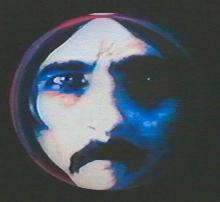
1. The birth of the star child (2001).
2. The return of the robin (Blue Velvet).
3. The dance of death and his followers, hand in hand (The Seventh Seal).
4. The dancing rooster machine (Stroszek).
5. The bleeding elevators (The Shining).
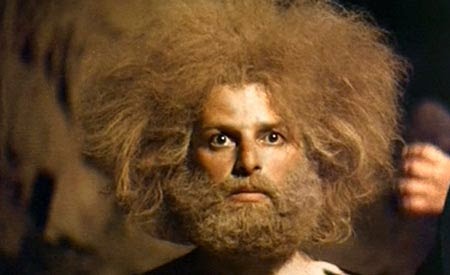
6. Merrick's dream (The Elephant Man).
7. Scottie's dream (Vertigo).
8. Rebekah del Rio singing "Llorando" (Mulholland Drive).
9. The car crash and the harmonium (Punch-Drunk Love).
10. Chauncey walking on water (Being There).

Monday, June 05, 2006

Fuck you, Grandma.


You were my little baby girl,
And I shared all your fears.
Such joy to hold you in my arms
and kiss away your tears.
But now you're gone, there's only pain
and nothing I can do.
And I don't want to live this life,
If I can't live for you.
To my beautiful baby girl.
Our love will never die...

- A poem for Nancy Spungeon by Sid Vicious


Sid and Nancy opens the morning after the death of Nancy Spungeon from a stab wound likely inflicted by her lover, ex-Sex Pistols bassist Sid Vicious. Sid (Gary Oldman) stares vacantly as cops try in vain to get answers. This device frames most of the film as a flashback, a story rolling ahead to an inevitably downbeat conclusion. It mirrors the fatalistic, self-destructive spirits of its leads, and it's bloody romantic. While the film is unsparing in its depiction of Sid and Nancy's drug-fueled downward spiral, it also has a heart as big as a dumpster.

John Lydon referred to Sid and Nancy as "mere fantasy...the Peter Pan version" (of course, it's important to note that Lydon is by all appearances an insufferable prick). But it'd be hard to accuse Cox of sanitizing his young lovers; Sid first endears himself to Nancy (Chloe Webb) by throwing himself headfirst into a brickwall, and the pair's romance defies terms like "abuse" and "sadism," existing on its own distinctly chaotic wavelength. These characters are losers by all conventional standards; Sid can hardly play his bass, and Nancy repeatedly calls him "John" in the first reel. Yet as we follow their wild eighteen-month romance through the breakup of the Pistols to Vicious' stab at a solo career to collapse, we come to acknowledge these two as soulmates, for better or worse. Scenes like the one where the couple trashes Sid's house while his mom (an interesting character herself, ignored her) is away veer wildly between manic affection and pure bile. And the ugliness of the lovers is the key to the film's enduring power. When we're asked to believe that Billy Crystal and Meg Ryan could fall in love, both leads are so generically appealing that we assume attraction follows naturally. But when bruised Nancy and bloodied Sid fall into bed together, we know it must be true love. If you're the type of person who defends the wildly implausible emotional instability of Romeo and Juliet as precisely the point, than Sid and Nancy is likely to be one of your favorite films.

The leads deliver two of the all-time great performances in cinema. Gary Oldman's genius is so reliable that it seems to be taken for granted by now; here, in one of his earliest film roles, he not only perfectly embodies the Vicious persona but lends the character layers of depth and sensitivity. He's equally believable quietly asking Nancy for a kiss as he is thrashing the life out of a rock critic. Chloe Webb is revelatory - I haven't seen her in much else (she played Danny De Vito's girlfriend in Twins and has a brief role in Ghostbusters 2), and on the basis of the evidence here, she's criminally underused. Webb achieves the almost impossible feat of a violently unrestrained performance that never quite goes over the top. While Nancy's piercing shreaks ("SIIIID!!!") become a familiar refrain, and her behavior grows steadily worse, she remains utterly endearing. There scenes together have both undiluted passion and razor-sharp precision. While the film gets in some pointed jabs at Malcolm McLaren and the artifice of the punk movement, it's really just backdrop to the love story. Cox creates a playground of alleys, rooftops, and hotel rooms for Sid and Nancy to roam violently through, firing toy pistols and stumbling through glass doors, and the results are magical.

By the time Sid and Nancy reaches the Hotel Chelsea, we've become totally immersed in these two kids, and Cox's unflinching look at their heroin-fueled downfall is almost unbearable to watch. The film's version of Nancy's death is, of course, speculative, but in the context of the film, it's the only believable outcome. The film neither glamorizes nor moralizes their drug use, but depicts with clarity how the drug becomes a logical method of spiritual self-immolation for Sid and Nancy. An earlier scene where Nancy's grandparents politely kick them out of the house prepares us for the end; when Sid asks why they rejected her, Nancy responds, "Because they know me." These characters are who they are, yet the film's ethereal final scene invites not despair but exhilaration. When Titanic ended similarly, it was unsatisfying, as we were asked to believe that Kate Winslet's character shrugged off her husband and kids to get back on that ship with that guy she barely knew. Here, we believe it wholeheartedly. And for whatever reason, though Sid and Nancy is unremittingly grim, it's also incredibly life-affirming; I always finish it with a smile on my face.

Sidenote:

Jess, my girlfriend, called me yesterday during the final minutes of the film and asked what I was doing. "Nancy Spungeon's about to die," I responded.

"I still can't believe you compared me to Nancy. I hate Nancy."

"Yeah, well, she hated herself."

"That's true."

"Anyway, I meant it as a compliment."

"But she's so shrill and annoying!"

"I think she's alright...I feel like we're always one bad decision away from complete self-destruction."

"Awww...I love you too!"

Sunday, June 04, 2006

The Trim Bin #26


- Friday night's screening of Back to the Future at the Cinemark was packed with a rowdy, appreciative audience. The movie is the perfect crowd-pleaser; even though most of the audience had seen the film before, there was spontaneous applause in several spots. July brings Terminator 2 and hopefully another fun collective experience of the kind that we film geeks live for.

- Rob Zombie is directing the next installment in the Halloween series. I'm not much of a Bond fan, but I think I understand the 007 crowd's anxiety over Casino Royale, because I'd love to see the film meet the highs of the original. Or part II. Or at least part 4. Anyway, I wonder if Sid Haig will play Donald Pleasance.

- The screenwriting process carries on at a snail's pace. It's like Whack-a-Mole: when one problem has been successfully clobbered, another rears its ugly, toothy little head. The story is more or less in place; now all I have to do is figure out what the characters, you know, say. There also remains the persistent question of tone; the choice of whether to push the story in a funnier, or scarier, or more reflective direction opens up opportunities at the same time as it closes others. And what I believe to be every filmmaker's nightmare has already happened; a sequence I'd imagined as a cornerstone of the film has turned out to be strikingly similar to another work (in this case, Charles Burns' brilliant Black Hole). My choices are to defend the similarities as unintentional (as Terry Gilliam did with Brazil and 1984), push them further in the direction of homage, or start from scratch. I really just want to get behind a camera.

- Re-watching Sid and Nancy today, I found myself reflecting on the fact that Alex Cox desperately needs to make another movie that lives up to the one-two punch of Repo Man and this. I mean, it's been twenty years. Which auteur are you rooting for to make a comeback?
Thursday, June 01, 2006

Play the game (6/1/06)

Last week: The Dark Crystal

Wednesday, May 31, 2006

Oh my stars and garters.


Late in X-Men: The Last Stand, a character begins quoting Churchill before cutting himself off with "Ah, you get the point" and resuming an action sequence. That's typical with The Last Stand (horrid title), a film that ain't got no time for speechifyin when there's punchin' and clawin' to be had. Like Joel Schumacher's contributions to the Batman franchise, it represents a startling rejection of just about everything that made the earlier films worthwile. In short, it's every bit as stupid, lazy and disposable as you think it is.

The first X-Men was filled with cornball moments (My favorite is Senator Kelley's "Bleech!"), but it also had real audacity and vision - the opening scene, which used Holocaust imagery to stress the urgency of its own persecuted minority story, could have been a disaster but somehow worked under director Bryan Singer's sure hand. In X2, everything came together nicely - the cast had begun to gel as an ensemble, Singer's abilities as an action director had grown considerably, and the ending had me psyched for a sequel. This brings us to The Last Stand, which, after two flashback scenes and an opening credits sequence stolen from Hulk (only louder and less elegant), opens with explosions and incoherence as the principals run around shouting one-liners in a scene that turns out to be completely beside the point - it exists only to be loud, as is true of most of The Last Stand. The film's two plots revolve around a "mutant cure" that divides the mutant population over its ethics and the resurrection (via telepathy bubble) of Dr. Jean Grey (Famke Janssen), reborn as the all-powerful id-creature Phoenix. This story is told with a cast of approximately three hundred mutants, none of which are fleshed-out in any specific way. There just here for action figure fodder.

The mutant concept was used nimbly in the first two films as an a metaphor for minority rights, summarized most perfectly in X2 when Mystique (Rebecca Romijn) responded to the question of why she doesn't use her shape-shifting powers to look normal with "Because I shouldn't have to." It's not subtle, but it's a masterpiece of understatement compared with The Last Stand, which uses basically the same shot of protesters outside a "mutant cure" clinic several times in case we didn't get the hamhanded connection to abortion (or Terri Schaivo, or gay marriage, or whatever) in the first place. The X-Men movies were built to sermonize, but topical sermons are just the worst - they never hold up over time, and this sucker is going to fade fast. And worst off all, the film sidesteps saying anything provocative about any of this; its conclusion is more or less "Well, that's just like, your opinion, man." Co-screenwriter Zak Penn, who co-wrote and directed the brilliant Incident at Loch Ness - which satirizes exactly this sort of wrongheaded, homogenizing Hollywood mentality - should know better.

Now we come to the subject of director Brett Ratner. I refer to Truffaut: "A director possesses a style that one will find in all his films, and this is true of the worst filmmakers and their worst films. Differences from one film to the next - a more ingenious script, superior photography, or whatever else - don't matter, because these differences are precisely the product of exterior forces, more or less monney, a greater or shorter shooting schedule." These words could have been written for Ratner, who with Red Dragon had one of the greatest casts of all time and produced a just-okay film, and here is given an army of special effects technicians working at the top of their games and gives them absolutely nothing of interest to do. Favorite characters die in this film; I should have cared, but instead I was insulted at the cheaply manipulative, poorly timed and executed offing of some damn fine X-Men. Other characters, like Rogue (Anna Paquin) and Kitty Pryde (Ellen Page) are wasted to provide more screentime for the worthess Storm (Halle Berry, who must have whined to Fox execs a whole lot). Characters like Angel (Ben Foster) come and go without being given any opportunity to make an impression. The Last Stand fails even as an action movie; it's the most incoherently edited film since the advent of Michael Bay, and fails to create or sustain even a moment's worth of genuine tension at the proceedings. By the time Magneto assembles the cast of Rent for a last stand (the title ain't lyin'!), I felt like I was watching some kind of idiot's Rorschach test, and I was failing.

I could go on an on, but this would just turn into a laundry list of bad decisions, from testicle-centric humor that would have seemed stale in 1991 to the feeble one-liners to Kelsey Grammer as Beast (toss your salad, you worthless hack). Oh, and through in casual misogyny for good measure! I just have this to say: over the years, there have been hundreds of wonderful, escapist movies that told thrilling tales with imagination, humor, and vitality. The Last Stand offers no such pleasures; I defy anyone to explain to me why exactly it is fun. Because it's loud? Because things happen? Because it has special effects? I'm so sick and tired of the "shut your brain off at the door" defense - we deserve more. If you gladly devour overprocessed slurm like this and ask for seconds, than you have no right to complain that movies aren't better. There's just no way around it: this is a tale told by an idiot, full of sound and fury, signifying nothing.

Monday, May 29, 2006

You're in a desert, walking along in the sand when all of a sudden you look down...


Usually, internet memes are totally disposable. But this one, from Sergio Leone and the Infinite Fly Rule, is unusually thought-provoking. After four full-length reviews in a week, I thought this might make for a fun grab bag of opinions. Feel free to add your own answers.

1) What film made you angry, either while watching it or in thinking about it afterward? I know I'm very much in the minority on this one, and I'd love to have my mind changed. But Caché, to me, is the very definition of pretentious, using art-house conventions (extended static shots, no music score, an unresolved mystery) to tell what is essentially a empty, simplistic story. The central conceit is a blatant rip from Lost Highway, where it was used with more wit and style. And while a delibarate pace can be exhilarating, in Cache it adds up to nothing. While others found its message disturbing, I found it banal; worse, it exhibits nothing but resignation towards the prospect that we are all haunted by our sins and doomed to repeat them again. This makes the final, "optimistic" shot just seem crass and insincere, and if art cannot at least hold out the possibility of understanding with a straight face, than it holds no interest for me.
2) Favorite sidekick Wang Chi (Dennis Dun) in Big Trouble in Little China; Dun and the filmmakers manage to subvert the sidekick archetype brilliantly, as Wang is in every way superior to the ineffectual, blowhard hero Jack Burton (Kurt Russell).
3) One of your favorite movie lines "Y'all know me. Know how I earn a livin'. I'll catch this bird for you, but it ain't gonna be easy. Bad fish. Not like going down to the pond and chasing bluegills and tommycocks. This shark, swallow you whole. No shakin', no tenderizin', down you go. And we gotta do it quick, that'll bring back your tourists, put all your businesses on a payin' basis. But it's not gonna be pleasant. I value my neck a lot more than three thousand bucks, chief. I'll find him for three, but I'll catch him, and kill him, for ten. But you've gotta make up your minds. If you want to stay alive, then ante up. If you want to play it cheap, be on welfare the whole winter. I don't want no volunteers, I don't want no mates, there's too many captains on this island. Ten thousand dollars for me by myself. For that you get the head, the tail, the whole damn thing."
4) William Holden or Burt Lancaster? Holden, no contest, for squeezing more pathos out of the words "Let's go" than I ever thought possible.
5) Describe a perfect moment in a movie I've always been fairly certain that Wes Anderson made The Royal Tenenbaums for the scene where Richie (Luke Wilson) is meets his adoptive sister and unrequited love Margot (Gwyneth Paltrow) at a bus stop. The mad cap pace of the film comes to a standstill as Margot steps off a bus, accompanied by the opening strains of Nico's "These Days." In slow motion, Margot approaches Richie, their faces etched in silent longing, and they embrace. Not only is the moment a masterpiece of audiovisual composition, it's unabashedly beautiful and moving.
6) Favorite John Ford movie The Searchers, no contest. If more westerns were this thematically dense, the genre wouldn't carry its unfortunate stigma.
7) The inverse of a question from the last quiz: What film artist (director, actor, screenwriter, whatever) has the least–deserved good reputation, artistically speaking. And who would you replace him/her with on that pedestal? I'm tempted to say Michael Haneke, but I'll reserve final judgement until I see more of his work. So I'll go with Troy Duffy, patron saint of schmoes. It's inexplicable to me how much otherwise intelligent people love The Boondock Saints (its fan base is evenly divided between the Irish and the wannabe-Irish). I assumed that the documentary Overnight, which reveals Duffy not only as a hack but also an unbearable ass, would put a stop to this lunacy; sadly, it hasn't changed a thing. Scary to think that if Boondock Saints 2 were actually made, it would probably gross well over a hundred million dollars.

I'd boot Duffy from the "New England's Own" pedestal and replace him with Brad Anderson, director of the madly underrated Session 9. The film is not only the scariest so far this century; it also makes brilliant, evocative use of its digital cinematography and well-drawn characters, a group of likeable, struggling working-class New Englanders. The backdrop, characters and genre elements intersect to giddily creepy effect. While his previous romantic comedies and his most recent film The Machinist, don't have the same impact, they still show a great deal of promise.

8) Barbara Stanwyck or Ida Lupino? Lupino, both for her work as an auteur and her appearances on radio shows like "Suspense" with actors like Vincent Price; I loaned a bunch of recordings from the local library when I was nine or ten, and spent a wonderful weekend getting the heebie-jeebies in my basement.
9) Showgirls -- yes or no? Yes, while I drink moonshine out of my Showgirls tie-in shot glass.
10) Most exotic or otherwise unusual place in which you ever saw a movie I once watched Jumanji on a video projector in a church. That's about all I've got, unfortunately.
11) Favorite Robert Altman movie Nashville. "You may say that I ain't free/But it don't worry me"
12) Best argument for allowing rock stars to participate in the making of movies David Bowie as Thomas Jerome Newton in The Man Who Fell to Earth. It's not only the greatest rock-star performance, it's one of the great film performances, period. "Get out of my mind!"
13) Describe a transcendent moment in a film (a moment when you realized a film that just seemed routine or merely interesting before had become become something much more) The shower scene in Psycho is the ultimate example of this, recontextualizing the more conventional intrigue of the first forty minutes and upping the stakes immeasurably. Hitchcock kills his own movie; it's an incredibly ballsy moment in cinema.
14) Gina Gershon or Jennifer Tilly? Jennifer Tilly, who despite often appearing in crap is incredibly witty, perceptive and likeable (see her Bride of Chucky diaries).
15) Favorite Frank Capra movie Mr. Smith Goes to Washington, one of the best arguments for unabashed idealism around.
16) The scene you most wish you could have witnessed being filmed The stimulation of the enormous mechanical vagina in The Holy Mountain.
17) Robert Ryan or Richard Widmark? Widmark, for the wheelchair scene in Kiss of Death.
18) Name a movie that inspired you to walk out before it was finished Evolution; not the worst movie ever made, but a thudding, medoicre disappointment from the likes of Ivan Reitman and Julianne Moore.
19) Favorite political movie Nashville again. I'm voting Hal Phillip Walker in '08.
20) Your favorite movie poster/one-sheet, or the one you’d most like to own The poster for Alien, as mentioned before here, is one haunting work of art.
21) Jeff Bridges or Jeff Goldblum? With respect to the Dude, I'd have to vote Goldblum, who has been doing stellar, idiosyncratic work for over thirty years, from Nashville (again) to Invasion of the Body Snatchers to The Adventures of Buckaroo Banzai to Jurassic Park to The Life Aquatic. And then, of course, there's his underrated, heartbreaking work as Seth Brundle in The Fly. Drink deep, or taste not the plasma spring!
22) Favorite Ken Russell movie Altered States, a film that truly earns the adjective "mind-blowing."
23) Accepting the conventional wisdom that 1970-1975 marked a golden age of American filmmaking in which artistic ambition and popular acceptance were not mutually exclusive, what for you was this golden age’s high point? (Could be a movie, a trend, the emergence of a star, whatever) This is a tough one. Let's go with the emergence of Jack Nicholson as a leading man. 70-75 saw Five Easy Pieces, The Last Detail, Chinatown, The Passenger, One Flew Over the Cuckoo's Nest and more. It's as good a streak as any actor has ever had. Jack Nicholson is the face of the seventies.
24) Grace Kelly or Ava Gardner? Rear Window makes this a no-brainer.
25) With total disregard for whether it would ever actually be considered, even in this age of movie recycling, what film exists that you feel might actually warrant a sequel, or would produce a sequel you’d actually be interested in seeing? I'd love to see Jodorowsky's long-gestating El Topo sequel.

Sunday, May 28, 2006

The Trim Bin #25


- Marie Antoinette and Southland Tales both received boos at their Cannes premieres; this makes me want to see Sofia Coppola and Richard Kelley's newest films even more. Films booed at Cannes include Fear and Loathing in Las Vegas, Velvet Goldmine, and even L'Avventura. So in my mind, the divisive (and in the case of Southland Tales, downright hostile) response makes both films as important as the Palme D'Or winner (Ken Loach's The Wind That Shakes The Barley; never been much of a Ken Loach fan, but it does star Cillian Murphy, so I'll give it a try). This doesn't necessarily mean that either film won't suck - The Brown Bunny was booed too - but at least they're ambitious and divisive.

- News of the halfhearted release of the Star Wars trilogy in its original form (I'm the biggest Lucas advocate around, but non-anamorphic on the eve of HD is a slap in the face) was quickly trumped by the announcement of a Blade Runner megaset coming next year and featuring the theatrical, director's, "ultimate," and international cuts. The new "ultimate" cut will also play in select cities next year. I missed the re-release of Alien because the nearest screening was in Connecticut; I won't make the same mistake twice.

- Major pet peeve: the tendency of midnight and repertory screenings to be shown on DVD unannounced. Max and I first experienced this a few years ago when we drove three hours to see Tron (shut up) at the Coolidge, only to find that the print had never arrived. Forgivable, except we didn't realize this until we'd bought our tickets and sat down. This month alone, the DVD switcheroo has occured at the Pleasant Street Theater, the Spectrum 8, and even our beloved Brattle. First of all, 35mm is the reason to even attend; the Brattle cited a damaged print, but for me, that's just a romantic reminder of the print's journey across various movie houses. Second, I understand when a print cannot be obtained after a schedule has been announced, particularly with a program as Pleasant Street's "31 Days, 30 Movies" marathon. But it seems unethical to charge full ticket price for a subpar, artifact-ridden presentation, particularly as Pleasant Street's screens are extremely small to begin with. In the interest of full disclosure, Images occasionally shows films on DVD, but only for reduced-price or free screenings as far as I know. And we make up for it with the complimentary shoeshine (ask for Chet).

- Last night I watched The Elephant Man, and it was a case of watching just the right movie at just the right moment. Tears ensued. When's the last time you had a case of cinematic/cosmic synchronicity, when it felt like a movie was speaking directly to you?

Saturday, May 27, 2006

You're so ugly you could be a modern art masterpiece!


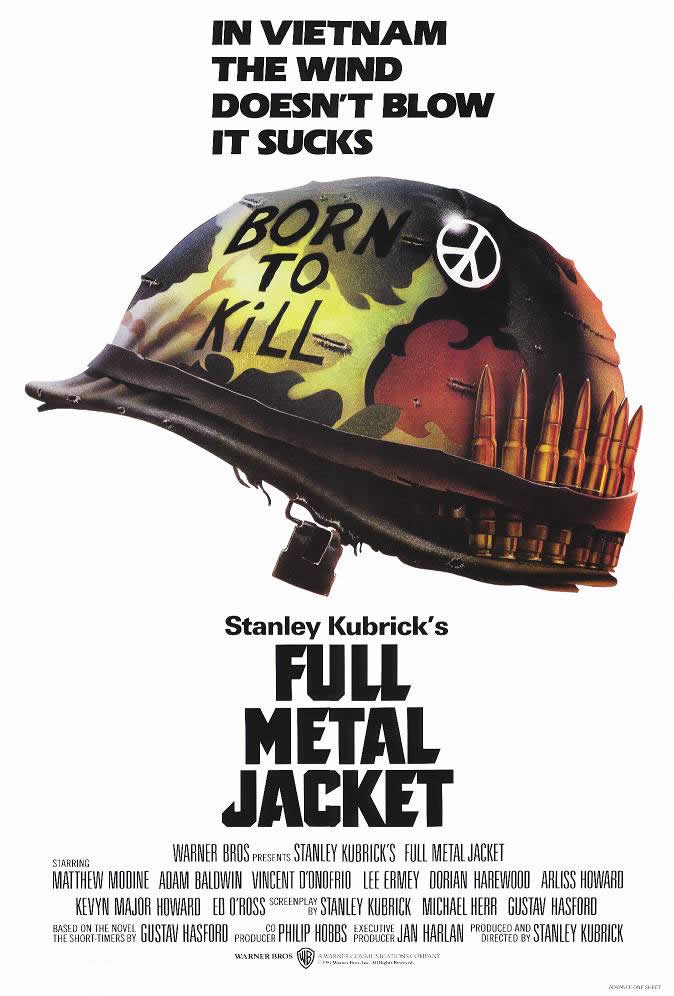
Full Metal Jacket opens, as the twangy "Hello Vietnam" plays on the soundtrack, with a montage of Marine Corps recruits getting buzzcuts. We examine one bored, distracted face after another until the sequence ends with a shot of the piles of hair collecting on the linoleum floor. Their individuality has been stripped away, and the first half of the film is concerned with the military's methods of rebuilding these "unorganized, grabastic pieces of amphibian shit" into a powerful, violent collective. Stanley Kubrick exerts a similar control over his most restrained, calculated film; as with any of his films, it's fascinating to consider how the ideas that drive Full Metal Jacket are mirrored in the director's process.

We follow a platoon of recruits during their training at Paris Island under the delightfully profane Gunnery Sergeant Hartman (R. Lee Ermey). Both the film and Ermey have earned their place in the pop culture firmament, of course, thanks to the character's endlessly quotable dialogue. But to recall Hartman simply as a collection of one-liners is to underestimate Ermey's brilliant performance. A retired Staff Sargeant and Vietnam vet, Ermey lends the film enormous verisimilitude and helps to steer Hartman clear of becoming a cardboard, Strother Martin-like caricature. Ermey was one of the rare actors that Kubrick allowed room to improvise, and his torrents of almost poetic verbal abuse not only lend the film credibility, but also color in shades of ambiguity. On the one hand, we're invited to recoil at Hartman's dehumanizing treatment of the recruits, particularly the dim, sensitive Private Leonard Lawrence (Vincent D'Onofrio), who is dubbed "Private Gomer Pyle." On the other hand, you can sense both Ermey's pride in the role and Kubrick's respect for the character; Hartman is never depicted simply as a sadist, but as a man who is preparing these "maggots" to serve in his beloved Corps. It is a sign of Kubrick's faith in the audience's intelligence that he allows us to answer the question of whether such treatment is necessary for ourselves.

Full Metal Jacket spends a great deal of time establishing the monotonous routines of basic training ("1, 2, 3, 4, United States Marine Corps!"), and it's no wonder that Kubrick, who would put his actors through the paces with dozens of takes, would be drawn to the methodical aspect of the military experience. The man who made Shelley Duvall cry invites us to consider the morality of pushing characters like Private Pyle to the breaking point because they don't fit into a well-oiled machine ("Everything clean"). Our narrator, Private Joker (Matthew Modine), is assigned to whip Pyle into shape, and we share both his compassion for and impatience with poor Pyle. A scene where the recruits give Pyle a brutal beating to teach him a lesson is painful to watch, but rather than going for easy emotional manipulation by allowing us to view the scene from Pyle's perspective, Kubrick shoots the scene from Joker's point of view as he attempts to drown out Pyle's childlike sobs. We share Joker's (and Kubrick's) anger at Pyle's lack of restraint, and so we are partially implicated in Pyle's "major malfunction."

The second half of the film alienates much of the audience, and it is indeed an abrupt tonal shift from Paris Island. Nancy Sinatra announces this shift on the soundtrack; country has given way to rock and roll. Joker (Matthew Modine), now a combat journalist, hooks up with fellow Parris Island graduate Private Cowboy (Arliss Howard) near Hue. These scenes, particulary the "Vietnam: The Movie" sequence, are often dismissed as aimless, but they actually serve as a thorough demythologization of war. John Wayne is frequently name-dropped, but the closest thing we get to John Wayne is Animal Mother (Adam Baldwin), a dull, racist meathead. These kids are armed only with their rifles and well-worn cliches about camaraderie and valor learned from movies. Animal Mother's idiocy allows him to inadvertently see the war as it is; when he remarks that if he were to die for a word, that word would be "poontang," at least he chooses something tangible. Ever the pragmatist, Kubrick largely sidesteps political philosophy and depicts Vietnam as the place we sent a lot of well-meaning, naive kids to die.

Kubrick's clinical approach turns chilling in the final scenes, as a sniper offs several troops. Each death is accompanied by a hollow blast on the soundtrack that echoes the film's icy electronic score (composed by Kubrick's daughter, Vivian). The director is a master of irony, using it not as a cheap, sarcastic tool but as a microscope that exposes underlying truths; here, the well-oiled military machine is severely crippled by one resorceful individual. It's enough to turn Private Joker, who wears a peace symbol and a helmet reading "BORN TO KILL," from a detached outsider to a "hardcore" killer. The war/sex parallel seen throughout the film and previously in Dr. Strangelove comes into focus here, as Joker is "born again hard." He's a walking erection, and rather than editorializing, Kubrick leaves us to decide whether this is evolution or regression. As the soldiers march into the darkness singing the Mickey Mouse Club theme song, we reflect on their homecoming, when they will return to Mickey's world, maybe for the better, maybe for the worse, but definitely not the same.

Friday, May 26, 2006

Laugh away, laughing boy!


Any film that has a deliberately unlikeable lead will probably be met with a negative respose. So while Art School Confidential is a letdown in some ways, I still admire writer Daniel Clowes and director Terry Zwigoff for inviting such scorn. The film is a scathing attack on the often acolytic, unispired nature of any institution that claims to teach an art, and it's absolutely merciless to those who buy into the idea that they can learn how to be "the greatest artist of the twenty-first century." So while the film is often aimless, I still found myself laughing loudly at its moments of insight.

Jerome (Max Minghella) has just started his first semester at the prestigious Strathmore Art Institute. Jerome quickly falls in love with Audrey (Sophia Myles), a model in one of his classes, and becomes determined to win her affections through his art. But Jerome is soon adrift in a sea of pretension and self-importance, with little guidance coming from his professors, like the pompous Professor Sandford (John Malkovich), who specializes in triangles ("I was one of the first"), or peers like his blowhard roomate Vince (Ethan Suplee) a film student making a hyperbolic movie based on a real-life serial killer prowling the campus. Jerome's only real friend is Jimmy (Jim Broadbent, brilliant), an aging Strathmore graduate who spends his days getting drunk in a tiny apartment and bitterly condemning the rest of humanity.

Zwigoff and Clowes are merciless in their too-true depiction of various art school types - fellow student Bardo (Joel Moore) identifies such familiar characters as the "vegan holy man" and the "beat girl" early on - yet the satire would ring hollow if it weren't for their subtler and more brutal critique on their central character. Jerome repeatedly cites Picasso as his favorite artist, yet he doesn't seem to know much of anything about the artist. He's also quick to emulate others, repeating one of Jimmy's rants in a class, yet he doesn't seem to have many ideas of his own. Much of the film is made up of Jerome looking soulfully at Audrey from across the room, or morosely wandering down streets at night. It's possible that much of the negative response to Art School Confidential is tied into the protagonist's hollowness, but I think that's exactly what Zwigoff and Clowes are going for; Jerome has ambition, but it's vague and passive. The irony is that he's a decent painter, better than most of his fellow students. But while he's right to question their pretensions, he doesn't really have anything to say either. He's a total cipher, and despite his declarations of love for Sophie, his emotional range doesn't really extend beyond horniness and self-pity. He has a lot of growing up to do.

The film enters into shades of Argento and Hitchcock halfway through, and I found that I actually liked this shift quite a bit in terms of what it reveals about the characters. My disappointment with the film derives more from the sense that Zwigoff and Clowes aren't always on the same page. While their humor is wonderfully dry and understated, sometimes the film simply becomes vague and aimless. Many scenes trail off rather than arriving anywhere, and several characters, like Anjelica Huston's compassionate professor Sophie and Steve Buscemi's gallery owner Broadway Bob, could have been explored more fully. The film also has a weird, vagulely condescending attitude towards its gay characters; I'm not really sure what the joke is, and the parts that are evident are sort of familiar and below both the writer and director. When Art School Confidential works, such as the Thanksgiving scene where Jerome receives well-intentioned but terrible advice from his clueless family, it works wonderfully. And both Minghella and Myles are great. But after Ghost World, which worked not only as razor-sharp satire but as a bittersweet exploration of misfit malaise, it is something of a letdown.

Monday, May 22, 2006

I've been tasting roads my whole life.


Here's what I wrote about My Own Private Idaho a year ago in my notebook:

"River Phoenix was so fucking good. Fuck heroin."

These are the sort of earnest declarations, rarely seen after adolescence, that some of the great films can inspire. My Own Private Idaho is one of those films; it's that rare cinematic treasure that speaks to our hearts and minds with equal measure. The film's main character is asleep and adrift, carried through life in the arms of strangers. Anyone who denies relating to him is a robot.

The film opens, as a cheerful title card informs us, in Idaho, on a lonely stretch of road. Mike Waters (River Phoenix), a young street hustler and drifter, is wandering along; we don't know where he's been or where he's headed, and neither does he. Before collapsing with a bout of narcolepsy, Mike remarks that he recognizes this road - it's "like a fucked-up face." Mike squints, and we share his point of view; the camera irises in, and we'd have to agree that it does, indeed, look like a fucked-up face. As we follow Mike on various tricks, from Seattle to Portland to Italy and always back to Idaho, we are always invited to see the world through his eyes. And while Van Sant does not flinch away from the seedier aspects of street life - multicolored porn in a dingy store, stories of violent johns, Udo Kier - the result is never self-consciously gritty or "real." Instead, the film, like Mike, revels in a heightened reality, one that is bittersweet, funny, and romantic.

It's a world where characters like fellow hustler Scott Favor (Keanu Reeves), who plans to end his wayward life on his twenty-first birthday and assume control of his father's empire, and their corpulent father figure Bob (William Richert) can unknowingly echo Prince Hal and Falstaff. The riff on Shakespeare could have easily been insufferably arch, but instead it makes for a beautiful gesture, taking something that has been made elitist and giving it back to the groundlings. But Shakespeare is only one of Idaho's densely woven tapestry of allusions. The soundtrack veers between the haunting echo of Marty Robbins' "Cattle Call," the syrupy sweetness of Elton John's "Blue Eyes," and a lone guitar picking "Home on the Range" - these songs are mixed in wind, water, and overheard conversations, as though they were being sounded by the heavens. A brief scene of Mike laughing at a Simpsons episode is weirdly enchanting, and the image lingers reflected in a window, out of focus, ephemeral. And his dreams of his long-lost mother are shot on super-8, like an old home movie; memories and celluloid become one and the same. It's a world that is at once constructed and organic, where there is little to distinguish waking life from dreams.

In the midst of this gleefully chaotic smash-up comes the scene that makes My Own Private Idaho an indisputable masterpiece. Mike and Scott are sitting at a makeshift campfire in the middle of the night, in the midst of a search for Mike's mother. With six words - "I really wanna kiss you, man" - the film immediately and sharply cuts deep into the hearts of anyone who has suffered unrequited longing. After quite an elusive, complex first hour, Van Sant's decision to address the central meaning of the film so directly must have seemed a dangerous proposition. The film, so delicate, could have fallen like a house of cards under the weight of such unabashed romanticism. But it's a credit to Van Sant's vision, and the two leads, that the scene works so wonderfully. The bulk of the credit has to go to Phoenix, who never strikes a false note in the whole film. Look at him laughing in the background at Bob's wild stories, or cradling himself like a child as he tells Scott's new girlfriend that he knows how she feels - he is unabashedly, nakedly human.

Still, I've only begun to scratch the surface. The film is crammed with great characters, from Reichert's pompous, scraggly den mother to Mickey Cottrell's spooky bit as Daddy Carroll. As a piece of filmmaking craft it's perfect - every shot and cut are just as they should be. And yet none of this would matter if the film didn't have an emotional center, and My Own Private Idaho has a heart as big as Boise. When we leave Mike, he's just left on a new journey. We don't know any more about where he's headed then we did at the start, but he's not without love anymore; the miracle of cinema is that we've grown to love him. It'd be easy to read the last words - "Have a nice day" - as sarcastic, but I prefer to take them at face value. Van Sant sees our basic desires so clearly. He never strikes a dishonest note, but manages to tell us a very heartfelt story about a narcoleptic prostitute, motherless and adrift, who wants nothing more than to be held. What a beautiful film.

Sunday, May 21, 2006

Oh my God Almighty! Someone has sent me a bowel movement!


The term "cult film" has always seemed vague to me, because it's difficult to draw a line between cult and popular appeal. Can The Rocky Horror Picture Show still be considered a cult item after grossing hundreds of millions of dollars from screenings, video, and related merchandise? Would Napoleon Dynamite, with its massive advertising push on MTV and Nickelodeon, have found its audience if it were released with less fanfare? However, if there is any such thing as a true cult film, that film is Pink Flamingos. Made on 16mm in the Baltimore area in 1971, John Waters' film was propelled to widespread appreciation with only a shoestring budget and a cheerful willingness to defy even the most basic standards of taste.

Divine plays Divine, also known as Babs Johnson, who lives in a trailer with her chicken-loving son Crackers (Danny Mills), their girlfriend Cotton (Mary Vivian Pearce), and Divine's egg-devouring mother Edie (Edith Massey). Their quiet life of shoplifting, bestiality, and eggs is interrupted by Connie and Raymond Marble (Mink Stone and David Lochary), who aim to challenge Divine's clan for the title of "the filthiest people alive." The Marbles, incidentally, make a living kidnapping and impregnating young women with the help of their assistant, Channing (Channing Wilroy). This admittedly flimsy plot is an excuse for ninety minutes of scatology, weird sexual fetishes, incest, gore, and genital gymnastics. And I never stopped laughing.

It would have been extremely easy for Pink Flamingos to come off as smug and repugnant, but Waters and the cast invest the film with a charming guilelessness; it's the cinematic equivalent of the look in a golden retreiver's eyes as he humps your leg. The camera is unflinching when presenting us with, for instance, a man with a sausage tied to his penis, and yet the setup in the film is so cheerfully goofy that one can't help but laugh. Pink Flamingos is using filth to challenge mainstream standards about gender and deviance, yet it does so with a wink and a smile. Comedy, particularly gross-out, has rarely been used so effectively as a weapon of subversion.

The filmmaking is admittedly rough. Most scenes are shot from one angle without cuts, flubbed lines remain in the final cut, and the cinematographic technique is mostly "zoom in, zoom out." Yet this doesn't really hurt Pink Flamingos; if anything, the home movie look of the film adds to its charm. And while none of the actors were trained by Stanislavski (or even James Lipton), they manage to create winning, compelling characters. Massey's extended monologues professing her love for eggs and "the egg man" rival Bunuel. Lochary rants about "the fucking jerk-off hippies" with his lisping drawl and exposes himself to young girls with gusto. But the real unheralded star of Pink Flamingos, to me, is Mink Stole; with fireball red hair and cat glasses, the petite, unassuming actress hornily sucks her on-screen husband's toes while proclaiming that she loves him "more than the sound of bones breaking." She's simultaneously the scariest and most intriguing aspect of Pink Flamingos.

And then there's Divine, who completely earns her name. The plus-size transvestite is at once superstar, tramp, and circus geek, and cheerfully embraces every role. Divine is at home acting out Sirk-style melodrama as he is fellating his onscreen son. He approaches every transgressive or degrading act with total commitment and gusto. He manages to eat dog shit with a big grin and walk away with his dignity intact. Divine is a role model.

About the shit-eating: the scene endures because it's unparalleled in its gross-out power, but also because it's a perfect, iconic moment. Tristan Tzara frequently claimed that the greatest compliment to his plays would be for the audience to riot; Waters comes close, working us into a fit of simultaneous repulsion and maniacal laughter. Divine stares directly at us, excrement smeared on his teeth, grinning as he chokes bag his own gag reflex. It's a moment that anticipates the synthesis of exploitation, porn and pop culture that would occur over the next thirty years. It's one of the great moments in cinema.

Thursday, May 18, 2006

Coming Attractions


Back from, and in some ways still in the midst of, a whirlwind tour of the region's big screens. Seen on 35mm this month: Fargo, Blue Velvet, Pink Flamingos, My Own Private Idaho, Badlands, and Days of Heaven. Still to come: King Kong and Full Metal Jacket. Expect multiple articles on the experience (any preferences?). To say things have been busy would be an understatement; the past few weeks have brought a graduation (diploma's in the mail), a violent car crash for my parents (who emerged unscathed, thankfully), and the rediscovery of true romance founded on celluloid and dreams. Also, a honkin' tv set. Here's to irresponsibility and adventure. Here's to the future.

Sunday, May 07, 2006

The Trim Bin #24


- "The State of Cinema" - Tilda Swinton's recent speech at the San Francisco Film Festival. Not much to add, except to say that Tilda Swinton gets it.

- Alida Valli died on April 22 at the age of 84. Valli's film credits include Eyes Without a Face, 1900, and her memorable performance as Mrs. Tanner in Suspiria. But her most enduring character is Anna, Harry Lime's girlfriend, from The Third Man. The final shot of Valli strolling right by a defeated Joseph Cotten is a great image in a film full of great images; it perfectly summarizes the struggle between romance and cynicism that permeates the film.

- Read a New Yorker piece on Werner Herzog recently; it mostly regurgitated thirty-year-old stories about Klaus Kinski, but the bits about tension during the making of Rescue Dawn were fascinating. Before shooting began, one of the production execs showed Herzog The Rundown in the hopes that the director would consider working with the cinematographer from the Dwayne Johnson vehicle. Really think about that.

- Jess and I checked out Albany's Spectrum 8 Theatres on a whim last night; it was worth the trip. The cinema has a gorgeous marquee and a comfortable interior, and straddled the line between multiplex and art-house wonderfully. Plus, they have a great midnight series on Fridays. Dawn of the Dead is this week (I'll actually get to see it on a big screen for the second time), and next week is Grey Gardens (which I'll get to see for the first time this way). Which brings me to a very difficult question regarding June 2nd: Back to the Future or The River's Edge?

- "And then you mix it all together and that's more or less it."

Wednesday, May 03, 2006

Sunday, April 30, 2006

Heineken? Fuck that shit! Pabst! Blue! Ribbon!


Why do we value our favorite things? Why do we even take the time to designate favorites? What does our relationship with the artworks that most profoundly move us say about who we are? My favorite song is "Tangled Up in Blue," my favorite book is Franny and Zooey, and now, my favorite film is Blue Velvet. The film was comfortably residing in the bottom half of my top ten until a few weeks ago, when something was irrevocably shaken. As Bruce Willis' character in 12 Monkeys points out, the film remains the same - we're the ones that change.

"She wore blue velvet/Bluer than velvet was the night/Softer than satin was the light/From the stars"

The song "Blue Velvet" describes a haunting, fleeting romance that has now been lost; Bobby Vinton's voice aches as he sings about the velvet he can still see through his tears. The song is deceptively simple, and it forms a perfect marriage with the opening sequence of David Lynch's film. Tranquil images of suburbia give way to a startling moment of violence (Jeffrey's father clutching his neck and dropping to the ground) and a hidden layer of chaos (the insects attacking each other right under our noses). It's easy to read these early moments as a declaration of our world's fundamental savagery and the ways we sweep our indescretions under throwrugs lovingly purchased at Linens 'n' Things. But it's more than an attack on the American dream; it's also an affirmation of the power and importance of such dreams. Lumberton is a world where light and dark coexist, and Blue Velvet is about the collision of these two opposing forces in Jeffrey Beaumont (Kyle MacLachlan), who is either "a detective or a pervert." Or maybe both.

Jeffrey is a college student who has returned to Lumberton, his hometown, because his father is ailing. One day, walking home from the hospital, he discovers a human ear lying in a field. After reporting it to the police, he and a detective's teenage daughter, Sandy Williams (Laura Dern), begin their own Nancy Drew-esque investigation. This leads them to Dorothy Valens (Isabella Rossellini), a mysterious chanteuse. Dorothy's son and husband are being held captive by Frank Booth (Dennis Hopper), a gas-sniffing monster who has trapped Dorothy in a violent, perverse, sadomasochistic relationship. Through the course of the film, Jeffrey veers between Sandy, who dreams of robins that spread love throughout the world, and Dorothy, who describes sex as a disease. While this description may make Blue Velvet's sexual politics sound binary and simplistic, to view the film is to realize that Lynch's message is anything but simple.

See my breast? You can feel it. My nipple. Still hard. You can touch it. You can feel it. Do you like the way I feel?

Yes.

Feel me. Hit me.

The first third of Blue Velvet establishes an offbeat yet reassuringly familiar and comic environment. We're invited to laugh with Jeffrey and Sandy as they stumble along on their amateur sleuth work. The kids have a cute chemistry; perhaps, we think, they'll kiss in the last reel. Then Jeffrey decides to spy on Dorothy from her closet, and Blue Velvet suddenly flies violently off the rails. It's frankly a marvel that the film works at all; the scene in Dorothy's apartment rips us from our comfort areas and drags us into the darkest areas of human emotion via raw, lurid sexuality. We are first, through Jeffrey, confronted with our own voyeuristic intentions. When Dorothy asks Jeffrey if he likes to watch women undress, she is asking us as well. As Jeffrey is forced to strip and engage in a sex act that is as arousing as it is terrifying, we have no choice but to acknowledge the same conflict between desire and fear in ourselves. With Frank's entrance, identification gives way to something at once alien and familiar - Hopper is terrifying in the role because he is at once utterly evil and heartbreakingly human. And funny too - our apprehension at the brutal near-rape at the center of the film is undercut by our awareness of Frank's utter ridiculousness. Each punch to Dorothy's face, each cry of "Don't you fucking look at me!" is charged with horror and eroticism, dread but also a perverse curiosity, as well as the nagging question of whether this is all a joke. Frank leaves, and Jeffrey is left to cradle Dorothy, who offers herself to him in a way that is wrenchingly needy. Her red, ripe lips fill the frame, begging us to hurt her as though nothing would be more pleasurable. Even the squarest cat in the audience would have to concede that this is intriguing and sort of hot. In about ten minutes of running time, Blue Velvet delivers on the promise of its opening sequence, pulling back the reassuring mask of indie quirk to reveal something darker and infinitely more complicated. Lynch excells at this sort of switch, and many of his imitators have failed to repeat his magic; they copy the weirdness without finding the soul within.

I'm seeing something that was always hidden. I'm involved in a mystery. I'm in the middle of a mystery and it's all secret.

You like mysteries all that much?

Yeah. You're a mystery. I like you very, very much.


The crime plot in Blue Velvet is incidental. It serves a functional purpose in bringing the characters together, and as we only know what Jeffrey knows (very little), it serves to remind us that there is so much beyond our frame of reference. The mysteries Jeffrey is pursuing are the mysteries of love referenced on the soundtrack; all of the main characters are driven by romantic longing in one way or another. Sandy is an innocent attracted to Jeffrey's perversion and capacity for cruelty (note the subtle moments when he manipulates the younger girl into giving him what he wants). Jeffrey, in turn, idealizes Sandy; she's the wide-eyed girl that he can take home to mom and dad. Lynch reserves the heart of the film for Sandy, and Dern delivers the famous "robins" speech with perfection, underlining Sandy's optimism and quiet yearning. The speech moves Jeffrey, yet in the next scene, he's back at Dorothy's apartment, the two of them locked together like figures in a painting by Francis Bacon (Lynch's favorite artist). Sandy is the girl that Jeffrey dreams of; Dorothy is the woman he jacks off to. Lynch is treading on the borders of misogyny here, yet his message is more complex. Sandy has elements of darkness (why does she forgive Jeffrey so easily?) and Dorothy has light (she started everything, at least, to save her family). Lynch is exploring the ways that love can send people spiralling in dramatically different directions. Love can mean soft kisses while slow-dancing at a high school party, and it can also mean wandering naked, beaten and dazed through someone else's yard. Both are equally possible, and Lynch only reserves his indifference for those who are simply incapable of experiencing real emotion (the running joke of Sandy's dim, cardboard boyfriend underscores this point).

Lynch even has sympathy for his devil. When we see Frank at the Slow Club, clutching a square of Dorothy's bathrobe and silently weeping, we have to accept his humanity. Who is Frank? What happened to turn him this way? Was he just born damaged? Lynch has Jeffrey ask "Why are there people like Frank?" and later has Frank respond "We're the same." It's simple, but that doesn't make it untrue. The captivating joyride sequence, where we meet Frank's fey, "suave" friend Ben (Dean Stockwell), takes us even deeper into the labyrinth. Who the hell is Ben? Stockwell creates a fascinating enigma, a character that is apparently all surface and is capable of total indifference ("Here's to your fuck"). And yet when he lip-synchs to Roy Orbison's "In Dreams," Frank is visibly shaken. There's a power to artifice, and Lynch knows this; it's why we respond so strongly to fictional narratives even though there is no logical reason to do so. We long too - for romance, for strangeness, for kink, for adventure - and Lynch pulls that longing into unexpected places. The scene by the side of the road, where Frank repeats "In Dreams" to Jeffrey while showering him with kisses (because this movie needed homoeroticism, it just wasn't strange enough otherwise), lays bare the unabashed emotion - the love, the hate, the fear and wonder - that is at the heart of both Lynch's work and the whole bloody history of human experience.

"Sometimes the wind blows/And you and I/Float in love/And kiss forever/In darkness"

It's an oft-overlooked aspect of the Lynch canon that while he treads heavily in darkness, his films are ultimately very optimistic. Lost Highway is the only one that ends in a truly downbeat manner; Eraserhead, The Elephant Man, Twin Peaks: Fire Walk With Me, and Mulholland Drive all contain the promise of transcendence beyond this life; Dune, Wild at Heart, and The Straight Story all hint at the possibility of peace on earth. Blue Velvet is unique in that it preposes a reconciliation of light and darkness. The hero ultimately defeats the monster by confronting the darkness existing within him (would the Jeffrey we meet at the start of the film be capable of figuring out the radio bit?). Peace is wholly restored - we see families united, and the last image is of a mother holding her child before the camera tilts upwards to the sky. And yes, the robins return. And yes, famously, the image looks patently artificial. But no, it's not just a glib joke. It's a challenge - knowing what we know now, can we accept that which we see? But on the other hand, having touched darkness, doesn't that make the light all the more valuable?

I realize I'm becoming vague, and that is because the ending of Blue Velvet is something I've changed my mind about countless times - it's a giant question mark. And that's why I love it. I've come to recognize life as a mosaic of different feelings and experiences that clash and intertwine in both violent and lyrical ways. This film, more than any other, reflects life as I know it - scary and sexy and funny and elusive and beautiful. I hear Sandy tell me that "There's trouble 'till the robins come," and in my heart I know she's absolutely right. It's a strange world, isn't it?

Best. Movie. Ever.

Sunday, April 23, 2006

The Trim Bin #23


- Life interceded this month and kept me quite busy, so I apologize for the recent lack of writing. I'm looking forward to returning to routine updates; movies took a backseat to life, and I haven't actually seen much (save for Inside Man, which was slick but disappointing). Thanks to all friends who have given support; I've got to admit it's getting better. Interestingly, the only film I found myself watching (and re-watching) during much of the past few weeks is Blue Velvet, and I'm prepared, after much thought, to declare it my favorite film. Look for an extensive argument for this choice very soon.

- This morning I went with Jess C. to a quiet spot along route 2A and made a film. It was, quite honestly, one of the most delightfully easy and rewarding directing experiences I've ever had. The light this morning was perfect, and Jess delivered a stirring, guileless performance. I can't wait to show it off (just needs a few trims and titles); I'd also like this to become a series of shorts in the same vein, so if anyone would like to sing to no music in the future, please let me know.

- On Friday night I discovered an inebriated film geek's Nirvana. Midnight Snack, hosted by Alan Cumming on IFC, presents a different offbeat movie each Friday at midnight. Of the film/host combos, this is by far the best. Friday night's film was Sgt. Pepper's Lonely Hearts Club Band. It's easily one of the worst films I've ever seen, and it changed my life forever. I immediately ordered a copy and look forward to exposing as many people as possible to this cinematic virus (and of course, to share with my devoted readers here).

- Which moments in cinema actually anger you with their sheer idiocy? This was inspired by catching a few minutes of The Phantom of the Opera on HBO and remembering how much I hate, hate, hate the voguing fancypants that shows up during the "Masquerade" scene. Really, how does Joel Schumacher keep getting work?

Friday, April 14, 2006

Top 10: Audience Identification


These are the ten movie characters I most closely identify with. Not because their life situation has a striking resemblance to mine - in some cases, there is no obvious relation. These are simply the characters I most sympathize with. I'll leave it to you to figure out why, because damned if I know.

1. Mike Waters (River Phoenix), My Own Private Idaho
2. Jeffrey Beaumont (Kyle MacLachlan), Blue Velvet
3. Bobby Dupea (Jack Nicholson), Five Easy Pieces
4. Lux Lisbon (Kirsten Dunst), The Virgin Suicides
5. Larry (Clive Owen), Closer
6. Thomas Jerome Newton (David Bowie), The Man Who Fell to Earth
7. Mookie (Spike Lee), Do the Right Thing
8. Steve Zissou (Bill Murray), The Life Aquatic
9. Betty Elms (Naomi Watts), Mulholland Drive
10. "Quiz Kid" Donnie Smith (William H. Macy), Magnolia

Sunday, April 09, 2006

The Trim Bin #22


- The "Extreme Documentary" panel with Werner Herzog, Faye Ginsburg, and Jonathan Caouette was worth the wait; early on, Herzog advised students in the audience to drop out of school and make a film, and it's clear that a few hours in the presence of accomplished filmmakers sharing insight into their trade is more valuable than many more hours of film classes. Ah, but I'm singing a familiar song. Caouette was charming, self-effacing and lovely as always; Ginsburg seemed a little out of her league, but the selections she brought of films by a culture new to the medium were exciting (particularly the musical). Herzog, of course, responded to even the most asinine questions about Myspace, cell phone cameras and man/bear love with humor and insight. I'm so glad every day that I came to this area - earlier in the day, I sat next to Herzog at another panel (!) - and I can only thank my scatterbrained, spontaneous 18-year-old self for unwittingly stumbling upon a good decision. Who knows, maybe the next good decision will even be premeditated.

I was particularly happy that my friend Kate, who hadn't seen any of the filmmakers' works, was able to take a lot from the evening. It reminded me of the power of the film to reach us where we are. It doesn't take self-conscious "I'm a film geek" posturing to experience the magic of cinema; all it takes is an open heart.

- I'll be making a short in a few weeks with a good friend along a quiet stretch of road. It's the first time I've been behind a camera since Love House, and I can't wait. It's my belief that we don't engineer our ideas - they're out there, floating around, waiting to be discovered and given a form. The idea came to me about two months ago, but it was only yesterday that I realized what it was about. You can't plan these things, really; all you can do is open the door when they come knocking. I don't know what will happen on the day, and that's a wonderful feeling.

Monday, April 03, 2006

The Trim Bin #21


- Werner Herzog, Jonathan Caouette, Frederick Wiseman, and Herbert Sauper are among the many directors appearing this weekend at Williams College and Mass MoCA for the "Extreme Documentary" conference (see the full schedule here). I'm anticipating some interesting tension between the filmmakers and the format, which seems to have been designed for people who don't like cinema. I can't wait, though; Herzog could read selections from the Boxcar Children series and it would be riveting.

- See Slither. My review is forthcoming, but go see it now because you don't have much longer. Often a bomb like this can be attributed to misleading marketing, but Slither's was right on the money, and that might be the problem. I guess people don't like gross-outs as much as I assumed, or maybe those that do simply prefer torture to slime. Kudos to Jack Criddle, who worked on the film at Kleiser-Walczak. Yeah, see Slither. Take the whole family. Do it for Rooker. You know he'd do the same for you.

- I finally got to read the famed Hitchcock-Truffaut; it provides enormous insight into the filmmaking process and is basically required reading for all aspiring directors. The book did what all such interviews, either in print or on video, should do: it confirmed my instincts about some aspects of the process and offered me insight into others that I hadn't considered. After finishing the book, I did an editing analysis of The Birds. The next time you watch the film, pay attention to the restaurant sequence, where Hitchcock veers wildly between humor and dread with pitch-perfect timing. There are some sequences that can tell you more than four years of film studies, and Hitchcock usually has several in a single film.

More and more, my suspicion that the dozen-odd film classes I've taken add up to an appalling dump-heap is being realized. Watching the extras on the King Kong DVD, I realized that Peter Jackson, like Hitchcock and also Spielberg, Lynch, and many others, is more interested in discussing the process than subtext. This is not to say that the subtext isn't there, just that directors (good ones, anyway) don't think like professors. Great filmmakers that are eager to talk about a film's content, like Herzog, do so in a way that raises more questions than answers; they understand that a film is an ongoing process of discovery for both its makers and its audience, and this is as it should be. What I'm trying to say, Prof. Langston, is that if you return one more of my essays with the note "underdeveloped ideas," I'm liable to shit bees.

- Harry Knowles is in love. This is good, this gives me hope.

- General question: favorite Michael Rooker performance?

Wednesday, March 29, 2006