UPDATED: Jess told me today that the ending of Harold and Maude makes her feel alive, and I think I know what she's talking about. There are few more uplifting films, and I can see why that wins out over the aggressively downbeat Raging Bull. But I will say that Raging Bull is personally important because it leaves me confident that cinema is a meaningful art form. That said, any movie that has Ruth Gordon and Bud Cort stealing trees is okay by me.
Saturday, September 23, 2006
UPDATED: Jess told me today that the ending of Harold and Maude makes her feel alive, and I think I know what she's talking about. There are few more uplifting films, and I can see why that wins out over the aggressively downbeat Raging Bull. But I will say that Raging Bull is personally important because it leaves me confident that cinema is a meaningful art form. That said, any movie that has Ruth Gordon and Bud Cort stealing trees is okay by me.
Friday, September 22, 2006
UPDATED: I have a game I play in my head during slow moments at work where I try to think of two films that are the exact opposite of each other. For instance, Body Double is the exact opposite of Shirley Temple's Heidi, and Tango and Cash is the exact opposite of My Dinner With Andre. While Alien and It's a Wonderful Life may not be exact opposites, they're pretty close. And in this case, chestbursters beat angels, and horror beats uplift. Appropriate with Halloween right around the corner...
Thursday, September 21, 2006
Do you think you're capable of playing sadness?
Adapted from a James Ellroy novel that told a fictional story centering around the real-life unsolved 1947 murder of an unknown young actress named Elizabeth Short (Mia Kirshner), The Black Dahlia first introduces us to two L.A. cops and ex-boxers, Dwight "Bucky" Bleichert (Josh Hartnett) and Lee Blanchard (Aaron Eckhart) as they meet each other during a zoot suit riot, become partners after a bout staged for publicity, and become close friends who love the same woman, Blanchard's articulate, elusive girlfriend Kay Lake (Scarlett Johansson). But when Blanchard, obsessed with the desire to avenge a personal tragedy, gets them assigned to the Short case, both men, to paraphrase another of De Palma's tormented heroes, forswear themselves and break laws they swore to defend. But Blanchard's old sins, the love triangle, and Bleichert's affair with Madeleine Linscott (Hilary Swank) - an upper-class whore with a connection to the Dahlia - transform a police procedural into a tangled web of hidden motives and secret desires. Critics who complained that the plot is convoluted are better off watching old episodes of Columbo; it's transparently obvious that De Palma (like Ellroy) is both employing and distorting genre archetypes to expose the underlying truths and ambiguities that motivate our stories and, consequently, the ways in which we understand our own lives. Love it or hate it, but at least acknowledge that it isn't a mistake.
De Palma's films often contain a Rosetta Stone, and here it comes in the form of Betty Short's studio audition reel, which Bleichert revisits throughout the film, obsessed. Kirshner is fantastic as Short, creating in just a few scenes a young girl with dreams of stardom that allow her to ignore the bleak reality of her life - she's alternately flighty, endearing, distant, and deeply sad, and her recitation of Vivian Leigh's dialogue from Gone With the Wind is more emotionally affecting than the real thing. De Palma cameos offscreen, impatiently barking direction at Short; like Michael Powell in Peeping Tom, De Palma has taken the role of the cold, manipulative director. It's a comment on his perceived misanthropy, and it's also an acknowledgement of his ability to hold a young ingenue's dreams in the palms of his hand. De Palma hasn't been this reflective since Body Double, another film that both satirizes the crasser aspects of the dream industry and indicts the filmmaker in the process (ironically, that film was also panned upon its release, yet one review of The Black Dahlia complained that De Palma may never make a movie as great as Body Double again). In these scenes, De Palma is acknowledging the relationship between the filmmaker and the audience - we have asked to be manipulated, and De Palma wishes to manipulate us. But while The Black Dahlia, like most of his films, delights in that manipulation (the staircase sequence is phenomenal), it's also a profoundly personal exploration of the morality of that relationship. At the end, our hero is haunted by the memory of all he has experienced, and the audience, having taken the journey with him, also shares that memory. De Palma is clearly aware of the influence he has on our experience, and here, as with Femme Fatale, he is concerned with the implications of that power. While De Palma's trademark smartass behavior and playful camerawork are on display, this is also an exceptionally mature film.
It's true that all the metatextual games at play here sometimes detract from the film on a surface level. De Palma adheres dogmatically to the style and conventions of noir, which results in several scenes that are overly talky and heavy with exposition (not usually a problem for the director). And Johansson, while luminously shot by the great cinematographer Vilmos Zsigmond, is stuck playing an underwritten archetype - the devoted blonde with a sad past (though she does as much as she can with very little). But it's a worthwile exchange for the pleasurable tension that occurs as De Palma simultaneously analyzes and indulges his fetishes. This is clear in the creepy stag film that unexpectedly references The Man Who Laughs, the strange all-lesbian musical number featuring K.D. Lang (I'm not kidding), and in the appearance of none other than the great William Finley as a silent villain - De Palma is not only referencing Hollywood's distant past, he's referencing his own.
Deconstruction and self-perception dovetail most succesfully with Swank's terrific perfomance. Casting Mo Cuishle as a vampy, Bette Davis-esque tart dressed in black, De Palma is at once using Swank to remind us that in a less shallow time, unconventional beauties who possessed authority and strength could become sex icons, and he's also confessing his admittedly unusual attraction to Hilary Swank (which I admit that I share, so I may be biased). As for complaints that Swank looks nothing like Kirshner (though the characters repeatedly say so), I can only respond with a McBain-esque "That's the joke." The same goes for Fiona Shaw's hilariously over-the-top performance as Swank's mother - either you get it or you don't. But then, that's how it always is for De Palma.
Wednesday, September 20, 2006
The Trim Bin #40
- Monday brought the joy of seeing 2001: A Space Odyssey on the big screen for the second time, this time at the Mahaiwe Performing Arts Center in Great Barrington. The Mahaiwe is a grand old movie palace with a balcony and a stage, and while the projection was a bit jittery, it was still the perfect environment to get caught up in Kubrick's Blue Danube-driven sci-fi tone poem. It's magic, I tells ya. The Mahaiwe's upcoming movie schedule includes Jaws, Cabaret, Blade Runner and Jurassic Park - you can check it out here.
- Great news: Bernardo Bertolucci's 1900 and The Conformist will both be making their R1 DVD debuts on December 5. 1900 is an overwhelming experience that I can't wait to revisit and share with the missus; I've never seen The Conformist because of my reluctance to rent the dubbed VHS, so I can't wait to check it out for the first time. Pirates of the Caribbean: Dead Man's Chest is being released on DVD the same day, so if you need a break from the Disney marketing machine, Bertolucci's your man.
- CHUD ran a great interview with Brian De Palma last week. He's one of the smartest guys working in film today; notice how he seems to be completely anticipating the mixed response to The Black Dahlia and almost shrugging his shoulders about it. That sort of dogged dedication to one's vision is rare, and critics who claim that The Black Dahlia could have been directed by anyone just weren't paying attention. He's just the coolest. Here's an example:
"I try to tell stories with pictures. I usually have quite elaborate designs, and I spend a lot of time picking these architectural places precisely because they will take root in your subconscious. But the critics sort of dismiss it as nice camera work. (Laughs)"
- The second round of The Gauntlet starts tomorrow, complete with big pretty pictures. The first round has brought some very surprising results, both pleasant (hooray for Bringing Out the Dead!) and baffling (The Wicker Man over Blue Velvet? Aliens over The Shining? Really?). Of course, all of this is intensely subjective, which is a lot of the fun for me - I hope those of you who have been chiming in are as alternately happy, grumpy, and flummoxed as I am.
- This week also marked a personal triumph for me: the missus finally let me buy Krull. Usually, if I were to reach for a copy, I would be rewarded with a slap on the wrist. Turns out she was mistaking the goofy 80's fantasy movie for the just plain unwatchable 90's Kevin Sorbo vehicle Kull the Conqueror, so I can't blame her for the violent resistance. Anyway, Jess now knows of the awesome power of the glaive. And that's an important part of any marriage.
Films watched this week:
The Black Dahlia 8
The Man Who Fell to Earth 10
Real Genius 9
Empire of the Sun 10
Krull 5
Carrie 10
Poltergeist 9
Oldboy 9
2001: A Space Odyssey 10
The Beaver Trilogy 9
Brazil or Vertigo?
UPDATED: Vertigo takes it. This is easily the most difficult match so far, because both movies are essentially perfect, and because they are alike in many ways (shifting identities, dream imagery, downbeat endings). I'd have to agree with Vertigo - it's an almost unbearably haunting and romantic film that has permanently burrowed into my subconscious. If you don't like it, we probably don't have much in common. Plus, it features my all-time favorite score.
Round 2 begins shortly. Bring galoshes.
Tuesday, September 19, 2006
Oldboy or Bringing Out the Dead?
UPDATED: Ambulance beats hammer. I must say that I put off seeing Oldboy for a long time because I can't stand self-serious, dour Asian action movies that deliver formulaic violence with a grimace. So I was delighted to find out that Oldboy isn't that at all - it's witty, philosophical, and visually stunning, and the violence is both believably awkward and kinetic.
That said, I'd have to go with Bringing Out the Dead as well. The combination of Scorsese, Schrader, and driving led to the film being stupidly identified as a retread of Taxi Driver. It's actually a profound, meditative and humane story about nothing less than life and death. It also boasts one of those all-too-rare terrific Nicolas Cage performances, blood-red cinematography by all-time best DP Robert Richardson, a perfect supporting cast, the always-adorable Patricia Arquette (easily the best Arquette), and an amazing soundtrack (the use of "Bell Boy" gives me chills). I think it will eventually be widely recognized as the masterpiece that it is, but until then, remember: the first step is love, the second is mercy.
The last match of Round 1 goes up soon, and it's a doozy.
Monday, September 18, 2006
Before Sunrise or Blade Runner?
UPDATED: Blade Runner wins 3-2. That'd be my choice, because it's amazing. Case closed.
Sunday, September 17, 2006
Carrie or Night of the Hunter?
UPDATED: This is very close, but I'll have to cast my vote for Carrie. Robert Mitchum's performance in Night of the Hunter is one of the all-time greats, and Charles Laughton does an incredible job of investing the film with palpable dread. However, the last scene is unberably maudlin, whereas Carrie follows through with almost clinical precision until its shock ending. It's a remarkably effective horror film, a subtle character study, and a virtuosic display of cinematic craft.
Saturday, September 16, 2006
King Kong or Mulholland Drive?
UPDATED: Looks like the tiebreaker vote is mine, and I'll go with Mulholland Drive. Lynch's films, especially his most recent films, escape the dry, detached intellectualizing that often goes hand in hand with the term "postmodern." Mulholland Drive is a complex cinematic experiment, but it's also thrilling, sexy and boldly emotional. Few films are as alive.
As for King Kong, it's a great deal of fun and has a bunch of awe-inspiring scenes, but it's also painfully dated in many ways. When I saw it on the big screen in May, I had a big smile on my face half of the time, but the rest of the time I was cringing at the racial stereotypes and creaky acting (excluding Fay Wray, of course). Blasphemy alert: I think I prefer the Peter Jackson version.
Friday, September 15, 2006
The Shining or Aliens?
UPDATED: James Cameron beats Stanley Kubrick. Everything that Max and everyone else said about Aliens is 100% true - it's a completely kickass masterpiece that is essential to any film lover's appreciation of what movies are capable of.
But.
The Kubrick Anthology mentions that the director of With a Friend Like Harry watched The Shining hundreds of times, learning nearly everything about filmmaking from one movie. And I feel the same way - The Shining (which I wrote about here) is one of the most perfectly composed, thematically rich, labyrinthine, visually enthralling, sonically compelling, challenging, total and pure film experiences of all time. There isn't a better horror film.
Thursday, September 14, 2006
What you feel only matters to you.
As reluctant as I am to admit it, Zach Braff is adorable. His directorial debut, Garden State, is too earnest, openhearted, and just plain "golly-gosh" to truly hate. Braff is like the male Amelie, which makes his presence in The Last Kiss extremely disturbing. Because in director Tony Goldwyn's adaptation of a recent Italian film, Braff's impish, hangdog face becomes the vehicle for a neverending torrent of dull-witted, misanthropic bile. He may be cute, but he's completely evil.
Braff plays Michael, a nondescript dude on the verge of thirty who is going to have a baby with his girlfriend of many years, Jenna (Jacinda Barrett). But he's bored, so he flirts with the idea of sleeping with a vapid, smarmy college student named Kim (Rachel Bilson). Michael's hijinks as a sexual predator are juxtaposed with the mind-numbingly offensive exploits of his friends - Chris (Casey Affleck), who enjoys screaming at the mother of his child; Izzy (Michael Weston), who possessively stalks his ex-girlfriend; and Kenny (Eric Christian Olsen), a grinning dipshit who describes his airheaded, indifferent, barely alive fuck buddy as "the perfect woman." Also, Jenna's parents (Tom Wilkinson and Blythe Danner) work through their own mundane marriage troubles. It's not the subject matter I find abhorrent - there have been many fine films about relationships and the growing pains of early adulthood. But The Last Kiss is so witless and free of any original or meaningful insight into its characters that it becomes a hateful, depressing death march. It panders in ugly cliches and lazy, sitcomlike observations - men are superficial and afraid of commitment, women are vindictive shrews, and there is no escaping a lame middle-class existence. And yet a tearful montage set to Coldplay makes the whole world better. Movies like this cause brain fever.
I wish I could say that I'm being hyperbolic, but I'm not. There were some talented people involved in this film - Braff, Wilkinson, Danner - but rather than elevating the material, they sink to its level. I can't decide which is the most disturbing scene of the year, Braff and Bilson's sex scene or the scene where Braff screams "FUCK YOU!" at his pregnant girlfriend. These characters are impossible to like, which wouldn't be a problem if this were directed by Todd Solondz or any director who can find the essential humanity in even the most repugnant characters. But the horrifying thing is, I think we're supposed to love these people. Paul Haggis' script does for infidelity what Crash did for relationships, namely to dumb things down to the point where we can only gawk at the inhuman, cartoonish, feeble-minded characters as they squawk nonsense at each other and wonder "Good lord, who are these people?" I assume at this point that Haggis' script for Million Dollar Baby was actually ghostwritten by Sir Francis Bacon. The Last Kiss is shot like a tampon commercial, and the soundtrack is a sub-Garden State mix tape assembled by Braff. Note to Goldwyn: don't let your star choose the music cues. That is the director's job (that's you). I can't imagine any possible reason why anyone would like this movie.
Here's why The Last Kiss really, really sucks: I am a twentysomething newlywed going through the challenges that these characters are dealing with. This movie is about the exact point that I'm at in my own life. And I cannot relate to one second of it. There's not a single moment in this movie that rings true - it's a complete and utter lie. It's the sort of bullshit that is actually dangerous, as it encourages complacency and adherence to routine. Marriage, and relationships in general, can be an adventure. The Last Kiss reduces life to a funeral procession. A funeral procession set to Coldplay.
Never see this movie, ever.
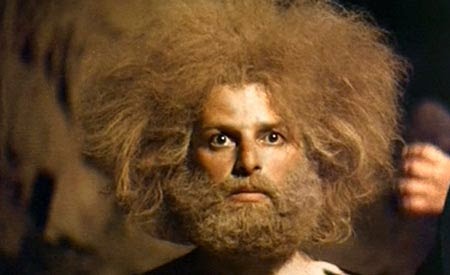
Rosemary's Baby or El Topo?
UPDATED: Hail Satan! While I love El Topo, I realize that its limited availability has kept most people from enjoying its insane genius. And Rosemary's Baby is one creepy, creepy movie (plus I'm always pro-Ruth Gordon). Sorry, by the way, for the late update - I went straight from work to The Black Dahlia, so I'll let the next round run a little later into tomorrow evening (say, 9ish) to compensate.
Wednesday, September 13, 2006
The Trim Bin #39
- A while ago, I posted a link to the teaser trailer for Shortbus, the new John Cameron Mitchell movie. Here is the uncensored trailer. Excuse me while I go wash my eyes.
- Intrigue at Images Cinema on Monday night: the Williamstown Film Festival's advance screening of The Last Kiss sold out, largely on the strength of Blythe Danner, who was scheduled to appear and introduce the film (Blythe cancelled due to back problems but sent her love). When the cans containing The Last Kiss arrived, I noticed they were sealed with combination padlocks. The cans could only be unlocked with a special code - but wait, it gets spookier. Paramount hired two security guards to stand in the lobby during the movie, prepared to oust anyone using a camera. One of the guards sternly lectured the audience - a largely fifty-plus festival audience - about the damage that cell phone cameras are doing to the motion picture industry, and the negative impact this has on our filmgoing habits (more expensive popcorn, for instance). The guards even asked a photographer from the Advocate to hand over his camera - his still camera - before the film could begin.
It's been a while since I've casually thrown around the term "fascist," so I'll use it now. Have things really gotten this paranoid in the film industry? The sheer effort expended to keep a grainy, out-of-focus video file of a Zach Braff movie from ever hitting the seedy underworld of black-market video piracy is so transparently crazy that I cannot belive an audience of several hundred people didn't collapse in hysterical, jeering laughter at the sight of it. And oddly enough, they didn't even ask me any questions, even though the best-shot bootlegs are usually made in the projection booth.
As for The Last Kiss, director Tony Goldwyn did attend the screening, and he seemed pleasant, thoughtful and ambitious. It's too bad he directed one of the worst movies I've ever seen.
- The Gauntlet seems to be moving along nicely. Thanks to readers who keep coming back day after day to participate; I always look forward to checking the results, and I hope you do too.
- I Viddied it On the Screen's Alex Jackson was kind enough to provide me with a link to My Best Friend's Birthday, the unfinished movie Quentin Tarantino made with his friends in the 1980's. Like Kubrick's Fear and Desire, it's a genuienly encouraging experience, a seriously bad movie that nevertheless suggests future genius. It's the sort of movie that shows you what is innate and what is learned, and while it can be cringeworthy at times, it's impossible to hate. At the moment, it seems like only part one hasn't been made friends-only, so check it out while you still can.
"Friends-only video" - wow, what a concept...
- On October 6, The Departed opens. On October 6, Cinemark Friday Night Rewind will be screening The Lost Boys. October 6 will be a fine, fine day.
Films watched this week:
Mission to Mars 4
Sgt. Pepper's Lonely Hearts Club Band 2
The Squid and the Whale 9
Unforgiven 10
True Romance 10
Strangers with Candy 7
Scarlet Diva 8
The Last Kiss 0
The 400 Blows 10
Suspiria 10
Friday the 13th 7
Natural Born Killers 10
2001: A Space Odyssey or Enter the Dragon?
UPDATED: "2001 is god," indeed. Apologies to John Saxon (a demigod).
Tuesday, September 12, 2006
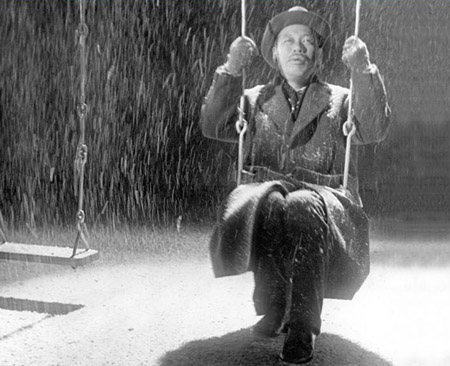
Eyes Wide Shut or Ikiru?
UPDATED: I'm sorry to see the missus' favorite movie lose, but Ikiru is as sweet and loveable as a chocolate covered puppy. Incidentally, these two films are closely tied in my head, as I took a class called Kurosawa and Kubrick in college, and had the pleasure of hearing both movies get grotesquely misinterpreted.
Monday, September 11, 2006
Dazed and Confused or E.T. the Extra-Terrestrial?
UPDATE: Dazed and Confused wins. Just keep livin', penis breath.
Sunday, September 10, 2006
Videodrome or Nashville?
UPDATED: The way of the flesh wins it. Cronenberg is one of the most exciting directors working today, so it's a fair defeat. I will say this: Nashville is one of the defining works of American cinema. It's essential. But, in its own way, so is Videodrome. The thing is, everyone who submitted top tens chose such excellent films that every showdown feels like a triumphant victory and a bitter defeat. Oh well, it don't worry me.
Saturday, September 09, 2006
There is no escape from the funhouse!
The Funhouse was released in 1981, the same year as Blow Out, and it has more in common with De Palma's brand of self-reflexive exercises in pure cinema than generic fodder like My Bloody Valentine. The opening scene, like the opening of Blow Out, references archetype-setting films like Psycho and Halloween in a way that resonates more deeply than simple cinematic name-dropping. While it is eventually revealed that the scene is a preteen boy's prank on his older sister, the echoes of Halloween's underaged sister-killer reverberate in creepy, unexpected ways. This is not to say that The Funhouse drowns in subtext; in fact, it's a refreshingly straightforward and unpretensious "boo!" movie. But Hooper and screenwriter Lawrence Block are smart enough to recognize the conventions of the then-new genre and defy them in interesting ways.
The prank victim in the opening scene is Amy Harper (Elizabeth Berridge), a fresh-faced teen preparing for a date with the Dorothy Hamill hairdo-sporting Buzz (Cooper Huckabee - best name ever). Amy's parents warn her against going to the carnival in town; apparently, after the same carnival passed through a nearby town the year before, two young girls were found murdered. Amy assures her parents that she won't go to the carnival, but of course, she and her friends go anyway. The teens smoke pot and giggle uneasily at the goofy attractions, like a macabre magic show by Marco the Magnificent (William Finley!). They also have a spooky run-in with a crazy old lady who prophesies death and despair (I love "crazy old prophet" characters). While the characters are somewhat underwritten, the actors succeed at making them likeable and relatable (particularly Berridge, who went on to play Mozart's wife in Amadeus). Eventually they decide to hide in the carnival's funhouse for the night, and as they fool around, I found myself admiring Hooper's resistance to the shallow moralizing that too often sinks these films - these are just kids having a fun time. But when the kids inadvertently witness a murder and learn the dark secret of the carnival barker's quiet, mask-wearing son, they find themselves trapped in the funhouse, trying to survive until morning. It's a straightforward horror premise, executed with remarkable style and atmosphere.
Much of the film's success can be attributed to the setting - the carnival isn't an over-the-top Hollywood set, but instead captures the eerie mixture of makeshift "amusement" and grungy carnyfolk that makes carnivals such a compelling experience. Hooper set up an actual travelling carnival on his Florida location, and the exterior lighting is mostly provided by the rides and attractions themselves. The result is uncanny; Hooper guides us to look our desire to be frightened in a new light. And as the film descends into the backstory of the central monster, it becomes impressively sleazy - when a monster mask is pulled away to reveal a much more horrifying face (this is one of Rick Baker's best works), it's a reminder that our "innocent" boogeymen are often rooted in something deeper and more horrific. The final scene of The Funhouse mirrors the hopelessness of The Texas Chain Saw Massacre's ending in a knowing way; if there's a recurrent theme in Hooper's work, it's the idea of the neverending nightmare. It's an idea I wish he'd pursued more, but all the Manglers in the world don't change the fact that The Funhouse is an unheralded gem. Watch it this Halloween season in its original aspect ratio with the lights turned off - it's creepier than you remember.
Punch-Drunk Love or Yojimbo?
UPDATED: The samurai beats the plunger salesman. I would have liked to see Punch-Drunk Love win; it's the kind of movie that gets better with each viewing, and I think it will be an established classic in fifty years. Yojimbo is expertly made and lots of fun, but it's sort of cold and impersonal compared to Ran or Ikiru. However, Masaru Sato's score is undeniably awesome.
Subscribe to:
Posts (Atom)